To avoid these ads, REGISTER NOW!

More Whatzits--Can we make this the official Whatzit thread?

RTM

Well-known member
Joined
May 13, 2019
Messages
13,259
Location
SF Bay Area
real head-scratcher. The yoke is hell-for-stout.n The throat is maybe about an inch deep. The shaft is hollow--about 3/8" ID. The knurled part to the right is a pin vise. The knurled part perpendicular to the shaft does absolutely nothing but turn.
Interesting things, the centering pin or punch on the left hand face intrigues me. Seems like clamping something in the pin vise end, then spinning the handle perpendicular to tighten, would drive that something into the pin or punch. If all that mattered was the punch, there would not be an arch, which implies something got center punched.

Now, if what you clamped was a hollow cylinder, would it then be a hole punch?

Those odd mismatched handles on the perpendicular shaft still intrigue me, gotta think on it more.
 
To avoid these ads, REGISTER NOW!
OP
B

Beerhippie

Well-known member
Joined
Oct 13, 2023
Messages
10,029
Location
Far NE Oregon
Interesting things, the centering pin or punch on the left hand face intrigues me. Seems like clamping something in the pin vise end, then spinning the handle perpendicular to tighten, would drive that something into the pin or punch. If all that mattered was the punch, there would not be an arch, which implies something got center punched.

Now, if what you clamped was a hollow cylinder, would it then be a hole punch?

Those odd mismatched handles on the perpendicular shaft still intrigue me, gotta think on it more.
I was thinking the anvil and screw might be for setting hollow rivets or snaps? Maybe the pin chuck held a needle and the spinny part off to the side was a spool for thread? Some kind of leather/sail makers multi-tool?

Anyhow, as soon as the gal that runs the place saw the asking price of $250 on Etsy, she grabbed it back--I suspect that $12.50 has gone up some.
 

LowOiL

Active member
Joined
Apr 25, 2025
Messages
37
From the amount of whaling upon it's suffered, we had some tough horses and mules back then!
Yeah, it definitely needs those cracks whacked off otherwise one chunk would sling off and cut ya good (don't ask me how I know splitting wood w/ a manual wedge I didn't clean soon enough).
I imagine the horses/mules appreciate not hurting with overgrown toenails.... most of us have had an ingrown toenail or two also...
 
Last edited:
OP
B

Beerhippie

Well-known member
Joined
Oct 13, 2023
Messages
10,029
Location
Far NE Oregon
Antique vintage tool leather Lock stitch sewing awl and rivet setter from an eBay listing, at $270. Shown with copper rivets with a rove (washer).


Poking thru DATAMP, under trade specific, I did not find it under Leatherworker or Cobbler, or Tailor.
So my guess wasn't that far off.

And, even at $12.50, not something I need.
 
  • Like
Reactions: RTM

d42jeep

Well-known member
Joined
Oct 22, 2014
Messages
16,591
Location
Northern California
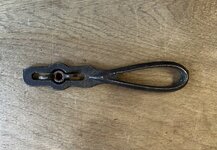
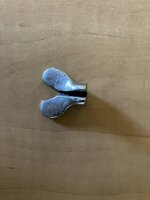
My wife picked this up at a Nevada garage sale. It seems to be a wingnut wrench. IMG_2554.jpegIMG_2555.jpegIMG_2556.jpeg
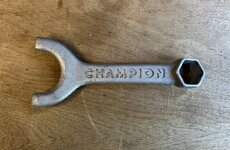
This wrench she found yesterday seems to be for Champion Brass sprinklers of LA.IMG_2801.jpegIMG_2802.jpeg
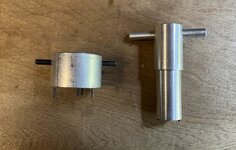
More items we found yesterday look to have been made by a machinist for some specific purpose. IMG_2807.jpegIMG_2806.jpeg
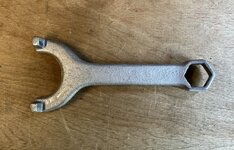
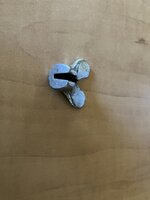
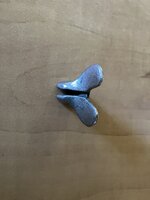
An item my neighbor found. A wingnut with a slot and no threads. IMG_2810.jpegIMG_2811.jpegIMG_2812.jpeg
Any guesses on the last few?
-Don
 

nadogail

Well-known member
Joined
Jan 23, 2009
Messages
32,057
Location
Coronado, CA
My wife picked this up at a Nevada garage sale. It seems to be a wingnut wrench. IMG_2554.jpegIMG_2555.jpegIMG_2556.jpeg
This wrench she found yesterday seems to be for Champion Brass sprinklers of LA.IMG_2801.jpegIMG_2802.jpeg
More items we found yesterday look to have been made by a machinist for some specific purpose. IMG_2807.jpegIMG_2806.jpeg
An item my neighbor found. A wingnut with a slot and no threads. IMG_2810.jpegIMG_2811.jpegIMG_2812.jpeg
Any guesses on the last few?
-Don
The Wingnut with no threads looks it may be a Spoke Wrench, with a tapered slot to "Sort Of Fit" various sized spokes.
 
OP
B

Beerhippie

Well-known member
Joined
Oct 13, 2023
Messages
10,029
Location
Far NE Oregon
My wife picked this up at a Nevada garage sale. It seems to be a wingnut wrench. IMG_2554.jpegIMG_2555.jpegIMG_2556.jpeg
This wrench she found yesterday seems to be for Champion Brass sprinklers of LA.IMG_2801.jpegIMG_2802.jpeg
More items we found yesterday look to have been made by a machinist for some specific purpose. IMG_2807.jpegIMG_2806.jpeg
An item my neighbor found. A wingnut with a slot and no threads. IMG_2810.jpegIMG_2811.jpegIMG_2812.jpeg
Any guesses on the last few?
-Don
Sounds like your neighbor is a loose wingnut!

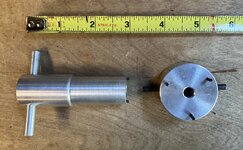
The machinist-made tools look they're for a bezel of some sort? Scale?
 

Outlawmws

Well-known member
Joined
Aug 9, 2011
Messages
39,334
Location
The Badlands
This wrench she found yesterday seems to be for Champion Brass sprinklers of LA
Correct
An item my neighbor found. A wingnut with a slot and no threads.

The Wingnut with no threads looks it may be a Spoke Wrench, with a tapered slot to "Sort Of Fit" various sized spokes.
Yep Spoke wrench - probably for bicycles (rather than motor cycles)


Heh, responded and didn't hit "Post"
 

four.cycle

Well-known member
Joined
Oct 19, 2015
Messages
29,350
Location
Tacoma, Washington
Any guesses on the last few?
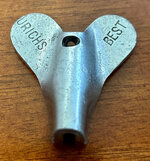
That last one is a spoke wrench (aka "****** grip") - looks similar to the Urich model, but a wee bit different.
 

Attachments

  • Urich spoke wrench ****** grip (ebay 276703590999 01).jpg
    Urich spoke wrench ****** grip (ebay 276703590999 01).jpg
    724.9 KB · Views: 19
  • Urich spoke wrench ****** grip (ebay 276703590999 02).jpg
    Urich spoke wrench ****** grip (ebay 276703590999 02).jpg
    545.1 KB · Views: 12

Blue Chips

Well-known member
Joined
Jan 25, 2012
Messages
199
Location
Maine
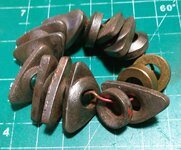
Ooh, I got some whatzits right here:

IMG_20250615_215317899.jpg


They look simple enough but heck if I know what they're from.

Seems to me I saw plenty of those back in the '70s. IIRC, they were commonly used under manifold bolts.
That would be my take on it as well. To me they look like plain and flanged varieties of spherical washers, such as used to secure exhaust and intake manifolds, often found on straight 6s and straight 8s. The idea was to evenly distribute the clamping pressure on uneven, mismatched, misaligned, or slightly angled surfaces, hopefully without breaking off any of the cast-iron mounting bosses or tabs. My 1954 Dodge M37 manifolds are mounted with spherical washers.

Spherical washers are also known as 'leveling washers,' and are supposed to have two parts, male and female.

Example: https://www.mcmaster.com/products/washers/washer-type~spherical/
 

Skyman

Well-known member
Joined
Nov 9, 2021
Messages
1,225
Location
Central Maryland
My admittedly hazy memory is that the set in this photo was used on MOPAR slant six manifolds. Might have also been used on other makes. Come to think of it, looks like traces of Chevy orange paint on a few of them.
 
Last edited:
To avoid these ads, REGISTER NOW!

pcrov

Well-known member
Joined
Feb 27, 2023
Messages
378
Location
Ontario, CA
That would be my take on it as well. To me they look like plain and flanged varieties of spherical washers, such as used to secure exhaust and intake manifolds, often found on straight 6s and straight 8s. The idea was to evenly distribute the clamping pressure on uneven, mismatched, misaligned, or slightly angled surfaces, hopefully without breaking off any of the cast-iron mounting bosses or tabs. My 1954 Dodge M37 manifolds are mounted with spherical washers.

Spherical washers are also known as 'leveling washers,' and are supposed to have two parts, male and female.

Example: https://www.mcmaster.com/products/washers/washer-type~spherical/
Those have a flat side each, these are concave on one side and convex on the other (aside from the two brass bushings.)
 

Blue Chips

Well-known member
Joined
Jan 25, 2012
Messages
199
Location
Maine
Those have a flat side each, these are concave on one side and convex on the other (aside from the two brass bushings.)

Hmm. In that case, it's a bit harder to speculate about their use.

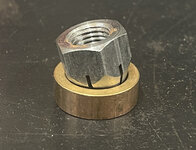
There are a lot of variations on spherical and conical washers and nuts, and they can be used for quite a range of applications. For example, instead of a two-piece male-female spherical washer, a female spherical washer can coupled with a nut that has a male spherical base. These nut-washer combinations can be spherical or conical.

Here's an example of a brass conical washer coupled with a conical nut:
nut-washer-smaller-image.jpg

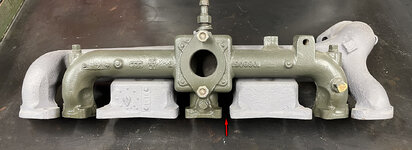
As to the concave/convex triangular pieces in your photo, I'm not sure about their use, but here's one possible scenario: They 'might' have been used between the mounting flange of an exhaust manifold and the mounting flange of an intake manifold, with the mounting stud in the position of the arrow in the image below, in which case a spherical-bottom nut could have been used in conjunction with them. It's cheaper to stamp a part like that than to machine it, and IF the gap between the flanges is wide enough, the convex side would simply protrude down between the flanges without touching anything. (The triangular pieces in your photo would have required a wider gap than the gap in the image below.) Because the thicknesses of manifold flanges are not always equal, a spherical or conical washer or washer-nut combination would allow for differences in thickness while more or less equalizing the clamping pressure on both flanges.
intake-exhaust-smaller-image.jpg

You might try taking a few photos of the individual pieces and do a Google image search on them.

Edit: I should add that there are also various ways of stacking spherical washers and combining them.
 
Last edited:
OP
B

Beerhippie

Well-known member
Joined
Oct 13, 2023
Messages
10,029
Location
Far NE Oregon
Hmm. In that case, it's a bit harder to speculate about their use.

There are a lot of variations on spherical and conical washers and nuts, and they can be used for quite a range of applications. For example, instead of a two-piece male-female spherical washer, a female spherical washer can coupled with a nut that has a male spherical base. These nut-washer combinations can be spherical or conical.

Here's an example of a brass conical washer coupled with a conical nut:

nut-washer-smaller-image.jpg

As to the concave/convex triangular pieces in your photo, I'm not sure about their use, but here's one possible scenario: They 'might' have been used between the mounting flange of an exhaust manifold and the mounting flange of an intake manifold, with the mounting stud in the position of the arrow in the image below, in which case a spherical-bottom nut could have been used in conjunction with them. It's cheaper to stamp a part like that than to machine it, and IF the gap between the flanges is wide enough, the convex side would simply protrude down between the flanges without touching anything. (The triangular pieces in your photo would have required a wider gap than the gap in the image below.) Because the thicknesses of manifold flanges are not always equal, a spherical or conical washer or washer-nut combination would allow for differences in thickness while more or less equalizing the clamping pressure on both flanges.

View attachment 2350873

You might try taking a few photos of the individual pieces and do a Google image search on them.
Oh gawd! That set-up just brings back too many bad memories... trying to find a wrench that fits in there... percolating carburetor in the middle of the desert... etc... drain plugs on the intake manifold... there's something ain't right about it.
 
Last edited:

pcrov

Well-known member
Joined
Feb 27, 2023
Messages
378
Location
Ontario, CA
You might try taking a few photos of the individual pieces and do a Google image search on them

I didn't have much luck, but it's easier when you have an idea of which rabbit hole to follow. Here's some singles in case anyone wants to have a crack at it.

IMG_20250616_185527756.jpgIMG_20250616_185522513.jpgIMG_20250616_185516477.jpgIMG_20250616_185535679.jpg

(The background grid is half-inch squares, by the way.)
 

bcschief

Well-known member
Joined
Oct 29, 2014
Messages
499
Location
Crescent City Florida
Hmm. In that case, it's a bit harder to speculate about their use.

There are a lot of variations on spherical and conical washers and nuts, and they can be used for quite a range of applications. For example, instead of a two-piece male-female spherical washer, a female spherical washer can coupled with a nut that has a male spherical base. These nut-washer combinations can be spherical or conical.

Here's an example of a brass conical washer coupled with a conical nut:

nut-washer-smaller-image.jpg

As to the concave/convex triangular pieces in your photo, I'm not sure about their use, but here's one possible scenario: They 'might' have been used between the mounting flange of an exhaust manifold and the mounting flange of an intake manifold, with the mounting stud in the position of the arrow in the image below, in which case a spherical-bottom nut could have been used in conjunction with them. It's cheaper to stamp a part like that than to machine it, and IF the gap between the flanges is wide enough, the convex side would simply protrude down between the flanges without touching anything. (The triangular pieces in your photo would have required a wider gap than the gap in the image below.) Because the thicknesses of manifold flanges are not always equal, a spherical or conical washer or washer-nut combination would allow for differences in thickness while more or less equalizing the clamping pressure on both flanges.

intake-exhaust-smaller-image.jpg

You might try taking a few photos of the individual pieces and do a Google image search on them.

Edit: I should add that there are also various ways of stacking spherical washers and combining them.
Chrysler slant six uses that style nuts and washers and the bat wing washers.
 

Private Lugnutz

Well-known member
Joined
Mar 30, 2012
Messages
30,710
Location
The Authentic Jersey Shore
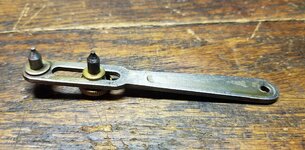
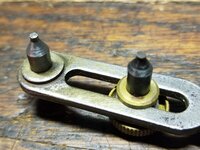
I found what looks to me like some kind of adjustable pin spanner at the flea market today. I am not 100% certain of that. No markings. I have hook spanners, pin spanners, and adjustable hook and pin spanners, but I have never seen one quite like this design, with a thumbnut slider, or with the pins in line with the handle. It's also not very heavy duty. Does anyone more precisely recognize it?
 

Attachments

  • 20250808_143708.jpg
    20250808_143708.jpg
    782 KB · Views: 23
  • 20250808_143730.jpg
    20250808_143730.jpg
    758.8 KB · Views: 24
  • 20250808_143755.jpg
    20250808_143755.jpg
    658 KB · Views: 25
  • 20250808_143809.jpg
    20250808_143809.jpg
    650.6 KB · Views: 25

Outlawmws

Well-known member
Joined
Aug 9, 2011
Messages
39,334
Location
The Badlands
Does anyone more precisely recognize it?

Nope and I was surprised when looking at the pics up close that it was not shop made!
No, but I'd be inclined to go down the watch tool rabbit hole first, rather than a mechanic's tool. The Benj Allen catalog didn't show one, so maybe not.

Agree watch, or other fine instruments. meaning measurement or electronic analysis gear or similar.
 

Private Lugnutz

Well-known member
Joined
Mar 30, 2012
Messages
30,710
Location
The Authentic Jersey Shore
Thanks, guys. Makes sense. The teats are 1/16" in diameter and the range is 1/2" to 1-7/16" center to center teat. This example looks older to me, just because of the materials and wear, but it's interesting how consistent the design is. It seems like a lot of tool for a watch. I wish I had one just to try it! (I don't wear watches.) But I'm sure I'll find a use for it. Ratchets, for instance.
 
To avoid these ads, REGISTER NOW!
Top Bottom