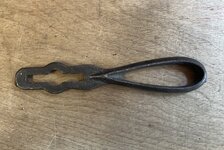
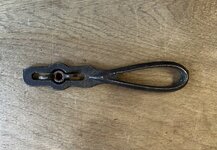
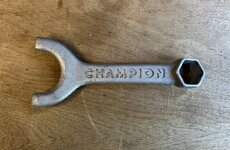
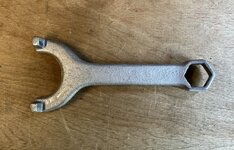
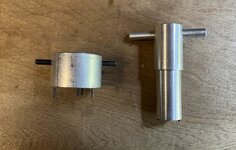
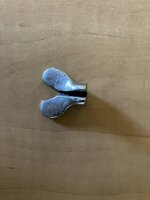
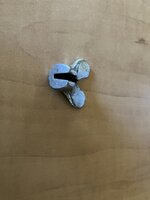
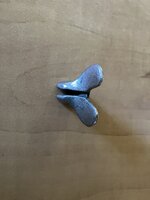
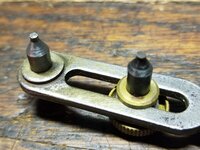
Hmm. In that case, it's a bit harder to speculate about their use.
There are a lot of variations on spherical and conical washers and nuts, and they can be used for quite a range of applications. For example, instead of a two-piece male-female spherical washer, a female spherical washer can coupled with a nut that has a male spherical base. These nut-washer combinations can be spherical or conical.
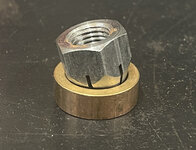
Here's an example of a brass conical washer coupled with a conical nut:
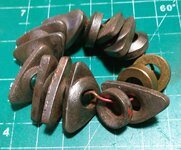
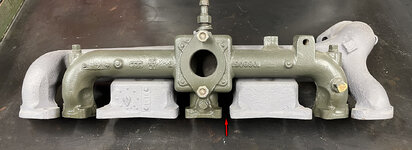
As to the concave/convex triangular pieces in your photo, I'm not sure about their use, but here's one possible scenario: They 'might' have been used between the mounting flange of an exhaust manifold and the mounting flange of an intake manifold, with the mounting stud in the position of the arrow in the image below, in which case a spherical-bottom nut could have been used in conjunction with them. It's cheaper to stamp a part like that than to machine it, and IF the gap between the flanges is wide enough, the convex side would simply protrude down between the flanges without touching anything. (The triangular pieces in your photo would have required a wider gap than the gap in the image below.) Because the thicknesses of manifold flanges are not always equal, a spherical or conical washer or washer-nut combination would allow for differences in thickness while more or less equalizing the clamping pressure on both flanges.
You might try taking a few photos of the individual pieces and do a Google image search on them.
Edit: I should add that there are also various ways of stacking spherical washers and combining them.