To avoid these ads, REGISTER NOW!

We keep blowing fuses

Codyboy

Well-known member
Joined
Jan 31, 2019
Messages
1,713
Location
S.E. TEXAS
It didn't exist as far as the code goes. And I didn't come across a post where anyone claimed to have never seen it. I did see plenty of posts other than my own saying it wasn't correct.

Normal practice would mean that someone thought it was the right thing to do, and I believe this is the first time you've used the word hack.
Hack. That was auto correct or a fat thumb. I edited it i think.
It was supposed to be back

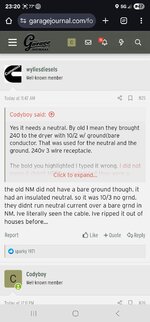
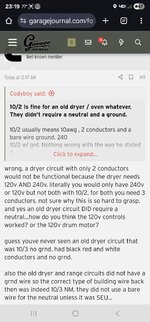
Eta. It was mentioned at least twice that 10/2 was not used and it was 10/3 w/o ground. Because no one would use a bare wire for a curre t carrying neutral.
I was somewhat called a liar in roundabout terms.
 

Attachments

  • Screenshot_20250625_232024_Chrome.jpg
    Screenshot_20250625_232024_Chrome.jpg
    479.6 KB · Views: 8
  • Screenshot_20250625_231944_Chrome.jpg
    Screenshot_20250625_231944_Chrome.jpg
    605.3 KB · Views: 8
To avoid these ads, REGISTER NOW!

sparky 1971

Well-known member
Joined
Oct 9, 2018
Messages
8,007
Location
Central Iowa
Hack. That was auto correct or a fat thumb. I edited it i think.
It was supposed to be back

Hack is more fitting. Normal practice hack back then fits perfectly.
Eta. It was mentioned at least twice that 10/2 was not used and it was 10/3 w/o ground. Because no one would use a bare wire for a curre t carrying neutral.
I was somewhat called a liar in roundabout terms.
Every one of us that have been doing this job long enough have seen 10/2 used for a dryer so I doubt he was saying it literally didn't exist. He was saying it was supposed to be 10/3 and the old 10/3 (or 14/3, 12/3, 8/3, and probably 6/3) didn't have a ground and that would have been the proper cable to use. 10/2 w/ ground would have been for water heaters, air conditioners, ovens (not ranges) and some cook tops though I've seen all of the above wired with 10/3 w/o ground using the white for ground. Those guys probably carried one type of wire for everything.
 

Codyboy

Well-known member
Joined
Jan 31, 2019
Messages
1,713
Location
S.E. TEXAS
Hack is more fitting. Normal practice hack back then fits perfectly.

Every one of us that have been doing this job long enough have seen 10/2 used for a dryer so I doubt he was saying it literally didn't exist. He was saying it was supposed to be 10/3 and the old 10/3 (or 14/3, 12/3, 8/3, and probably 6/3) didn't have a ground and that would have been the proper cable to use. 10/2 w/ ground would have been for water heaters, air conditioners, ovens (not ranges) and some cook tops though I've seen all of the above wired with 10/3 w/o ground using the white for ground. Those guys probably carried one type of wire for everything.
Ok. 3 conductor no ground was probably the correct wire to use. I don't disagree with that at all.
However , I don't know but believe that back then the thought was ..
10/2 was cheaper,
And why insulate a neutral back to the panel thats buried in the wall, I'm tying the ground to the cabinet of a giant piece of steel (dryer or range case/cabinet) thats touched all the time.
And the neutral coming to the house from the pole and into the panel is a bare wire and not insulated.

ETA

Just 2 weeks or so ago I called the AC manufacturer for the unit i bought, condenser and AH . The manual said that each was 240.
I wanted to make sure it wasn't 120/240 or just 240 before I ran my wire.
Nope just 240. No 120.
I didn't want to waste 3 conductor if it wasn't warranted.
 
Last edited:

sparky 1971

Well-known member
Joined
Oct 9, 2018
Messages
8,007
Location
Central Iowa
Ok. 3 conductor no ground was probably the correct wire to use. I don't disagree with that at all.
However , I don't know but believe that back then the thought was ..
10/2 was cheaper,
It probably was cheaper. Combine that with the fact that, even today, many 'lectricians think that a three wire dryer is 240, two hots and a ground along with no inspections and you have hack installs.
And why insulate a neutral back to the panel thats buried in the wall, I'm tying the ground to the cabinet of a giant piece of steel (dryer or range case/cabinet) thats touched all the time.
And the neutral coming to the house from the pole and into the panel is a bare wire and not insulated.
Because the neutral on the load side of the meter is supposed to be insulated unless it's SE cable. Period. And when it's SE cable, the bare can't (isn't supposed to) be used as a neutral unless it's a main panel, no subs. Why didn't they run two hots in EMT, then run a bonding jumper from the box to the neutral lug on the receptacle? They would have had to use a jumper since the neutral lug would have been isolated, leaving the pipe to carry five amps.
ETA

Just 2 weeks or so ago I called the AC manufacturer for the unit i bought, condenser and AH . The manual said that each was 240.
I wanted to make sure it wasn't 120/240 or just 240 before I ran my wire.
Nope just 240. No 120.
I've never seen an AC that required a neutral, I doubt they exist but I've seen lots of AC's wired with old 10/3 w/o ground and the neutral repurposed as a ground.
 

Codyboy

Well-known member
Joined
Jan 31, 2019
Messages
1,713
Location
S.E. TEXAS
It probably was cheaper. Combine that with the fact that, even today, many 'lectricians think that a three wire dryer is 240, two hots and a ground along with no inspections and you have hack installs.

Because the neutral on the load side of the meter is supposed to be insulated unless it's SE cable. Period. And when it's SE cable, the bare can't (isn't supposed to) be used as a neutral unless it's a main panel, no subs. Why didn't they run two hots in EMT, then run a bonding jumper from the box to the neutral lug on the receptacle? They would have had to use a jumper since the neutral lug would have been isolated, leaving the pipe to carry five amps.

I've never seen an AC that required a neutral, I doubt they exist but I've seen lots of AC's wired with old 10/3 w/o ground and the neutral repurposed as a ground.
Not sure how they do it in Iowa but here all the old stuff is a bare neutral at the WH into the meter can , and into the panel.
Probably the same way in the gutter pressure washing thread where OP has a bare neutral on the service entrance. Old ****. Yes now, the neutral is always insulated.

I know the outside condenser unit is only 240.
I was not sure on the AH though. It said 240 but I wanted to be sure. I guess they have a transformer in there to make 120 if needed.

The AH in my house now is 120.
 

sparky 1971

Well-known member
Joined
Oct 9, 2018
Messages
8,007
Location
Central Iowa
Not sure how they do it in Iowa but here all the old stuff is a bare neutral at the WH into the meter can , and into the panel.
Probably the same way in the gutter pressure washing thread where OP has a bare neutral on the service entrance. Old ****. Yes now, the neutral is always insulated.
The WH is supposed to be two hots and a ground and that is the norm. I was stating that in older homes I've seen the old 10/3 with no ground used for them, the white was used for the ground since there wasn't a bare wire present. The same for older AC circuits, even if it's a new unit.
I know the outside condenser unit is only 240.
I was not sure on the AH though. It said 240 but I wanted to be sure. I guess they have a transformer in there to make 120 if needed.
A 240 volt AH would be capable of electric heat, 120 is for gas. I missed the AH part of your previous post, just saw condenser.
The AH in my house now is 120.
So do you have gas heat or is it just an air handler and you have another heat source? I ask because we usually call them furnaces. Air handler is reserved for commercial buildings.
 

wyliesdiesels

Well-known member
Joined
Aug 14, 2012
Messages
20,073
Location
Modesto, CA
Maybe where your at they didn't IDK. But around here and other places it was 10/2 with grd. Sure the actual cord from the dryer was 3 conductors but the wiring in the wall was not.
Even on an old electric range most were hardwired with 2 conductors and a bare ground/ that served as the neutral also. No cord just straight from the wall to the range.
Thats NM. Someone used the wrong wire… doesnt even look like #10
 

Stuart in MN

Well-known member
Joined
Sep 8, 2005
Messages
23,172
Location
Minneapolis
Wow people. Way to get fixated on details that don't matter.

Doesn't matter that a couple fuses used to feed a dryer. Now he connected to one of those fuses with a cord for a 120v tt30.

Cord run out of the panel? I would do the exact same thing for temporary use.
There's no electrical question here that won't be run into the ground with pages of minutiae.
 

PCustoms

Well-known member
Joined
Jul 23, 2011
Messages
23,457
Location
VT
User Codyboy has been given a week vacation to think about his posting habits
Thank you.

I'll gladly argue a point back and forth a few times, but you've got to know when to back out because you're not articulating your ideas well, or worse yet when you've been patiently shown multiple times by several sources that you're flat wrong.
 

toplessHO

Well-known member
Joined
Oct 20, 2014
Messages
14,083
Location
central florida
(2) The Real Story (1911):
The St. Helens Cable and Rubber Company in Warrington, UK, developed a tough, flexible sheath for cables. The term "Cabtire" comes from:
  • Their work making rubber "tyring" for horse-drawn Hansom cabs.
  • The "cab" in Hansom cab inspired the term "Cabtyre," later simplified to "Cabtire."
Ive learned so many quirky sayings on GJ.
But please everyone refrain from using the term zipties to describe a Ty rap.
 

sparky 1971

Well-known member
Joined
Oct 9, 2018
Messages
8,007
Location
Central Iowa
a 3 wire dryer plug is not 120/240
you are using the ground conductor as a neutral.
Is the existing ground conductor full size and insulated?
I hope this isn't another here we go again. A three wire dryer is 120/240 but doesn't have a ground. The frame of the dryer isbonded to the neutral and comes that way from the factory. When going to four wire, the bonding strap is removed.
 

dave*99

Well-known member
Joined
May 5, 2009
Messages
4,282
Location
Coastal NJ
I hope this isn't another here we go again. A three wire dryer is 120/240 but doesn't have a ground. The frame of the dryer isbonded to the neutral and comes that way from the factory. When going to four wire, the bonding strap is removed.
Hmmm, maybe in Spanish?
From Google translate:
Espero que esto no sea otra vez. Una secadora de tres cables es de 120/240, pero no tiene conexión a tierra. El marco de la secadora está conectado al neutro y viene así de fábrica. Al usar una secadora de cuatro cables, se retira la tira de conexión.
 

toplessHO

Well-known member
Joined
Oct 20, 2014
Messages
14,083
Location
central florida
I hope this isn't another here we go again. A three wire dryer is 120/240 but doesn't have a ground. The frame of the dryer isbonded to the neutral and comes that way from the factory. When going to four wire, the bonding strap is removed.
and I can guess that 99% of the dryers before they made 4 wire were wired with 10/2 with ground
hence no insulated 3rd wire
 
To avoid these ads, REGISTER NOW!

mm08822

Well-known member
Joined
Jan 13, 2012
Messages
6,051
Location
NJ
and I can guess that 99% of the dryers before they made 4 wire were wired with 10/2 with ground
hence no insulated 3rd wire

a 3 wire dryer plug is not 120/240
you are using the ground conductor as a neutral.
Is the existing ground conductor full size and insulated?
Texas is close enough to Fla. (Possible internet Bro-mance brewing.)
 

wyliesdiesels

Well-known member
Joined
Aug 14, 2012
Messages
20,073
Location
Modesto, CA
a 3 wire dryer plug is not 120/240
you are using the ground conductor as a neutral.
Is the existing ground conductor full size and insulated?
wrong. if its not 120/240 then why does it need to use the ground conductor as a neutral? neutral is only needed for 120v and its not code permissible to send neutral current on a ground wire. anyone who says otherwise is a hack and creates potential for shock

a NEMA 10-30 receptacle (which is what is used for a dryer) is indeed 120/240 NO GRND.

dont believe me? look it up...

you are NOT i repeat NOT using the ground as a neutral. Its quite the opposite. you are using the neutral for the ground in addition to using it as a neutral....

THIS IS FACT. Period end of story...
 
Last edited:

wyliesdiesels

Well-known member
Joined
Aug 14, 2012
Messages
20,073
Location
Modesto, CA
and I can guess that 99% of the dryers before they made 4 wire were wired with 10/2 with ground
hence no insulated 3rd wire
whatever theyre wired with is not the point. They are 120/240 no grnd. go lookup nema 10-30.... Just because some hill-billy hack used the wrong NM wire doesnt make it correct and actually makes it potentially dangerous in some regards...

There was indeed NM w/ 3 insulated wires and no bare or insulated grnd back in the day. Ive literally seen it... it was probably a few pennies more per foot vs 10/2 with grnd so some penny pincher/penny-wise pound-foolish fool used it instead of the correct wire... still doesnt make it right just because you found it installed..... it was not code permissible and the applicable code is 250.140(B)(4)
 

sparky 1971

Well-known member
Joined
Oct 9, 2018
Messages
8,007
Location
Central Iowa
and I can guess that 99% of the dryers before they made 4 wire were wired with 10/2 with ground
hence no insulated 3rd wire
More like 1% and all of them were wrong. The proper way would have been 10/3 and the old 10/3 didn't have a ground. Four wire added the bare ground to 10/3. I don't know when the manufacturers started adding the ground but it hit the code with the adoption of the 1996 NEC.
 

sparky 1971

Well-known member
Joined
Oct 9, 2018
Messages
8,007
Location
Central Iowa
Texas is close enough to Fla. (Possible internet Bro-mance brewing.)
I was in TX from 95 to 98, so we would have been on probably the 93 code, maybe 90, When I started. We had 10/3 with ground and just shoved the ground to the back of the box knowing what was coming when the 96 was adopted. Of course, I was in Dallas and some people don't/didn't consider that Texas.
 

sparky 1971

Well-known member
Joined
Oct 9, 2018
Messages
8,007
Location
Central Iowa
because its valid.
Many dryers and ranges were using grounding conductors as current carrying conductors,hence the requirement for 4 wire systems
It was the other way around. The neutral was used for a ground by bonding the dryer or range chassis to the neutral. Hence the requirement for the ground.
 

toplessHO

Well-known member
Joined
Oct 20, 2014
Messages
14,083
Location
central florida
wrong. if its not 120/240 then why does it need to use the ground conductor as a neutral? neutral is only needed for 120v and its not code permissible to send neutral current on a ground wire. anyone who says otherwise is a hack and creates potential for shock

a NEMA 10-30 receptacle (which is what is used for a dryer) is indeed 120/240 NO GRND.

dont believe me? look it up...

you are NOT i repeat NOT using the ground as a neutral. Its quite the opposite. you are using the neutral for the ground in addition to using it as a neutral....

THIS IS FACT. Period end of story...
Again in case you didnt understand this
If a NEMA 10-30 receptacle is fed with 10-2w/ground it does not meet the requirements of 120/240.
 

toplessHO

Well-known member
Joined
Oct 20, 2014
Messages
14,083
Location
central florida
More like 1% and all of them were wrong. The proper way would have been 10/3 and the old 10/3 didn't have a ground. Four wire added the bare ground to 10/3. I don't know when the manufacturers started adding the ground but it hit the code with the adoption of the 1996 NEC.
I know someone that got rejected in the 70s for not having 4 wire to an oven that had a light.
So its been a thing long before 1996
 

sparky 1971

Well-known member
Joined
Oct 9, 2018
Messages
8,007
Location
Central Iowa
I know someone that got rejected in the 70s for not having 4 wire to an oven that had a light.
I'm calling BS unless there was a local amendment and I'll have to defer to some of the guys that were running wire in the '70s to chime in and tell if four wire romex was even a thing back then
So its been a thing long before 1996
It was the 1996 code that introduced the four wire circuit and cord/plug connection to dryer and range circuits, when I started in 1994 some places were still on the 1990 and some on the 1993 edition, but I remember the change to the '96 and going from three to four wire circuits.. An oven is different than a range since they don't have a surface for cooking with a pan or pot.
 

sparky 1971

Well-known member
Joined
Oct 9, 2018
Messages
8,007
Location
Central Iowa
Again in case you didnt understand this
If a NEMA 10-30 receptacle is fed with 10-2w/ground it does not meet the requirements of 120/240.
Would you care to explain how a NEMA 10-30, 125/250 volt non grounding receptacle is wired with two hots and a ground? If it were two hots and a ground, there would be no reason for the 10-30 since the 6-30 would be sufficient.

Straight from Hubbell:

And, if you were to look at the back of a flush mount 10-30R, you would see that the slot from the neutral does not have strap bonding it the the yoke. Therefore, it's not a ground. Fortunately for you, I can't find a picture of the back of one online and I don't have one in my stock.
 
Last edited:

Chuckster in NJ

Well-known member
Joined
Jan 26, 2010
Messages
2,319
Location
Hunterdon County NJ
I'm calling BS unless there was a local amendment and I'll have to defer to some of the guys that were running wire in the '70s to chime in and tell if four wire romex was even a thing back then
I was involved in the electrical trade since 1968 and the "known" Romex wire was no different than today.
EG : 10-2 has white and black insulated wires and a ground AND 10-3 has white, black and red insulated wires and a ground wire, on and on!

HOWEVER! This is what a 12-4 romex cable looks like so there is a real thing. I have seen this used on a few jobs…….. ONLY the insulated wires are counted and NOT the ground.
IMG_2967.jpeg
 
To avoid these ads, REGISTER NOW!
Top Bottom