To avoid these ads, REGISTER NOW!

Show Your Vintage Knife

To avoid these ads, REGISTER NOW!

four.cycle

Well-known member
Joined
Oct 19, 2015
Messages
29,143
Location
Tacoma, Washington
^ No, but the problem with ordering a whole bunch of belts at the same time to save on net cost and shipping is that it doesn't always turn out as hoped because environmental conditions can cause the belts to fail prematurely.
Can't be too hot, too cold, too wet, or too dry.
It gets kind of nutty when you have half a dozen all fly to pieces on you one after another right after you hit the "ON" switch.
First batch I ever bought I stored them up in an attic above my apartment - had no other kind of storage space.
Two things you never want to store in attics: sanding belts and reel-to-reel tapes.
 
Last edited:

Old Radar

Well-known member
Joined
Apr 17, 2019
Messages
2,755
Location
San Antonio, TX
No doubt.
But I was struck by the hilarity and similarity:
...a whole bunch of belts--or bears!
...too hot, too cold, too wet, or too dry--porridge!
...I also don't like them laying down--on too hard or soft beds!
 

RTM

Well-known member
Joined
May 13, 2019
Messages
13,230
Location
SF Bay Area
While researching the glue joints of sanding belts, I came across a tip for repairing failed glue joints:

https://www.woodmagazine.com/sanding-sharpening/easy-fix-for-seam-split-sanding-belts
I can't imagine that working well for very long. CA glues don't like change, and are very stiff. I imagine that repair fractures in several minutes. But if he says it works.

You can also buy tape for that, found some of my 1/2x18" belts use it.

Googling

sanding belt splicing tape

Shows many choices.
 

Beerhippie

Well-known member
Joined
Oct 13, 2023
Messages
9,964
Location
Far NE Oregon
I can't imagine that working well for very long. CA glues don't like change, and are very stiff. I imagine that repair fractures in several minutes. But if he says it works.

You can also buy tape for that, found some of my 1/2x18" belts use it.

Googling

sanding belt splicing tape

Shows many choices.
CA glues are extremely strong in tension and **** under shear.
 

Beerhippie

Well-known member
Joined
Oct 13, 2023
Messages
9,964
Location
Far NE Oregon
Today's add:

54648739999_42f31dae07_o.jpg

Kingston USMC folder, WWII.

Kingston was formed in 1943 by Ulster and Imperial to solely make knives for the US Gov't war effort and was dissolved in 1947.

We'll see how it looks after visit with the De-rusto bucket.
 

Private Lugnutz

Well-known member
Joined
Mar 30, 2012
Messages
30,667
Location
The Authentic Jersey Shore
Wow! That is a give-my-left-nut find. We've discussed them a little upthread and our host has a late war Army version. Thankfully those notches in the main blade aren't too deep and could be minimized with a skillful sharpening.
 
  • Like
Reactions: 555

Beerhippie

Well-known member
Joined
Oct 13, 2023
Messages
9,964
Location
Far NE Oregon
Wow! That is a give-my-left-nut find. We've discussed them a little upthread and our host has a late war Army version. Thankfully those notches in the main blade aren't too deep and could be minimized with a skillful sharpening.
Well for $5, I don't feel like I overpaid too much!

I don't know about restoring the blade. It would be very difficult to do without changing the profile.

All in all, the condition seems to be about average for what I see online. I take it the Marines in WWII weren't considering collectors' value of their kit.

After balancing the pH of my Rust Bucket, the knife is in for a bath.

Every reference to this knife I've found refers to it as stainless steel. Don't look it to me. With chrome and nickel critical metals during the war, I'm highly doubtful they'd be used for a pocket knife. The brass liners should have been enough of an extravagance for even the USMC.
 
  • Like
Reactions: 555

AreBeeBee

Well-known member
Joined
Sep 17, 2020
Messages
415
Location
Wisconsin
Well for $5, I don't feel like I overpaid too much!

I don't know about restoring the blade. It would be very difficult to do without changing the profile.

All in all, the condition seems to be about average for what I see online. I take it the Marines in WWII weren't considering collectors' value of their kit.

After balancing the pH of my Rust Bucket, the knife is in for a bath.

Every reference to this knife I've found refers to it as stainless steel. Don't look it to me. With chrome and nickel critical metals during the war, I'm highly doubtful they'd be used for a pocket knife. The brass liners should have been enough of an extravagance for even the USMC.

My understanding is that brass became a controlled metal as soon as we got in the war due to the need of it for cartridge and shell cases. I don't know how quickly the limit was lifted postwar.
 

Beerhippie

Well-known member
Joined
Oct 13, 2023
Messages
9,964
Location
Far NE Oregon
My understanding is that brass became a controlled metal as soon as we got in the war due to the need of it for cartridge and shell cases. I don't know how quickly the limit was lifted postwar.
Brass was a "critical metal" and not for the most part available for civilian uses. There were exceptions, and the military got what they needed.

Chromium and nickel were also among the critical metals restrictions during the war.

 
  • Like
Reactions: 555

Private Lugnutz

Well-known member
Joined
Mar 30, 2012
Messages
30,667
Location
The Authentic Jersey Shore
I've never studied the composition of the wartime MIL-K's, but it all depends on what priorities the USMC had for the knives and when.

Precious metals, including brass, nickel, chromium, molybdenum, and vanadium, were controlled and restricted in stages, by percentages in alloy formulas. I've discussed "New Emergency" (triple alloy) AISI 8000 steel here at great length for hand tools, for example, which was invented in 1942 and contains low doses of chromium, nickel, and molybdenum. On March 27, 1942, in Order M-18-d, the WPB restricted all chromium melting to orders of A-1-K or higher. From January 1 until then it had been A-10. On June 1, 1942, in Amendment 3 to Order M-21-a, the WPB added nickel and moly to the A-1-K or higher category. That same amendment allowed melting those alloys at priority A-3 or higher for “NE” steels, SiMn (AISI 9200) or stainless (AISI 400).

Also, keep in mind these early wartime MIL-K's were basically experimental. They weren't made in high numbers. The Army versions even fewer. They were the basis for the actual MIL-K's that were made in extremely high volume right up through the end of the century.
 

AreBeeBee

Well-known member
Joined
Sep 17, 2020
Messages
415
Location
Wisconsin
I've never studied the composition of the wartime MIL-K's, but it all depends on what priorities the USMC had for the knives and when.

Precious metals, including brass, nickel, chromium, molybdenum, and vanadium, were controlled and restricted in stages, by percentages in alloy formulas. I've discussed "New Emergency" (triple alloy) AISI 8000 steel here at great length for hand tools, for example, which was invented in 1942 and contains low doses of chromium, nickel, and molybdenum. On March 27, 1942, in Order M-18-d, the WPB restricted all chromium melting to orders of A-1-K or higher. From January 1 until then it had been A-10. On June 1, 1942, in Amendment 3 to Order M-21-a, the WPB added nickel and moly to the A-1-K or higher category. That same amendment allowed melting those alloys at priority A-3 or higher for “NE” steels, SiMn (AISI 9200) or stainless (AISI 400).

Also, keep in mind these early wartime MIL-K's were basically experimental. They weren't made in high numbers. The Army versions even fewer. They were the basis for the actual MIL-K's that were made in extremely high volume right up through the end of the century.
For what it's worth I have two of the Army Engineer pocket knives (with the U.S.A. shield) that Camillus made 1942-44. These are all steel except for the jigged bone scales, which I read came from cattle shinbones. These have the common camper or scout configuration: blade, can opener, bottle cap lifter/screwdriver, and the punch/drill. The civilian version of these knives (pre- and postwar) typically had brass liners that the folding blades/tools rubbed against -- smoother action.
 

Attachments

  • tumblr_nwyd5inZrW1r4zf5xo1_1280.jpg
    tumblr_nwyd5inZrW1r4zf5xo1_1280.jpg
    324.4 KB · Views: 28
Last edited:
To avoid these ads, REGISTER NOW!

Beerhippie

Well-known member
Joined
Oct 13, 2023
Messages
9,964
Location
Far NE Oregon
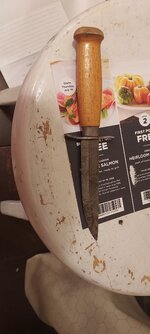
^Nice puukko!

Don't forget it's a Skandi grind if you chose to sharpen it. That doesn't look like someone has put a secondary bevel on it, which is pretty rare.
 

AreBeeBee

Well-known member
Joined
Sep 17, 2020
Messages
415
Location
Wisconsin
The USMC knife cleaned up nicely:

54650230866_b22e01887d_o.jpg

Still plenty of pitting from being stored in a can of seawater for decades, but better. I haven't decided what, if anything, I'll do with the edge of the main blade.
You could likely keep the overall blade profile by carefully removing enough to get down past the eroded edge sections. Or simply call it done now and have a display item.
 

Beerhippie

Well-known member
Joined
Oct 13, 2023
Messages
9,964
Location
Far NE Oregon
You could likely keep the overall blade profile by carefully removing enough to get down past the eroded edge sections. Or simply call it done now and have a display item.
The blade appears to have a full-flat-grind--I checked it out under my field 'scope and found no sign of a secondary bevel--so restoring that edge would both thin the blade and make it narrower. I could probably maintain the original shape, but then it would also be a bit shorter.

What ***** is that having an FFG with no evidence of a secondary bevel probably means this knife was never resharpened. It would be a like-new example... if not for the few decades it spent in a basement sump.

Looks like a shelf queen to me.
 

Beerhippie

Well-known member
Joined
Oct 13, 2023
Messages
9,964
Location
Far NE Oregon
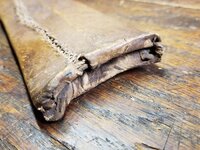
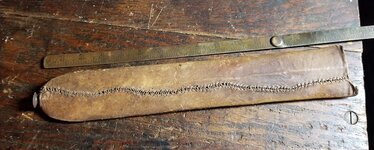
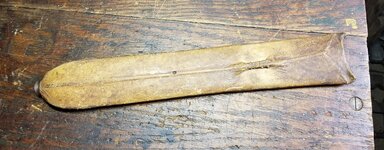
'Hard as plastic" hide is rawhide. It would have been shaped and sewn while wet. Rawhide is easy to work and sew when wet, but shrinks considerably as it dries.

That's very cool! I'd like to see the blade that lived in it.
 

Private Lugnutz

Well-known member
Joined
Mar 30, 2012
Messages
30,667
Location
The Authentic Jersey Shore
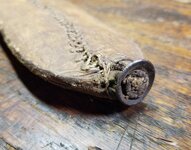
Thanks. Yes, of course, rawhide. It's only the second one like this - long and broad (~2-1/2") that I have seen in the wild, and the first was wildly overpriced by a guy treating it like Jim Bowie's personal accoutrement. This seller wasn't a dealer.

I can see what you're saying on which way it was worn. It would certainly hide the seam. I'd have to do some reading. Large side or hip knives were awkward enough in the field, which is why they were carried somewhere else except for daguereotypes. :) Either way, do you agree with my supposition about the button at the bottom? If it was for a leg-tie, it would be just above the knee. I can see it being worn on something else, too, such as a sling or strap (the loop is very narrow), across the body.

Any thoughts on age? From anyone? Anyone knowledgeable?

It seems like it could be mid 19th century frontier, but I'd hate to ascribe unduly historical significance to it. I have seen examples that seemed much, much later. (See attached photo below for example, from my LEFT BEHIND folders from several years ago.) I would like to find good comps or someone who really knows when a scabbard or sheath would've been made around a wire frame like that, and if that and the metal button were in any way characteristic of a place and era. I already mentioned it, and I won't re-post photos, but you can scroll up and see the outline of the wire frame on both sides.

The size and shape of it, and its implicit blade, may help with research.
 

Attachments

  • 20250619_073725.jpg
    20250619_073725.jpg
    273.1 KB · Views: 21
  • Like
Reactions: 555

Beerhippie

Well-known member
Joined
Oct 13, 2023
Messages
9,964
Location
Far NE Oregon
It looks like it would fit something like a German messer--which is just German from knife, but they were often a wide-bladed knife like that sheath.

As for age, it would help to know what the thread is. If it's sinew, it could be quite old--or a more recent "buckskinner" creation. If there's a loose end, try burning it. Any plastic will melt. Cotton will char. Sinew will stink.

The apparent under-belt carry seems newer--most truly old sheaths would have thongs to hang from.

No idea what the button is for.
 

Private Lugnutz

Well-known member
Joined
Mar 30, 2012
Messages
30,667
Location
The Authentic Jersey Shore
Definitely sinew. I wasn't guessing when I identified it in my first post, but, like you, I don't want to too quickly assume that means frontier.

As for the shape, yeah, almost like a short broadsword, but the sheath may not have conformed to the blade. The sheaths for WWII bolos, for example, belied their odd shape.
 
  • Like
Reactions: 555

Beerhippie

Well-known member
Joined
Oct 13, 2023
Messages
9,964
Location
Far NE Oregon
Definitely sinew. I wasn't guessing when I identified it in my first post, but, like you, I don't want to too quickly assume that means frontier.

As for the shape, yeah, almost like a short broadsword, but the sheath may not have conformed to the blade. The sheaths for WWII bolos, for example, belied their odd shape.
It's much easier to make a secure pouch sheath for an oddly-shaped blade than to make something like kukri sheath with the opening down the back. It's also easier to use a pouch sheath, IMHO.

51974635525_ef0a43a93f_o.jpg

51974150453_bf553d8a92_o.jpg

That's also another way of making a "behind-the-belt" sheath.
 
  • Like
Reactions: 555

AreBeeBee

Well-known member
Joined
Sep 17, 2020
Messages
415
Location
Wisconsin
Lugz & Beer —

There's a book that you may find useful, at least in part. It's the one on the left in the photo below. The set up in the photo was taken as part of a Blade Forums thread (short-lived, I think) on combining knives we have with related or appropriate books. Anyway, the Carl Russell book is a fascinating read, as is the Bennie DeVoto one. (The knife isn't old; it's a modern Russell Greenriver Works Dadley design.)
 

Attachments

  • tumblr_on8gv8nX8f1r4zf5xo1_1280.jpg
    tumblr_on8gv8nX8f1r4zf5xo1_1280.jpg
    393.1 KB · Views: 24

Private Lugnutz

Well-known member
Joined
Mar 30, 2012
Messages
30,667
Location
The Authentic Jersey Shore
There's a book that you may find useful, at least in part. It's the one on the left in the photo below.
Thanks for the rec, RBB.

I have Baldwin ("Early Knives and Sheaths of the American Frontier") ordered through Inter-Library Loan.

I got nowhere fast online. Lots of Native-American pieces in various museums, and even more (lots and lots more!) reproductions on modern blade makers and forums. Nothing this big or this primitive. Nothing around a wire frame (almost more like a scabbard that way).

Ironically, it's the book on the right that inadvertently gave me an idea. Seeing the title made me think of a spot I always like to go to when I travel to Ft Leavenworth, down by the river, where you can literally see two deep ruts in the earth, a wagon width apart, coming right out of the water and up the sloping hill, long grown over with grass. Which, in turn, made me remember the Army Frontier Museum. I'm going to ask my professional counterpart there to pop over there for a visit, explain my interest in brief, and get a good TPOC and some leads.
 

Beerhippie

Well-known member
Joined
Oct 13, 2023
Messages
9,964
Location
Far NE Oregon
@Private Lugnutz : I don't know if you already mentioned it, but what's the overall length and width of the sheath?

I'm wondering if it isn't a field-expedient sheath for a pioneer's sword. These were short, broad "swords" issued to scouts, engineers, artillery men, etc. and were often more used as tools than weapons--think brush clearing.
 
  • Like
Reactions: 555

Private Lugnutz

Well-known member
Joined
Mar 30, 2012
Messages
30,667
Location
The Authentic Jersey Shore
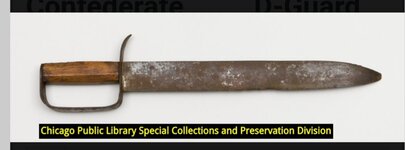
I had a rule next to it in the first photo. It's about 15" x 3". Probably too short for a pioneer/Foot Artillery sword.

I hate to be that guy, but it actually would be perfect for the kinds of big D-Guard Bowie knives popular with frontiersman and, then, some soldiers, especially Confederate.

20250726_134800.jpg
 

AreBeeBee

Well-known member
Joined
Sep 17, 2020
Messages
415
Location
Wisconsin
Thanks for the rec, RBB.

I have Baldwin ("Early Knives and Sheaths of the American Frontier") ordered through Inter-Library Loan.

I got nowhere fast online. Lots of Native-American pieces in various museums, and even more (lots and lots more!) reproductions on modern blade makers and forums. Nothing this big or this primitive. Nothing around a wire frame (almost more like a scabbard that way).

Ironically, it's the book on the right that inadvertently gave me an idea. Seeing the title made me think of a spot I always like to go to when I travel to Ft Leavenworth, down by the river, where you can literally see two deep ruts in the earth, a wagon width apart, coming right out of the water and up the sloping hill, long grown over with grass. Which, in turn, made me remember the Army Frontier Museum. I'm going to ask my professional counterpart there to pop over there for a visit, explain my interest in brief, and get a good TPOC and some leads.

Just FYI, DeVoto wrote three books on or around the subject: The Course of Empire, Across the Wide Missouri (a book title I can never read without hearing the song lyric in my head), and 1846; The Year of Decision. Course is the least engaging (for me) as it covers a big sweep of time and the people don't really stand out. Across covers the fur trade, and 1846 is about the westward emigration, including the Donner party. A large public library should have all three.

If tracing overland trails and the emigrants interests you, check into books by the late Gregory Franzwa:

https://www.goodreads.com/author/list/650683.Gregory_M_Franzwa

The subject is a big as the West itself — happy trails!

The knife in the photo below isn't old except in design. It's a Coureur des bois knife, medium size, by Dean Oliver (River Traders) plus a sheath by Ralph Williams (Bear Tooth Leather) of Bozeman. The blade is 3.25”. The wampum belt has been in the family for a while.
 

Attachments

  • tumblr_nkchgvx5rT1r4zf5xo2_1280.jpg
    tumblr_nkchgvx5rT1r4zf5xo2_1280.jpg
    629.1 KB · Views: 13
Last edited:
  • Like
Reactions: 555

Beerhippie

Well-known member
Joined
Oct 13, 2023
Messages
9,964
Location
Far NE Oregon
Thanks for the rec, RBB.

....

Ironically, it's the book on the right that inadvertently gave me an idea. Seeing the title made me think of a spot I always like to go to when I travel to Ft Leavenworth, down by the river, where you can literally see two deep ruts in the earth, a wagon width apart, coming right out of the water and up the sloping hill, long grown over with grass. Which, in turn, made me remember the Army Frontier Museum. I'm going to ask my professional counterpart there to pop over there for a visit, explain my interest in brief, and get a good TPOC and some leads.
There are quite few places in this part of Oregon where traces of the Oregon Trail are still easily visible. One is just barely outside a neighborhood in La Grande--like two minute's walk.
 

Private Lugnutz

Well-known member
Joined
Mar 30, 2012
Messages
30,667
Location
The Authentic Jersey Shore
"Came from an old San Antonio family that lived near the Alamo and found it on Davy Crockett's body."
That's the guy I was referring to! :)
There are quite few places in this part of Oregon where traces of the Oregon Trail are still easily visible.
I would imagine so. The site I am referring to is on post near Scott Avenue on Riverside Drive. This swale and ruts were primarily the results of a military route, although civilian traders and settlers also used it. Both the Oregon and Santa Fe Trails had a terminus in Ft Leavenworth.
 
  • Like
Reactions: 555
To avoid these ads, REGISTER NOW!
Top Bottom