I would like to run a gas line to my external garage which is roughly 25 feet from the gas meter to run a heater. Its a 19x19 garage so not a large heater. I probably will hire a plumber, but it looks like a simple hook up at the meter? The meter is schedule 40 3/4 pipe. There is a plug at the bottom of the tee going into the house. Any reason not to use that to connect the garage. Some concerns about how taxing the gas flow to the garage will be to the house if we have everything running like stove, furnace, and water heater. To easy to be true?

You are using an out of date browser. It may not display this or other websites correctly.
You should upgrade or use an alternative browser.
You should upgrade or use an alternative browser.
Running gas line from house
- Thread starter kjdad
- Start date
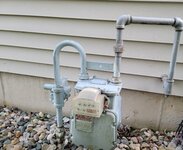
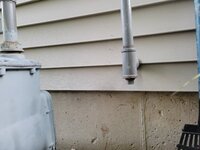
Some concerns about how taxing the gas flow to the garage will be to the house if we have everything running like stove, furnace, and water heater. To easy to be true?
Pick a heater, pull btu/hr requirements. Pull specs for all existing appliances.
Is meter big enough?
From there, you need to size the pipe to the demand in the garage. This is a btu/pipe dia/length calculation.
Firebrick43
Well-known member
3/4 iron pipe will support 150,000 btus if the run is 25 feet long. It shouldn't affect the other run as the tee would be just past the regulator unless the other run was near the limit already.
I wouldnt just attach to the bottom of that tee as its functioning as a drip leg. If you did want to come off right there remove the plug, use a close ******, put a second tee underneath with the tap off the side and plug in the bottom or even better a 3" ****** in the bottom and a cap on it..
I wouldnt just attach to the bottom of that tee as its functioning as a drip leg. If you did want to come off right there remove the plug, use a close ******, put a second tee underneath with the tap off the side and plug in the bottom or even better a 3" ****** in the bottom and a cap on it..
Here are the btu/hr for the installed appliances
Dryer 22000
Stove/oven 70500 at full tilt
Water heater 40,000
Main garage heater 30,000
House furnace 80,000
House fireplace..maybe 40,000ish
Heater i want to add 30,000 to 45,000
Dryer 22000
Stove/oven 70500 at full tilt
Water heater 40,000
Main garage heater 30,000
House furnace 80,000
House fireplace..maybe 40,000ish
Heater i want to add 30,000 to 45,000
Last edited:
If i add the 3" to the bottom as a drip leg its going to be fairly close to the ground and we get snow here. Is that a problem?3/4 iron pipe will support 150,000 btus if the run is 25 feet long. It shouldn't affect the other run as the tee would be just past the regulator unless the other run was near the limit already.
I wouldnt just attach to the bottom of that tee as its functioning as a drip leg. If you did want to come off right there remove the plug, use a close ******, put a second tee underneath with the tap off the side and plug in the bottom or even better a 3" ****** in the bottom and a cap on it..
TurnipTruck
Well-known member
The utility company requires a downstream pipe plug for testing/measuring. I have heard they can change the gas meter out without going inside to relight appliances by clamping a garbage bag to the spare tap and inflating it with the gas.
micromind
Well-known member
If you're using black iron pipe buried in the ground, wrap it with 10 mil tape, overlapped so it's double wrapped.
HoosierBuddy
Well-known member
The way to do it is with Polyethylene gas pipe and anodeless service risers at each end. You can make the joints with stab-type couplings which are approved for gas. In my area, Home Depot sells all that. You also want to use a tracer wire in the ditch in case you need someone to locate it in the future. If it was me, I'd bury the pipe with 18-inches of cover. 3/4" Pipe would be large enough.
Your gas meter there is an American 250 rated at 250,000 BTU/hour at 7-inches w/c. You should be fine with that meter. However, as your connected load will be in excess of the nameplate, you might bring this to NIPSCO's attention and see what they say. My view is that there is essentially no time ever when you are going to be running every gas load in your house at the same time (all the burners on the cook stove at the same time by itself hardly ever happens)....so you'll be OK....also the meter will pass more gas than 250,000 in a pinch...it just isn't rated to be accurate above 250K BTU/hour.
The plug on the bottom of the tee belongs to you, as does everything on the outlet side of the gas meter. You are free to use it. If NIPSCO/NISOURCE wants to change your meter out, that plug does them no good anyway.
The one issue you will need the gas companies help on is shutting off the gas for you to make that connection. The valve on the left side of the meter belongs to them and they are the only ones authorized to turn it.
When you pipe your new section you can put a valve in so you can shut it off yourself. You can also consider doing that on the line going into the house. You have plenty of room for a quarter turn valve on the horizontal leg before it goes into the house. If there was a valve there now, you wouldn't have to get the gas company involved to do the job your working on now.
Good luck.
Your gas meter there is an American 250 rated at 250,000 BTU/hour at 7-inches w/c. You should be fine with that meter. However, as your connected load will be in excess of the nameplate, you might bring this to NIPSCO's attention and see what they say. My view is that there is essentially no time ever when you are going to be running every gas load in your house at the same time (all the burners on the cook stove at the same time by itself hardly ever happens)....so you'll be OK....also the meter will pass more gas than 250,000 in a pinch...it just isn't rated to be accurate above 250K BTU/hour.
The plug on the bottom of the tee belongs to you, as does everything on the outlet side of the gas meter. You are free to use it. If NIPSCO/NISOURCE wants to change your meter out, that plug does them no good anyway.
The one issue you will need the gas companies help on is shutting off the gas for you to make that connection. The valve on the left side of the meter belongs to them and they are the only ones authorized to turn it.
When you pipe your new section you can put a valve in so you can shut it off yourself. You can also consider doing that on the line going into the house. You have plenty of room for a quarter turn valve on the horizontal leg before it goes into the house. If there was a valve there now, you wouldn't have to get the gas company involved to do the job your working on now.
Good luck.
Last edited:
HoosierBuddy
Well-known member
If you're using black iron pipe buried in the ground, wrap it with 10 mil tape, overlapped so it's double wrapped.
If you are using black iron your two choices are to either not wrap it or wrap it and bury a magnesium anode with it (attached to the pipe with an electrical bond). Do not coat pipe that is not to be protected from corrosion by a cathodic protection system. It will fail at the holidays much faster than bare pipe.
I haven't used this brand, but it would work...at least for a while.
Last edited:
fitter30
Well-known member
Gas company will use that plug for pressure testing. Just pipe in a other tee below with that plug and come off the bull( side outlet) with a 90° ( ell). Using poly they make a fitting for coming out of the ground. Also tracer tape should be used in the ditch for locating the pipe.
So all of these loads will never be running at the same time, and not at full tilt. A common diversity factor is .67 - meaning only 67% of the connected load would simultaneously occur during the normal course of the day. Yes, you can argue this multiplier up or down, but you won't exceed 250CFH with your loads.Here are the btu/hr for the installed appliances
Dryer 22000
Stove/oven 70500 at full tilt
Water heater 40,000
Main garage heater 30,000
House furnace 80,000
House fireplace..maybe 40,000ish
Heater i want to add 30,000 to 45,000
Even if you were to exceed 250 CFH, the worst that happens is a slightly larger pressure drop through the meter than the design standard created. The regulator output pressure can be adjusted possibly to account for this, but in no way should it be set higher than the lowest maximum value permitted for any connected load. It could even be already set correctly as you read this!
That plug should have been a drip leg. The cap could then be pulled off of it to add the temp test fitting.Gas company will use that plug for pressure testing. Just pipe in a other tee below with that plug and come off the bull( side outlet) with a 90° ( ell). Using poly they make a fitting for coming out of the ground. Also tracer tape should be used in the ditch for locating the pipe.
It won't matter, just keep it off the ground. Black pipe should be painted upon install and re-painted every several years. The drip leg ****** and cap could be galvanized.If i add the 3" to the bottom as a drip leg its going to be fairly close to the ground and we get snow here. Is that a problem?
HoosierBuddy
Well-known member
The regulator output pressure can be adjusted possibly to account for this, but in no way should it be set higher than the lowest maximum value permitted for any connected load. It could even be already set correctly as you read this!
But under no circumstances should the homeowner, or anyone other than the gas company, adjust delivery pressure.
Agreed. I don't mess with their side. How easy is nipsco to deal with?But under no circumstances should the homeowner, or anyone other than the gas company, adjust delivery pressure.
Bah. I do it during gen installs if needed. You need pressure test gauges to know where you are going. My utility has no restriction on that .But under no circumstances should the homeowner, or anyone other than the gas company, adjust delivery pressure.
HoosierBuddy
Well-known member
Odd, because once you adjust the delivery pressure through the meter the meter is no longer accurate.Bah. I do it during gen installs if needed. You need pressure test gauges to know where you are going. My utility has no restriction on that .
Funny that your utility has no restriction on making a change that will either cheat the homeowner or the utility out of properly metered gas.
Also odd that they've opened themselves up to all kinds of pipeline safety issues by allowing an "Unqualfified" (See 49CFR 192 Supart N) person to perform a regulated pipeline operations and maintenance task.
The 250 CFH meters have a max op pressure of 5psi and will not drop more than 0.5 " pressure across it at max flow. Well within the range and limitation of the meter. And the meters are calibrated to ensure nmt 2% error understating the usage and nmt 1% error overstating the usage AT 5PSI and 250CFH.Odd, because once you adjust the delivery pressure through the meter the meter is no longer accurate.
Funny that your utility has no restriction on making a change that will either cheat the homeowner or the utility out of properly metered gas.
Also odd that they've opened themselves up to all kinds of pipeline safety issues by allowing an "Unqualfified" (See 49CFR 192 Supart N) person to perform a regulated pipeline operations and maintenance task.
Also the spring within the regulator provides a limit to the adjustable pressure range. So no way is someone dialing this up to an extreme setting (without changing parts).

So when we're discussing tweaking a regulator from 5" h2o up to 7"h20 or from 10"h2o down to 7" h2o, it's infinitesimal over the 5 psi window where the -2/+1% is permitted.
BTW, "PIPELINE" seriously.........
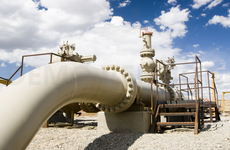 stay on topic.....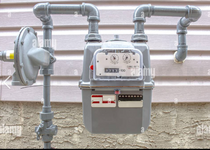
HoosierBuddy
Well-known member
That regulator is part of a pipeline. Seriously.The 250 CFH meters have a max op pressure of 5psi and will not drop more than 0.5 " pressure across it at max flow. Well within the range and limitation of the meter. And the meters are calibrated to ensure nmt 2% error understating the usage and nmt 1% error overstating the usage AT 5PSI and 250CFH.
Also the spring within the regulator provides a limit to the adjustable pressure range. So no way is someone dialing this up to an extreme setting (without changing parts).
So when we're discussing tweaking a regulator from 5" h2o up to 7"h20 or from 10"h2o down to 7" h2o, it's infinitesimal over the 5 psi window where the -2/+1% is permitted.
BTW, "PIPELINE" seriously.........
The utility that owns that regulator is subject to both federal and state jurisdiction.
There is no way in "Heck" that anyone the utility's engineering or pipeline safety has any idea that you are out there adjusting their regulators.
It isn't allowed period, by federal code. PHMSA jurisdiction for the picture on the right begins at the gathering lines for the natural gas just past the wellhead and doesn't end until threaded end of the spud (dielectric union) on the OUTLET side of that meter. That isn't my interpretation....it's theirs. These aren't my rules, they are federal code.
HoosierBuddy
Well-known member
Agreed. I don't mess with their side. How easy is nipsco to deal with?
I've never been one of their customers. If you have any issue though PM me. I've met many of their employees at various industry meetings over the years. There may be a charge. If so, I can't help you with that part. But...if you get the runaround...give me a shout.
Thanks! Im still debating hiring someone or doing the work. I could same some cash doing the work and its pretty straightforward..but I also like to support the trades when I can...they need to eat too.I've never been one of their customers. If you have any issue though PM me. I've met many of their employees at various industry meetings over the years. There may be a charge. If so, I can't help you with that part. But...if you get the runaround...give me a shout.
The regulation is for hazardous liquids........liquids being highly compressed gases....in this context liquified ng......Once distribution is in a gaseous state, this reg doesn't apply. You are analogously comparing a 115KV transmission line to a car battery. Find another reg.That regulator is part of a pipeline. Seriously.
The utility that owns that regulator is subject to both federal and state jurisdiction.
There is no way in "Heck" that anyone the utility's engineering or pipeline safety has any idea that you are out there adjusting their regulators.
It isn't allowed period, by federal code. PHMSA jurisdiction for the picture on the right begins at the gathering lines for the natural gas just past the wellhead and doesn't end until threaded end of the spud (dielectric union) on the OUTLET side of that meter. That isn't my interpretation....it's theirs. These aren't my rules, they are federal code.

HoosierBuddy
Well-known member
You are completely wrong. Hazardous liquid pipelines are covered under CFR195. Natural Gas is under 192.The regulation is for hazardous liquids........liquids being highly compressed gases....in this context liquified ng......Once distribution is in a gaseous state, this reg doesn't apply. You are analogously comparing a 115KV transmission line to a car battery. Find another reg.
Read this and get back to me:
Federal Register :: Request Access
 www.ecfr.gov
See especially the link to Subpart N Operator Qualification.
Also see the definition of a federally regulated service line in section 192.3 I'll jump to the fun part:
Service line
means a distribution line that transports gas from a common source of supply to an individual customer, to two adjacent or adjoining residential or small commercial customers, or to multiple residential or small commercial customers served through a meter header or manifold. A service line ends at the outlet of the customer meter or at the connection to a customer's piping, whichever is further downstream, or at the connection to customer piping if there is no meter.
Last edited:
welder4956
Well-known member
If you replace the 90 degree elbow above the tee with a tee, it will be higher off the ground. You're going to need to bury the line anyway, so either place is fine.If i add the 3" to the bottom as a drip leg its going to be fairly close to the ground and we get snow here. Is that a problem?
Last edited:
Somewhere I jumped from part 195 to 192. My bad. The web pages look the same.You are completely wrong. Hazardous liquid pipelines are covered under CFR195. Natural Gas is under 192.
Read this and get back to me:
Federal Register :: Request Access
See especially the link to Subpart N Operator Qualification.
Also see the definition of a federally regulated service line in section 192.3 I'll jump to the fun part:
Service line
means a distribution line that transports gas from a common source of supply to an individual customer, to two adjacent or adjoining residential or small commercial customers, or to multiple residential or small commercial customers served through a meter header or manifold. A service line ends at the outlet of the customer meter or at the connection to a customer's piping, whichever is further downstream, or at the connection to customer piping if there is no meter.
You are correct.
So apparently I am and have been an undocumented verker in da America. Simply because I don't have a documented qualification record from the operator or some other designee.
If anyone thinks turning POCOs valve on the line side of the meter is any different than load side, they're blowing smoke. Adjusting pressures I could see some concern, but again how is that different than adjusting a regulator on the load side when you have the proper measurement equipment? Even so, there is only so much range adjustment permitted w/o changing hardware (their hardware).
I'm not waiting half a day or week for someone to come out to do a 5 minute job. Let's remember this is in context to a low pressure system (1/4 psi) in a single family dwelling.
There's a lot of plumbers and mechanical contractors doing the same for decades....and will continue.
Another joke is per this CFR, the operator (utility) is supposed to inspect the service valves annually and nmt 15 months since last inspection. Sure they do!!!
larry4406
Well-known member
At the day job I have turned off the upstream valve on gas meters hundreds of times.
Never gave it a second thought if I was entitled to use the provided shutoff valve or not.
Never gave it a second thought if I was entitled to use the provided shutoff valve or not.
And I'll bet tomorrow you would still be that same bad boy.At the day job I have turned off the upstream valve on gas meters hundreds of times.
Never gave it a second thought if I was entitled to use the provided shutoff valve or not.
HoosierBuddy
Well-known member
And I'll bet tomorrow you would still be that same bad boy.
And when he breaks it by turning it past the stop, the gas company will be the one who has to go fix it. I've seen it happen multiple times.
Regarding your questions about how valves differ....It's the difference between you driving your truck and you driving mine. You know how to drive your truck. Theoretically you should know how to drive mine. That's my truck. It's not your truck. It doesn't belong to you. You don't get to drive my truck.
If you want to learn....which you don't....you just want to be right....but if that delivery pressure gets adjusted by the gas company to anything other than the standard delivery pressure defined in their tariff, they have to EITHER:
1. Install a correcting index in the meter, such as a 2PSI index which has a different gear ratio to correct the reading for the delivery pressure.
2. Install an electronic device such as a Honeywell EC350 (for commercial meters) and either program it properly to account for the change in pressure OR utilize a pressure transducer to monitor the metered pressure and calculate volume adjustments on the fly.
3. Reprogram the ERT (if equipped) with a fixed pressure correcting factor to increase/decrease the meter rate.
OR
4. Alert the office to have the billing program adjust the customers usage from "read" to "actual" based on a fixed pressure factor.
One other thing I've only seen one time..and thank God I wasn't directly involved...a building burned down and the insurance company brought the meter regulator to court and made the local gas company pay for the cost of the fire based on the delivery pressure to the building being higher than what was shown in the gas company's records. Movie theater burned to the ground. No I don't think the delivery pressure was the cause....but the insurance company's attorney sure convinced the jury it was.
Typically what I've seen is that gas fitters (not just generator installers) tend to sometimes run pipe that is a bit too small and then want the gas company to make up for it with delivery pressure. It seems to me the fitter would be better off running the right sized pipe to begin with. But, I don't pretend to understand your job. Maybe there's a reason I don't understand as you do that every day and I don't.
Last edited:
larry4406
Well-known member
Ones here are a quarter turn valve.And when he breaks it by turning it past the stop, the gas company will be the one who has to go fix it. I've seen it happen multiple times.
The circles on the hasp for locking tells one which way to turn the valve. Not rocket science. Turn slow for off to feel the stop and turn slow for on to not trip the high flow device.
Fire department thanked me for shutting one off when a leak in a house was detected and 911 had been called. Not sure why the spring closure valve or whatever the high flow device is did not shut it off automatically. Flex line at a range has broken at one of the corrugations; not sure why.
Exactly, not rocket science. I don't think I've even seen anything other than a 1/4 turn ball valve in gas piping.Ones here are a quarter turn valve.
The circles on the hasp for locking tells one which way to turn the valve. Not rocket science. Turn slow for off to feel the stop and turn slow for on to not trip the high flow device.
Fire department thanked me for shutting one off when a leak in a house was detected and 911 had been called. Not sure why the spring closure valve or whatever the high flow device is did not shut it off automatically. Flex line at a range has broken at one of the corrugations; not sure why.
The flow may not have been high enough or debris kept it partially open.
HoosierBuddy
Well-known member
Not sure why the spring closure valve or whatever the high flow device is did not shut it off automatically. Flex line at a range has broken at one of the corrugations; not sure why.
If you're talking about the excess flow valve built into modern range connectors, it SHOULD HAVE closed if the range connector broke. The old ones didn't include them and even on the new ones, it's possible to install the corrugated hose section and trash the EVF part. Not sure why someone would...but could.
If you're talking about an excess flow valve between the service tap and the meter, those weren't required by code until 2007 and there's currently no requirement to add them to old lines (something I think may change in the future). Also, they are sized to shut off flow (mostly) if the service line gets cut between the valve (downstream of the tap on the main) and the meter. They allow a lot of flow and wouldn't set if a customer line were severed inside the home. The ones I typically use are rated at 700 CF/H at 5 PSI. If the service has 40 PSI on it, that valve will trip at about 2000 cf/hour...which a typical house regulator won't pass.
larry4406
Well-known member
The buried excess flow valve. Surprised it didn’t trip.If you're talking about the excess flow valve built into modern range connectors, it SHOULD HAVE closed if the range connector broke. The old ones didn't include them and even on the new ones, it's possible to install the corrugated hose section and trash the EVF part. Not sure why someone would...but could.
If you're talking about an excess flow valve between the service tap and the meter, those weren't required by code until 2007 and there's currently no requirement to add them to old lines (something I think may change in the future). Also, they are sized to shut off flow (mostly) if the service line gets cut between the valve (downstream of the tap on the main) and the meter. They allow a lot of flow and wouldn't set if a customer line were severed inside the home. The ones I typically use are rated at 700 CF/H at 5 PSI. If the service has 40 PSI on it, that valve will trip at about 2000 cf/hour...which a typical house regulator won't pass.
I know from experience that if the meter shutoff valve is opened too quick after having down stream system shutoff and opened, it can trip the excess flow valve.
Then it’s the waiting game. Shut it off, wait a period of time (idk 15-30 min?) then slowly open the shutoff valve and the excess flow has always reset for me.
HoosierBuddy
Well-known member
The buried excess flow valve. Surprised it didn’t trip.
I know from experience that if the meter shutoff valve is opened too quick after having down stream system shutoff and opened, it can trip the excess flow valve.
Then it’s the waiting game. Shut it off, wait a period of time (idk 15-30 min?) then slowly open the shutoff valve and the excess flow has always reset for me.
Depends on the valve.
Don't be a DH. I said you were correct by locating and specifying a requirement in the CFR's. Bravo! Point made and I am very happy to have a credible source document referenced. Thanks for that information. I'm sure many others didn't know that either. All I'm saying is that is what I do and will continue.And when he breaks it by turning it past the stop, the gas company will be the one who has to go fix it. I've seen it happen multiple times.
Regarding your questions about how valves differ....It's the difference between you driving your truck and you driving mine. You know how to drive your truck. Theoretically you should know how to drive mine. That's my truck. It's not your truck. It doesn't belong to you. You don't get to drive my truck.
If you want to learn....which you don't....you just want to be right....but if that delivery pressure gets adjusted by the gas company to anything other than the standard delivery pressure defined in their tariff, they have to EITHER:
1. Install a correcting index in the meter, such as a 2PSI index which has a different gear ratio to correct the reading for the delivery pressure.
2. Install an electronic device such as a Honeywell EC350 (for commercial meters) and either program it properly to account for the change in pressure OR utilize a pressure transducer to monitor the metered pressure and calculate volume adjustments on the fly.
3. Reprogram the ERT (if equipped) with a fixed pressure correcting factor to increase/decrease the meter rate.
OR
4. Alert the office to have the billing program adjust the customers usage from "read" to "actual" based on a fixed pressure factor.
One other thing I've only seen one time..and thank God I wasn't directly involved...a building burned down and the insurance company brought the meter regulator to court and made the local gas company pay for the cost of the fire based on the delivery pressure to the building being higher than what was shown in the gas company's records. Movie theater burned to the ground. No I don't think the delivery pressure was the cause....but the insurance company's attorney sure convinced the jury it was.
Typically what I've seen is that gas fitters (not just generator installers) tend to sometimes run pipe that is a bit too small and then want the gas company to make up for it with delivery pressure. It seems to me the fitter would be better off running the right sized pipe to begin with. But, I don't pretend to understand your job. Maybe there's a reason I don't understand as you do that every day and I don't.
If people are too stupid to know what they are working with, I agree, stay away. A quarter turn valve is hardly a technology challenge, but there are people who don't know which end of screwdriver to hold.
As for the Pressure-compensating index changes, I spoke to someone at American Meter today. So much for not wanting to learn.....and he said the infinitesimal pressure changes I spoke of make virtually no difference in billing accuracy. Jumps in regulator output pressure from 1/4 psi to 2psi or 5 or 10 would certainly. But as i already stated, that is not the case in this thread or my contribution into it. BTW, BTU content is averaged over a 30-day period from each pipeline supply source so that easily affects a customers BTU consumption/charge.
One of the GasCo's tariff I read today, (see learning again), states standard delivery pressure is 4 - 7" H20.
I adjust gas pressure after the correct pipe size has been run by me (in some cases all the way back to the meter) first, when not running, then under no load and check for it at ~full load. It is when checked with little/no gas consumption occurring in the piping network, I find the existing state of the gas service regulator setting. In no case would I exceed the the maximum value for the lowest rating of any connected appliance.
welder4956
Well-known member
How did the discussion of a residential gas connection devolve into a Part 192 pipeline operator discussion?
Because I mentioned playing on the street-side of the meter.......operating the service 1/4 turn ball valve and bumping a regulator up or down a few measly "H2O. It really digressed to CFR 195. (192 was in error of my replying back)How did the discussion of a residential gas connection devolve into a Part 192 pipeline operator discussion?
Ultradog MN
Well-known member
I didn't read all the replies but went through this last fall.I would like to run a gas line to my external garage which is roughly 25 feet from the gas meter to run a heater. Its a 19x19 garage so not a large heater. I probably will hire a plumber, but it looks like a simple hook up at the meter? The meter is schedule 40 3/4 pipe. There is a plug at the bottom of the tee going into the house. Any reason not to use that to connect the garage. Some concerns about how taxing the gas flow to the garage will be to the house if we have everything running like stove, furnace, and water heater. To easy to be true?
Mine got a little more complicated than I expected.
A lot of it will depend on what pressure natural is gas coming in to your house.
My old gas system was measured in water column inches (I think it's 7" or about 1 psi) and came into the meter which was in the basement through a 1-1/4" black pipe.
It served the existing appliances - furnace, water heater, clothes dryer and kitchen stove but did not give me enough gas to add a furnace in the garage.
I had to have the gas company upgrade my service to the new 2 1/2 psi system which required them to cut a hole in the street and pierce an underground line to a new meter outside the house. Once that was done I dug the trench to the garage and ran a 1/2" copper line myself. I teed into their line upstream from the new regulator in the basement
Once in the garage I needed a regulator to reduce the pressure for the used 70K btu high efficiency furnace I already had.
If you have 2 1/2 psi to your meter and you're smarter than a flaring tool it's pretty simple to DIY.
Having heat in my shop is a wonderul thing.