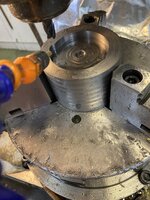
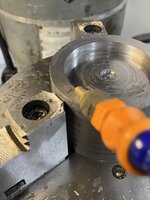
So, this is obviously too late, but you shouldn't use FHCS unless absolutely necessary. And I don't see why it's necessary here.
Because when used in a pattern, there can be ~.03" error in the tap and C'sink positions and this will lead to a bending stress at the bottom of the head that can easily reach 30% of the fastener's yield strength. And then the tensile stress from the torque is 70% of the yield, so now it's a TTY fastener. In the future, use SHCS. Plus, with the tiny hex in FHCS, people just love to strip them.
As said, tungsten is used for rad shielding because of density. You can use mild steel, it just needs to be ~2.5X thicker. Most rad shielding is just mild steel when there is the room for it. Then lead. Then tungsten. But lead typically needs to be enclosed now- make a sheetmetal enclosure, pour molten lead inside, seal the box with a welded cap. DOE hasn't allowed "naked" lead for decades AFAIK and has been using old lead bricks to be melted down for engineered and encased lead shielding.
OP, if you're machining lead, you better use PPE and clean up your **** or you'll be blacklisted if you ever get a DOE contract and they get a part back that's been microscopically contaminated with anything like: PB, BE, CD.... All of that is a "stop work" and you'll be fucked for months and no more work. And if you're machining lead on the same machine as other work, then that's a red flag.
We do nasty machining, but on dedicated machines in specialized ventilated cells that see nothing else but more of the same.


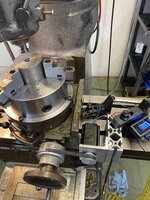
 This looks as much fun as having Cap't Hook for a proctologist.