I’d would approach this from a different angle, but I think I’ll make the exact same recommendations as everyone else.
One thing amateur mechanics get wrong is torque. The conventional wisdom of gutentite or bardrup bop with an impact gun is pretty bad advice. Reason being, the stuff you will most likely encounter, where you legit need a torque wrench, are jobs like a water pump, oil pan gasket, valve cover gasket. Even oil filters and drain plugs should really be torqued. It’s not (only) the high torqued bolts you should be concerned about getting right. The low torque stuff can be as or more important.
Now, there are literally dozens of GJ members desperate to respond saying they work on McLarens and don’t use torque wrenches for any of this. I think the root problem is, it’s hard to judge low torques accurately when you are first starting out. Lug nuts you can almost judge with a grunt (not recommending this, mistorquing lugs can lead to rotor warpage.
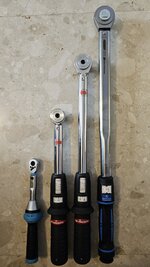
So my recommendation is a Nm 3/8 torque wrench with a 135Nm (100ftlb) top end. Digital models are great because you can switch units and are accurate at the bottom of their range. Clickers are not.
You might find that tool helpful for other applications, but not guns. If you wanted to float a rifle barrel for example, you’ll probably need a torque screwdriver with a range of maybe 50 in ounces (that’s about 1/4 ftlbs).
Appliances , HVAC stuff, you need a 1/4” torque wrench that reads in inch pounds.
Here’s my advice: You can’t post on GJ and get good general advice for a non specific application of a tool you’ve never used and may know little about. That’s a sure recipe to get bad advice.
Instead, find a job you have to do, or want the ability to do, and look at the torque specs, and buy a tool that meets that requirement set. And only buy if that tool won’t be single use for you.
People treat torque wrenches as optional tools and maybe some can getaway without them. No one really should do that.
For automotive, depending on what you attempt, you will likely encounter the need for both 3/8” and 1/2” torque wrenches. Most of us probably have both. Digitals have advantages and there is lots of content here about angle sensing wrenches you need to read. Beyond that, none of us can really help with more specific advice.
If this helps, my salary as an engineer has gone up 6X since I started my career 35yrs ago. My take home pay is still less than 1/2 the labor rate of my friendly independent auto shop. So even successful and in my 60s I’m still fixing my cars to save money. My tools are, by GJ standards, high end, excessive, bordering on fan boy collectors items. The money I’ve saved just fixing cars has paid for those tools many times over. Don’t be afraid to spend $200 on a nice torque wrench.