To avoid these ads, REGISTER NOW!

What ft lbs range of torque wrench??

Griff79

Well-known member
Joined
Jun 9, 2018
Messages
584
Location
Denver
Hello,
I am in need of a torque wrench. And since I don’t have experience with them I thought I would ask what foot pounds range would be most used. My use case is general automotive, small engine and DIY fasteners, maybe appliances, gun smithing. I also realize that multiple torque wrenches are necessary to cover the ranges required to cover most applications. But I need to get started so what are your suggestions?
Thanks much,
Griff
 
To avoid these ads, REGISTER NOW!

Firebrick43

Well-known member
Joined
May 12, 2015
Messages
14,227
Location
West central Indiana
Hello,
I am in need of a torque wrench. And since I don’t have experience with them I thought I would ask what foot pounds range would be most used. My use case is general automotive, small engine and DIY fasteners, maybe appliances, gun smithing. I also realize that multiple torque wrenches are necessary to cover the ranges required to cover most applications. But I need to get started so what are your suggestions?
Thanks much,
Griff
Automotive is going to be a **** shoot which is used more, a 20-200 inch pound, or a 10-80 ft lbs.

Most everything else is going to be 20-200 inch lbs except gunsmithing.

For gunsmithing its going to be a very small torque wrench for scopes and rings, or a larger one for barrels.
 

Ilikeike

ALLIANCE MEMBER
Joined
Jan 8, 2015
Messages
2,452
Location
Northern Ca.
Something that does 5 to 125 ft-lb range should do most jobs, Unless you're doing suspension steering then you may need something the goes 150 or more. Just get a small inch lb clicker for your light weight stuff.
 
Last edited:

moemc

Well-known member
Joined
Mar 12, 2025
Messages
356
You will want a few. Keep in mind that they are not particularly accurate near the extremes of their range. I think they say you want to stay between 20-80% of capacity to have good accuracy. Something you use for gunsmithing is going to be more of a torque driver generally, and rarely if ever useful for automotive. Except maybe something you’d use on a barrel nut, that would be more automotive range.

I’d probably look at something like the wheeler torque driver for general gunsmithing. A 3/8” something like 25-75ft-lb ish range and 1/2” that can get you in the higher numbers for lug nuts and axle nuts and head studs etc.
 

Wamsutta

Well-known member
Joined
Jan 8, 2014
Messages
10,890
Location
Amarillo, Texas
An inch-pound torque wrench is most useful for things that are mushy and never get tight.

Anything to do with bolts going through grommets are like that.

Squishy gaskets are another thing.
 

YesIHaveAHammer

Well-known member
Joined
Jun 1, 2025
Messages
907
But I need to get started so what are your suggestions?
Given you're starting from nothing, know your uses, and know you need a few, you're in a great position to plan out what optimal set you eventually want to buy. So I suggest you plan this out. If you know you're going to need 3, you can plan out which sizes and start with one of those, and avoid having a lot of overlap.
 

Phang

Well-known member
Joined
Jul 30, 2008
Messages
113
Location
Singapore
motorcycle and car hobbyist, I started with two

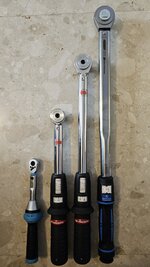
3/8" 10Nm to 50Nm (7.4 ftlbs to 36.8 ftlbs)
1/2" 40Nm to 200Nm (29.5 ftlbs to 147.5 ftlbs)

that covered my needs for a long time

then I expand upwards and downwards from there

now I got it covered from 1Nm to 300Nm (0.7 ftlbs to 221 ftlbs)

20240719_141111.jpg

20241216_143436.jpg

20241216_143342.jpg
 

merkyworks

Well-known member
Joined
Nov 11, 2016
Messages
587
Location
Texas
This is the one I use for gunsmithing.

(Amazon link)


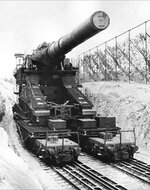
With a torque wrench like that when you say gunsmithing, do you mean a howitzer cannon? :lol:


To the OP @Griff79, I'm a DIY/home gamer and here is what I have.
1/2" Precision Instruments 40-250 ft-lbs, used for torquing lug nuts and suspension/drivetrain hardware.
3/8" Icon Professional flex-head 5-75 ft-lbs, used for anything engine bay related.
1/4" Dual-Direction Micrometer 10-150 in-lbs, used on a few engine items and mounting optics to guns.

Eventually want to get a torque screwdriver that does 2-30ish in-lbs which would make gunsmith things easier. Also just throwing this out there but Harbor Freight currently has all torque wrenches 35% off so not a bad place to look.
 

KnurledNut

Well-known member
Joined
Jan 28, 2011
Messages
8,206
Location
n/a
I use 3/8” 10-100 and 1/2” 30-250 clickers the most.
1/4” and 3/4” drives sparingly.
Digital torque adaptor, occasionally. Being able to cycle through multiple settings quickly is great. And showing the active torque as its applied and final max value can be helpful. Strain gauges are quite reliable, I use it to check calibration of the others.
Then there is oddball stuff that I have found useful like the Ridgid no hub band tool for use on screw type hose clamps. Not recommending it to the OP, just stating an example.
Can’t plan for every situation. But the basics will cover a lot.
Calibration is key.
 
Last edited:

Steve_P

Well-known member
Joined
Sep 15, 2010
Messages
5,188
if you want to cover all the reasonable bases, including guns, but not large trucks, you will need at least four IMO. Torque screwdriver, 1/4, 3/8, and a 1/2 drive that goes thru 250 lbf-ft. Logical place to start would probably be a 3/8 drive that will get you thru 100 lbf-ft if that covers your vehicle's wheels. And/or a 1/2" drive either next or first. I owned only a 1/2 drive 150-lbf-ft? Craftsman for many years before I expanded out.

The flex head Icon clickers from HF are really nice if you can get them on sale; I am mostly CDI but have two of the Icons.

Edit- I have the Quinn torque screwdriver from HF; it's accurate and worth the $, especially with a coupon.
 

AEAdam

Well-known member
Joined
May 27, 2023
Messages
2,804
Location
SE PA
I’d would approach this from a different angle, but I think I’ll make the exact same recommendations as everyone else.

One thing amateur mechanics get wrong is torque. The conventional wisdom of gutentite or bardrup bop with an impact gun is pretty bad advice. Reason being, the stuff you will most likely encounter, where you legit need a torque wrench, are jobs like a water pump, oil pan gasket, valve cover gasket. Even oil filters and drain plugs should really be torqued. It’s not (only) the high torqued bolts you should be concerned about getting right. The low torque stuff can be as or more important.

Now, there are literally dozens of GJ members desperate to respond saying they work on McLarens and don’t use torque wrenches for any of this. I think the root problem is, it’s hard to judge low torques accurately when you are first starting out. Lug nuts you can almost judge with a grunt (not recommending this, mistorquing lugs can lead to rotor warpage.

So my recommendation is a Nm 3/8 torque wrench with a 135Nm (100ftlb) top end. Digital models are great because you can switch units and are accurate at the bottom of their range. Clickers are not.

You might find that tool helpful for other applications, but not guns. If you wanted to float a rifle barrel for example, you’ll probably need a torque screwdriver with a range of maybe 50 in ounces (that’s about 1/4 ftlbs).

Appliances , HVAC stuff, you need a 1/4” torque wrench that reads in inch pounds.

Here’s my advice: You can’t post on GJ and get good general advice for a non specific application of a tool you’ve never used and may know little about. That’s a sure recipe to get bad advice.

Instead, find a job you have to do, or want the ability to do, and look at the torque specs, and buy a tool that meets that requirement set. And only buy if that tool won’t be single use for you.

People treat torque wrenches as optional tools and maybe some can getaway without them. No one really should do that.

For automotive, depending on what you attempt, you will likely encounter the need for both 3/8” and 1/2” torque wrenches. Most of us probably have both. Digitals have advantages and there is lots of content here about angle sensing wrenches you need to read. Beyond that, none of us can really help with more specific advice.

If this helps, my salary as an engineer has gone up 6X since I started my career 35yrs ago. My take home pay is still less than 1/2 the labor rate of my friendly independent auto shop. So even successful and in my 60s I’m still fixing my cars to save money. My tools are, by GJ standards, high end, excessive, bordering on fan boy collectors items. The money I’ve saved just fixing cars has paid for those tools many times over. Don’t be afraid to spend $200 on a nice torque wrench.
 
Last edited:
To avoid these ads, REGISTER NOW!

Fedwrench

ALLIANCE MEMBER
Joined
Dec 9, 2007
Messages
14,961
Location
Valley of the sun
A general rule of thumb is a torque wrench is most accurate in its middle 80% of range. The bottom 10% and the upper 10% may be a little off. However, that might not be a deal breaker unless you're building spaceships, uber expensive exotic car engines and the like.
I like the flexibility a digital torque wrench or torque adapter offers you. You might not always have room to use the adapter but, being able to bounce between various units of measurement is handy and I like the flashing lights and the beep. :beer:
 

merkyworks

Well-known member
Joined
Nov 11, 2016
Messages
587
Location
Texas
A general rule of thumb is a torque wrench is most accurate in its middle 80% of range. The bottom 10% and the upper 10% may be a little off. However, that might not be a deal breaker unless you're building spaceships, uber expensive exotic car engines and the like.
I like the flexibility a digital torque wrench or torque adapter offers you. You might not always have room to use the adapter but, being able to bounce between various units of measurement is handy and I like the flashing lights and the beep. :beer:

I have gone by these guidelines for mechanical torque wrenches but in the modern era of digital torque wrenches I wonder if the 10%/80% guideline applie?
 

wantedabiggergarage

Member Emeritus
Joined
Feb 25, 2006
Messages
3,897
Location
Independence, MO, USA.
Also, for those of you who use digital torque wrenches, do you keep batteries in them, or remove them for storage? (how often do you use them I expect would be a deciding factor between pro use and home).

After once using a digital one, and since my shape is not as good, I would like a digital one, but I have several clickers that have always served me well.
 

tamaraw

Well-known member
Joined
Jun 6, 2022
Messages
843
...I thought I would ask what foot pounds range would be most used.
Look up what values you need; that's your answer.

My use case is general automotive, small engine and DIY fasteners, maybe appliances, gun smithing.
Even lug nuts for something like an Isuzu NPR, Ford F-150, or Mazda Miata are going to be wildly different. In that example, the spec roughly doubles for each vehicle size up.

Really, you just have to look up what jobs you plan to do and what torque fasteners require. Make a list and that will be the range you need.

I also realize that multiple torque wrenches are necessary to cover the ranges required to cover most applications.
You would need at least two. The gunsmithing one is more likely to be a torque screwdriver or bicycle style wrench that takes hex bits.
 

AEAdam

Well-known member
Joined
May 27, 2023
Messages
2,804
Location
SE PA
I have gone by these guidelines for mechanical torque wrenches but in the modern era of digital torque wrenches I wonder if the 10%/80% guideline applie?
Does not. Digital wrenches are pretty good throughout their range. There’s no “so inaccurate it’s not worth using” range.
 
Last edited:

Crazyjake8493

Well-known member
Joined
Sep 26, 2014
Messages
3,977
Location
Upstate NY
For automotive I've never needed more than 200 ft-lbs, and my torque wrench goes up to 250 ft-lbs (1/2" drive). I also have a 1/4" drive that's 20-200 in-lbs.
 

moemc

Well-known member
Joined
Mar 12, 2025
Messages
356
While on the subject, does anyone have any interesting anecdotes about testing/calibration? I have a few units that are many years old now and I’d like to get them checked out and dialed in if necessary. I was considering buying a digital torque adapter to DIY it, since that means I can always check them any time hassle-free. I second guess the accuracy, since the “official“ torque testing hardware is exponentially more expensive. With a relatively inexpensive torque adapter, I start wondering if I need to have the torque adapter tested to validate it before using it calibrate my wrenches, and then it’s just making it more complicated.
 

AC-WC

Well-known member
Joined
Jan 22, 2023
Messages
784
Location
NE, Indiana
While on the subject, does anyone have any interesting anecdotes about testing/calibration? I have a few units that are many years old now and I’d like to get them checked out and dialed in if necessary. I was considering buying a digital torque adapter to DIY it, since that means I can always check them any time hassle-free. I second guess the accuracy, since the “official“ torque testing hardware is exponentially more expensive. With a relatively inexpensive torque adapter, I start wondering if I need to have the torque adapter tested to validate it before using it calibrate my wrenches, and then it’s just making it more complicated.
To have them professionally calibrated generally costs as much as a new one.
 

zimman

Well-known member
Joined
Mar 2, 2014
Messages
2,324
Location
Mark Twain National Forest
The torque on my F250 track bar nut is like 410lbs. LOL 250lbs on the other side. It came loose down in the mountains and the entire body tried to delete the chat on a curve. Most folks won't have one of those wrenches but if you go large on a truck you'll need some large gear.
Zim
 

richfinn

Well-known member
Joined
Jan 29, 2011
Messages
4,818
Location
Leeds, Yorkshire, England
Start off with the big 1/2" first (lug nuts and wheel hubs/brake caliper brackets) you will use it the most (70-350nm is a good range)

Then get a 3/8" (10-100nm) good for general purpose engine stuff (spark plugs/belt tensioners) and pre-torque before they want a specified angle

Then maybe a 1/4" (5-20nm)

Any lower than that I prefer a torque screwdriver.

I still use the old fashioned mechanical angle gauge for the odd time I need it (over having $3000 of Tech-angles)

If you can get flexhead Torque Wrenches that would be a bonus for most automotive work
 

AEAdam

Well-known member
Joined
May 27, 2023
Messages
2,804
Location
SE PA
While on the subject, does anyone have any interesting anecdotes about testing/calibration? I have a few units that are many years old now and I’d like to get them checked out and dialed in if necessary. I was considering buying a digital torque adapter to DIY it, since that means I can always check them any time hassle-free. I second guess the accuracy, since the “official“ torque testing hardware is exponentially more expensive. With a relatively inexpensive torque adapter, I start wondering if I need to have the torque adapter tested to validate it before using it calibrate my wrenches, and then it’s just making it more complicated.
Maybe not a response but hope this helps:

Poor technique, improper cleaning/friction management play huge roles in bolt stretch. I wonder if its really worthwhile to bother with calibration. At the end of the day, aside from engine building, most of the jobs requiring a torque wrench don’t require an absolute value as much as similarity between the torques (bolt stretch, or gasket compression) in the pattern.
 

Ohio Andy

Well-known member
Joined
Jul 31, 2024
Messages
2,374
Location
Columbus, Ohio
For things like gunsmithing I would have thought you would have used a torque screwdriver

This is the one I have


But if you know the range you can just get the ones that you need. I had intended to buy the Craftsman version of that, but I got a really good deal on the one I bought. So the Craftsman is under $100 listed below. The wiha listed above. I paid under $300 for the set

 
Last edited:

wantedabiggergarage

Member Emeritus
Joined
Feb 25, 2006
Messages
3,897
Location
Independence, MO, USA.
To have them professionally calibrated generally costs as much as a new one.
Ironically, I have only had mine calibrated once. I bought my first one when I was 16, and around 10 years later, a machinist friend, who was building a plane, told me it was probably junk, since he suspected I didn't leave it zero'd out when not in use. He was shocked when he pulled it out to show me and found I had, the only time I used it. (told to do that from my mechanic friend)
I had picked up two more, one from a mechanic's friend who was dying from cancer, and another, I think Proto 3/8" in a much lower range with a tighter tolerance. I did some work for a fellow mechanics dad, and didn't charge him. He was a pilot and was taking his in to be calibrated and his boss told him to do that to any others he might use (expecting his son's). He took mine instead as his son didn't have one yet. (had the Snap on flex head digital on order) My brand new one, was WAY off, where my others that had been zero'd out (may not be the correct term, just what I was told), were all still within spec.
 

KnurledNut

Well-known member
Joined
Jan 28, 2011
Messages
8,206
Location
n/a
While on the subject, does anyone have any interesting anecdotes about testing/calibration? I have a few units that are many years old now and I’d like to get them checked out and dialed in if necessary. I was considering buying a digital torque adapter to DIY it, since that means I can always check them any time hassle-free. I second guess the accuracy, since the “official“ torque testing hardware is exponentially more expensive. With a relatively inexpensive torque adapter, I start wondering if I need to have the torque adapter tested to validate it before using it calibrate my wrenches, and then it’s just making it more complicated.
If you have access to a Snap-on truck, some of them will have a torque comparator mounted and they will test yours for free, of course at the drivers discretion, so YMMV. They are more likely to help if its a quality tool. Not sure they would waste their time on a $12 Pittsburgh clicker. If you are not a regular customer, leaving a tip or buying something will go a long way to leaving the door open for another visit. They can't calibrate it but it will tell you if its within spec and if not, by how much.
 

danielbuck

Well-known member
Joined
Apr 15, 2014
Messages
933
my most used torque range is around 90-165 ft.lbs for lug nuts on various vehicles. After that, my second most used range it's probably brakes and beadlock bolts, which is inch pounds for some of them.
 

Cruzan80

Well-known member
Joined
Jul 22, 2015
Messages
4,320
Location
Denver, CO
While on the subject, does anyone have any interesting anecdotes about testing/calibration? I have a few units that are many years old now and I’d like to get them checked out and dialed in if necessary. I was considering buying a digital torque adapter to DIY it, since that means I can always check them any time hassle-free. I second guess the accuracy, since the “official“ torque testing hardware is exponentially more expensive. With a relatively inexpensive torque adapter, I start wondering if I need to have the torque adapter tested to validate it before using it calibrate my wrenches, and then it’s just making it more complicated.
Beam style torque wrenches with a needle generally have nothing to go wrong (they are based on the properties of the metal). So if you are worried about any option, this will tell you if it is close.
 

country83

Well-known member
Joined
May 28, 2009
Messages
505
A general rule of thumb is a torque wrench is most accurate in its middle 80% of range. The bottom 10% and the upper 10% may be a little off. However, that might not be a deal breaker unless you're building spaceships, uber expensive exotic car engines and the like.
I like the flexibility a digital torque wrench or torque adapter offers you. You might not always have room to use the adapter but, being able to bounce between various units of measurement is handy and I like the flashing lights and the beep. :beer:
Having done torque wrench calibration for a major tool manufacturer as part of my job, I see this misconception pop up, and it's wrong. Torque wrenches are calibrated between 20% and 100% of full scale, meaning that if your wrench is 100 ft-lbs, then it is calibrated accurate between 20 and 100 ft-lbs. A 250 ft-lbs wrench would be accurate between 50 and 250 ft-lbs. When we calibrated them, we started at the lowest setting, got that accurate within the % spec, and then checked the top of the range. So the 100 ft-lb wrench would be checked at 20 and 100 ft-lbs. Most of the mechanical wrenches were calibrated within +-4%, and most of the digitals were +-2%.
 

KnurledNut

Well-known member
Joined
Jan 28, 2011
Messages
8,206
Location
n/a
Having done torque wrench calibration for a major tool manufacturer as part of my job, I see this misconception pop up, and it's wrong. Torque wrenches are calibrated between 20% and 100% of full scale, meaning that if your wrench is 100 ft-lbs, then it is calibrated accurate between 20 and 100 ft-lbs. A 250 ft-lbs wrench would be accurate between 50 and 250 ft-lbs. When we calibrated them, we started at the lowest setting, got that accurate within the % spec, and then checked the top of the range. So the 100 ft-lb wrench would be checked at 20 and 100 ft-lbs. Most of the mechanical wrenches were calibrated within +-4%, and most of the digitals were +-2%.
While this is the calibrated range, some manufacturers provide recommendations for optimal use.
For instance, CDI says:
• All mechanical torque wrenches are calibrated from 20% to 100% of full scale, therefore, they should never be used below or above those limits.
• To determine which torque wrench capacity is best suited for an application, many factors must be considered. However, as a recommendation, use a torque wrench in the middle 50% of the overall capacity of the tool. This will result in longer tool life, ease of use for the operator and increased accuracy from "clicker" type torque wrenches.
 

country83

Well-known member
Joined
May 28, 2009
Messages
505
While this is the calibrated range, some manufacturers provide recommendations for optimal use.
For instance, CDI says:
• All mechanical torque wrenches are calibrated from 20% to 100% of full scale, therefore, they should never be used below or above those limits.
• To determine which torque wrench capacity is best suited for an application, many factors must be considered. However, as a recommendation, use a torque wrench in the middle 50% of the overall capacity of the tool. This will result in longer tool life, ease of use for the operator and increased accuracy from "clicker" type torque wrenches.
Correct. Another reason for this is so you don't strain yourself using a wrench that is barely long enough to get to the max torque rating. I'd have to measure my SO that I have, but I'm not sure I could do the max 250 ft-lbs. that it's calibrated for.

One of the things that gripes me about torque wrenches is how many manufacturers mark them too low, and they're not calibrated that low. For example, I think my 75 is marked down to 5 ft-lbs, but it's only actually calibrated at 15. I've seen 250's marked down to 25, but they only calibrate them starting at 50. You'd think that the manufacturers would know better.

At least on electronic wrenches they usually advertise the % accuracy changes below the 20% mark.
 
To avoid these ads, REGISTER NOW!
Top Bottom