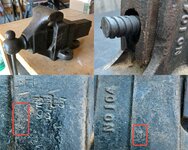
KMScott
Well-known member
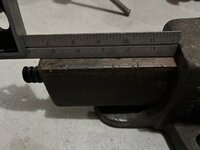
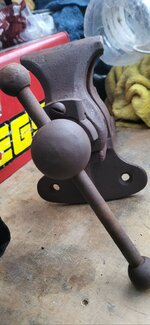
That slide was not docked. The slide ends have a ribbing cast and in the pic you can clearly see the ribbing. Normally around 3/8 to a 1/2” must have had a replacement screw at one time. Vise is in pretty good shape Tom.


Thanks for the correction, Kevin. I’m still new enough with vises and with this as my first Reed, I was uncertain.That slide was not docked… must have had a replacement screw at one time.
That slide was not docked. The slide ends have a ribbing cast and in the pic you can clearly see the ribbing. Normally around 3/8 to a 1/2” must have had a replacement screw at one time. Vise is in pretty good shape Tom.
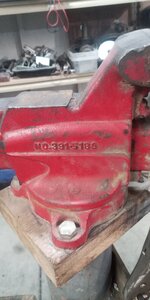
I’ll let those of you with the most experience, help explain this. I’ll just take photos and sit quietly.…Close the vise and measure the sickout on top of the slide; that's the part that gets pressure when clamped down.
I’ll let those of you with the most experience, help explain this. I’ll just take photos and sit quietly.
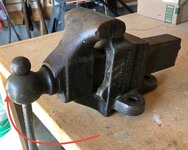
The bayonet is an early model for a M1 Garand. Idk the year they switched from the really long one to the shorter one but it happened.Got these 2 from a barn sale today. One on the right is a Craftsman. Not sure about the little one yet. I will post pics when I get them cleaned up and painted. Got the old bayonet thrown in.
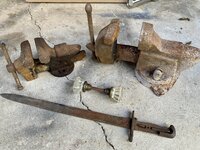

It might be a M1905 bayonet. That M1917 said it was for a Enfield where the 1905 was for a 1903 Springfield and the M1 Garand. I would think that M1917 would be rare since the US military had more 1903 Springfields in its arsenal then the Enfield.Looks like an M1917 bayonet: https://en.wikipedia.org/wiki/M1917_bayonet
Not specific to any particular gun.
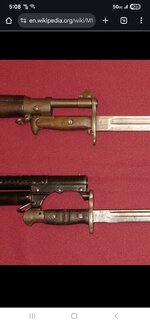
I had the pictures backwards in my mind. The difference in the pommel is obvious.It might be a M1905 bayonet. That M1917 said it was for a Enfield where the 1905 was for a 1903 Springfield and the M1 Garand. I would think that M1917 would be rare since the US military had more 1903 Springfields in its arsenal then the Enfield.
EDIT:
Final answer... its a M1905 in the picture below the M1905 is mounted on the top rifle and the M1917 is on the bottom. You can see the differences in the grip.

I have this vise at work, at least I think, I'll check tomorrow if I remember, not like my old iron, doesn't clamp evenly, today I had to clamp down harder than i wanted to get a solid grip.BTL: This is from a 1993 Columbian Vise (Warren Tool Group) catalog.
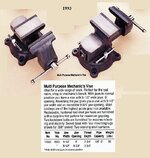
Again if I remember, I'll look if I don't need to remove it from the bench.I can see that you remove the dynamic jaw and insert it from the backside for the wide opening, but how is the nut anchored to give equal strength in both directions?


 edit; ..was not right.
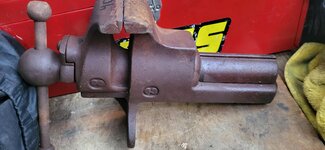
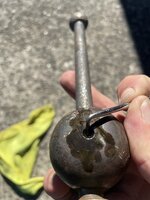
Possible, but I still think unlikely as I’ve seen it on at least a couple of other old Reeds …but not on most of those with meatball nose screws.Is it possible that hole was bored …

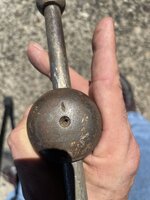
I guess that hole was center bore hole from production was repaired on some Reed meatball noses…and not others.…that hole was bored to put in a lathe for a thread …from production, but never filled…
Question for you, Kevin. In all the Prentiss vises you’ve touched, have you ever seen one with a center drill bit hole on the end of the spindle that was drilled into a set screw?The meatball ends have a center drill bit used so you can have it on lathe with a live center. When I work on spindles I always add these center mark so I can sand, clean and polish the handle ends. Reed, Prentiss and Rock Island on the right. I’ll add a center on the Prentiss.
Only one, a Prentiss #20. Also it looks like I did not add a center drill on most of my other Prentiss restorations. I did have access to a large lathe in Colorado.Question for you, Kevin. In all the Prentiss vises you’ve touched, have you ever seen one with a center drill bit hole on the end of the spindle that was drilled into a set screw?


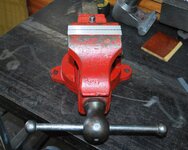


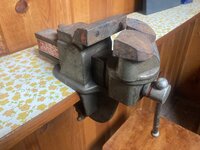
Nice find!Picked up this Wilder All-Shapes vise at the flea market last weekend. Had no idea what it was at the time, but I've never seen a double swivel dynamic jaw before this one.