To avoid these ads, REGISTER NOW!

Watt meter for 220v heat pump

WI/MI Border

Well-known member
Joined
Jan 27, 2025
Messages
196
Looking for a simple watt meter to measure watts over time for a new heat pump (220v).

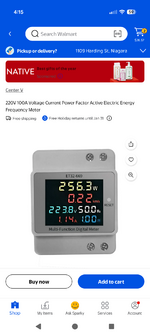
Some inexpensive meters have pass through hall sensors, others have hard wired connections. The models I am looking at are between $15 & $30. One example...


1000000844.png

Is there a big difference in accuracy between pass thru and wired units? Either would work for my situation. Most have good reviews.

Thanks, Tim
 
To avoid these ads, REGISTER NOW!
OP
W

WI/MI Border

Well-known member
Joined
Jan 27, 2025
Messages
196
IMO, get an Emporia Vue system. You can data log multiple circuits, see spikes, cycles and runtime. Mine has been very useful.

More costly, but worth it
Thanks. I looked at that option but it's more than I need. I just want a running total of watts. I don't have any interest in monitoring other loads.
 

mike93lx

ALLIANCE MEMBER
Joined
Dec 9, 2013
Messages
37,848
Location
Richmond, VA
Thanks. I looked at that option but it's more than I need. I just want a running total of watts. I don't have any interest in monitoring other loads.
Fair enough.

What is driving the need to track usage?

A system that uses a clamp-on CT should be plenty accurate for this
 

johnre

Well-known member
Joined
Dec 1, 2016
Messages
1,056
Location
Portland, OR
For 240 V equipment, there doesn't appear to be much ready-made, plug-in devices, like there is for 120 V.

I use this on my repair bench to just monitor current and power draw when I'm working on something; it will handle 240 V at up to 100 A.

You will have to mount it into something and wire it yourself. I put it inside a 4 x 4 Jbox with a blank panel custom cut out for the display and one-button control.

And yes, that one-button control is kind of hokey - to reset energy drawn, you have to pick up the instruction sheet every time.

1762163388311.png
 

mike93lx

ALLIANCE MEMBER
Joined
Dec 9, 2013
Messages
37,848
Location
Richmond, VA
For 240 V equipment, there doesn't appear to be much ready-made, plug-in devices, like there is for 120 V.
A heat pump won't be plug in, anyway

That meter you linked would only be reading 120v...does it have a function to double the amperage so that it reflects the wattage correctly?

On my Emporia, you can tell it you are measuring a single leg on a 240v device and it will adjust accordingly.
 

WisJim

Well-known member
Joined
Dec 20, 2010
Messages
2,296
Location
Menomonie, WI
You will have to mount it into something and wire it yourself. I put it inside a 4 x 4 Jbox with a blank panel custom cut out for the display and one-button control.
1762163388311.png
I use a similar device to monitor the power usage of my level 2 charger for my electric car and it worked fine for me. It monitors the 240 circuit just fine.
 
OP
W

WI/MI Border

Well-known member
Joined
Jan 27, 2025
Messages
196
...

What is driving the need to track usage?

...

My better half : )

I am just being pro-active for when my bride asks me how much that heated workshop is costing! I mostly want to be able to verify that the heat pump is using about what I estimate for cost to run. I don't think I'll be keeping it real warm most of the time. Just want it to stay above freezing and have a "quick" way to warm it up before I start a project. The heat pump/mini split is supposed to be able to operate at emergency heat most of the time. I think that is about 42 degrees F.
 

johnre

Well-known member
Joined
Dec 1, 2016
Messages
1,056
Location
Portland, OR
That meter you linked would only be reading 120v...does it have a function to double the amperage so that it reflects the wattage correctly?

On my Emporia, you can tell it you are measuring a single leg on a 240v device and it will adjust accordingly.
The voltmeter can and should be reading the difference between H1 and H2, thus 240 V or thereabouts - there is no neutral on a 240 V heat pump circuit. And the toroid that feeds the ammeter function reads the current in either H1 or H2 - and it doesn't matter which one you pick because the heat pump is a balanced 240 V system.

Power and energy thus involve straight arithmetic, there's no doubling - V(RMS) * I(RMS) = Power (at unity power factor anyway, but this device does accommodate PF correction). And the integral of power over time is energy used.

I like the ammeters that use a regular 1/2" knockout to mount: https://www.amazon.com/dp/B0BG2LD82C?tag=atomicindus08-20
Agree, that's a nicer mounting system - but none of these three different models read anything beyond instantaneous voltage, current, and frequency. There's no power and integral of power to get energy, let alone power factor measurement and correction.

@WI/MI Border definitely needs the latter, so he can point to a single number on the readout and say "See - I told you so - it's very low cost." If he has to Man-splain heat pump duty cycle factors, AC power factors, integral calculus, and the like to her, we can predict how that will turn out now, yes?
 
Last edited:
OP
W

WI/MI Border

Well-known member
Joined
Jan 27, 2025
Messages
196
Haha. No man-splaining going on here : )

I'm now looking at a Sonoff Powct (aka Sonoff Ring. It seems to have two model names). It's a little more than what I was looking for in that it does wifi but the price is reasonable and it seems simple to mount inside the breaker panel with an external antenna if needed (a couple YouTube vids state they left the antenna inside the enclosure with no problem). When I wired the heat pump circuit I didn't leave much slack in the wires so the clamp on ct would be convenient.

I understand what the "NO" (Normally Open) and "Com" terminals do. I don't plan to switch other equip on/off.

I'm assuming from the little I've looked at it that if you power it with 110v it will output 110v data and if wired to 220v it will produce 220v data. Does that sound correct?
 
To avoid these ads, REGISTER NOW!

johnre

Well-known member
Joined
Dec 1, 2016
Messages
1,056
Location
Portland, OR
I'm now looking at a Sonoff Powct (aka Sonoff Ring. It seems to have two model names) .... it seems simple to mount inside the breaker panel.
Do note that this is designed for a DIN mount.
I'm assuming from the little I've looked at it that if you power it with 110v it will output 110v data and if wired to 220v it will produce 220v data. Does that sound correct?
Essentially correct. But for your heat pump, wire it to H1 and H2 you should be measuring voltage, and therefore power and energy, in the entire balanced 240 V supply - as opposed to half of it in just one leg.
I understand what the "NO" (Normally Open) and "Com" terminals do. I don't plan to switch other equip on/off.
It's unrelated to what you're using it for - it's an auxiliary SPST contact set that can be used for load switching. Since you already have programmability built in to this module for the metering function, they put this in an extra feature that they must think would find useful as a designer.
 
Last edited:

dcg9381

Well-known member
Joined
Jun 20, 2018
Messages
11,883
Location
Austin, TX
The heat pump/mini split is supposed to be able to operate at emergency heat most of the time. I think that is about 42 degrees F.
I've never seen a mini-split with "emergency heat" (resistive heating). I've seen mini-splits that heat great in the cold and some that were not designed for it and kinda ****.

You have resistive heat on heat pumps (traditional HVAC) if you don't have gas. Nothing spins the meter faster.. But if you're trying to measure the emergency heat load, make sure you clamp it at the breaker, not the compressor.

If you are hitting resistive heat (emergency) - it's going to pull some pretty serious power.
 
OP
W

WI/MI Border

Well-known member
Joined
Jan 27, 2025
Messages
196
I've never seen a mini-split with "emergency heat" (resistive heating). I've seen mini-splits that heat great in the cold and some that were not designed for it and kinda ****.
...
I worded that wrong. It's not an "Emergency Heat" setting. It is referred to as "FP" on the remote and app (Freeze protection). It will maintain about 42f in the heated space. The Senville Aura 18k BTU's lowest setting is 62f. That's probably as warm as I'll ever need it since I keep my home at 64 all winter. I'll definitely use the FP function most of the time. I'm not an expert on heat pumps but I don't see why a unit would use resistive heating to keep that temperature when it is a heat pump. I'm hoping that it will have little trouble in FP mode no matter the outside temps.

It may have resistive heating but isn't that a function used to thaw out the coils? In my research I never ran into anyone mentioning that resistive heating as a function of conditioning the interior room.
 
OP
W

WI/MI Border

Well-known member
Joined
Jan 27, 2025
Messages
196
Bought the Sonoff Powct (Ring) unit. It's on a slow boat from China. I'll give an update on it, and maybe some more questions after I get it installed.

I vac'd out the line set this afternoon on the Senville Aura 18k. If the vacuum is still holding after a couple hours I'll release the kraken, I mean coolant, and try to fire it up. If successful I'll feel more confident installing the 9k unit I'm putting in my basement.

It's been an interesting adventure to vac the lines. I cut the line set to shorten it a bit and used a cheap menards sourced flare tool. That was garbage, the cone just pushed the copper back into the die repeatedly no matter how much clamping pressure I put on it. So I borrowed my BIL's decades old flare tool. Another nightmare. The cone would split the copper even if I lubed it a bit with Nylog. So I ordered a fairly inexpensive eccentric flare tool. What a breeze. It is dummy proof (maybe a requirement in my case : )
 

dcg9381

Well-known member
Joined
Jun 20, 2018
Messages
11,883
Location
Austin, TX
It may have resistive heating but isn't that a function used to thaw out the coils? In my research I never ran into anyone mentioning that resistive heating as a function of conditioning the interior room.
That's for correcting it. Yes, they have an "unfreeze" the coils cycle where the stop interior heating and heat up the coils to defrost them. I don't think it's resistive heat though, not 100% sure.

I'm not an expert on heat pumps but I don't see why a unit would use resistive heating to keep that temperature when it is a heat pump.
I'm in the south. They generally don't install HVAC heat pumps that are worth a lick in cold weather. The resistive elements are there because the heat pumps (some) won't perform worth a darn in cold weather.... Mini splits are generally better, but if you're operating in the cold you want one designed to perform in the cold.... Otherwise they're just spinning and not giving you much heat above ambient. Below 35 degrees, I deploy propane heat to the shop and sometimes to the house... Highest electrical bills are the FEW days we get that are cold in winter.
 
Last edited:
OP
W

WI/MI Border

Well-known member
Joined
Jan 27, 2025
Messages
196
Do note that this is designed for a DIN mount.

Essentially correct. But for your heat pump, wire it to H1 and H2 you should be measuring voltage, and therefore power and energy, in the entire balanced 240 V supply - as opposed to half of it in just one leg.

It's unrelated to what you're using it for - it's an auxiliary SPST contact set that can be used for load switching. Since you already have programmability built in to this module for the metering function, they put this in an extra feature that they must think would find useful as a designer.
Thanks for the advice, however I should note that you are replying to someone that is unfamiliar with the nomenclature you posted. I don't know what H1 and H2 are. Nothing in my install manuals or terminal designations refer to those.

And your previous reply... "Torid"? : )

No disrespect intended. It's just a bit over my head. Err, way over my head!
 
OP
W

WI/MI Border

Well-known member
Joined
Jan 27, 2025
Messages
196
...They generally don't install HVAC heat pumps that are worth a lick in cold weather. The resistive elements are there because the heat pumps (some) won't perform worth a darn in cold weather.... Mini splits are generally better, but if you're operating in the cold you want one designed to perform in the cold...
My mistake. I am using "heat pump" and "mini split" interchangeably. It is a Senville Aura 18k mini split. I'm on the WI/MI border. It is marketed as producing heat down to -30c or -22f. Hoping that's my experience. When it gets down to below -10f (rarely anymore) I tend to take the dog for a brisk walk and spend the day reading or catching up on documentaries. The dog appreciates that!
 

johnre

Well-known member
Joined
Dec 1, 2016
Messages
1,056
Location
Portland, OR
Thanks for the advice, however I should note that you are replying to someone that is unfamiliar with the nomenclature you posted. I don't know what H1 and H2 are. Nothing in my install manuals or terminal designations refer to those.

And your previous reply... "Torid" [sic]? : )
H1 and H2 refer to the two balanced hot lines in the 240 V mains - and they're sometimes referred to as L1 and L2. Diagram here; the right side of this represents what you are delivered to your panel by your utility company. H1 and H2 are the two on the outside; N (neutral) is the center:
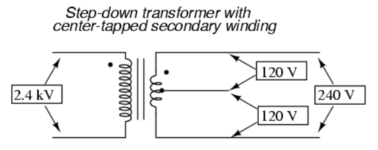
1762447135996.png

Ignore the 2.4 kV primary side here, that's the domain of the utility.

And a toroid is the one-turn transformer device that senses the current; it's usually in the shape of a toroid and essentially surrounds either H1 or H2 (but not both, as that would either double or zero out the current sensed, depending on the direction the wires went through).
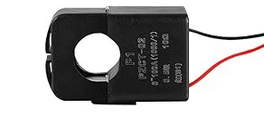
1762446488833.png

Their instructions will often just illustrate a 120 V connection to line and neutral (essentially, either one of the 120 V mains above, plus neutral), and you have to dig in and infer if you can connect a 240 V system. This diagram was the key to me that this was OK, as it illustrates a Chinese universal socket carrying 230 V AC / 50 Hz power on both the upper and lower parts - and whether this is balanced or not, who knows, it's a Chinese system and it all depends on how the utility does it.

1762447581431.png

Finally - if you're unfamiliar with this, you might want to seek some professional help to get this device installed, as it's not to be taken lightly.
 
Last edited:
OP
W

WI/MI Border

Well-known member
Joined
Jan 27, 2025
Messages
196
Thanks for the translation : )

I'm comfortable with wiring, however this meter is new to me. Thus the questions. I'll update the thread after I get the meter.
 
Last edited:
OP
W

WI/MI Border

Well-known member
Joined
Jan 27, 2025
Messages
196
The Sonoff PowCT (aka Sonoff Ring) is wired and working well. It works with WIFI and an APP to tell me the current draw, today's kWh, yesterday's kWh, this month's kWh, voltage and watts. So far I am very pleased about the little current my 18K mini-split uses to maintain 45F most of the time and 60F when I am tinkering. Total energy for yesterday... midnight to 8am @ 45F, 8am to 7pm @ 60F and then back to FP mode (45F) until midnight - 11.22 kWh. At my off peak rates that translates to just over $1.20 of power. Outdoor temps are mid twenties at night and high 30s during the day.

It was easy to install. After reading some reviews stating that the antenna does not need to be installed outside the breaker panel enclosure I stuck it to the inside and left the antenna inside as well. My router is only about two feet from the breaker panel so no problem receiving the WIFI signal. Your experience may be different if your router is a at greater distance from the meter/antenna.

I contemplated getting a DIN enclosure for the Sonoff and installing it so I can read the screen easily. However, after testing it inside the breaker panel and viewing on the APP (eWeLink) that works fine. It is attached with VHB tape to the sidewall and I've zip-tied it to wires above it in case the VHB tape fails. They make a cheaper meter without the WIFI function if you want to install where you can view the screen to get your data.

Bought my Sonoff through AliExpress. I find that that source is shakey at best and probably should have spent the extra six bucks at a more reputable vendor.

Sonoff PowCT
 
To avoid these ads, REGISTER NOW!
Top Bottom