
You are using an out of date browser. It may not display this or other websites correctly.
You should upgrade or use an alternative browser.
You should upgrade or use an alternative browser.
J H Williams vintage hand tools
- Thread starter z1kzonly
- Start date
Not in that one.Never saw that before.
Anything inside??
59Sled
Well-known member
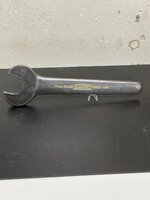
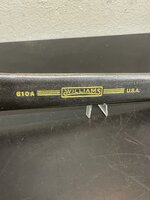
This big guy was given to me. 1 11/16 open end. Little wire wheel clean up. I painted the lettering to give it some pop. Then some wax to protect it.

Found just the metal box
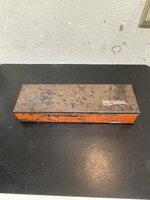


Found just the metal box
Patrickm82
Well-known member
That puppy’s a tank!!


genog
Well-known member
I got this ratchet from a friend of mine recently
and I Think I saw an empty Williams box around here......maybe not period correct, but I'll need to locate it first
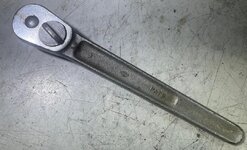
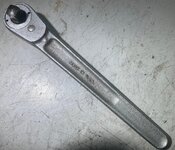
and I Think I saw an empty Williams box around here......maybe not period correct, but I'll need to locate it first
nadogail
Well-known member
When I was buying used tools, I looked for the Williams and Armstrong branded ones.
INSP380
Well-known member
A good friend was out picking today and spotted this…Unfortunately it was not for sale… 
Steve
Steve
genog
Well-known member
Found a small Williams 4 ounce hammer
Another one.....
If I put all of my little hammers together, I can make a big useful hammer out of them
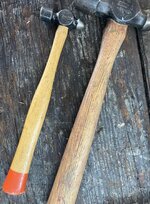
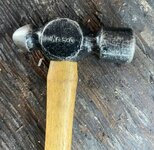
Another one.....
If I put all of my little hammers together, I can make a big useful hammer out of them
Last edited:
Beerhippie
Well-known member
I likes my leetle hammer friends.Found a small Williams 4 ounce hammer
Another one.....
If I put all of my little hammers together, I can make a big useful hammer out of them
Vulcan carb tool I believe. Looks identical to the blue point one. Actually thought it was a blue point until I decided to finally give it a clean. Never seen one by them before. And then a koto breaker bar. Not sure of the relationship that I saw. Someone post a super ratchet by them a while back
Attachments


3baygarage
Well-known member
Neat finds. I do believe the Koto is made and Japan and they copied the Williams Superratchet right down to the name. The Japanese and Germans loved to copy the look of US ratchets. The breaker bar doesn’t seem to have have a Williams look.Vulcan carb tool I believe. Looks identical to the blue point one. Actually thought it was a blue point until I decided to finally give it a clean. Never seen one by them before. And then a koto breaker bar. Not sure of the relationship that I saw. Someone post a super ratchet by them a while back
3baygarage
Well-known member
Here is a neat one I haven’t seen before. It has the handle of an old Williams breaker bar! My new favorite single end wrench.
No size stamp, think it’s 7/8”.

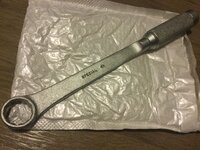
Mystery set screw hole.

No size stamp, think it’s 7/8”.
Mystery set screw hole.
Depends on which style. I'll have to check if I still have but I know I had one just like it. But also have had some that look completely different. One of the ones I had was identical the Milwaukee tool & forge. Always interesting to see the different stylesNeat finds. I do believe the Koto is made and Japan and they copied the Williams Superratchet right down to the name. The Japanese and Germans loved to copy the look of US ratchets. The breaker bar doesn’t seem to have have a Williams look.
Beerhippie
Well-known member
Well, that's special!Here is a neat one I haven’t seen before. It has the handle of an old Williams breaker bar! My new favorite single end wrench.
No size stamp, think it’s 7/8”.
Mystery set screw hole.
Provincial
Well-known member
I suspect that it was an adjustment handle on a piece of equipment. The set screw retained it on a hex. This allowed the handle to stay attached, but be relocated to keep it in the desired position, even if there was wear in the parts.Here is a neat one I haven’t seen before. It has the handle of an old Williams breaker bar! My new favorite single end wrench.
No size stamp, think it’s 7/8”.
Mystery set screw hole.
3baygarage
Well-known member
That would make the most sense.I suspect that it was an adjustment handle on a piece of equipment. The set screw retained it on a hex. This allowed the handle to stay attached, but be relocated to keep it in the desired position, even if there was wear in the parts.
Tom "Python" Aycock
Well-known member
- Joined
- Nov 27, 2022
- Messages
- 427
My S series 1/2 drive set with the same ratchetI got this ratchet from a friend of mine recently
and I Think I saw an empty Williams box around here......maybe not period correct, but I'll need to locate it first

four.cycle
Well-known member
.... probably because almost all of those were manufactured by Aircraft Specialties in Lapeer, Michigan - they made them for everybody.Vulcan carb tool I believe. Looks identical to the blue point one.
Does anyone know when these <W> marked ratchets were produced? They are usually described as "early." I always thought they were a budget version made by Williams. I haven't been able to find a picture of them in any of my Williams catalogs.

Private Lugnutz
Well-known member
Not definitively. Most reasonable theory is after WWII but before 1948 based on other characteristics (the label under the lid of the box, socket construction) of sets owned by @Oldtuleguy in which the ratchet looks original to the set.Does anyone know when these <W> marked ratchets were produced?
Budget line, value line, etc, is the leading theory here among a core group of collectors on this thread here at GJ. That they don't get the full branding treatment, only the < W > logo, seems to bear that out. Also lending credence to this theory is that they are nearly identical to the Volume line, which was Williams' known budget/value line.I always thought they were a budget version made by Williams.
You didn't ask, but the "S" most likely signifies "Standard" - Williams' name for their 1/2-drive line, and "B" most likely "Bantam" - Williams' name for the 3/8-drive line. These abbreviations also seem to fit the paucity of markings typical of an economy production.
Nobody has as far as I am aware.I haven't been able to find a picture of them in any of my Williams catalogs.
In addition to Otg tagged above, also tagging @misterbill and @3baygarage who may want to add or clarify.
Private Lugnutz
Thanks for your very informative response!
Here are the sockets that came with my Bantam ratchet. Any idea on how many sockets would have come in the 3/8" drive set? I saw 10 sockets in the 1/2" drive set posted by @Oldtuleguy.

Th
Thanks for your very informative response!
Here are the sockets that came with my Bantam ratchet. Any idea on how many sockets would have come in the 3/8" drive set? I saw 10 sockets in the 1/2" drive set posted by @Oldtuleguy.
Th
Private Lugnutz
Well-known member
Nice socketry! That is the number (7), range (3/8"-3/4"), and configuration (12-pointers) they put in their Bantam sets in the late 40's. You can double-check that in the late 40's catalogs on IA/ITCL, but I am 99.9% sure of it. I have a B-6 set. The sizes of the sets came down to the diversity of handles and extras (deeps, swivels, etc) they put around the basic set.
four.cycle
Well-known member
There is an acute shortage of "old catalog" for WilliamsI haven't been able to find a picture of them in any of my Williams catalogs.
And 7 is the magic number for most American-made 3/8" drive SAE socket sets made post WWII: 3/8, 7/16, 1/12, /9/16, 5/8, 11/16, and 3/4
Last edited:
Oldtuleguy
Well-known member
- Joined
- Nov 4, 2017
- Messages
- 10,461


Private Lugnutz
Well-known member
No there's not. You've said this before, and I've corrected you before. In general, Williams is one of the most comprehensively represented mfgrs on IA/ITCL, and that period in particular is jam packed with catalogs. There are twenty-one (21) catalogs between 1937 and 1964, and several other related documents (Price Lists, Supplements, Tool Facts, etc). In particular, a 1947, a 1948, and a 1949 catalog, which is when his tools were most likely made.There is an acute shortage of "old catalog" for Williams between the mid-1930s and the early 1960s.

four.cycle
Well-known member
I got my years off, sorry. There's a hole - maybe it's later.
Not the first time I got my wires crossed.
(I recall there being no info because somebody was asking about patterns on the exterior of the box. Couldn't find anything.)
Not the first time I got my wires crossed.
(I recall there being no info because somebody was asking about patterns on the exterior of the box. Couldn't find anything.)
d42jeep
Well-known member
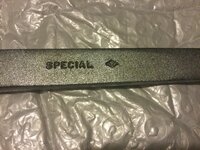
Here is a 1/4” drive Williams spinner. I’m not sure why it’s special. 
-Don
-Don
Mark Stansbury
Well-known member
Now available, a scan of J. H. Williams Twentieth Edition Catalog (Dec. 1926), with separate Nov. 1, 1927 supplement.

3baygarage
Well-known member
I think they were dubbed that before becoming a catalog item. Just my theory. Seen a decent number of them marked that way but I can't remember if all had a female end. That could be the reason.Here is a 1/4” drive Williams spinner. I’m not sure why it’s special.
-Don
Private Lugnutz
Well-known member
^ Makes sense. "SPECIAL" as in "new and additional to our regular NM-110 1/4-inch drive steel rotating handle spinner/extension". Would've been just before 1947, right?
Does it have the NM-106 part number stamped on it?
Does it have the NM-106 part number stamped on it?
d42jeep
Well-known member
No part number, just the Williams W and SPECIAL.
-Don
-Don
Private Lugnutz
Well-known member
^ I think that lends credence to the 1946-ish introduction explanation. Once they were a regular item, they were stamped with the P/N, and no "SPECIAL" status.

d42jeep
Well-known member
They eliminated the N eventually and the part number became M-106. The original M-106 was 9/32” drive, just to add to the confusion. 
-Don
-Don
Private Lugnutz
Well-known member
Yeah, but that was later. I talked about it upthread here...They eliminated the N eventually and the part number became M-106
Williams actually dropped the "N" (for New) from their "NM-" (for New Midget) 1/4-inch drive model number scheme sometime before 1963 (first newer catalog I found it in...), ostensibly because enough time had passed when "M-" could be used for Midget again without any concern about confusion with the earlier "M-" scheme for original 9/32-inch drive Midget tools.
four.cycle
Well-known member
wow! so ALL "NM" prefix part numbers were produced prior to 1963?
very interesting! thanks!
very interesting! thanks!
misterbill
Well-known member
- Joined
- Dec 24, 2015
- Messages
- 670
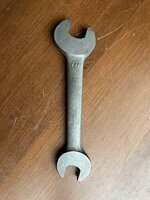
I picked this beauty up yesterday while out tool scavenging. It has the oval logo and markings consistent with the period of time that Williams had plants in both Brooklyn and Buffalo. Aside from the W-in-a-diamond the only other marking is "131". The milled openings appear (without getting a micrometer) to be 5/8" x 3/4". I can't find anything similar in the catalogs from that period. Anyone know the significance of the "131"?

Bill
Bill
Oregon Dave
Well-known member
- Joined
- Sep 16, 2023
- Messages
- 298
A die/mold number comes to mind.I picked this beauty up yesterday while out tool scavenging. It has the oval logo and markings consistent with the period of time that Williams had plants in both Brooklyn and Buffalo. Aside from the W-in-a-diamond the only other marking is "131". The milled openings appear (without getting a micrometer) to be 5/8" x 3/4". I can't find anything similar in the catalogs from that period. Anyone know the significance of the "131"?
Bill
Private Lugnutz
Well-known member
If it was a Vlchek or a couple other mfgrs, that would be a good possibility. Williams is not known for using them, though, especially not in that era.A die/mold number comes to mind.
A very odd one, indeed, Billiam. Not just the "131" not being a Williams model number, but no size markings on the flip side. They would typically be expressing U.S.S. sizes if they were present. A woebegotten "731" is not out of the question, but not likely, either.I can't find anything similar in the catalogs from that period.
I will call your attention to the forged-in number on the shank under the major jaw face that looks smooshed, worn or possibly semi-removed. Might be a "30"? This is actually characteristic of Williams in this era. They would forge a wrench with a die suitable for a few different milled service opening combinations, mill the jaws, stamp the model number, or sometimes even forge it in with the flip side die, and then file or grind the other one off. A "30" wrench would have 11/16" x 7/8" milled openings. Not saying that's what it is. But that was their practice at this time and wrenches with one, two, or even three different numbers, with one of them partially or fully removed is not uncommon. I have examples with two model numbers, one of them obviously left inadvertently.
Last comment. Williams was very active in contract production in this time period, it has that look, and I have a number of examples, but they typically have the customer name on the flip side. Sometimes it has the customer number. Could that be the "131"?
Long-winded "IDK", as the kids like to text.