Oldtuleguy
Well-known member
- Joined
- Nov 4, 2017
- Messages
- 10,478
I have a couple with raised numbers like that but 7 series. Maybe a misprint?


Don't have Williams; for those that do, how often do you see the forged/raised number oriented transversely on the stem and a 1 in that font style?My 729 is 5/8 and 3/4, so 131 is kinda off the wall. Got some Brooklyn stuff two digits with a letter.
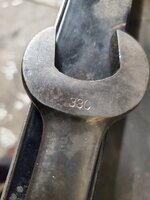
33C is a Williams model number for a DOE engineers wrench with milled openings of 1" x 15/16". Just like your previous 723, as well as the 729, which are Williams model numbers for DOE engineers wrenches with milled openings of 3/8" x 7/16" and 5/8" and 3/4", respectively. In the early days, the model number for their DOE engineers wrenches were two digit numbers between 21 and 65. There is no......two digits with a letter.
...of wrenches, as you mentioned earlier. The "7" is a prefix that was used to add DOE engineers wrenches to the lineup later, after all the other numbers were used. Same as the "C" in "33C", which is one of several suffixes used to add wrenches to the lineup later.7 series

There is nothing odd about the style of the forged-in number ("131") or its placement across the beam of the shank on the flip side of the wrench under the major jaw. It's very common. As is the flattened and partially obscured number ("30"?) and its placement across the beam of the shank on the top side of the wrench under the major jaw. This is where and how Williams commonly forged-in model numbers. Later they would start stamping them on jaws and also on the shank and later still they turned those in line with the beam of the shank.how often do you see the forged/raised number oriented transversely on the stem and a 1 in that font style?
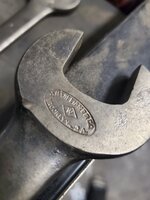
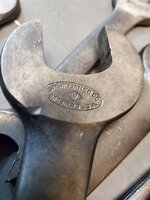
Hello, thanks for posting this photo; the oval logo is different from the two listed on AA, which they note as a pair at.I have a couple with raised numbers like that but 7 series. Maybe a misprint?
Thanks for the reply; the wrench in the left photo has another face marking I can’t find in AA’s file. Seems they would have more comprehensive data; don’t know if you can contact them, they should be very interested in your two wrenches.It's a w in the square just hard to read. I pick them up here and there and keep them on this toolboard. It's fun to see all the variations.
There are numerous examples of wrenches with just the "< W >" and "U.S.A." markings on this thread.


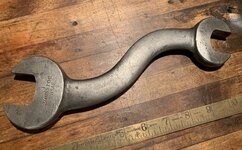
Lending credence to the contract or economy line use. The meaning of the "V" has never been definitively resolved, but it is often seen on tools that can be dated to wartime.I'll add one more example, found last week. (Although this one also has a V forged onto the other side).
That was before the molt. Next come the red scales and fangs.It was brown when I fownd it.

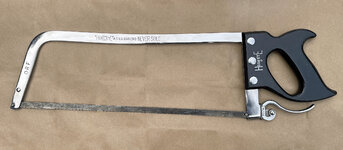
The Atlantic Service Company saw is another Williams link to the meat industry in NYC which ties in with Lugz' previously mentioned connection with Globe (in post #1,306).Here are all my third party Williams wrenches. I've posted them individually on this thread before if you want to search for more details, but never before as a group shot. From the top to the bottom are Automatic Screw Machine Company (most similar to your Foster find in terms of type of customer), Globe Slicers (easily the coolest in my collection, Globe was thee most prolific supplier of meat slicers to butchers and delis in NYC), Kelly Press (printing outfit), and Dexter (also lithography, printing, etc).
Abso-f#$%ing-lutely gorgeous.Found an old Atlantic Service Company Hook-Eye meat saw
Very cool observation.The Atlantic Service Company saw is another Williams link to the meat industry in NYC which ties in with Lugz' previously mentioned connection with Globe (in post #1,306).
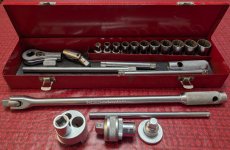
Hey, thanks for posting this. I just found a ST-70 yesterday and looking at it more closely today, was puzzled on how this worked (originally thought it was a random cool socket). Mystery solved with this post but now I obviously have to find the other 17 tools! I'm guessing the beveled opening slides onto that handle (stem)? If ya get a chance to show a picture of this piece attached as illustrated, thanks.From the catalog.




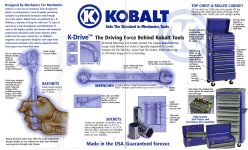
It was still J.H. Williams at the time of that brochure (it's on there) and up until 2011. https://www.garagejournal.com/forum...roup-is-now-snap-on-industrial-brands.111761/By the 90's, Williams was a lower division of Snap-On (like Blue-Point). My general understanding is that JH Williams pre-dates the sale, as SnapOn dropped the JH part (only Williams).
Not saying the paer isn't interesting, just slightly off-target.

Cool anecdote. I am assuming the "he" pronoun refers to your father. What years did she work there? And if they were vintage, when is the next time you can rummage through the house for Williams factory ephemera, memorabilia, and paraphernalia?My aunt used to work at Williams in Buffalo. He introduced her to his brother one thing led to another and they were married for over 50 years
Would have been early 50's. Yes, my Dad, corrected that. Only thing we have is some wrenches that Dad bought years ago from them. He passed 3 years ago otherwise I would ask him for more information.Cool anecdote. I am assuming the "he" pronoun refers to your father. What years did she work there? And if they were vintage, when is the next time you can rummage through the house for Williams factory ephemera, memorabilia, and paraphernalia?
That's passed my personal collecting niche, but I'm objective enough to recognize that it was a very interesting time for Williams. They must have thought their late 40's postwar production - which, except for dropping the "FORGED < W >" from the scroll marking, was not that different than their wartime production - was getting stale. They changed the look of their main logo, introduced what would eventually become their most popular and well-known (Johnson patent) dual-pawl progressive RHFT ratchet, the double-groove style sockets, as well as the distinctive "ribbed" style of end wrenches. And all that came just before the United-Greenfield acquisition in 1959. It was all downhill in conglomeration and relegation from there, in my opinion.Would have been early 50's.
Sorry to hear that. I lost mine, a WWII vet, 28 years ago. Not a day goes by...He passed 3 years ago
. Thanks 93 and still had all his faculties, the body just wore out. Able to be at home until the very end, moved his bed downstairs, the last few months couldn't make it up the stairs so we moved upstairs downstairs. Mom was an absolute angel taking care of him. At night they get Whispering sweet nothings to each other which since they both had their hearing aids out weren't exactly whispering. I was upstairs and had to remind them that I could hear them and didn't want to! Luckily I only live half a mile away so I was there quite a bit.That's passed my personal collecting niche, but I'm objective enough to recognize that it was a very interesting time for Williams. They must have thought their late 40's postwar production - which, except for dropping the "FORGED < W >" from the scroll marking, was not that different than their wartime production - was getting stale. They changed the look of their main logo, introduced what would eventually become their most popular and well-known (Johnson patent) dual-pawl progressive RHFT ratchet, the double-groove style sockets, as well as the distinctive "ribbed" style of end wrenches. And all that came just before the United-Greenfield acquisition in 1959. It was all downhill in conglomeration and relegation from there, in my opinion.
Sorry to hear that. I lost mine, a WWII vet, 28 years ago. Not a day goes by...
Dad was 17 years older than mom, and I'm not the reason they got married I came along 2 years later.^ That's funny, and sweet. My mom is 94. Dad would be 99.
I came upon this brochure today while going through some old files. While late 1990s doesn't fit everyone's definition of "vintage", this 1st generation Kobalt paper seemed like it may fit with the J.H. Williams history info.
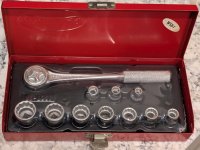
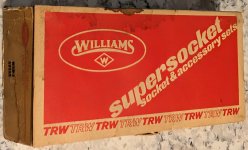
i don't have a ratchet but I lifted a picture from an old thread and an ebay listing.That ad was just what I needed. I was curious what a Williams made Kobalt ratchet (and wrench) looked like, and it's a lot different than the Danaher/Western Forge (which Cripe has had dozens of lately) or modern imported stuff.
I've got a 1/4 and 3/8 on my eBay watchlist. Anyone here have a photo of one of the ratchets so I can compare to be sure these are the Williams-made ones?