
To avoid these ads, REGISTER NOW!

Tekton technical article, "JIS vs Phillips: Understanding Tip Geometry, Myths, and Fastener Compatibility" Nov 2025

gahrajmahal

Well-known member
Joined
Dec 12, 2008
Messages
2,638
Location
Cincinnati, Ohio
I'm on Tekton's email list and just received this interesting article about Phillips screwdrivers. I really love the great Blueprints shown and the easy to read, side-by-side comparisons between the different "country standards".

https://www.tekton.com/cart


jis-header.jpg

SCREWDRIVERS​

JIS vs Phillips: Understanding Tip Geometry, Myths, and Fastener Compatibility​

November 7, 2025
Our new screwdrivers have Phillips tips that meet JIS standards (Japanese Industrial Standard). In this blog post, we’ll shed light on a highly confusing and widely misunderstood topic — what is the difference, if any, between JIS and Phillips drivers?

Cross-Tip Geometry (Normally Called Phillips)​

In the United States, a cross-tip screwdriver is typically referred to as a “Phillips,” much like how mechanics use “Allen” to mean a hex key or “Crescent” to mean an adjustable wrench. Technically, the Phillips name refers to long-expired patented driver tip and fastener recess geometry that is now just a distant relative to the modern cross-tip geometry used in screwdrivers. In the 90 or so years since the original Phillips patent, there have been many attempts to improve the function of the geometry by adding extra gripping features as seen in designs like POZIDRIV® or PHILLIPS II® or ACR® PHILLIPS®. In short, Phillips and cross-tip mean the same thing.


To manufacture a Phillips tip, we need a standard to follow. The standard provides the acceptable specifications according to the industrial group that made the standard. There is a standard for the driver tip and a parallel standard for the fastener recess that the tip goes into. Of course, these standards have to fit together.

The Phillips geometry is made today according to one of three standards:

  1. ASME, published by the American Society of Mechanical Engineers
  2. ISO, published by the International Organization for Standardization; or,
  3. JIS, published by the Japanese Standards Association.
geometry-standard-chart-desktop.jpg
In broad terms, ASME is typically the U.S. standard, ISO is typically a European or worldwide standard, and JIS is, of course, the Japanese standard. Another standard you may have heard about—DIN—comes from the German standards institute and refers to the Deutsches Institut für Normung. For the cross-tip geometry, DIN adopts the ISO standards and so we aren’t discussing it separately.

JIS “Compatibility”​

This brings us to a major conclusion: JIS is not a tip type. JIS is the name of the Japanese standard for cross-tip or Phillips drivers, just like there is an American standard (ASME) and a European/international standard (ISO).
Our Phillips tips follow the ISO 8764-1 standard, which is compatible with the JIS standard B 4633. In fact, of the three main standards, ASME, ISO, and JIS, the least strict standard is JIS. As shown below, the JIS dimensions almost all fall within the ASME or ISO acceptable dimensions. Therefore, any Phillips screwdriver, such as our new Tekton Phillips screwdrivers, can be made to meet JIS standards. In fact, you should expect that all well-made drivers that meet the ASME or ISO standards will also meet the JIS standard.
But what about the common concern we see on user forums that Phillips drivers will damage or at least not work well on what users call “JIS” fasteners found on vintage motorcycles or bicycle components of Japanese origin? These concerns are based on a misunderstanding. Some people have a bad experience with Phillips drivers on Japanese fasteners for the same reason they could have a bad experience on any fastener:
  • the screwdriver was damaged or made imprecisely; they needed a better screwdriver
  • the fastener was damaged or made imprecisely; they needed a better fastener
  • the user chose the wrong tip type
In summary, Phillips versus JIS is comparing apples and oranges. Phillips is about the shape. JIS is about the written standard. Are there any differences between the ASME, ISO, and JIS standards? Almost none, and the small differences are insignificant.

ASME Versus ISO Versus JIS for Cross-Tip or Phillips Screwdrivers​

In the chart below, we show the standard dimensions for a Phillips #2 driver tip according to ASME, ISO, and JIS. In almost every dimension, the ASME or ISO driver requires a tighter range inside the JIS dimensions.
tekton-dimensions-image-desktop.jpg
tekton-dimension-chart-desktop.jpg
There are a few really minor differences:
First, the JIS standard allows shorter screwdriver tips (but doesn’t require them) compared to ASME or ISO. For example, on #2 Phillips, JIS says tips must be at least 3.70 mm, ISO says at least 4.37 mm, and ASME says at least 4.83 mm. In practice, what matters is that the tip of your driver end can reach into the screw recess. All of them can, and in fact JIS is the one that is limited in deep screw heads, if any are.
Second, ASME and ISO say that the angle at the very end of the tip can range from flat to slightly pointed (0–19 degrees), while JIS calls for a slightly pointed tip (17–19 degrees). Both standards should work in any normal cross-tip screw. In fact, what’s surprising here is that the standards refute the popular assumption that JIS specifies a flatter tip.
Now that we have discussed the geometry of a cross-tip or Phillips driver and how they are made according to an industry standard (ASME, ISO, or JIS), let’s address some common questions and myths:

Question 1: Isn’t it true that a Phillips screwdriver will damage older JIS screws from the 1970s and 1980s made to JIS standards?​

Answer: No, not if the driver is made according to current ASME or ISO standards. We looked back at JIS literature as far as we could — to 1954, for which the standards were only available to us in Japanese. What we found is that, to the best of our knowledge, the JIS standard from 1954 is consistent with the modern JIS standard, which in turn aligns with ASME and ISO. This means that properly-made ASME/ISO Phillips drivers, like Tekton’s, will work on JIS-standard screws, both old and new.

Question 2: What about all the online illustrations and images showing clearly that the geometry of a JIS driver is different than a Phillips driver?​

Answer: This is based on a misunderstanding that keeps getting passed around the internet. The illustrations are comparing different tip sizes, not different standards. We found examples of people claiming significant differences between Phillips and “JIS” driver tips, typically using an illustration like this as proof:
geometry-image-desktop.jpg
This example is not showing what people claim. It shows the difference between sizes #1–4 and size #0, rather than a difference between ISO/ASME and JIS standards. The #0 size, because it’s so small, does not have the additional angle at the base of the flutes — it has a small radius instead. This is true across ASME, ISO, and JIS. When you compare the same tip sizes — such as #2 versus #2 — the ASME, ISO, and JIS standards are compatible for Phillips drivers.
tip-geometry-desktop.jpg

Question 3: If I buy from a Japanese manufacturer, will I get a better driver for JIS-standard screws?​

Answer: Not necessarily. Again, there is no JIS tip type that is different from Phillips. There are a lot of great drivers made in Japan that fit screws really well. However, a standard works the same universally when used, no matter where you follow it. A driver from a Japanese manufacturer might work well in a cross-tip or Phillips screw because the driver (and the screw too) are well-made. It’s not because the screwdriver came from Japan or was made to the JIS standard. An ASME or ISO Phillips driver made well in Japan, Europe, the United States, or elsewhere will fit a JIS-standard screw.


Question 4: Do dots on a screw head require a JIS tip while everything else uses Phillips?​

tekton-phillips-fastener-head-graphic.jpg
Answer: No, again, there is no such thing as a JIS tip that is different than a Phillips tip. The dot is actually an indicator of a JIS-standard screw thread pitch, which is not related to the screwdriver. In the mid-1960s, the JIS standards adopted the thread pitch specified by ISO and this dot was an indication to the industry and to service technicians of the new specifications. For example:
size-pitch-desktop.jpg
Only the fastener sizes that changed their thread pitch may have the dot. Many other JIS fasteners do not have the dot because they have standard thread pitches.

Question 5: Is Phillips geometry designed to “cam out” under pressure?​

Answer: No. This is an often-repeated error. The original Phillips patents (US1908081A and US2046837A) show that camming out is not a design goal; on the contrary, the tip was designed to engage firmly and stay engaged. If camming out were a design goal, however, it would be the same design for all Philips drivers, whether made according to ASME, ISO, or JIS standards.

Trademark disclaimers​

PHILLIPS®, POZIDRIV®, PHILLIPS II®, and ACR® are registered trademarks of The Phillips Screw Company.

 
To avoid these ads, REGISTER NOW!

four.cycle

Well-known member
Joined
Oct 19, 2015
Messages
30,058
Location
Tacoma, Washington

Attachments

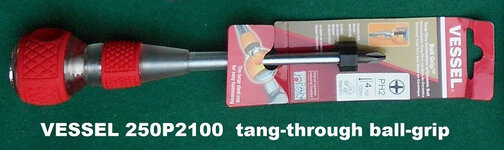
  • Vessel 250P2100 tang-through P2 ball-grip screwdriver 111525.jpg
    Vessel 250P2100 tang-through P2 ball-grip screwdriver 111525.jpg
    133 KB · Views: 104
Last edited:

dnschmidt

Well-known member
Joined
Oct 3, 2014
Messages
7,348
Location
Phoenix, AZ
The missing part is what about OLDER Phillips screwdrivers. Many a Honda carburetor was ruined by Craftsman Phillips screwdrivers. Perhaps as Tekton states all new Phillips screwdrivers are compatible but I can tell you through hard won experience that if it's over five years old to throw them out when working on Japanese stuff.
 

Dave455

Well-known member
Joined
Mar 19, 2013
Messages
5,874
Location
Sussex, England
They seem go have largely got that right.

A couple of observations -

Pozidriv is not a Phillips with “added gripping features”. It’s a completely different design that’s designed to reduce “cam out”. Phillips and Pozidriv are not interchangeable.

Critically, I believe the JIS screw head spec did change a few years back. The original JIS screws were different, and deliberately so I believe, to avoid paying royalties.

Yes, the CURRENT JIS screw heads are compatible with Phillips, but the older ones are different. I work on classic bikes, occasionally Japanese ones, and Phillips drivers are really not a great fit. The same can be said for older Japanese electronics or cameras. The older Japanese drivers fit much better.

I remain to be convinced that the ANSI drivers have changed significantly. Buy a new Snap On driver and I can guarantee it will be a good fit in a 40 year old ANSI screw. You wouldn’t be able to remove any screw from a Boeing airliner otherwise.

But all the evidence is that older Japanese screws are different.
 
Last edited:

slowtwitch73

Well-known member
Joined
Apr 18, 2019
Messages
5,876
Location
Hellgate
Many older Phillips have fit/worked just fine with 'jis' for years despite what the 'jis' cognoscenti have been going on about.

Not difficult to notice if the tip isn't a good fit before butchering the screw. Often a few swipes with a file across the nose on a non compliant Phillips will do the trick.
 

4xdog

Well-known member
Joined
Aug 18, 2012
Messages
5,675
Location
Santa Fe, NM
Here's a JIS-dot screw on my 2001 Tacoma's MAF sensor years ago that I almost stripped using a conventional (older) Phillips driver, before I noticed the dot and went back to the workbench for a Vessel driver. That took it out perfectly, and the second one came out without a mark.

First one, before Vessel JIS
i-45RcGtf-X5.jpg

Second one, Vessel all the way.
i-gPcHCgq-X5.jpg
 

Ohio Andy

Well-known member
Joined
Jul 31, 2024
Messages
2,487
Location
Columbus, Ohio
They seem go have largely got that right.

A couple of observations -

Pozidriv is not a Phillips with “added gripping features”. It’s a completely different design that’s designed to reduce “cam out”. Phillips and Pozidriv are not interchangeable.

Critically, I believe the JIS screw head spec did change a few years back. The original JIS screws were different, and deliberately so I believe, to avoid paying royalties.

Yes, the CURRENT JIS screw heads are compatible with Phillips, but the older ones are different. I work on classic bikes, occasionally Japanese ones, and Phillips drivers are really not a great fit. The same can be said for older Japanese electronics or cameras. The older Japanese drivers fit much better.

I remain to be convinced that the ANSI drivers have changed significantly. Buy a new Snap On driver and I can guarantee it will be a good fit in a 40 year old ANSI screw. You wouldn’t be able to remove any screw from a Boeing airliner otherwise.

But all the evidence is that older Japanese screws are different.
So does that mean that a modern JIS screwdriver will not work in an old JIS screw and you must use an older screwdriver?
 

Max

ALLIANCE MEMBER
Joined
Jun 16, 2018
Messages
3,423
Location
Georgia
I'm here to tell you that's 70s and 80s Craftsman screwdrivers will eventually destroy the heads on 70s and 80s Japanese motorcycles. I have no such issues on my 80s Yamaha now with Vessel drivers. Same guy and same motorcycle as in the 80s - just different drivers.

Tekton's article talks about compatibility with current ISO standards and JIS. They do not talk about older customary units/SAE drivers with JIS. Tekton's point is to prove that current ISO drivers are OK with JIS, not to show that older screwdrivers won't screw up your JIS heads.
 

Dave455

Well-known member
Joined
Mar 19, 2013
Messages
5,874
Location
Sussex, England
@BrandonV covered all that in that thread I cited above.
I think he even learned a bit of the Japanese language in the process.

JIS screwdrivers, screws and fasteners from Japan
He did.

But practice doesn’t seem to align with theory.

I can’t say why.

They do say that a picture is worth a thousand words.

Here is a Phillips tip (left) compared to two 1980’s vintage Japanese drivers (centre and right).

While they certainly do look similar at first inspection, they seem to be slightly differently sized. Measuring the “splines” of the driver, the outer edges of the very tips measures approximately .010“ less on the Japanese drivers than on the U.S. one.

This is the same on both the Japanese drivers, from different manufacturers, so it’s not an accident, or sloppy manufacture. If the screw were a precise fit for the Japanese drivers, the U.S. driver with it’s thicker splines could not be inserted so far, and would either damage the screw, or would be held out and possibly slip.

From personal experience, one of these things is exactly what happens.
IMG_2536.jpeg

As for all those folks saying that Vessel drivers work just fine, that has been my experience also.
 

woody 73

Well-known member
Joined
Apr 14, 2009
Messages
11,578
Location
The Great State Up North
 

alfazer

Well-known member
Joined
Nov 1, 2011
Messages
394
Location
N. Ireland
I've had Toyota cars, Honda, Suzuki and Yamaha motorcycles from the 70's on, and they always had the correct JIS screwdriver supplied in the tool roll. Yet most folks would use a Phillips screwdriver on them.
 
OP
G

gahrajmahal

Well-known member
Joined
Dec 12, 2008
Messages
2,638
Location
Cincinnati, Ohio
Wow. I didn’t know this. Thanks for posting it. That was really interesting.
as AEAdam said, I didn't know any of this stuff either. About what the dot on the screw head meant, or that Japanese "cross head" screws were any different than Phillips screws. If I was having troubles, I would just blame it on my screwdrivers and not a completely different made screw.

I sure miss the half dozen or so technical Engineering magazines I no longer get (or are no longer still in print) that would have articles regarding all of these interesting details about the manufacturing world.

Thanks to everyone who has added their knowledge, experience, photos (this means you 4xdog and Dave455!) videos and links. I always end up smarter when I am cruising the GJ.
 

assassin10000

Well-known member
Joined
Feb 11, 2022
Messages
385
The tekton article talks about jis being worse as the standard doesn't reach as deep. IRL reaching deeper isn't necessarily better. To apply good torque you want better grip at the outside of the cross. If the cross section is too deep you only catch the center and not the outside.

Thats why the old horrible freight and craftsman screwdrivers **** iirc.


The "jis" being a fraction of a mm shorter have better bite because of this.
 

dnschmidt

Well-known member
Joined
Oct 3, 2014
Messages
7,348
Location
Phoenix, AZ
I've had Toyota cars, Honda, Suzuki and Yamaha motorcycles from the 70's on, and they always had the correct JIS screwdriver supplied in the tool roll. Yet most folks would use a Phillips screwdriver on them.
ONLY ONCE. After that the next tool needed was a screw extractor. This was before the Vampliers and Knipex Twin Grips were available.
 
To avoid these ads, REGISTER NOW!

KnurledNut

Well-known member
Joined
Jan 28, 2011
Messages
8,422
Location
n/a
One thing with all this technical banter that always gets overlooked is that the screwdriver is only half the equation.
Screws widely vary in design and quality.

When a fastener matters, my solution is simple: I try different drivers and use the one that feels right.
For this reason, I keep a variety of insert and power bit styles and fixed screwdrivers in my arsenal.
The variance in fit among high qualiy brands is noticeably different even though they all follow similar standards.
 

lund

Well-known member
Joined
Nov 2, 2019
Messages
951
Location
Michigan
They seem go have largely got that right.

A couple of observations -

Pozidriv is not a Phillips with “added gripping features”. It’s a completely different design that’s designed to reduce “cam out”. Phillips and Pozidriv are not interchangeable.

Critically, I believe the JIS screw head spec did change a few years back. The original JIS screws were different, and deliberately so I believe, to avoid paying royalties.

Yes, the CURRENT JIS screw heads are compatible with Phillips, but the older ones are different. I work on classic bikes, occasionally Japanese ones, and Phillips drivers are really not a great fit. The same can be said for older Japanese electronics or cameras. The older Japanese drivers fit much better.

I remain to be convinced that the ANSI drivers have changed significantly. Buy a new Snap On driver and I can guarantee it will be a good fit in a 40 year old ANSI screw. You wouldn’t be able to remove any screw from a Boeing airliner otherwise.

But all the evidence is that older Japanese screws are different.
Agree there has been an evolution on JIS. But Tekton's article is a good summary of the situation with newer stuff today. On old stuff, I am afraid it may become more muddled. A lot of us do work on older stuff too. Everything from the 80s and before has not disappeared. Not all Phillips screwdrivers in the 60s-80s were made poorly but performance on older JIS was horrific.
 
Last edited:

dscheidt

Well-known member
Joined
Apr 26, 2017
Messages
2,978
The tekton article talks about jis being worse as the standard doesn't reach as deep. IRL reaching deeper isn't necessarily better. To apply good torque you want better grip at the outside of the cross. If the cross section is too deep you only catch the center and not the outside.

Thats why the old horrible freight and craftsman screwdrivers **** iirc.


The "jis" being a fraction of a mm shorter have better bite because of this.
I've ground the tip off a few cross headed screwdrivers to fix this problem. In one case, the screws were ****, and the recesses too shallow. Others I wasn't sure about, but it was clearly the screwdriver bottoming out, so the grinder it was.
 

ptgarcia

Well-known member
Joined
Nov 15, 2016
Messages
1,202
Location
Alta Loma, CA
Vessel just flat out makes exceptional screwdrivers...if it feels good in your hand...can't go wrong.

Agreed. I work on Japanese motorcycles and they are the best on those. My Wiha screwdrivers work great, too, but I reach for the Vessel first every time.
 

seber

Well-known member
Joined
May 31, 2016
Messages
4,231
Location
Deep East Tx.
I worked on Hondas in the seventies. I had a set of screwdrivers with the ends ground short to deal with those screws. At that time no screwdrivers I could find would fit them. Every single bike that came in had damaged screws. No exceptions. I wore out a few manual impact drivers.
 

mslim

Well-known member
Joined
Mar 25, 2015
Messages
296
Location
Fayetteville, AR
The missing part is what about OLDER Phillips screwdrivers. Many a Honda carburetor was ruined by Craftsman Phillips screwdrivers. Perhaps as Tekton states all new Phillips screwdrivers are compatible but I can tell you through hard won experience that if it's over five years old to throw them out when working on Japanese stuff.
In the '70's I changed all the cross point fasteners on my Yamaha dirt bike for Allen heads due to buggering the heads with my craftsman Phillips driver. At the time I thought that the japanese metallurgy was at fault. IDK it might have been the driver. That said... nothing fits a cross point fastener like my Vessel #2 Megadora.
 

IndyGarage

Well-known member
Joined
Apr 29, 2010
Messages
9,933
Location
Indy
Vessel just flat out makes exceptional screwdrivers...if it feels good in your hand...can't go wrong.
I bought a couple, based on the praise here. They work well, but the feel of the handle is not even close to PB Swiss, Wera or Felo, which are my favorites. I must say I absolutely love my Vessel Famidora 8 sets.
 

GaryM909

Well-known member
Joined
Apr 11, 2016
Messages
1,589
Location
Calgary, Alberta, Canada
I just did the first oil change on my wife's Honda CRV. The splash pan is held on by 4 flat head type fasteners and 4 JIS fasteners. I cammed out the JIS ones by trying to use a phillips and I had to remove them by catching the edges with vise grips. I could probably re-use two of them but I damaged the other two bad enough not to trust removing them once they get some corrosion.
I ordered new fasteners and these Vessel JIS bits from Amazon which arrived yesterday. Now to find a special place to store them since they don't belong with the sae or metric stuff.
 

Attachments

  • 61AhtU9ffFL._AC_SX679_.jpg
    61AhtU9ffFL._AC_SX679_.jpg
    23.7 KB · Views: 23

CHI_Tool&Die

Well-known member
Joined
Jul 20, 2021
Messages
1,422
Location
Chicago, IL
So I work on modern Japanese industrial machines, most manufactured after 2015. Vessel drivers just fit better. My Snappy and Witte drivers fit but they have play. The Vessel drivers just pop in and do not move. Only other drivers that are just as good are my Heyco screwdrivers. Those things, if not for the fact that I went with the clear green handles which ****, would be my go to for work because they fit snug in every type of fastener I encounter. I really, really hate Vessel handles and I think their tips are softer than my US/Euro drivers.
 

Jbear

Well-known member
Joined
Aug 2, 2025
Messages
141
I bought a couple, based on the praise here. They work well, but the feel of the handle is not even close to PB Swiss, Wera or Felo, which are my favorites. I must say I absolutely love my Vessel Famidora 8 sets.
I get it but it's 100% subjective...innit?
 

rice rocket

Well-known member
Joined
Mar 24, 2011
Messages
3,175
I get it but it's 100% subjective...innit?
100%.

I can't stand the Vessel balldrivers that everyone recommends for more than a few turns here and there, it gives me hand cramps beyond that.

That said, I really like the Vessel Impactas. Work great as regular screwdrivers, and has a striking cap for use as an impact driver as well. I'd put them above my Weras and Felos, don't own any PB Swiss other than their P-handle hex.
 

CHI_Tool&Die

Well-known member
Joined
Jul 20, 2021
Messages
1,422
Location
Chicago, IL
So what is it about the Vessel handles? Too small, too big, weird shape? I have large hands, and don't really have a problem with most handles.
They aren’t square or tri-lobed, more like a polygon or multi-faceted piece. They spin really well and fit nicely in your palm. My biggest complaint is that the handle is plastic and even though it says it’s non-slip, when your hands are covered in **** they definitely slip.
 

KnurledNut

Well-known member
Joined
Jan 28, 2011
Messages
8,422
Location
n/a
They aren’t square or tri-lobed, more like a polygon or multi-faceted piece. They spin really well and fit nicely in your palm. My biggest complaint is that the handle is plastic and even though it says it’s non-slip, when your hands are covered in **** they definitely slip.
My experience with the Megadora handle and why I quit using them.
 

M.Brane

ALLIANCE MEMBER
Joined
Feb 11, 2024
Messages
2,105
Location
1 hr N/W of LA LA Land
They aren’t square or tri-lobed, more like a polygon or multi-faceted piece. They spin really well and fit nicely in your palm. My biggest complaint is that the handle is plastic and even though it says it’s non-slip, when your hands are covered in **** they definitely slip.
Thanks for that. I try to clean things before I work on them. Don't like to be a human rag. When that's not possible I'll stop to clean hands/tools when it becomes an issue.

I have a buddy that has an awesome shop, but he's seriously lacking rags. It makes me not want to work in there. I always have plenty on hand. A few minutes to clean something before digging in makes a huge difference IMHO.
 

Gebirgekind

Well-known member
Joined
Oct 5, 2020
Messages
138
Location
Montana
They aren’t square or tri-lobed, more like a polygon or multi-faceted piece. They spin really well and fit nicely in your palm. My biggest complaint is that the handle is plastic and even though it says it’s non-slip, when your hands are covered in **** they definitely slip.
My experience with the Megadora handle and why I quit using them.
I wonder if you've tried the Vessel Wood Compo version? I don't mind the megadoras but don't love them either, however the wood non-slip have become my favorite in the shop. They have a much better feel and heft plus the perfect Vessel fit.
 

Dave455

Well-known member
Joined
Mar 19, 2013
Messages
5,874
Location
Sussex, England
My experience with the Megadora handle and why I quit using them.
I’ve always had the Megadora handle down as “O.K.” Not bad, but not great either.

The problem is the environment some of us use them in, and getting handles right is not easy. Soft materials are totally useless, as they get covered in grease and dirt, are impossible to clean, and become unpleasant to use.

Hard handles are not always ideal as they can get slippy to grip. In honesty, the best I’ve found are the older style Snap On hard handles. They have a tiny bit of texture, but the shape allows for grip, they wipe clean, and are very durable.

The Vessel Megadora seem to be excellent for cleaner tasks, but not quite ideal for automotive. Way better than Wera though.

Bear in mind that the top of the range Vessel drivers are the “Power Grip”. In my opinion these are a much better choice. They are high quality, grip comes largely from the shape, they’re durable, and clean up well.

I don’t think they are quite as good as the Snap On hard handle to clean up, and generally I think an opaque material is marginally preferable to a transparent. In all other respects they are excellent, and I don’t even mind the striking caps (which I don’t generally like) on the slotted and Phillips as Vessel seem to have integrated them in such a way that they enhance the feel rather than destroying the balance!

I’m honestly not bothered about getting “maximum torque” from a screwdriver handle any more. If I need that I’ll use a screwdriver bit on a ratchet, or an impact.
IMG_2550.jpeg
 
Last edited:
To avoid these ads, REGISTER NOW!
Top Bottom
