There were a lot of remarks about, “Sure glad I don’t do this for a living.”Ugh, I did that to my dad’s D14 Allis a couple years ago. What a messy, smelly task that was!


You are using an out of date browser. It may not display this or other websites correctly.
You should upgrade or use an alternative browser.
You should upgrade or use an alternative browser.
What did you do "IN" your garage today?
- Thread starter mayhemman
- Start date
garfieldzzz
Well-known member
Thats some serious proper work, respect to your dad.I wandered down to the shop, fired up the compressor, and blew the dust off some of my Dad's wood turnings.
Five layer puzzle ball turned from a pruning from his backyard walnut tree.
Open segmented Christmas ornament Dad made from his holly & walnut prunings.


LeeG
Well-known member
My 2010 F150 is burning about 1/2 quart every 1500 miles. I use my NOS Crack-L can I’d picked up from HJE while back to top it off with the correct amount.

It needed a bit of lubricant on the spout to get it bending well, but worked a treat.
Lee
It needed a bit of lubricant on the spout to get it bending well, but worked a treat.
Lee
landrover bodger
Well-known member
Spent a few hour with one of my grandson's while he replaced the valve cover on his first car a mini. He has just finished his first year training as a mechanic.
kaymccampbell
Well-known member
Over the last decades, I've seen the move to propylene glycol or beet juice. Heavy, less toxic, less corrosion.Two day project, due to interruption, and waiting for the pump. Tractor tires can be filled with various liquids to add weight for better traction. Water and calcium chloride has been standard for a long time, but is slowly being replaced with non-corrosive, more environmentally friendly materials. One of the worst problems with chloride comes from ignoring minor leaks, and just adding air to keep the tire up. Eventually the rim develops severe corrosion and fails. On the other hand, chloride is cheap, works, and doesn’t give problems if you keep the tires in good shape.
My friend brought his tractor over, and we pumped out the fluid, removed and replaced this rotting rim. I’m sure the only thing holding one bead on was the rust. There was not enough flange left for the bead breaker to bear against, so we had to go caveman, and get out the old tire hammer. Fortunately the inner flange was intact, and the bead breaker worked, but not easily. The tire came off easily, because there was no flange to pry it over. The tube was rusted to the wheel, and required some poking and prying to remove.
Surprisingly, the wheel bolts gave no trouble. Bolted the new wheel up, installed the tire with a new tube, and inflated it. It took five tries to seat the bead.
Because I don’t do this for a living, I use a cheap rubber impeller pump to remove and replace fluids. The impeller gave up and had to be replaced before we could refill the tire. It took ten gallons more to refill than was pumped out.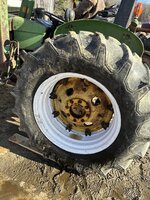

kaymccampbell
Well-known member
Unwrapped and assembled the new shopvac. Dragged the air and electro hoses outside. Pulled the hoses back inside. Cleaned up.
budo55
Well-known member
What shopvac did you get?Unwrapped and assembled the new shopvac. Dragged the air and electro hoses outside. Pulled the hoses back inside. Cleaned up.
gearhead1960
ALLIANCE MEMBER
Yeah, I agree but not in the cards right now.A larger table so you can work standing up would make your life a lot easier. Add some tunes and zone out.
Old Man Roger
Well-known member
Oh! That’s not what I thought you meant.Sure we do.


kaymccampbell
Well-known member
The $60 Ridgid 16 gallon on sale at Orange Hell.What shopvac did you get?
kaymccampbell
Well-known member
Then you weren't keeping up.Oh! That’s not what I thought you meant.
Motorman55
Well-known member
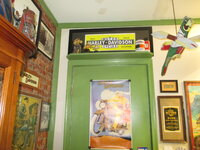
Working in the shop office to gain some wall space to hang some more pieces of my vintage original motorcycle stuff.
First I needed to remove, fix, reinstall and level the shelf over the inside office door. Next I moved the large horizontal Harley Decal picture frame and centered it over door.
Now the fun part begins. Unpacking some boxes and deciding which items to place on the shelf and which new pieces to hang on the empty wall space. I'm even thinking of adding another shelf to that space too. This will take some time as I switch things around and see what will fit where. (I'm also working on the left side brick wall at the same time)
I like changing things around to keep the displays clean, dusted and looking interesting. Looks like Polly the shop Mascot approves.
First I needed to remove, fix, reinstall and level the shelf over the inside office door. Next I moved the large horizontal Harley Decal picture frame and centered it over door.
Now the fun part begins. Unpacking some boxes and deciding which items to place on the shelf and which new pieces to hang on the empty wall space. I'm even thinking of adding another shelf to that space too. This will take some time as I switch things around and see what will fit where. (I'm also working on the left side brick wall at the same time)
I like changing things around to keep the displays clean, dusted and looking interesting. Looks like Polly the shop Mascot approves.
Last edited:
jblnut
ALLIANCE MEMBER
Assembled a pallet racking loft of sorts in a shed. I rather like this a lot and may get another row or two to extend it farther into the shed space. I always have things parked in the spaces below so why not make use of the space above ?

Jay__Dub
Well-known member
Bench tested the starter off the old fergie. Steel wool and wd40, all good to go.
Put stuff away I left laying around, what a frickin mess.
Hung some signs I bought.
Stabilized all the fuel needing it and called it a day.
Put stuff away I left laying around, what a frickin mess.
Hung some signs I bought.
Stabilized all the fuel needing it and called it a day.
kaymccampbell
Well-known member
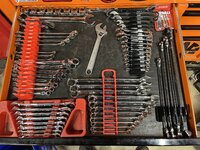
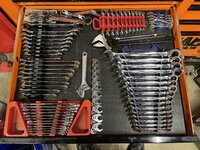
It looks better than my drawers, where the wrenches are just poured in.Started organizing some wrenches. Not too sure I’m happy with it yet. The drawers are very shallow, so that hinders a couple ideas I had.
Over the last decades, I've seen the move to propylene glycol or beet juice. Heavy, less toxic, less corrosion.
All more expensive. Windshield washer fluid, a lot lighter, still expensive, still toxic.
Beet juice is much harder to pump, all the others can be done with a drill pump, if you don’t mind waiting.
I don’t like doing it myself , but the tire guy is a minimum of $200, plus pump charge, plus labor on site, plus materials. Also going to be a second service if he finds something more than just a change.
bmwrd0
Well-known member
Kept scraping paint on the lathe bed this AM, also started moving some things into place on how I will eventually set the whole thing up. Then I got out of the house to give the wife her Sat. morning time.
ObnoxiousFumes
Well-known member
I’d say use your car’s old antifreeze from the last rad flush or something, or even ask about that sort of thing at some mechanic shops.All more expensive. Windshield washer fluid, a lot lighter, still expensive, still toxic.
Beet juice is much harder to pump, all the others can be done with a drill pump, if you don’t mind waiting.
I don’t like doing it myself , but the tire guy is a minimum of $200, plus pump charge, plus labor on site, plus materials. Also going to be a second service if he finds something more than just a change.
cody1325
Well-known member
My 2010 F150 is burning about 1/2 quart every 1500 miles. I use my NOS Crack-L can I’d picked up from HJE while back to top it off with the correct amount.
It needed a bit of lubricant on the spout to get it bending well, but worked a treat.
Lee
Really need to get one of those on order, unless I can clean up my old one.
I have an old one I found in an abandoned barn, but it's pretty rusty. I need to see if I can get it cleaned up. Gearbox oil for things like the Bush Hog and roto-tiller is where it would, most definitely shine.
Beerhippie
Well-known member
I'm in the shop acid-washing one of our Rinnais today so we can brew on Monday. It takes eight to ten hours to finish and it's a hurry-up-and-wait job, so I need something to do while I'm waiting.
My desk in the shop has really janky legs that I've been wanting to replace for years. Not only are they unstable and impossible to get level, but they're in the way as I want to mount a slide-out keyboard shelf under the bench and the leg mounting hardware is in my way.

So, out to the bone yard to see what I can find.

That'll do. The M18 angle grinder paid off in full again, as that was welded to a 8" deep by four-foot long I-beam I really didn't want to lug over to the shop and back.
Cut it to fit: 30" wide for the top, 26" legs to allow for the use of leveling feet.
Which I found in the shop Connex:

Still NIB. Being a packrat pays off again.
Now for some mounts for the feet.

More from the boneyard. About the right width, hole spacing is close enough and I don't have to cut it from sheet.
Punch the holes out to 5/8", a little more cutting on the abrasive cut-off, and some hot-metal glue:

The bolts are for clamping the nuts in place while I give them two good, solid tacks, one on each side.
I like to size the plugs for an open-corner weld

as it gives me enough weldment to grind the welds flush without weakening them.
That done, scrounge around the boneyard again for some angle. More cutting, punch a few more holes, some cleaning of the cut edges and some more hot-metal gluing:

Those are the ugliest welds I've made in years. No idea what the problem was. I cleaned down to clean, shiny metal and had the settings where they should be, but nothing but bubble-gum and goobers. Oh, well, I think it'll support a computer desk.
If I'm not feeling too lazy, I might even get that installed under the desk tonight. I could have cleaned it up and slapped some paint on, but I'm feeling rustic (and lazy) today. It'll look fine from my side of the desk.
My desk in the shop has really janky legs that I've been wanting to replace for years. Not only are they unstable and impossible to get level, but they're in the way as I want to mount a slide-out keyboard shelf under the bench and the leg mounting hardware is in my way.
So, out to the bone yard to see what I can find.
That'll do. The M18 angle grinder paid off in full again, as that was welded to a 8" deep by four-foot long I-beam I really didn't want to lug over to the shop and back.
Cut it to fit: 30" wide for the top, 26" legs to allow for the use of leveling feet.
Which I found in the shop Connex:
Still NIB. Being a packrat pays off again.
Now for some mounts for the feet.
More from the boneyard. About the right width, hole spacing is close enough and I don't have to cut it from sheet.
Punch the holes out to 5/8", a little more cutting on the abrasive cut-off, and some hot-metal glue:
The bolts are for clamping the nuts in place while I give them two good, solid tacks, one on each side.
I like to size the plugs for an open-corner weld
as it gives me enough weldment to grind the welds flush without weakening them.
That done, scrounge around the boneyard again for some angle. More cutting, punch a few more holes, some cleaning of the cut edges and some more hot-metal gluing:
Those are the ugliest welds I've made in years. No idea what the problem was. I cleaned down to clean, shiny metal and had the settings where they should be, but nothing but bubble-gum and goobers. Oh, well, I think it'll support a computer desk.
If I'm not feeling too lazy, I might even get that installed under the desk tonight. I could have cleaned it up and slapped some paint on, but I'm feeling rustic (and lazy) today. It'll look fine from my side of the desk.
Last edited:
Nofries
Well-known member
Sons new to him boat. 17' jon boat. New trailer lights and wiring, re wired the bilge pump, cleaned and fixed the Nav lights, put on new wheels and tires, started to install USB chargers (replacing cigar lighter in dash) got too dark to finish up. Wiring is a mess from 25 years of multiple owners.
Probably get enough done to get it on the water, and eventually clean up all the wiring but the best fix is a temporary fix at the moment. Oh also wired up spare bilge pump for quick swap if it the other fails.

Probably get enough done to get it on the water, and eventually clean up all the wiring but the best fix is a temporary fix at the moment. Oh also wired up spare bilge pump for quick swap if it the other fails.
Beerhippie
Well-known member
I don't think anyone will notice the rusty steel and **** welds:

Still not level. I'll tackle the ledger at the other end tomorrow--unless I get all inspired and do it tonight, as I'm here for another couple of hours at least.
Still not level. I'll tackle the ledger at the other end tomorrow--unless I get all inspired and do it tonight, as I'm here for another couple of hours at least.
Skyman
Well-known member
Wrapped up the work going from this hot mess:
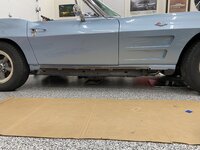

to this:


to this:
Yesterday I organized 1 bay of the garage to put all of the baseball and softball gear up for a couple months.
Today I pulled the wife's car in, changed the oil and then put all 4 corners on jack stands. I pulled 1 wheel, the caliper, pads and rotor. Have to pull all of them tomorrow to replace them and rotate the tires.
Today I pulled the wife's car in, changed the oil and then put all 4 corners on jack stands. I pulled 1 wheel, the caliper, pads and rotor. Have to pull all of them tomorrow to replace them and rotate the tires.
GX460DIYguy
Well-known member
Blew all the dust off the tractor and shredder after using it today and decided to drain the air compressor which turned into the drain valve going bad so I’ll have to order another one. Tempted to try cleaning it to see if I can get it working again.
Painted the board that our house numbers go on at the front gate. Put a coat of paint on the plastic numbers. 32 years had taken a toll on them and we just had the trellis that they hang from rebuilt and freshly painted.
Put a coat of black ceramic high-temp paint on the screens for the fireplace in our bedroom. Just had the fireplace surround redone from slate to ceramic tile and the door hardware powder coated to match the new color scheme. Screens are off in this pic.

Put a coat of black ceramic high-temp paint on the screens for the fireplace in our bedroom. Just had the fireplace surround redone from slate to ceramic tile and the door hardware powder coated to match the new color scheme. Screens are off in this pic.
Furthermore, as a historical note, some tires were filled with powdered lead. They still show up occasionally. Serio toxicity, environmentally unfriendly, hazardous waste.All more expensive. Windshield washer fluid, a lot lighter, still expensive, still toxic.
Beet juice is much harder to pump, all the others can be done with a drill pump, if you don’t mind waiting.
I don’t like doing it myself , but the tire guy is a minimum of $200, plus pump charge, plus labor on site, plus materials. Also going to be a second service if he finds something more than just a change.
gearhead1960
ALLIANCE MEMBER
Pest disposal services....Jif & Victor are the best! Been having visits by little furry creatures.....they check in, but they don't check out....today's visitor....

....courtesy of Victor who provides a jolt when said visitor completes the circuit....
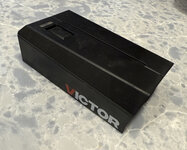
..and the visitor from earlier this week....

....hotel Victor is now open for visitors......
....courtesy of Victor who provides a jolt when said visitor completes the circuit....
..and the visitor from earlier this week....
....hotel Victor is now open for visitors......
M.Brane
ALLIANCE MEMBER
I've run into this with old bed frames that I like to use for projects like this. It's nice rigid material, but some of it just doesn't like to be welded no matter how clean. Must be some kind of funky alloy. It also tends to be hard on bandsaw blades.I'm in the shop acid-washing one of our Rinnais today so we can brew on Monday. It takes eight to ten hours to finish and it's a hurry-up-and-wait job, so I need something to do while I'm waiting.
My desk in the shop has really janky legs that I've been wanting to replace for years. Not only are they unstable and impossible to get level, but they're in the way as I want to mount a slide-out keyboard shelf under the bench and the leg mounting hardware is in my way.
So, out to the bone yard to see what I can find.
That'll do. The M18 angle grinder paid off in full again, as that was welded to a 8" deep by four-foot long I-beam I really didn't want to lug over to the shop and back.
Cut it to fit: 30" wide for the top, 26" legs to allow for the use of leveling feet.
Which I found in the shop Connex:
Still NIB. Being a packrat pays off again.
Now for some mounts for the feet.
More from the boneyard. About the right width, hole spacing is close enough and I don't have to cut it from sheet.
Punch the holes out to 5/8", a little more cutting on the abrasive cut-off, and some hot-metal glue:
The bolts are for clamping.
I like to size the plugs for an open-corner weld
as it gives me enough weldment to grind the welds flush without weakening them.
That done, scrounge around the boneyard again for some angle. More cutting, punch a few more holes, some cleaning of the cut edges and some more hot-metal gluing:
Those are the ugliest welds I've made in years. No idea what the problem was. I cleaned down to clean, shiny metal and had the settings where they should be, but nothing but bubble-gum and goobers. Oh, well, I think it'll support a computer desk.
If I'm not feeling too lazy, I might even get that installed under the desk tonight. I could have cleaned it up and slapped some paint on, but I'm feeling rustic (and lazy) today. It'll look fine from my side of the desk.
afinepoint
Well-known member
- Joined
- Jul 16, 2024
- Messages
- 198
I can think of alot of more fun ways. 6 mm, 6.5, 308, 223, 300 Win Mag . . .Agent Campbell
16again
Well-known member

rzims
Well-known member
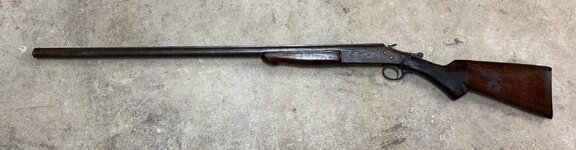
I have a similar model in 410g. Mine is branded Montgomery Wards though and not as old as yours....Inspected, cleaned, and lubed (free to me) antique/vintage Western Field break action, single-shot shotgun. Don't have much info on this gun. Western Field was a Wards brand among others and might have been made by Savage or Mossberg. More research is needed....not sure I'll ever shoot it. Might end up being a display piece....


gearhead1960
ALLIANCE MEMBER
Does it have a model number?I have a similar model in 410g. Mine is branded Montgomery Wards though and not as old as yours....
Outlawmws
Well-known member
Inspected, cleaned, and lubed (free to me) antique/vintage Western Field break action, single-shot shotgun. Don't have much info on this gun. Western Field was a Wards brand among others and might have been made by Savage or Mossberg. More research is needed....not sure I'll ever shoot it. Might end up being a display piece....
Nice acquisition! Is it a 12 ga.?
It's not marked. At least I haven't found a mark that tells me the gauge. Unfortunately, my knowledge of shotguns is lacking. I'm open to suggestions on figuring out the gauge....
Does it fit a 12 ga. shell? That would be an answer right there.
Don't check with a 16 Ga. as those can catch the rim part of the chamber and could be very unsafely fired. Inserted partially they would flop around and the brass part would not provide the required pressure seal to the chamber and breech plate. many 12's were destroyed with an accidental chambering of a 16 in a 12.
gearhead1960
ALLIANCE MEMBER
Not having had a shotgun before I need to pick up ammo for the bonifide 12ga. shooter I do have. I’ll try it then. It’s not a high priority but will update once I figure it out.Does it fit a 12 ga. shell? That would be an answer right there.
Don't check with a 16 Ga. as those can catch the rim part of the chamber and could be very unsafely fired. Inserted partially they would flop around and the brass part would not provide the required pressure seal to the chamber and breech plate. many 12's were destroyed with an accidental chambering of a 16 in a 12.
jblnut
ALLIANCE MEMBER
Started setting up the hydraulic crimping setup today. We decided to put it in the loft to keep everything cleaner.

Rewired the air compressor after testing the hydraulic press I'd sold last year(both 3 phase). Cleaned up around the blast cabinet and blasted a trailer rim.
Attachments


Beerhippie
Well-known member
I think the main problem was that that railing had been sitting outside in the boneyard for over twenty years. It's heavily pitted in the areas I was welding. Kind of like old exhaust pipe. From the sounds of the welding, I may not have had the best grounding, either.I've run into this with old bed frames that I like to use for projects like this. It's nice rigid material, but some of it just doesn't like to be welded no matter how clean. Must be some kind of funky alloy. It also tends to be hard on bandsaw blades.
The beads wouldn't build and wanted to drip and run--but, as I said, it'll do fine to support my "office" desk.