To avoid these ads, REGISTER NOW!

Between 485 & 705 SQ/FT Bob Heine's Auto Emporium

Workspaces between 485 and 705 squarefeet.

Squankum

Well-known member
Joined
Mar 28, 2011
Messages
7,835
Location
Southeast
I listened to several segments of "The Day Walt Disney Died" and realized why I never heard of JFA (Jody Foster's Army). Liane and I DANCED to the vast majority of the music we listened to. Same thing happened when I listened to Refused's "New Noise." I can only survive a few minutes of that kind of music.

Minutes? I'm impressed! :D
 
To avoid these ads, REGISTER NOW!
OP
B

Bob Heine

ALLIANCE MEMBER
Joined
Oct 24, 2009
Messages
10,708
Location
Boca Raton, Florida
Minutes? I'm impressed! :D
@Squankum, I jumped ahead a few times, hoping it would get better but once again, Liane was trying to nap and even with volume down and doors closed, that stuff carries.
I guess that's rap. Look into some early 20th and late 19th century rap. It's got a different vibe. More of a call n response kind of storytelling.
Kay,, I took your advice and some pre-pubescent musicologist led me to a barbershop quartet that started the whole thing in 1944. Not exactly the same as the Platters "Smoke Gets in Your Eyes" (song playing when Liane and I did our first slow dance together). For your listening pleasure, here's a link to the Jubalaires "Noah:"
 

kaymccampbell

Well-known member
Joined
Feb 27, 2015
Messages
29,603
Location
Upstate New York
@Squankum, I jumped ahead a few times, hoping it would get better but once again, Liane was trying to nap and even with volume down and doors closed, that stuff carries.

Kay,, I took your advice and some pre-pubescent musicologist led me to a barbershop quartet that started the whole thing in 1944. Not exactly the same as the Platters "Smoke Gets in Your Eyes" (song playing when Liane and I did our first slow dance together). For your listening pleasure, here's a link to the Jubalaires "Noah:"
It's a bit older than the 40s, as my grandfather picked it up in his childhood, so 1880-ish? Either way, your pick of Noah is a good one. The Jubilaires were a fine singing group.
 

PugetDude

ALLIANCE MEMBER
Joined
Mar 13, 2013
Messages
22,456
Location
Superstition Mountains, AZ
I had suppressed the memory of meeting my brother-in-law's mother-in-law a year or so before she died. She had cancer in her lower jaw and they removed a section of it. They continued removing sections until she had no lower jaw left. She was unable to hold a conversation so we just sat around listening to her try to **** down a smoothie. She wore a large silk scarf to hide the damage but pulled it down to eat.
Bob. my grandmother had exactly the same issue. Gruesome surgery. She lost half her face, upper neck, jaw, her tongue and her teeth. For the next ten years everything she ate went into a blender. Her favorite was bacon and eggs. This was the same grandmother that turned down a marriage proposal from a famous Hollywood cartoonist when he lived in Kansas City in the 1920's....
 

Squankum

Well-known member
Joined
Mar 28, 2011
Messages
7,835
Location
Southeast
Random question completely off the recently beaten path in this thread if you'll indulge me Bob...

If you were to recommend touristy type activities to a 40 something yrs old couple coming to Miami area without kids....what would your(or Liane's) be? Wife and I may be headed to Miami for a couple days without kids and trying to figure out what we may do....a day will probably be spent doing nothing at the beach....likely an evening coastal boat ride as we enjoyed those in Chicago....Frost Museum of Science gets stellar reviews....night club scene is not for us, boat tour of Biscayne Bay and maybe snorkeling as well. Little Havana seems like a must see...what's the secret recommendations of the locals?

Not precisely in Miami but you'll be closer to it than you usually are. This was my first thought, alas, Google Maps tells me it's a 3 hr 18 min drive from Miami:


CNC_RICK

Well-known member
Joined
Nov 12, 2016
Messages
1,066
Location
Wisconsin
Bob, you mentioned Refused, New Noise.. Did it make you and Liane sweat? Have you tried to dance to C & C Music Factory "Gonna Make You Sweat"? Pretty good song. C & C has nothing to do with my title as a programmer, but really like the song.
 

CNC_RICK

Well-known member
Joined
Nov 12, 2016
Messages
1,066
Location
Wisconsin
Actually, @loganb, I've just started reading through your "Three Times" writings. I've read through some of your stuff in the past, now, I'm really paying attention. I like where you're going. I agree with you getting some woodworking equipment. I like that you have some equipment, and would like to sell something to pay for the new goodies... Break even, so to speak... Or even come out ahead. I'm not like that, but I should be like that. 😀. I've read some of your stuff, Cody (@madison069), has taught me a ton about organizing, painting cars, mechanical work on cars, in general... My next step in my writings is to talk to Nick, in the Twin Cities... Need to do that. Me and Cheryl (Cheryl and I) just bought my Son a 3D printer.. just like you did... We bought him a Bambu A1... He loves it. I would like to retire in about a year. I'd like to buy a 3d printer... I've spent the past 28 years, as a CNC Programmer, using CAD/CAM to create G-Code for the machines at work. Hope I can handle a 3d printer... We'll see...😀
.
 
OP
B

Bob Heine

ALLIANCE MEMBER
Joined
Oct 24, 2009
Messages
10,708
Location
Boca Raton, Florida
It's a bit older than the 40s, as my grandfather picked it up in his childhood, so 1880-ish? Either way, your pick of Noah is a good one. The Jubilaires were a fine singing group.
Kay, my paternal grandfather died nine years before I was born and my maternal grandfather grew up in Denmark, moved to northern Alberta to stay away from heat and I don't recall either of my grandparents singing anything but hymns. Grandma grew up in Sweden so I didn't recognize the songs she hummed (in Swedish or English -- she had a pretty thick accent).
Bob. my grandmother had exactly the same issue. Gruesome surgery. She lost half her face, upper neck, jaw, her tongue and her teeth. For the next ten years everything she ate went into a blender. Her favorite was bacon and eggs. This was the same grandmother that turned down a marriage proposal from a famous Hollywood cartoonist when he lived in Kansas City in the 1920's....
Scott, I try not to rank issues but elbow is nowhere near the top, while slowly losing one's face is much closer. Then again, I may be biased. I'd like to see who she said yes to after turning down Walt.
Not precisely in Miami but you'll be closer to it than you usually are. This was my first thought, alas, Google Maps tells me it's a 3 hr 18 min drive from Miami:

@Squankum, in addition to the almost 7 hours of driving, the Kennedy Space Center is only open from 9:00AM to 5:00 PM most days so you have to leave Miami around 5:00 AM (rush hour traffic is unavoidable) and not get back to Miami until 9:00 PM at the earliest. If one were to combine a visit to Disney World, Sea World, Universal Studios and Medieval Times, the Kennedy Space Center is the perfect next destination. You'll already be used to maxing out your credit cards so another $169 will seem cheap ($77 admission each plus $15 parking).
Bob, you mentioned Refused, New Noise.. Did it make you and Liane sweat? Have you tried to dance to C & C Music Factory "Gonna Make You Sweat"? Pretty good song. C & C has nothing to do with my title as a programmer, but really like the song.
Rick, we never heard of or danced to New Noise or anything else from Refused. When it was released in 1998 we were probably on our 14-day Scandinavian cruise. We wasted our time in museums and city tours of Stockholm, Oslo, Helsinki, St. Petersburg, Tallin and Copenhagen. We were traveling with people our age (55-ish) so I don't recall going to the disco or club on the ship. We did win several Trivial Pursuit challenges on board -- Liane knows a lot about entertainment and I know a bit about history and geography (we are both clueless about sports).

I've heard The C & C Music Factory "Gonna Make You Sweat" song but we never danced to it. First of all, that song came out in 1990 when we were living in Australia and second, it was more stomping and jumping than dancing music. I brought a boom box (with transformer) and a few CDs but that group and song didn't make the cut. I did buy a Milli Vanilli album for the teen daughter of a co-worker while on a business trip to the US in 1989, before their lip sync scandal broke.
Actually, @loganb, I've just started reading through your "Three Times" writings. I've read through some of your stuff in the past, now, I'm really paying attention. I like where you're going. I agree with you getting some woodworking equipment. I like that you have some equipment, and would like to sell something to pay for the new goodies... Break even, so to speak... Or even come out ahead. I'm not like that, but I should be like that. 😀. I've read some of your stuff, Cody (@madison069), has taught me a ton about organizing, painting cars, mechanical work on cars, in general... My next step in my writings is to talk to Nick, in the Twin Cities... Need to do that. Me and Cheryl (Cheryl and I) just bought my Son a 3D printer.. just like you did... We bought him a Bambu A1... He loves it. I would like to retire in about a year. I'd like to buy a 3d printer... I've spent the past 28 years, as a CNC Programmer, using CAD/CAM to create G-Code for the machines at work. Hope I can handle a 3d printer... We'll see...😀
.
Rick, you are always welcome to post here on my thread but you probably have a better chance of connecting with other visitors by posting on their threads. I suspect many of the million visits to this thread involve skimming over the text and looking carefully at the photos. More than a few of us grew up preferring the comic book (or at least CliffsNotes) versions of "War and Peace" and other lengthy tomes.
 
Last edited:

kaymccampbell

Well-known member
Joined
Feb 27, 2015
Messages
29,603
Location
Upstate New York
Some news for you computer people of yesteryear:

I do love how they don't have the technology to read it anymore, and have to send it away to get a dump. Sad part is, that it may be scrambled at this late date. Magnetic media has a limited lifespan. Bit rot is real. When I ran data centers, we had a planned data refresh cycle for all archived magnetic media.
 
OP
B

Bob Heine

ALLIANCE MEMBER
Joined
Oct 24, 2009
Messages
10,708
Location
Boca Raton, Florida
Some news for you computer people of yesteryear:

@Squankum, you know you're old when people describe a computer tape from 1973 as a relic. The UNIX operating system first hit the market in 1971 and by that fourth release I was into my 9th year with IBM. I was writing manuals for machines that manufactured the earliest examples of a 'computer on a chip'. The 8-inch diameter, two foot long silicon crystals IBM was growing in East Fishkill, NY were being turned into wafers to produce custom chips for IBM computer systems. IBM farmed a lot of work to Intel, a fairly small company back in 1973 (Intel went Public in 1971). GoogAI tells me:
  • Integrated Circuits (ICs): By 1973, the industry was firmly in the era of LSI (Large-Scale Integration), with complex chips like microprocessors and memory devices containing several thousand transistors.
  • Microprocessors: Specific chips available around 1973 included the Intel 8008 (3,500 transistors, 1972) and the NEC μCOM-4 (2,500 transistors, 1973). Memory chips (RAM) with capacities up to 4K bits were also in development or production at this time.
For goodness sake, on June 26, 1974 the first item (a pack of Wrigley's Juicy Fruit gum) was scanned at a grocery store using the now-common Universal Product Code (UPC) barcode system. I am a one-armed dinosaur.
 

kaymccampbell

Well-known member
Joined
Feb 27, 2015
Messages
29,603
Location
Upstate New York
@Squankum, you know you're old when people describe a computer tape from 1973 as a relic. The UNIX operating system first hit the market in 1971 and by that fourth release I was into my 9th year with IBM. I was writing manuals for machines that manufactured the earliest examples of a 'computer on a chip'. The 8-inch diameter, two foot long silicon crystals IBM was growing in East Fishkill, NY were being turned into wafers to produce custom chips for IBM computer systems. IBM farmed a lot of work to Intel, a fairly small company back in 1973 (Intel went Public in 1971). GoogAI tells me:
  • Integrated Circuits (ICs): By 1973, the industry was firmly in the era of LSI (Large-Scale Integration), with complex chips like microprocessors and memory devices containing several thousand transistors.
  • Microprocessors: Specific chips available around 1973 included the Intel 8008 (3,500 transistors, 1972) and the NEC μCOM-4 (2,500 transistors, 1973). Memory chips (RAM) with capacities up to 4K bits were also in development or production at this time.
For goodness sake, on June 26, 1974 the first item (a pack of Wrigley's Juicy Fruit gum) was scanned at a grocery store using the now-common Universal Product Code (UPC) barcode system. I am a one-armed dinosaur.
And my Ryzen 9 based PC-in-a-cigarette-pack supposedly has 20 BILLION transistors. That's 6 million times the number as a Intel 8008. Oh, how times have changed.
 
OP
B

Bob Heine

ALLIANCE MEMBER
Joined
Oct 24, 2009
Messages
10,708
Location
Boca Raton, Florida
I do love how they don't have the technology to read it anymore, and have to send it away to get a dump. Sad part is, that it may be scrambled at this late date. Magnetic media has a limited lifespan. Bit rot is real. When I ran data centers, we had a planned data refresh cycle for all archived magnetic media.
Kay, I remember re-creating the contents of damaged tapes using a oval vial with clear windows on both sides. I think it was filled with Perchloroethelyne with iron powder suspended in it. Hold the tape on one side of the vial and give it a few swirls. The magnetized bits magically appeared and we could transcribe the data by hand. Time consuming task but it was simple and worked almost every time. There was always one doofus operator who could totally destroy a section of tape. They were quickly promoted to managerial positions.
 

Squankum

Well-known member
Joined
Mar 28, 2011
Messages
7,835
Location
Southeast
East Fishkill, NY

For those of you not from the NYC metropolitan region, here's a little language lesson. When you see "Kill" in place names, blame the Dutch! Fishkill, NY, the Kill Van Kull over near Bayonne, NJ, the Fresh Kills landfill in Staten Island -- kill was the word the Dutch in the area way back used for streams.

(I don't know about the modern Dutch language, as all of the Dutch were driven out by angry Irishmen wielding shillelaghs in 1833.)
 

kaymccampbell

Well-known member
Joined
Feb 27, 2015
Messages
29,603
Location
Upstate New York
Kay, I remember re-creating the contents of damaged tapes using a oval vial with clear windows on both sides. I think it was filled with Perchloroethelyne with iron powder suspended in it. Hold the tape on one side of the vial and give it a few swirls. The magnetized bits magically appeared and we could transcribe the data by hand. Time consuming task but it was simple and worked almost every time. There was always one doofus operator who could totally destroy a section of tape. They were quickly promoted to managerial positions.
That worked on the old low density tapes. Imagine doing that for even a small percentage of a couple million reel archive.
More modern ones, like the carts, are too dense, with 19 tracks and 10 times the linear density. Even the operator tricks, like drowning the read head in drive cleaner, to force a read, or washing the tape in carbon tet or drive cleaner, don't work with sick carts.
 

rharman

Well-known member
Joined
Apr 22, 2012
Messages
8,897
Location
SoCal
I do love how they don't have the technology to read it anymore, and have to send it away to get a dump. Sad part is, that it may be scrambled at this late date. Magnetic media has a limited lifespan. Bit rot is real. When I ran data centers, we had a planned data refresh cycle for all archived magnetic media.
Good old 9-track tape. 1600 or 6250 bpi. I still remember moving them around - looking like the Michelin Man with the tapes stacked up on my arms.
 

rharman

Well-known member
Joined
Apr 22, 2012
Messages
8,897
Location
SoCal
And my Ryzen 9 based PC-in-a-cigarette-pack supposedly has 20 BILLION transistors. That's 6 million times the number as a Intel 8008. Oh, how times have changed.
At one time, I did a quick presentation to some folks on the tape technology changes that had occurred in my time at that employer. 8mm, QIC, 9-track, LTO (various generations). Pretty frightening how the capacity has increased exponentially.

Cracks me up that it would take 50,000 of the hard drives from my original IBM XT to equal the single NVMe in my laptop today.
 
To avoid these ads, REGISTER NOW!

gilr

Well-known member
Joined
Jul 26, 2008
Messages
299
Location
Richmond, VA
Cracks me up that it would take 50,000 of the hard drives from my original IBM XT to equal the single NVMe in my laptop today.
I was a VAR for IBM PCs in my company back in the 80s, and I recall getting a shipment of new XTs in and wondered what on earth we would store in the massive 5 MB hard disks!! Boy have times changed!

Gil
 

rharman

Well-known member
Joined
Apr 22, 2012
Messages
8,897
Location
SoCal
I was a VAR for IBM PCs in my company back in the 80s, and I recall getting a shipment of new XTs in and wondered what on earth we would store in the massive 5 MB hard disks!! Boy have times changed!

Gil

And.... What about the whopping 384k memory mine came with? 256k standard on motherboard and 128k extra on an AST 6-Pack card!

Although, I did max out the 6-Pack card to get to 640k. Used a lot of it for a RAM disk. Really sped up large program compiles.
 

gilr

Well-known member
Joined
Jul 26, 2008
Messages
299
Location
Richmond, VA
And.... What about the whopping 384k memory mine came with? 256k standard on motherboard and 128k extra on an AST 6-Pack card!

Although, I did max out the 6-Pack card to get to 640k. Used a lot of it for a RAM disk. Really sped up large program compiles.
And the price was around $5K for said machine before the upgrades! It came with OS/2 and used Token Ring networking instead of Ethernet. Those were the days.
 
OP
B

Bob Heine

ALLIANCE MEMBER
Joined
Oct 24, 2009
Messages
10,708
Location
Boca Raton, Florida
I do love how they don't have the technology to read it anymore, and have to send it away to get a dump. Sad part is, that it may be scrambled at this late date. Magnetic media has a limited lifespan. Bit rot is real. When I ran data centers, we had a planned data refresh cycle for all archived magnetic media.
Kay, in 1965 my unit record account was at JC Penney. They ran an IBM7010 with a 40K word core storage unit twenty 729 tape drives. After my return to work at the end of the year I was doing some machine language coding for a parts inventory program. One day they asked me to go to GCS (Grand Central Station) to meet a guy from the IBM Poughkeepsie plant. He was delivering a 60K word core storage upgrade and didn't want to navigate the subway system for the final leg. I met him and he handed over a large, heavy box on a flimsy two wheel hand truck. I didn't witness the upgrade process because the IBM CEs (Customer Engineers) did it over the weekend. It involved a huge number of connections and re-wiring, including the core storage power supply. I think it was the first field upgrade of a 7010 to 100K.
And my Ryzen 9 based PC-in-a-cigarette-pack supposedly has 20 BILLION transistors. That's 6 million times the number as a Intel 8008. Oh, how times have changed.
Kay, as you know, Moore's Law states that the number of transistors in a dense integrated circuit doubles approximately every two years, leading to corresponding increases in processing power while the cost per transistor decreases. I'm terrible at math but doubling 31.5 times (in 61 years) sounds about right to be 6 million times bigger.

That 100K word 7010 leased for $6,000 to $7,000 per month. The peripherals were probably twice that per month.
For those of you not from the NYC metropolitan region, here's a little language lesson. When you see "Kill" in place names, blame the Dutch! Fishkill, NY, the Kill Van Kull over near Bayonne, NJ, the Fresh Kills landfill in Staten Island -- kill was the word the Dutch in the area way back used for streams.

(I don't know about the modern Dutch language, as all of the Dutch were driven out by angry Irishmen wielding shillelaghs in 1833.)
@Squankum, Liane's 8th great grandfather, Jan Arcer, was born in Amsterdam, Holland around 1630. He emigrated to Westchester County sometime before January 1658 when he was party to a lawsuit. He married an English woman in 1659 and when the British took over New Amsterdam (without a fight) in August 1664, he changed his name to John Archer and two years later bought 110 acres of land near Kingsbridge and founded the village of Fordham. John signed the the oath of allegiance to the English king and was confirmed by royal patent as First Lord of the manor of Fordham and granted the land from Kingsbridge south to Moristania between the Hudson and Bronx Rivers, approximately 3,900 acres. It included Spuyten Duyvil (Dutch for "Spouting Devil" because of the fierce tidal currents at the juncture of the Harlem and Hudson Rivers). To pay for improvements, he heavily mortgaged the estate to Cornelius Steenwyck and died suddenly in his coach on a trip from Fordham manor to New York. John's son and Steenwyck petitioned to be executor of his estate but before it could be settled, Steenwyck died and his will conveyed the manor of Fordham to the Nether Dutch Reform Church. Conflicting claims reduced the extent of the property and at some point the Catholic church acquired a piece of land that became the site of St. John's College, a jesuit institution that was later renamed Fordham University.

My 7th great grandfather, Jean John Coutant, was born in La Rochelle, France around 1658. A Jeanie come lately, he was living in New York City as early as 1692. He and his wife moved to New Rochelle in 1703 to a 100 acre farm. When he died his wife sold the farm and bought a 114 acre farm on the other side of town. Their son, Isaac, married Catherine Bonnefoy in 1718 and died at age 58 in 1755. Catherine died on November 23, 1776 and would have been buried in the church yard in White Plains next to Isaac but because the British controlled that location, she was buried on the farm. It became a private family cemetery and because I'm a descendent, that's where Liane and I will share a headstone, in the middle of New Rochelle, New York.

In addition to Kill, the early settlers had the creek, brook, run, burn and river. Bull Run near Manassas, Virginia was one of those little watterways. Some say the names indicated the width of the waterway and whether you could step over, jump over, wade across or swim across.
D'oh! I hadn't thought of Mr. Disney. I ran and googled for Chuck Jones's bio.
I had no clue either but a Google of "famous cartoonist Kansas City" mentioned Walt Disney (in the right time frame).
That worked on the old low density tapes. Imagine doing that for even a small percentage of a couple million reel archive.
More modern ones, like the carts, are too dense, with 19 tracks and 10 times the linear density. Even the operator tricks, like drowning the read head in drive cleaner, to force a read, or washing the tape in carbon tet or drive cleaner, don't work with sick carts.
Kay, those dots were already hard to see. I can't imagine the size of the specks in the high density tapes. I come from the computer age when there was a sledge hammer for whacking the steel frame of the computer to check for loose filaments in the vacuum tubes.
Good old 9-track tape. 1600 or 6250 bpi. I still remember moving them around - looking like the Michelin Man with the tapes stacked up on my arms.
Roger, I know you were out west but there were a bunch of operators in New York who did the Michelin Man thing.
No ringie, no writie.
Kay, the Michelin Man (and Woman) operators always had a handful of the write protect rings.
At one time, I did a quick presentation to some folks on the tape technology changes that had occurred in my time at that employer. 8mm, QIC, 9-track, LTO (various generations). Pretty frightening how the capacity has increased exponentially.

Cracks me up that it would take 50,000 of the hard drives from my original IBM XT to equal the single NVMe in my laptop today.
Roger, I spent $399 on a used 5M hard drive for my first PC.
I was a VAR for IBM PCs in my company back in the 80s, and I recall getting a shipment of new XTs in and wondered what on earth we would store in the massive 5 MB hard disks!! Boy have times changed!

Gil
Gil, it was a game changer going from two 5.25" floppy disks to a hard drive.
And.... What about the whopping 384k memory mine came with? 256k standard on motherboard and 128k extra on an AST 6-Pack card!

Although, I did max out the 6-Pack card to get to 640k. Used a lot of it for a RAM disk. Really sped up large program compiles.
Roger, I was thrilled that my soldering and jumpers worked to upgrade my PC from 64K to 256K. Another game changer.
And the price was around $5K for said machine before the upgrades! It came with OS/2 and used Token Ring networking instead of Ethernet. Those were the days.
Gil, when I took the IBM Australia assignment I bought a brand new IBM PS/2 Model 70 desktop (20MHz 386 processor, 2MB memory, 3.5" diskette drive and 20MB ESDI hard drive) with keyboard and 2 button mouse. Added an 8513 12-inch 256 color monitor and 4201 ProPrinter dot matrix printer. With my employee discount it was $5,200 and it arrived the day before our flight was to depart. Upon return to the US in 1991 I bought a surplus P75 Luggable for just over $1,000 (they retailed for $18,500) and a bunch of Microchannel adapters, including everything needed for a Token-Ring network. While working as a contractor at IBM from 1993-4 (part of my retirement at 50 deal) I took a side job with Fairway Technology in Deerfield Beach, Florida. A former boss started the company to develop a CD and DVD on demand systems with Blockbuster Video. I was writing the manuals for the in-store machines and everything worked great until Blockbuster tried to get the motion picture studios to provide the rights to the movies. To be able to digitize drawings and photos I added a HP flatbed scanner to the office and a Lexmark 4019 laser printer to provide drafts of the manuals. Between the two jobs, my office was a giant mess 90% of the time. Still is.

Office 1996.jpg
 
Last edited:

Lou's Garage

Well-known member
Joined
Feb 12, 2008
Messages
582
Location
Anderson, SC
"...when I took the IBM Australia assignment I bought a brand new IBM PS/2 Model 70 desktop (20MHz 386 processor, 2MB memory, 3.5" diskette drive and 20MB ESDI hard drive)..."

I had two of those and a model 80 tower courtesy of a pc upgrade at Saab. I also acquired a couple of dumb terminals in the same transaction. The terminals worked great for amateur radio packet, while the 2 model 70's became our family computers. I kept the model 80 for myself as it was the former corporate server and the last one to get working. A good ham friend (N2MSS), who was a genius with PS/2 architecture, helped me mix and match cards until we got all of them working the way we wanted. The Model 80 required a complete reconfigure with a refernce disk.

Lou
 

gilr

Well-known member
Joined
Jul 26, 2008
Messages
299
Location
Richmond, VA
Bob, I had one of the first IBM "portable" PCs (I called in Luggable), it weighed a ton and I used to travel around the country and Europe doing demonstrations of the Building Automation System Software we developed. I swear that my arms stretched an inch due to the weight of that thing! It had a 5" yellow character screen and floppy discs and maybe a small hard-drive. I am amazed I could find space on the planes back thing to carry that thing on as "carry-on luggage"! I don't miss those days at all!
 
OP
B

Bob Heine

ALLIANCE MEMBER
Joined
Oct 24, 2009
Messages
10,708
Location
Boca Raton, Florida
You know more about Laine's 8th grandfather then I know about my 3rd grandfather!

Maybe one day I can enlist the help of some Genealogist to see if there's anything interesting in my family tree or were they just a bunch of drunk nuts.
Cody, I've been using Family Tree software and the Ancestry site to track down our bunch of drunk nuts. Liane's 8th great grandfather, John Archer, was notable because he was the first drunk to cross the Atlantic to settle in Fordham Manor in the Bronx. I've traced John's ancestors back to Richard Archer, her 15th great grandfather who died at 83 (1388-1471). My biggest challenge is to connect Richard back to France and the son of Achardus the Rich, Fulbert L'Archer (1040-?), who fought with William the Conqueror. William led a Franco-Norman army to victory over the Anglo-Saxon forces of Harold Godwinson at the Battle of Hastings in 1066. Fulbert was given an estate in England as a reward for his efforts in the war. Part of William's Frenchifying of England included making many Anglo Saxon words filthy and substituted genteel words in their place. To this daym it's OK to say urinate, defecate or copulate but not their Anglo Saxon equivalents.

On my father's side, there are a couple of drunks who were elected President, William Henry (#9) and his grandson Benjamin (#23) Harrison. Aside from William running on his military record: "Tippecanoe and Tyler too," he is famous for not wanting to wear a coat at his inauguration and dying from pneumonia 30 days into his presidency (March 4 to April 4, 1841). Benjamin did better, serving a full term (1889-1893) and during his four years got Congress to pass the McKinley Tariff and the Sherman Antitrust Act. He was a moderate Republican who significantly expanded the U.S. Navy, oversaw the admission of six new states, fostered an active foreign policy with the first Pan-American Congress, and was a Union Army veteran.

On my mother's side things get sticky. She was born in England to Danish and Swedish parents. I've managed to trace her father, Frede Bjarneson Hansen, back to my 7th great grandfather, Hans Paalsen Tolstad (1625-1695). Names in Scandinavian countries are somewhat different, with "-son," "-sen" and "-datter" indicating they were the male or femal offspring of the first part of their name. "Scandinavian names, where "Hans" is a short form of "Johannes" (John), and the endings "-sen" (Danish/Norwegian) or "-son" (Swedish/Icelandic) denote "son," with "Hanson" being an Anglicized version for English speakers." It signifies direct descent from an ancestor named Hans, reflecting strong Nordic family naming customs that emphasize lineagemy. Thus, grandfather was the Danish son of Hans. My Swedish grandmother's maiden name was Johansson so she was a descendent of another Johannes). Frede's middle name indicated he was also related to Bjarne (Danish version of the Norwegian Bjarni), who was connected to Leif Erikson. Bjarni Herjólfsson, a merchant explorer, inspired by another's tale, first sighted lands in North America (Vinland) but didn't land, so Leif, son of Erik the Red, bought Bjarni's ship and crew to explore them, becoming the first European to establish a settlement there around 1000 AD, as detailed in the Icelandic Sagas.

Leif Erikson came from Greenland, but was born in Iceland around 970 AD, the son of Erik the Red, His family had roots in Norway, as his paternal grandfather was banished from there, leading to their exile in Iceland, and later, Erik the Red established the first Norse settlement in Greenland where Leif grew up, making him a Norse explorer of Icelandic birth, Norwegian descent, and Greenlandic upbringing. A recent update to my Ancestry.com DNA profile has added new regions beyond Sweden and Iceland.
2025-10 Ancestry Update 1200.jpgI got hooked on the family history when my aunt (wife of my father's brother) put together a family tree on a big sheet of vellum (Uncle Harvey was an architect so big sheets of vellum were always on his drafting table in his attic office). She had it duplicated (blue print) and gave one to me. That was 30 years ago and I've been fascinated with the family geneology ever since.
https://www.google.com/search?clien...2ahUKEwim6s_sgrGRAxWeSDABHQBNOzcQgK4QegQIARAB
 
OP
B

Bob Heine

ALLIANCE MEMBER
Joined
Oct 24, 2009
Messages
10,708
Location
Boca Raton, Florida
"...when I took the IBM Australia assignment I bought a brand new IBM PS/2 Model 70 desktop (20MHz 386 processor, 2MB memory, 3.5" diskette drive and 20MB ESDI hard drive)..."

I had two of those and a model 80 tower courtesy of a pc upgrade at Saab. I also acquired a couple of dumb terminals in the same transaction. The terminals worked great for amateur radio packet, while the 2 model 70's became our family computers. I kept the model 80 for myself as it was the former corporate server and the last one to get working. A good ham friend (N2MSS), who was a genius with PS/2 architecture, helped me mix and match cards until we got all of them working the way we wanted. The Model 80 required a complete reconfigure with a refernce disk.

Lou
Lou, the mainframe leaders of IBM believed in the leasing model and IBM-unique products. When Don Estridge died in a plane crash, those old-school folks took over and pushed the unique Microchannel architecture and patented parts no one could duplicate without paying a ransom license fee. Same with the operating system, OS/2, which followed Six Sigma quality development processes. Too bad no one wanted to pay the premium and learned to live with the old AT (off the shelf parts) and DOS (bugs are a feature) architectures.
 

Lou's Garage

Well-known member
Joined
Feb 12, 2008
Messages
582
Location
Anderson, SC
Lou, the mainframe leaders of IBM believed in the leasing model and IBM-unique products. When Don Estridge died in a plane crash, those old-school folks took over and pushed the unique Microchannel architecture and patented parts no one could duplicate without paying a ransom license fee. Same with the operating system, OS/2, which followed Six Sigma quality development processes. Too bad no one wanted to pay the premium and learned to live with the old AT (off the shelf parts) and DOS (bugs are a feature) architectures.

Bob,

To this day, I can't believe how far down IBM leadership had their collective "heads in the sand." Around 2007 I worked on a fairly substantial consuting project for them concerning mainframe parts and service. At the presentation they completely rejected the data simply because it conflicted with their version of reality. We left frustrated because I had spent weeks gathering data from users and independent service providers that reflected the true pulse of the market. The bright spot was that we used their pricing model so we did pretty well on that job. They chose to ignore some very accurate and very expensive data.

Lou
 
OP
B

Bob Heine

ALLIANCE MEMBER
Joined
Oct 24, 2009
Messages
10,708
Location
Boca Raton, Florida
Bob, I had one of the first IBM "portable" PCs (I called in Luggable), it weighed a ton and I used to travel around the country and Europe doing demonstrations of the Building Automation System Software we developed. I swear that my arms stretched an inch due to the weight of that thing! It had a 5" yellow character screen and floppy discs and maybe a small hard-drive. I am amazed I could find space on the planes back thing to carry that thing on as "carry-on luggage"! I don't miss those days at all!
IBM5100.jpg

This is a picture from Wikipedia, who also noted this thing weighed 25 kg. or 55 lbs! Try lugging that around the country on planes and through large airports. I can't imagine trying to carry this on a plane today!
Damn Gil, you were a glutton for punishment. That 1975 IBM 5100 was incompatible with the PC, using a tape drive and running APL or BASIC (sadly my "Information Development" wrote the manuals). If you waited, you could have had the PC version, the IBM 5155 that came out in 1984 to compete with the Compaq portable. It weighed in at around 13.6 kg or 30 pounds.
IBM Portable PC 5155 - 1984.jpg
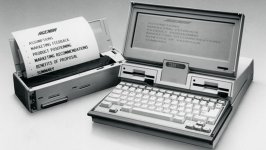
...wait until 1986 for the IBM Convertible 5140. It weighed in at 12 to 13 pounds (approximately 5.5 to 6 kg). I was tempted to buy one but at $1,695 with 256K of RAM and no hard drive, I gave it a pass. The PC Convertible has expansion capabilities through a proprietary ISA-based port on the rear of the machine. Extension modules, including a small printer and a video output module, were provided as plastic modules that snap into place. The machine can also take an internal modem, but has no room for an internal hard drive. The printer used thermal paper or, with a ribbon added, could impact print on regular paper or narrow tractor feed continuous forms.
IBM Convertible.jpg
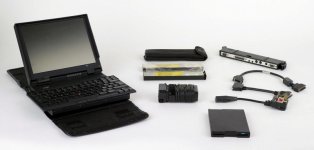
I carried my P75 Luggable (10 kg or 22pounds) back and forth between Florida and Northern Virginia starting in July 1995. By September I had enough and splurged on the IBM Thinkpad 701c, the one with the butterfly keyboard. IBM gave no discount to ex-employees so I forked over the $2,299 for the Intel DX4 75/25 MHz with a 720 MB hard drive. It came with a bunch of dongles and a separate 3.5 diskette drive and it only weighed 4.96 lb (2.25 kg). What a game changer. I could work on the plane for the 4-hour commutes every other week and not bother the person in the next seat. I carried that little guy on a trip to India and I didn't get dinged for multiple carry-ons. It fit nicely in my shoulder bag so my roll-on that went in the overhead bin only had my two-week supply of clothes and toiletries. When you stay in hotels in India, overnight dry cleaning and laundry were close to free. I think IBM made a mistake killing the 701 after only 9 months on the market. Even so, it was the best selling laptop of 1995.
IBM Thinkpad 701c.jpg
I bought an extra docking station so the one at home didn't need to travel with me to NOVA (Northern Virginia). I would still have it but the plastic was turning into a kind of black goo that I couldn't clean.
 

gilr

Well-known member
Joined
Jul 26, 2008
Messages
299
Location
Richmond, VA
Thanks for more memories Bob, I think IBM made a big mistake selling the laptop PC business to Lenovo, the ThinkPads were very good machines, but perhaps they figured the couldn't compete with cheap Asian manufacturers. And, a hell of a lot easier to carry on a plane!
 
OP
B

Bob Heine

ALLIANCE MEMBER
Joined
Oct 24, 2009
Messages
10,708
Location
Boca Raton, Florida
Bob,

To this day, I can't believe how far down IBM leadership had their collective "heads in the sand." Around 2007 I worked on a fairly substantial consuting project for them concerning mainframe parts and service. At the presentation they completely rejected the data simply because it conflicted with their version of reality. We left frustrated because I had spent weeks gathering data from users and independent service providers that reflected the true pulse of the market. The bright spot was that we used their pricing model so we did pretty well on that job. They chose to ignore some very accurate and very expensive data.

Lou
Lou, the little group that put together a bunch of parts and an operating system was led by Don Estridge. Don made hundreds of trips to Armonk to try to convince the executives there was a market for a Personal Computer. Most top IBM executives were salesmen and they couldn't grasp what Don was showing them. When they finally gave Don the go-ahead, the bean counters predicted it would be a success if 240,000 units were sold during its five year expected life.
  • 65,000 units sold within the first four months of availability.
  • 100,000 orders taken by Christmas of 1981.
  • 200,000 units sold by the one-year mark.
The success of the PC really pissed off the mainframe folks. They were out to destroy us from the get-go and it got worse when the new ESD (Entry Systems Division) was formed. When one of my departments gave me a presentation on a new on-line help system for OS/2, I approved it because it was such a tiny footprint in the operating system and worked like magic. As soon as the IBM Charlotte group that was developing BookMaster (plus BookManager), an online documentation system, they started calling the manager I assigned to the project. She was getting 2,000+ PROFS (Professional Office System) e-mails a week, all of which required detailed answers. They wanted a copy of BookMaster in every copy of OS/2 and a royalty of $100 per copy. Without BookMaster, a copy of OS/2 Version 1 was going to sell for $325 so adding another $100 was ridiculous. The BookMaster software required 10 diskettes to be added to the 13 needed to install OS/2. Our help system took up 50K in the operating system and was included in the price of the operating system.

When Don Estridge died in 1985, mainframe experts took over and tried to negotiate deals with Bill Gates. The JDA (Joint Development Agreement) gave Microsoft any and all software IBM developed for OS/2. That included our patented Help system and all of the Windows 3.1 bug fixes to allow Windows to run seamlessly in OS/2. As mentioned before, Microsoft threw out those bug fixes and gave application workarounds to all their App developers. Surprise, surprise, our hot line received millions of angry calls about Windows apps not running in OS/2. Obviously those negotiations between IBM ex-salespeople and Bill Gates went great and resulted in Microsoft becoming a bigger player in the market than all of IBM. Microsoft surpassed IBM in market value within 10 years and other than a brief switch, has grown far beyond IBM in both value and influence. PC manufacturing moved to Charlotte, NC in 1987 and software development moved to Austin, TX in 1996. Having retired from IBM Boca Raton in 1994 with an offer I couldn't refuse, I missed out on moving to a new location and working for a bunch of strangers who hated our guts (Austin was focused on AIX and Charlotte was focused on consolidating IBM hardware manufacturing from all over).

IBM sold the rights to the "THINK" brand to Lenovo in 2005. A very telling and ironic action.
 

loganb

ALLIANCE MEMBER
Joined
Dec 29, 2011
Messages
5,619
Location
Omaha, NE
Logan, Miami and I have a love/hate relationship so I have little advice on the things to do. I think you're already on the right track and Tripadvisor has some good suggestions:

The one place they don't list that I would put at the top for a member of the Garage Journal is The Coral Castle:
It's a 30 mile drive from Miami International Airport, at 28655 S Dixie Hwy, Homestead, FL 33033 (assuming your rental car has a GPS). One sickly man built a garden and house out of the native sedimentary rock called Oolite. By himself, without a single helper (or witness), he quarried 1,000 tons of the rock and carved them into 260 shapes and structures, the heaviest one weighing 21 tons and tallest standing 23 feet. There's a huge swinging door you can open with one finger. All of his tools and equipment were from junked Model T and A era vehicles. Your wife may enjoy the carvings but I guarantee you will enjoy the mystery. Even if he had a modern crane, cutting a chunk of rock in the ground, lifting it out and transporting it to its resting place, cutting a bunch of rock away and still having a 21 ton thing that you have to lift into position is mind boggling. Maybe it's just me -- I mean it was just tuberculosis and he hat two good arms.

My hate for Miami comes from the day we returned from a vacation to Miami International Airport on April 18, 1980. As our plane made its final descent I noticed a number of columns of smoke rising over Liberty City and Overtown. Once on the ground our African American porter told us to get on the limited access highway with our windows closed and stop for no one and don't take a side street -- get to I-95 as fast as I could. The air conditioning in our 1971 Lincoln Town car was not working so we had a sauna ride from the airport to I-95, when we opened the windows an inch or two.

Not precisely in Miami but you'll be closer to it than you usually are. This was my first thought, alas, Google Maps tells me it's a 3 hr 18 min drive from Miami:


Thanks for the recommendation's gent's! We hit a number of the items on the TripAdvisor list, didn't make it to Coral Castle though. We did this trip without a rental so did some public transit in downtown Miami and uber to/from airport.

A dedicated "space" trip is a bit of my bucket list to go and watch a launch, we looked ahead of time at the launch schedule and saw nothing was scheduled to launch while we were there....had it been on the books we would've gone. With the rate of SpaceX launches my "rocket launch trip" will probably end up being a SpaceX launch from Texas which is fine with me....no preferences on what I see I just want to see 1 go up....and why not see the biggest one then in Super Heavy launching from South Texas
 
OP
B

Bob Heine

ALLIANCE MEMBER
Joined
Oct 24, 2009
Messages
10,708
Location
Boca Raton, Florida
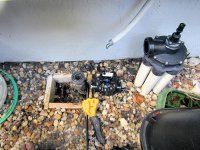
I'm keeping myself busy. I was expecting a very reasonable water bill in November and was surprised it was over $400 for October & November. I happened to move a yard cuttings garbage can and exposed the sprinkler system. Water was dripping from both sides of the solenoid control valve, like two drops a second.
Solenoid Valve Leak 0.jpg
From the green slime it's obviously leaking from the supply side but with the valve turned off it's also leaking on the distribution side. Fortunately, I installed this valve setup with gray PVC unions at both ends. Cut the wires to the solenoid and disconnected the valve.
Solenoid Valve Leak 2.jpg
Following some probably biased advice, I used PVC sealer/lubricant to make up the new valve and all the old fittings.
Solenoid Valve Leak 3.jpg
I put it all back together and tested it. Well, it's still weeping on the supply side but not on the side that goes to the sprinkler heads -- until I energize the solenoid. Rather than go back to the drawing boards, I started work on the protective cabinet so the sprinkler system plumbing isn't getting hit by random items.
Sprinkler Housing 1.jpg
I eventually got the box in position after making a number of cuts and holes in the box and lid. But that will wait for another post.
 

rharman

Well-known member
Joined
Apr 22, 2012
Messages
8,897
Location
SoCal
@Bob Heine - I remember using BookManager.

Whenever I see an OS/2 reference, I laugh. I was at a meeting of some computing organization - don't recall which - when OS/2 was announced. They did a drawing for a free copy. I won! I was probably the only person in the room whose employer had exactly ZERO machines capable of running it. They thought they were being generous allowing me to order PS-2 Mod 30's (with an 8086). Which was funny, considering we were a big IBM shop running multiple System/38's & AS/400's at the time and always the latest/biggest available - later adding a dozen AIX boxes to the mix.

We had a graphics department that produced our monthly sales magazine reaching over 3 million members. When we finally got them computerized (for CorelDraw?), I was told to use the computers we sold in our stores - Packard Bell 386's. What junk. Disk drives (Seagates) suffered from horrible "stiction". This group of users, being artists, posted a drawing above their "server" that was driving a Bernoulli Box to detail the startup procedure.
  • Turn on power to Bernoulli Box
  • Turn on power to PC
  • Bop the disk drive lightly to get it started
Accompanied by a drawing depicting the act. Like this but non-destructive.
They actually had a little wooden mallet kept next to the PC which had the case open.
1765340198156.png
 

Squankum

Well-known member
Joined
Mar 28, 2011
Messages
7,835
Location
Southeast
I put it all back together and tested it. Well, it's still weeping on the supply side but not on the side that goes to the sprinkler heads -- until I energize the solenoid. Rather than go back to the drawing boards, I started work on the protective cabinet so the sprinkler system plumbing isn't getting hit by random items.
Sprinkler Housing 1.jpg

Good idea, Bob! Some punk in your neighborhood is hurling dead blow hammers!
 

Squankum

Well-known member
Joined
Mar 28, 2011
Messages
7,835
Location
Southeast
@Bob Heine - I remember using BookManager.

Whenever I see an OS/2 reference, I laugh. I was at a meeting of some computing organization - don't recall which - when OS/2 was announced. They did a drawing for a free copy. I won! I was probably the only person in the room whose employer had exactly ZERO machines capable of running it. They thought they were being generous allowing me to order PS-2 Mod 30's (with an 8086). Which was funny, considering we were a big IBM shop running multiple System/38's & AS/400's at the time and always the latest/biggest available - later adding a dozen AIX boxes to the mix.

We had a graphics department that produced our monthly sales magazine reaching over 3 million members. When we finally got them computerized (for CorelDraw?), I was told to use the computers we sold in our stores - Packard Bell 386's. What junk. Disk drives (Seagates) suffered from horrible "stiction". This group of users, being artists, posted a drawing above their "server" that was driving a Bernoulli Box to detail the startup procedure.
  • Turn on power to Bernoulli Box
  • Turn on power to PC
  • Bop the disk drive lightly to get it started
Accompanied by a drawing depicting the act. Like this but non-destructive.
They actually had a little wooden mallet kept next to the PC which had the case open.
1765340198156.png
 

scooterbum46

Well-known member
Joined
Jan 29, 2014
Messages
884
Location
South Central Michigan / ex Gulf Coast Florida
Kay, those dots were already hard to see. I can't imagine the size of the specks in the high density tapes. I come from the computer age when there was a sledge hammer for whacking the steel frame of the computer to check for loose filaments in the vacuum tubes.
Bob -I've still got a can (probably dry) of the magnetic fluid you'd spread on a piece of 800 BPI tape to look at the tracks. Only use AFAIK was to demo "tracks" to visitors.

As far as the sledge hammer bit - my trainer in my first Operations job (ca 1967) had developed the belief that when a 2400 series tape drive went into read error conditions (where the drive kept backing up and retrying a section of tape) that stomping on the computer room floor in front of the drive would help. In view of the fact that this was the old "goldfish bowl" computer room, I'm sure that more than one visitor left believing there were either rodents, bugs or snakes that we were trying to stomp out.

With my latest storage acquisition, a simple 16 TB Buffalo NAS, I've given up in trying to compare hard drive costs with the 1967 equivalents. Google says 1967 prices work out to about $.10 per byte. Whatever, let's just repeat the saying that popped up around my place in the '90's "Disk is cheap"....
 
To avoid these ads, REGISTER NOW!
Top Bottom