I do love how they don't have the technology to read it anymore, and have to send it away to get a dump. Sad part is, that it may be scrambled at this late date. Magnetic media has a limited lifespan. Bit rot is real. When I ran data centers, we had a planned data refresh cycle for all archived magnetic media.
Kay, in 1965 my unit record account was at JC Penney. They ran an IBM7010 with a 40K word core storage unit twenty 729 tape drives. After my return to work at the end of the year I was doing some machine language coding for a parts inventory program. One day they asked me to go to GCS (Grand Central Station) to meet a guy from the IBM Poughkeepsie plant. He was delivering a 60K word core storage upgrade and didn't want to navigate the subway system for the final leg. I met him and he handed over a large, heavy box on a flimsy two wheel hand truck. I didn't witness the upgrade process because the IBM CEs (Customer Engineers) did it over the weekend. It involved a huge number of connections and re-wiring, including the core storage power supply. I think it was the first field upgrade of a 7010 to 100K.
And my Ryzen 9 based PC-in-a-cigarette-pack supposedly has 20 BILLION transistors. That's 6 million times the number as a Intel 8008. Oh, how times have changed.
Kay, as you know, Moore's Law states that the number of transistors in a dense integrated circuit doubles approximately every two years, leading to corresponding increases in processing power while the cost per transistor decreases. I'm terrible at math but doubling 31.5 times (in 61 years) sounds about right to be 6 million times bigger.
That 100K word 7010 leased for $6,000 to $7,000 per month. The peripherals were probably twice that per month.
For those of you not from the NYC metropolitan region, here's a little language lesson. When you see "Kill" in place names, blame the Dutch! Fishkill, NY, the Kill Van Kull over near Bayonne, NJ, the Fresh Kills landfill in Staten Island -- kill was the word the Dutch in the area way back used for streams.
(I don't know about the modern Dutch language, as all of the Dutch were driven out by angry Irishmen wielding shillelaghs in 1833.)
@Squankum, Liane's 8th great grandfather, Jan Arcer, was born in Amsterdam, Holland around 1630. He emigrated to Westchester County sometime before January 1658 when he was party to a lawsuit. He married an English woman in 1659 and when the British took over New Amsterdam (without a fight) in August 1664, he changed his name to John Archer and two years later bought 110 acres of land near Kingsbridge and founded the village of Fordham. John signed the the oath of allegiance to the English king and was confirmed by royal patent as First Lord of the manor of Fordham and granted the land from Kingsbridge south to Moristania between the Hudson and Bronx Rivers, approximately 3,900 acres. It included Spuyten Duyvil (Dutch for "Spouting Devil" because of the fierce tidal currents at the juncture of the Harlem and Hudson Rivers). To pay for improvements, he heavily mortgaged the estate to Cornelius Steenwyck and died suddenly in his coach on a trip from Fordham manor to New York. John's son and Steenwyck petitioned to be executor of his estate but before it could be settled, Steenwyck died and his will conveyed the manor of Fordham to the Nether Dutch Reform Church. Conflicting claims reduced the extent of the property and at some point the Catholic church acquired a piece of land that became the site of St. John's College, a jesuit institution that was later renamed Fordham University.
My 7th great grandfather, Jean John Coutant, was born in La Rochelle, France around 1658. A Jeanie come lately, he was living in New York City as early as 1692. He and his wife moved to New Rochelle in 1703 to a 100 acre farm. When he died his wife sold the farm and bought a 114 acre farm on the other side of town. Their son, Isaac, married Catherine Bonnefoy in 1718 and died at age 58 in 1755. Catherine died on November 23, 1776 and would have been buried in the church yard in White Plains next to Isaac but because the British controlled that location, she was buried on the farm. It became a private family cemetery and because I'm a descendent, that's where Liane and I will share a headstone, in the middle of New Rochelle, New York.
In addition to Kill, the early settlers had the creek, brook, run, burn and river. Bull Run near Manassas, Virginia was one of those little watterways. Some say the names indicated the width of the waterway and whether you could step over, jump over, wade across or swim across.
D'oh! I hadn't thought of Mr. Disney. I ran and googled for Chuck Jones's bio.
I had no clue either but a Google of "famous cartoonist Kansas City" mentioned Walt Disney (in the right time frame).
That worked on the old low density tapes. Imagine doing that for even a small percentage of a couple million reel archive.
More modern ones, like the carts, are too dense, with 19 tracks and 10 times the linear density. Even the operator tricks, like drowning the read head in drive cleaner, to force a read, or washing the tape in carbon tet or drive cleaner, don't work with sick carts.
Kay, those dots were already hard to see. I can't imagine the size of the specks in the high density tapes. I come from the computer age when there was a sledge hammer for whacking the steel frame of the computer to check for loose filaments in the vacuum tubes.
Good old 9-track tape. 1600 or 6250 bpi. I still remember moving them around - looking like the Michelin Man with the tapes stacked up on my arms.
Roger, I know you were out west but there were a bunch of operators in New York who did the Michelin Man thing.
Kay, the Michelin Man (and Woman) operators always had a handful of the write protect rings.
At one time, I did a quick presentation to some folks on the tape technology changes that had occurred in my time at that employer. 8mm, QIC, 9-track, LTO (various generations). Pretty frightening how the capacity has increased exponentially.
Cracks me up that it would take 50,000 of the hard drives from my original IBM XT to equal the single NVMe in my laptop today.
Roger, I spent $399 on a used 5M hard drive for my first PC.
I was a VAR for IBM PCs in my company back in the 80s, and I recall getting a shipment of new XTs in and wondered what on earth we would store in the massive 5 MB hard disks!! Boy have times changed!
Gil
Gil, it was a game changer going from two 5.25" floppy disks to a hard drive.
And.... What about the whopping 384k memory mine came with? 256k standard on motherboard and 128k extra on an AST 6-Pack card!
Although, I did max out the 6-Pack card to get to 640k. Used a lot of it for a RAM disk. Really sped up large program compiles.
Roger, I was thrilled that my soldering and jumpers worked to upgrade my PC from 64K to 256K. Another game changer.
And the price was around $5K for said machine before the upgrades! It came with OS/2 and used Token Ring networking instead of Ethernet. Those were the days.
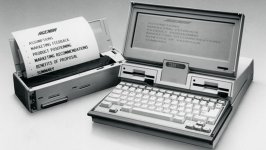
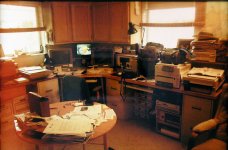
Gil, when I took the IBM Australia assignment I bought a brand new IBM PS/2 Model 70 desktop (20MHz 386 processor, 2MB memory, 3.5" diskette drive and 20MB ESDI hard drive) with keyboard and 2 button mouse. Added an 8513 12-inch 256 color monitor and 4201 ProPrinter dot matrix printer. With my employee discount it was $5,200 and it arrived the day before our flight was to depart. Upon return to the US in 1991 I bought a surplus P75 Luggable for just over $1,000 (they retailed for $18,500) and a bunch of Microchannel adapters, including everything needed for a Token-Ring network. While working as a contractor at IBM from 1993-4 (part of my retirement at 50 deal) I took a side job with Fairway Technology in Deerfield Beach, Florida. A former boss started the company to develop a CD and DVD on demand systems with Blockbuster Video. I was writing the manuals for the in-store machines and everything worked great until Blockbuster tried to get the motion picture studios to provide the rights to the movies. To be able to digitize drawings and photos I added a HP flatbed scanner to the office and a Lexmark 4019 laser printer to provide drafts of the manuals. Between the two jobs, my office was a giant mess 90% of the time. Still is.


 . I've read some of your stuff, Cody (