To avoid these ads, REGISTER NOW!

I don't want a track saw !

AEAdam

Well-known member
Joined
May 27, 2023
Messages
2,783
Location
SE PA
You can also use the rip guides made for the circular saw to cut off the stock edge off of a sheet of plywood, and use that as the “straight edge” and glue or nail that to the bottom piece of plywood the saw runs on.
Just rub some paste wax into the edge and lower wood to lower friction.
Not this application but I've done this before. I've waxed or oiled a lot of wood. Furniture wax like butchers, even car wax, can get sticky, which in a wood shop, attracts dust etc etc. It's totally workable and cheap and just about everyone has wax in their workshop. I keep a block of beeswax in my toolbox and an old candle under my work bench for waxing plane soles etc.

Better is to apply a strip of UHMW. UHMW comes in strips with a PSA back that's pretty ideal if you want a low friction surface. I'm currently working with Azek for a lot of stuff- not low friction, but better than plywood. You could line something with that.
 
To avoid these ads, REGISTER NOW!

Mr onetwo

Well-known member
Joined
Apr 6, 2011
Messages
2,010
Location
Coastal Maine
Plus 1 on a real track saw. I have a Makita corded model and it makes cutting sheet goods so accurate and easy. I do not regret spending the money on it one bit. I may move to an LXT 18vx2 cordless next year as the cord seems to always be in the way, not sure at this point.
 

jblnut

ALLIANCE MEMBER
Joined
Jan 17, 2015
Messages
7,086
Location
In the Middle of MN
I use my track saw to break down sheet goods once in a while but mostly use it to put a straight edge on home sawn lumber. Prior to the track saw I used a homemade shooting board like a few have described and shown.

OP if you’re such a tightass just build your own for $20 like a few in here have shown. You can build a dozen of them in different sizes if you want.
 

dnschmidt

Well-known member
Joined
Oct 3, 2014
Messages
7,284
Location
Phoenix, AZ
I bought the Milwaukee and kinda regret it. I think I would have been happier with Makita.

I think you know this about me: I think most tool reviews are ****. Tool reviews quickly became tool sales or YouTube businesses such that its tough to actually get someone with actual hands on experience using the tool.

Anyway, I bought that saw like a year ago or so and have used it pretty extensively. 2 things I don't like about my Milwaukee Track saw:
1) It needs batteries bigger than any of my other Milwaukee tools need. Therefore, the saw doesn't/can't use a common M18 battery. I have a few Milwaukee tools and none of them share batteries with the saw. I think the 2 smaller batteries on the Makita solves that.
2) The Milwaukee blades aren't great. And that's the business end of the tool. Makita uses Tenryu blades which are top notch. And the way their blades are, you can swap them for Freud/Diablo blades, which I like. Milwaukee can't. The blade thicknesses and kerfs don't allow brand swapping (or I'd cut the fence rubber or have a gap). The other related problem is the thickness of the riving knife. Technically I could take it off I guess.

Regarding track saws: I used mine for the last 3 days straight- almost all day long. Today, I had this sort of epiphany: I do what I do, I make my cuts, then the track goes away, saw goes on a shelf under the work bench, and all my stock is there on my clean work bench ready for the next step. My saw station is my workbench. And all the stuff I need is right there. I don't move lumber to another place, an assembly table or whatever. It's convenient to just have a work bench where you do all your work.
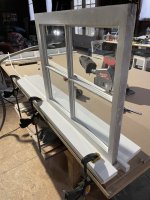
IMG_7915.jpeg

This is an old picture, but I'm building the last 4 windows for the 3rd floor of my next house (barn conversion). I saw up Azek to make cpvc frames for 120yr old window sashes. I do the whole job including painting at this one work bench. At the left end of the bench, I drilled a hole for a router and made a fence out of scrap Azek.

IMG_7913.jpeg

I just hold it in place with C clamps at each end. The MDF could be waxed or finished to make a lower friction surface. The Azek is ok- not as good as UHMW, but this was scrap I had on hand.
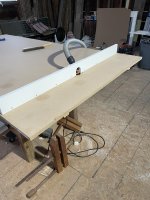
IMG_7912.jpeg

Here's the cut-out for the router bit on the other side.
My response to your points.

Point #1) Not valid for me as I have a huge collection of all three FORGE batteries 6.0, 8.0 and 12.0 so this deficiency doesn't affect me.
Point #2) I didn't know that and that's valuable information. I too prefer Freud/Diablo and Tenryu blades and would consider buying Forrest of Ridge Carbide blades for this saw as that's what I use on my table saw. Additionally, I have Makita tracks and I've been told that the Milwaukee saw works on these tracks but not as well as it should and does on the Milwaukee tracks. When an 8 foot track cost as much as the saw this is a serious consideration. THANKS FOR POINTING THIS OUT!
 

jar944

Well-known member
Joined
Jul 26, 2010
Messages
5,935
Location
Northern VA
My response to your points.

Point #1) Not valid for me as I have a huge collection of all three FORGE batteries 6.0, 8.0 and 12.0 so this deficiency doesn't affect me.
Point #2) I didn't know that and that's valuable information. I too prefer Freud/Diablo and Tenryu blades and would consider buying Forrest of Ridge Carbide blades for this saw as that's what I use on my table saw. Additionally, I have Makita tracks and I've been told that the Milwaukee saw works on these tracks but not as well as it should and does on the Milwaukee tracks. When an 8 foot track cost as much as the saw this is a serious consideration. THANKS FOR POINTING THIS OUT!
#2 is a non issue, the blades are standard the riving knife is setup for the factory thin kerf blade.

I only have makita tracks and they are fine.
 

gahrajmahal

Well-known member
Joined
Dec 12, 2008
Messages
2,537
Location
Cincinnati, Ohio
I work out of a two car attached garage that always has two cars, so all my stuff is on wheels and usually work happens in the driveway. I have also had loads of work offsite so my tools have to be portable, that means liftable by an old man and at the end of the day. I can lift the heavy tools easier in the morning than after bashing it all day!

My secret is to use an inexpensive plastic 8 ft. Folding table. To cut down sheet goods I lay something sacrificial onto it then lay the sheets flat on top of that. My straight edge is, like others have shown, an 8 ft. Long factory edge of 3/4” plywood and some quick clamps. I have the measurement from the shoe to the blade written down on the shoe of my cordless Metabo saw and my corded Milwaukee.

For my table saw I have a Bosch, contractor saw and a custom built plywood stand. The stand has locking wheels and places the top of the table saw 1/4” above the surface of my 8 ft. Long plastic folding table. This becomes my out-feed table and can be used to the side or directly behind. The saw is light enough (barely) so I can tip it into the back of my low-to-the-ground Honda Ridgeline. I modified the table saw by replacing the normal cord with a 25’ long extension cord wired directly so no additional cords needed usually. Under the saw I have a large sliding plastic container that collects the majority of the sawdust. I reuse that for soaking spills and hardening old paint etc.

IMG_1616.jpeg

IMG_1617.jpeg
 

RyanE

Well-known member
Joined
Feb 4, 2013
Messages
201
Location
Golden, BC
@jar944 you saying the Milwaukee works on Makita tracks?
Yes it does. And the Makita track was much cheaper than the Milwaukee track when I bought my saw 2 years ago, so I bought both the 110" and 55" Makita tracks.

There is a locking feature on the Milwaukee saw that secures it to the Milwaukee track for beveled cuts. The Makita track doesnt have the correct profile to allow this feature of the Milwaukee saw. I don't need this feature so wasn't concerned about losing it since my main purposes for the tracksaw are square cuts on sheet goods.
 

jar944

Well-known member
Joined
Jul 26, 2010
Messages
5,935
Location
Northern VA
Yes it does. And the Makita track was much cheaper than the Milwaukee track when I bought my saw 2 years ago, so I bought both the 110" and 55" Makita tracks.

There is a locking feature on the Milwaukee saw that secures it to the Milwaukee track for beveled cuts. The Makita track doesnt have the correct profile to allow this feature of the Milwaukee saw. I don't need this feature so wasn't concerned about losing it since my main purposes for the tracksaw are square cuts on sheet goods.

That locking feature is a gimmick imho. The Makita has that feature as well and you still have to hold the saw to keep it from tipping on a steep bevel cut.
 

dnschmidt

Well-known member
Joined
Oct 3, 2014
Messages
7,284
Location
Phoenix, AZ
Aren't track saws for building furniture? Like built in book cases and taller things like the Biltmore wall pieces? LOL
Zim
That was their original purpose but oddly they are now used by framers. RR Buildings on YouTube use them all the time as does Studpack. Just makes cutting sheeting easier and giving clean straight cuts.
 

Aaron_W

Well-known member
Joined
Feb 6, 2018
Messages
2,927
Location
Northern California
2) The Milwaukee blades aren't great. And that's the business end of the tool. Makita uses Tenryu blades which are top notch. And the way their blades are, you can swap them for Freud/Diablo blades, which I like. Milwaukee can't.

Being locked into proprietary blades is a huge negative for a circular saw. While I'm sure there are plenty of people who don't care, woodworkers can be pretty particular about saw blades. I'm not even that fussy being perfectly happy with Diablo and I wouldn't even consider a saw that couldn't use standard 7-1/4" blades.
 

rlitman

Well-known member
Joined
Oct 18, 2010
Messages
24,630
Location
Long Island
Being locked into proprietary blades is a huge negative for a circular saw. While I'm sure there are plenty of people who don't care, woodworkers can be pretty particular about saw blades. I'm not even that fussy being perfectly happy with Diablo and I wouldn't even consider a saw that couldn't use standard 7-1/4" blades.
That is unfortunately an issue common among all track saws. Even if you can find a number of brands that fit, since the dimensions vary a bit across brands, a change in blade can necessitate a splinter guard replacement.
 

jar944

Well-known member
Joined
Jul 26, 2010
Messages
5,935
Location
Northern VA
Being locked into proprietary blades is a huge negative for a circular saw. While I'm sure there are plenty of people who don't care, woodworkers can be pretty particular about saw blades. I'm not even that fussy being perfectly happy with Diablo and I wouldn't even consider a saw that couldn't use standard 7-1/4" blades.

You are making something out of nothing.

All track saws use a 160-167mm blade with 160 (festool) and 165 being most common. The 160 works fine on the 165mm saws.

It's no different than having a 6.5" saw

That is unfortunately an issue common among all track saws. Even if you can find a number of brands that fit, since the dimensions vary a bit across brands, a change in blade can necessitate a splinter guard replacement.

The same could be said for any saw with a zero clearance insert. Any change in carbide width will require a new insert.

The reality is you can just use the various blades and account for the extra offset visually. If you need perfect edges, just make a scoring cut first. Or just keep to one brand, and tooth count.
 

tarbellb

Well-known member
Joined
Apr 17, 2011
Messages
5,762
Location
Oregon
You are making something out of nothing.

All track saws use a 160-167mm blade with 160 (festool) and 165 being most common. The 160 works fine on the 165mm saws.

It's no different than having a 6.5" saw


The same could be said for any saw with a zero clearance insert. Any change in carbide width will require a new insert.

The reality is you can just use the various blades and account for the extra offset visually. If you need perfect edges, just make a scoring cut first. Or just keep to one brand, and tooth count.
This ☝️

The splinter guard is the only thing that needs replaced when changing blade brands, and often not needed unless you go ultra thin kerf.

That being said, I buy the Diablo 6.5" blades for under $10ea and run them no problem in my Makita

Festool and the new wave of tool nerds using it have really warped the industry and the perceived necessity of whats required.
But (some) woodworkers have always had a rep for being.... a bit precious 🤣
 

dnschmidt

Well-known member
Joined
Oct 3, 2014
Messages
7,284
Location
Phoenix, AZ
This ☝️

The splinter guard is the only thing that needs replaced when changing blade brands, and often not needed unless you go ultra thin kerf.

That being said, I buy the Diablo 6.5" blades for under $10ea and run them no problem in my Makita

Festool and the new wave of tool nerds using it have really warped the industry and the perceived necessity of whats required.
But (some) woodworkers have always had a rep for being.... a bit precious 🤣
If you think Festool owners are bad just check out Felder owners. They are without doubt the worse.
 

neophyte

Well-known member
Joined
Apr 23, 2012
Messages
9,725
Location
Pennsylvannia
Being locked into proprietary blades is a huge negative for a circular saw. While I'm sure there are plenty of people who don't care, woodworkers can be pretty particular about saw blades. I'm not even that fussy being perfectly happy with Diablo and I wouldn't even consider a saw that couldn't use standard 7-1/4" blades.
Most track saws, starting with the early Festool saws, didn’t really use “proprietary” blade sizes.
In the USA, the blades just wound up seeming “proprietary” because the blades were European standard sizes, that were not readily available in the USA, other than from Festopl and Mafell, who charged up the **** for the blades. (Which admittedly were on the higher end of blades quality wise).
Once Festoll seemed a standard and popular saw choice, and other manufacturers such as Makita started producing track saws, using the same blade sizes as Festool, other blade options became available from manufacturers like Tenryu etc.
some manufacturers like Hilti, simply modified a standard saw also sold in Europe, to use a standard 7-1/4” US blade size, which is what most major international tool manufacturers, like Makita and Bosch, do when selling saws in different markets were different blade sizes are standard.
Festool and Mafell don’t bother with this.
The 165mm blade size that is sort of the standard size for a number of the track saws, actually works out to practically the same as 6-1/2 inches, which was a standard US blade size, although way less standard than 7-1/4”.
The other major issue is the arbor size, which on US saws is usually 5/8” or sometimes 1/2” or 3/8”, but which on the European track saws is usually 20mm.
Adapter arbors can be used, (if you can find metric/inch adapters) to to shrink the 20mm arbor holes to US sizes, but the arbor holes need to be rebored for larger sizes, and nobody makes a good jig that I know of to do that on site.
As for 7-1/4”, 190mm which works out to 7-1/2” used to be a standard size for track saws from Festool and Mafell, and 7-1/4 blades should be useable just fine other than the arbor hole issue, (which for 190mm was usually 30mm), but both have since dropped the size.
Mafell have since started making a 185mm track saw, which practically works out to 7-1/4”, but the arbor hole sizing issue still exists.
Some saws were made in ways that the arbor hole could be resizes or adapted, but the manufacturers generally never offered the option.
 
To avoid these ads, REGISTER NOW!

milkovich

Well-known member
Joined
Oct 15, 2007
Messages
689
Location
Akron Ohio
FWIW, I used a 50" bora clamp for years, then I figured I'd be a cheapskate and buy a Kreg Accujig. It's junk. It took a bunch of messing around and UHMW tape to get the slop out of it. It also needs a reference to set up an 8' track so I never bother taking it apart.
 

neophyte

Well-known member
Joined
Apr 23, 2012
Messages
9,725
Location
Pennsylvannia
This ☝️

The splinter guard is the only thing that needs replaced when changing blade brands, and often not needed unless you go ultra thin kerf.

That being said, I buy the Diablo 6.5" blades for under $10ea and run them no problem in my Makita

Festool and the new wave of tool nerds using it have really warped the industry and the perceived necessity of whats required.
But (some) woodworkers have always had a rep for being.... a bit precious 🤣
The newer Festool and Mafell saws with the tracks that attach to the bases, so the saws can quickly and very accurately cut miters are nice, allowing close to the precision of the dedicated track saws, while also allowing use as a conventional circular saw once the track is detached, but the prices are high, and Festool discontinued their corded version.
 

tak1313

Well-known member
Joined
Feb 4, 2018
Messages
658

Garage Journal math is much simpler:

Being DIY,

See saw + not much use for saw = want saw = buy saw anyway.

Equation applies to both Milwaukee and Makita.

So I originally got the corded Makita. Worked fine for the few times I've used it so far, but was constantly annoyed at the cord getting hung up on stuff, especially on long cuts. That's when I started drooling at cordless, but did not want to go Makita because I have no other cordless Makita stuff.

When the Milwaukee came out (I am deeply entrenched in Milwaukee M18 and M12), it was almost like letting go after a box of Ex-Lax. Big plus was that the Milwaukee is Makita rail compatible.

So I kept drooling because of the price until one day ACME had reconditioned saws in stock. End of story, but I haven't actually used it yet.

I AM disappointed though that the blade kerf is not compatible. Luckily I also got new sacrificial rubber thingies just in case - which I haven't used yet.
 

Aaron_W

Well-known member
Joined
Feb 6, 2018
Messages
2,927
Location
Northern California
Most track saws, starting with the early Festool saws, didn’t really use “proprietary” blade sizes.
In the USA, the blades just wound up seeming “proprietary” because the blades were European standard sizes, that were not readily available in the USA, other than from Festopl and Mafell, who charged up the **** for the blades. (Which admittedly were on the higher end of blades quality wise).
Once Festoll seemed a standard and popular saw choice, and other manufacturers such as Makita started producing track saws, using the same blade sizes as Festool, other blade options became available from manufacturers like Tenryu etc.
some manufacturers like Hilti, simply modified a standard saw also sold in Europe, to use a standard 7-1/4” US blade size, which is what most major international tool manufacturers, like Makita and Bosch, do when selling saws in different markets were different blade sizes are standard.
Festool and Mafell don’t bother with this.
The 165mm blade size that is sort of the standard size for a number of the track saws, actually works out to practically the same as 6-1/2 inches, which was a standard US blade size, although way less standard than 7-1/4”.
The other major issue is the arbor size, which on US saws is usually 5/8” or sometimes 1/2” or 3/8”, but which on the European track saws is usually 20mm.
Adapter arbors can be used, (if you can find metric/inch adapters) to to shrink the 20mm arbor holes to US sizes, but the arbor holes need to be rebored for larger sizes, and nobody makes a good jig that I know of to do that on site.
As for 7-1/4”, 190mm which works out to 7-1/2” used to be a standard size for track saws from Festool and Mafell, and 7-1/4 blades should be useable just fine other than the arbor hole issue, (which for 190mm was usually 30mm), but both have since dropped the size.
Mafell have since started making a 185mm track saw, which practically works out to 7-1/4”, but the arbor hole sizing issue still exists.
Some saws were made in ways that the arbor hole could be resizes or adapted, but the manufacturers generally never offered the option.

Ah, they are 6-1/2", I didn't realize that.

I guess it is good that I bounced off the $400+ price tag of many track saws and just bought what is essentially a circular saw made to fit a track. It meets my needs just fine as I'm just breaking down plywood in my driveway, or cutting timbers to length. I just need straight cuts, anything fancy will get done with another saw. The Evolution circular saws come with an adaptor giving it either a 20mm or 5/8" arbor. I thought that was just their thing, I didn't know Europe used a different arbor size from the US.

If you use it often then I can see paying the price for a "real" track saw, but once you've bought the track, and such some of them are bumping the lower end of hybrid table saws. Clearly a different beast than the old Skil saw.
 

Steve_P

Well-known member
Joined
Sep 15, 2010
Messages
5,185
If you use it often then I can see paying the price for a "real" track saw, but once you've bought the track, and such some of them are bumping the lower end of hybrid table saws. Clearly a different beast than the old Skil saw.

Yeah, but a track saw doesn't take up floor space in a two-car garage- which most of us have. And it's infinitely safer to use for one person vs a table saw.

And I don't have a track saw, or table saw. But I've used a table saw many times and have also been very surprised by it more than any other tool, including a chain saw- yikes.
 

AEAdam

Well-known member
Joined
May 27, 2023
Messages
2,783
Location
SE PA
#2 is a non issue, the blades are standard the riving knife is setup for the factory thin kerf blade.

Milwaukee’s operator manual says:

“Match kerf width of blade (≥1.6 mm) (.063") and blade body thickness (≤1.3 mm) (.051") with the riving knife thickness (1.4 mm) (.055") to reduce the risk of Kickback."

Milwaukee’s thin 40T blades have .063 kerfs and .055 plates. (.063-.055)/2 = .004” offset

DIABLO 40T .039 thick, .059" kerf .010” offset
DIABLO 60T .039 thick, .057" kerf .008” offset
MAKITA 56T .039 thick, .057” kerf .008“ offset
MAKITA 48T .062 thick .087 kerf .012“ offset

All of these will cut the splinter guard back too much to get good performance out of the Milwaukee blades. 3 of the 4 are too thin for the Milwaukee‘s riving knife.

The reviews I saw all picked the milwaukee based on power, and speed of cut. But none of the reviews I saw reviewed cut quality to any extent or discussed any of these details about blade options. The Milwaukee blades are currently on sale. The 40T one I use was as much as $50 in some places, which I think is a lot. I found they were pretty consistently $35 at homedepot. (Currently on sale for $20.)

All things being equal, I think I would have prefered the Makita due to its bigger selection of high quality blades.

Detailed thread here:
 

whateg01

Well-known member
Joined
Mar 13, 2006
Messages
11,390
Location
doo dah, kansas, usa
I don't see how 0.004" difference is going to hurt anything. I'm pretty sure on the Bosch, there's more distance between the kerf and the splinter guard with the OEM blade.
 

jar944

Well-known member
Joined
Jul 26, 2010
Messages
5,935
Location
Northern VA
Milwaukee’s operator manual says:

“Match kerf width of blade (≥1.6 mm) (.063") and blade body thickness (≤1.3 mm) (.051") with the riving knife thickness (1.4 mm) (.055") to reduce the risk of Kickback."

Milwaukee’s thin 40T blades have .063 kerfs and .055 plates. (.063-.055)/2 = .004” offset

DIABLO 40T .039 thick, .059" kerf .010” offset
DIABLO 60T .039 thick, .057" kerf .008” offset
MAKITA 56T .039 thick, .057” kerf .008“ offset
MAKITA 48T .062 thick .087 kerf .012“ offset

All of these will cut the splinter guard back too much to get good performance out of the Milwaukee blades. 3 of the 4 are too thin for the Milwaukee‘s riving knife.

The reviews I saw all picked the milwaukee based on power, and speed of cut. But none of the reviews I saw reviewed cut quality to any extent or discussed any of these details about blade options. The Milwaukee blades are currently on sale. The 40T one I use was as much as $50 in some places, which I think is a lot. I found they were pretty consistently $35 at homedepot. (Currently on sale for $20.)

All things being equal, I think I would have prefered the Makita due to its bigger selection of high quality blades.

Detailed thread here:

Just run the blade you want any 160-165 will work assuming its not thinner than the riving knife. makita doesn't even have a riving knife and frankly the Milwaukee’s is more of a pain than anything. When you change blades on the Makita the same thing happens with the splinter guard. Either never change blades or just account for the offset.
 

AEAdam

Well-known member
Joined
May 27, 2023
Messages
2,783
Location
SE PA
Just run the blade you want any 160-165 will work assuming its not thinner than the riving knife. makita doesn't even have a riving knife and frankly the Milwaukee’s is more of a pain than anything. When you change blades on the Makita the same thing happens with the splinter guard. Either never change blades or just account for the offset.
Respectfully, I think this is really bad advice. For blade diameter, Milwaukee saws have really nice depth settings for on and off track. There’s a score setting. All this works really well with the correct diameter blade.

Having .002” clearance between the kerf and the riving knife sounds like trouble.

The details matter.

That said, I appreciate the “good enough” perspective. I do over complicate things sometimes. For this discussion, having used clamped on fences for years, the complexities of that approach, none of which we’ve discussed here, far exceed those of track saws. I made a lot of errors because the fence was not where the cut was. And do you mark a line or not? Most of the time the saw is on the scrap side. Still, I found this preferable to trying to cut 4X8 sheets on a small table saw.
 
Last edited:

rharman

Well-known member
Joined
Apr 22, 2012
Messages
8,870
Location
SoCal
Garage Journal math is much simpler:

Being DIY,

See saw + not much use for saw = want saw = buy saw anyway.

Equation applies to both Milwaukee and Makita.

So I originally got the corded Makita. Worked fine for the few times I've used it so far, but was constantly annoyed at the cord getting hung up on stuff, especially on long cuts. That's when I started drooling at cordless, but did not want to go Makita because I have no other cordless Makita stuff.

When the Milwaukee came out (I am deeply entrenched in Milwaukee M18 and M12), it was almost like letting go after a box of Ex-Lax. Big plus was that the Milwaukee is Makita rail compatible.

So I kept drooling because of the price until one day ACME had reconditioned saws in stock. End of story, but I haven't actually used it yet.

I AM disappointed though that the blade kerf is not compatible. Luckily I also got new sacrificial rubber thingies just in case - which I haven't used yet.

That equation works for the Kreg track saw as well. How do I know this? :dunno:
 

neophyte

Well-known member
Joined
Apr 23, 2012
Messages
9,725
Location
Pennsylvannia
Just run the blade you want any 160-165 will work assuming its not thinner than the riving knife. makita doesn't even have a riving knife and frankly the Milwaukee’s is more of a pain than anything. When you change blades on the Makita the same thing happens with the splinter guard. Either never change blades or just account for the offset.
One of the points of the track saws, is that the cutting track have a rubber strip designed to prevent chipping and tearout on the cut edge next to the track.
(This wasn’t on the first Festool saw tracks when Festool was “Festo”, but was added on the later track design that Festo started making, which is still essentially the same Festool track of today.)
If the blade body thickness and blade tooth kerf don’t have the same offset on all blades used, then the rubber anti splinter strip won’t, or will stop preventing chipping and tearout at the cutting edge, removing one of the benefits of using a track saw.
The strips can be heated and moved over a few tomes to save money, but this can be time consuming, or replaced, but this will get expensive, fast.
AEAdam was right to point out the issue, and even back when aftermarket blades started appearing on the market, I rarely saw Festool dealers, or woodworking magazines, mention the potential issue.
As for the riving knives, optimally, the riving knife on a saw should be just thicker than the blade body thickness, but thinner than the tooth kerf, (even after blade sharpening), so the the body of the blade is less likely to contact a kerf that might close up and cause kickback.
I’m not sure how many saws offer riving knifes in different thicknesses though.
 

AEAdam

Well-known member
Joined
May 27, 2023
Messages
2,783
Location
SE PA
One of the points of the track saws, is that the cutting track have a rubber strip designed to prevent chipping and tearout on the cut edge next to the track.
(This wasn’t on the first Festool saw tracks when Festool was “Festo”, but was added on the later track design that Festo started making, which is still essentially the same Festool track of today.)
If the blade body thickness and blade tooth kerf don’t have the same offset on all blades used, then the rubber anti splinter strip won’t, or will stop preventing chipping and tearout at the cutting edge, removing one of the benefits of using a track saw.
The strips can be heated and moved over a few tomes to save money, but this can be time consuming, or replaced, but this will get expensive, fast.
AEAdam was right to point out the issue, and even back when aftermarket blades started appearing on the market, I rarely saw Festool dealers, or woodworking magazines, mention the potential issue.
As for the riving knives, optimally, the riving knife on a saw should be just thicker than the blade body thickness, but thinner than the tooth kerf, (even after blade sharpening), so the the body of the blade is less likely to contact a kerf that might close up and cause kickback.
I’m not sure how many saws offer riving knifes in different thicknesses though.
Right on. I’m guessing Milwaukee’s riving knife drove them to source their own (thick plate thin kerf) saw blades. I have had my thin blades walk sideways in a cut when they get dull, resulting in unsquare edges. Otherwise, I think the .063 blades perform way better on a battery saw. The thicker .087 blades feel like I’m cutting with a shovel. I think these Tenryu blades were designed for corded tracksaws. End of story, I feel like I’m really limited to 2 blades on my Milwaukee. The 24T and the 40T. The 40T is night and day better for plywood.

Sorry for derailing this thread to tracksaws when the OP specifically requested to not discuss tracksaws.

Back on topic:
  • I’ve not yet purchased a 2x4 that was flat enough or straight enough to use as a straight edge. Mine are typically pretty twisted.
  • Sometimes the corner radii on construction lumber, depending on how well you can clamp it, lets the saw base slide underneath slightly, spoiling the cut.
  • A pine 1x4 has worked better for me. MDF can work, but needs to be wider. Azek is too bendy.
  • I cut a lot of plywood on saw horses. And it sags between the horses. If cut on a 4x8 workbench, with a stiff top and ideally sacrificial MDF or xps foam, that’s better
  • I’ve never been happy with the cut surface. There are things you can do to improve that. If you are cutting sheathing or sub flooring, maybe that doesn’t matter.
  • Whatever you use as a fence, ideally is low enough to fit under the motor side when sawing 2X material. That typically lets out finding a nice 2” angle extrusion. My saws won’t clear that. (I typically try to cut on the other side, problem is when the saw base is overhanging the edge of the material
  • Clamping is always an issue. I often don’t clamp my tracksaw track. It’s surface area and rubber strips hold it more than well enough most of the time. So if I’m cutting a 3’ piece of plywood on an 8’ long bench with an 8’ fence, I need spacer blocks and that’s not ideal
  • Last, I went from using a carpentry saw that ran on track to a dedicated plunge cutting tracksaw. Not being able to plunge meant starting the cut was trickier.
In my mind, these are the details one needs to have worked out to do good craftsmanly work with an applied circ saw fence. My family did this for 2 generations before me, so it can be done well. This was one of the things I personally found trickier than it appeared.

Hope this whole discussion and all the little details helps.
 

f121

Well-known member
Joined
Dec 8, 2018
Messages
2,078
Location
UK
The newer Festool and Mafell saws with the tracks that attach to the bases, so the saws can quickly and very accurately cut miters are nice, allowing close to the precision of the dedicated track saws, while also allowing use as a conventional circular saw once the track is detached, but the prices are high, and Festool discontinued their corded version.
I use the festool cordless with attached track a lot. Apart from the slightly shallow cut depth causing issues occasionally, it is fantastic. Dust extraction is not as good as a track saw, but much better than most circular saws. Accuracy is excellent.
 

purplezr2

Well-known member
Joined
Jun 1, 2010
Messages
5,294
Location
Central MN
That was their original purpose but oddly they are now used by framers. RR Buildings on YouTube use them all the time as does Studpack. Just makes cutting sheeting easier and giving clean straight cuts.
I used mine with an old blade to cut all my foam when doing by floor insulation on my shed build, used it for all the OSB and Plywood as well. It just makes life so easy to make perfect/straight/square cuts everytime.

I have a sliding table saw(altendorf) as well and still use the track saw alot.
 
OP
T

theoldwizard1

Well-known member
Joined
Feb 22, 2011
Messages
43,216
Location
SE MI
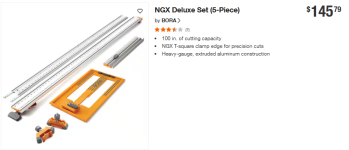
The Bora NGX looks very nice, especially with their shoe. Kind of pricey, but nice. Maybe next project !

Screenshot 2025-11-30 174357.png
Checking some YouTube videos, it appears that Bora has changed their "plate". The new one (in the above picture) does not look a nice as the older one (below).

Any feedback from people who have used either (or both) ?

Screenshot 2025-12-07 095743.png
 

tarbellb

Well-known member
Joined
Apr 17, 2011
Messages
5,762
Location
Oregon
$145 for a track and plate and NO SAW!

I cant....... For a few more dollars you get a real track saw and all its benefits and tracks?

What a odd compromise to make
 

AEAdam

Well-known member
Joined
May 27, 2023
Messages
2,783
Location
SE PA
$145 for a track and plate and NO SAW!

I cant....... For a few more dollars you get a real track saw and all its benefits and tracks?

What a odd compromise to make
The saws are usually around 350. You could easily spend another 150 on track. I bought a battery saw and spent another 150 on batteries, which isn't apples to apples. I would think you'd be hard pressed to buy a TS for less than $500. Could be wrong.

I just use the edge without the plate... I just keep a focus on holding the saw on the edge... And don't wander off. I found attaching the plate was too much trouble...

I have done a hundred or so cut downs with just the edge.

YMMV
If you had a saw you loved..... And it's connected to the track, which is really nice. And lets say this out loud:

No track, cutting freehand, you really want to be over the saw. So the plywood is on low horses, or probably on the ground with scrap under it. And you are bending over. Imagine a lengthwise rip operation. There's nothing ergonomically good about cutting plywood with a circle saw.

A fence makes this situation a little better. But generally, once the cut starts and you have wood on both sides of your blade (front and back) the saw blade tries to guide the saw. So again, you really need to be watching the guide rail. You can get good at this, and do it by feel. I did. But you can also make a mistake, especially at or near the end of the cut.

With a track saw, you put the plywood on a workbench up at waist level. You can't see or feel the cut. You are standing straight up. You set up the fence, clamp it or not, attach the saw, and the cut is a no brainer and one handed. You push it as hard and as fast as the motor will allow. If there's dust, turn your face away. Almost no skill required, which is nice as a beginner, or as a part timer who doesn't do the constantly.

More- the plunge feature is really nice. Forget about starting and stopping cuts in the middle of a sheet. Just the depth guide is really awesome. Milwaukee's is especially nice. It has 2 marks, one for on the track (2 lines) one for off the track (1 line). You set the thickness of the material you are cutting and it adds like 1/16" to ensure you are thru. So there's little worry about cutting up your work bench or saw horses.

Point is, for older workers, the ergonomics of track saws are way nicer. There are a couple minor details that make a big difference compared to a fence and a favorite circ saw.
 
To avoid these ads, REGISTER NOW!
Top Bottom