To avoid these ads, REGISTER NOW!

HUG Hydronics system- bought it, but I’m still not sure…..

bams50

Well-known member
Joined
Feb 23, 2012
Messages
2,784
Location
Central NY State
I just built a new barn, and the first thing I wanted was in floor heat. It is 40 wide by 64 deep with 16’ ceiling height.

After what I spent on the building, my budget was hurting. And then on this form, I came across the HUG open loop system. So I did a bunch of research, watched every video I could find, talked about it in another thread, and then pulled the trigger.

As seems to be the norm with me, it has not been easy. Installing the system was really pretty easy and straightforward. Turn right on. Started producing hot water. Of course, it takes a while, but the floor temperature was coming up.

After about three days, the heater started making a ridiculous moaning sound. It kept getting louder. Eventually, it was running, but not making heat. 18 KW tankless electric from State.

So, I called HUG. They agreed about calling me back. However, it was about a three hour diagnostic process on the phone. Finally, he determined that the heater must be defective. So they shipped me a new heater.

This system is two parts: the operating system, and the heater. Today, the system itself has been easy to operate and diagnose, and it hasn’t caused a single problem. But the heater was the issue. So the new heater arrived yesterday, and I installed it. It turned right on and started heating water immediately, and appears to be working properly.

Here’s the problem: it’s now been running 48 hours, and the floor temperature according to my heat gun has barely increased seven or 8°. The highest setting on the heater is 140°, what’s the temperature in the tank is barely hitting 80° still. Pipes going out to the floor are about 55 to 60°.

Currently, we have no insulation in there, it’s plastic wrap plus metal will a plastic wrapped ceiling. I wondered if the system would be enough to make a difference though. When I talk to the people at HUG they told me it should absolutely make a difference, some people use them to melt their driveways and they work fine.

My building is 2450 ft.². It is a single zone, eight loops of approximately 300 feet each, a total of around 2500 feet of tubing. I’m hoping somebody here can tell me if it’s working properly or not. How long should it be before I can feel some difference in there? To be fair it has been extremely cold. And I have it packed closely with 12 cars plus tools and so forth. Theory is that it’s taking a long time because not only does it have the concrete to warm, it’s trying to warm up everything in there, including all those cars all at once.

I’m trying not to be annoyed or frustrated. But I’m hoping people that actually know something can tell me: can I eventually expect it to make a difference? How long will it take? Or is it my biggest fear: the system I paid $4300 for is not enough for what I’m trying to do. The salesman told me that the system should be good to up to 5000 ft.², double of what I have.

Everything is running properly. At this point it looks like my only hope is to just be patient and see what happens over the coming days. I’m not trying to get to 70°, but I’d like it to get to a 40 or 45. I’m gonna call tomorrow and talk to The rep and see what they have to say about all of this. But, of course, maybe they’ll say whatever they think they need to placate me.

If anybody that has experience in this area could give me some imput, especially before I talk to the company, I would really appreciate it.
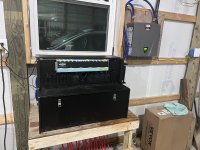
IMG_3476.jpegIMG_3689.jpeg
 
To avoid these ads, REGISTER NOW!

dscheidt

Well-known member
Joined
Apr 26, 2017
Messages
2,905
18 kw is 61k btu/hr. That seems about right to heat an insulated 2400 square foot building. That is not what you have, though. Is there insulation below the slab, at least, or are you trying to heat the ground, as well as the rest of the outside?
 

PoorUB

Well-known member
Joined
Mar 29, 2021
Messages
11,673
Location
Fargo, ND
I agree. 2400 feet of tubing at 30 BTU per foot is 72,000 BTU.

18K is 61,000 BTU.

You need insulation. Right now you are trying to heat basically a screen porch. No insulation I need the ceiling and walls and you might need 3-4 times the BTU to get the place warm.

You are beating a dead horse.
 
OP
B

bams50

Well-known member
Joined
Feb 23, 2012
Messages
2,784
Location
Central NY State
18 kw is 61k btu/hr. That seems about right to heat an insulated 2400 square foot building. That is not what you have, though. Is there insulation below the slab, at least, or are you trying to heat the ground, as well as the rest of the outside?
No, there is 2 inches of foam board insulation under the slab and around the edges.
 
OP
B

bams50

Well-known member
Joined
Feb 23, 2012
Messages
2,784
Location
Central NY State
I agree. 2400 feet of tubing at 30 BTU per foot is 72,000 BTU.

18K is 61,000 BTU.

You need insulation. Right now you are trying to heat basically a screen porch. No insulation I need the ceiling and walls and you might need 3-4 times the BTU to get the place warm.

You are beating a dead horse.
I understand what you’re saying about the air temperature, but should the slab itself at least come up? We don’t expect it to be really warm in there without being insulated, but should the floor not at least be coming up to temperature?
 

PoorUB

Well-known member
Joined
Mar 29, 2021
Messages
11,673
Location
Fargo, ND
I understand what you’re saying about the air temperature, but should the slab itself at least come up? We don’t expect it to be really warm in there without being insulated, but should the floor not at least be coming up to temperature?
The slab is rejecting heat into the cold air faster than it can heat up.
 

Firebrick43

Well-known member
Joined
May 12, 2015
Messages
14,140
Location
West central Indiana
That doesn’t make any sense. People literally run these systems outdoors to keep their driveway clear.
They only have to drive it above 32 and they have half a million or more btu gas boilers doing it.

Electric boiler ain’t going to cut it without insulation. You have a tenth of that heating capacity.
 

The Metric System

Well-known member
Joined
Apr 28, 2025
Messages
268
How thick is your slab? With this info I can do the rough math for how long it should take to warm up with the heat input you are giving it.

Consider that a driveway clearing application just has to keep the surface above freezing.
 

The Metric System

Well-known member
Joined
Apr 28, 2025
Messages
268
I just did the math assuming a 6 inch slab.

At 6 inches your slab weighs about 192,000 lbs and your 18kW heater would be able to warm it at a rate of about 1.5F per hour if all that heat was staying inside the slab.

However, your heat isn't staying inside the slab - it is being rejected your building. Since that building is uninsulated you are then losing virtually all of the heat, so the indoor air cannot increase in temp to match the slab.

That large slab is radiating heat to the air at a rate that represents a large portion of your 18kW heat input and this rate is increasing as your slab warms up. This explains why it is warming so slowly.

I roughly calculate that once you hit a temperature differential of about 10F between the slab and the air you'll hit a thermal stall where virtually all of the heat you put into the concrete is then going out to the air and the slab will effectively stop warming up.

Based on the information you have provided I suspect your system is working correctly but cannot remotely support the heat load of this uninsulated structure in Winter. Your options are to increase the heat input dramatically or reduce the heat lost to the environment via insulation. If you cannot do these things I would shut the system down for now; it is currently just burning money and further runtime won't improve things.

The mass of the cars and equipment isn't helping, but it's not significant compared to the mass of the slab and the heat loss through the uninsulated walls.

What you are doing is conceptually similar to pouring water into a bucket with a big hole in it. The only ways to fill the bucket any further are to flow more water or to reduce the size of the hole. Putting additional objects inside the bucket doesn't really change the underlying dynamic.

What is the current indoor air temperature and return pipe temperature?
 
Last edited:

jlv03

Well-known member
Joined
Jan 19, 2020
Messages
347
Location
SE IA
Your electric bill is going to be rough the next few months, unless you get to work on the insulation side of the equation.
 

PCustoms

Well-known member
Joined
Jul 23, 2011
Messages
23,236
Location
VT
Previous threads OP has in this heater:

Thread 'Cheapest way to get my in floor heating system running' https://www.garagejournal.com/forum...et-my-in-floor-heating-system-running.553100/

Thread 'Is my tankless water heater working right?' https://www.garagejournal.com/forum/threads/is-my-tankless-water-heater-working-right.553504/

The only other thread I see:

Thread 'HUG Hydronics Radiant In-Floor Heating System???' https://www.garagejournal.com/forum/threads/hug-hydronics-radiant-in-floor-heating-system.549860/
 

PoorUB

Well-known member
Joined
Mar 29, 2021
Messages
11,673
Location
Fargo, ND
That doesn’t make any sense. People literally run these systems outdoors to keep their driveway clear.
Yes, and we put in 2-3 times the tubing and 2-3 times the boiler.

If we treated your shop floor like a driveway with floor heat it would have 6,000 feet of tubing and a 200,000 BTU boiler.

You can only push about 30 BTU per foot of tubing. Need more BTU? Add more tubing, run closer together, and a larger boiler.
 

larry4406

Well-known member
Joined
Jan 27, 2006
Messages
19,445
Location
Northern Virginia
Previous threads OP has in this heater:

Thread 'Cheapest way to get my in floor heating system running' https://www.garagejournal.com/forum...et-my-in-floor-heating-system-running.553100/

Thread 'Is my tankless water heater working right?' https://www.garagejournal.com/forum/threads/is-my-tankless-water-heater-working-right.553504/

The only other thread I see:

Thread 'HUG Hydronics Radiant In-Floor Heating System???' https://www.garagejournal.com/forum/threads/hug-hydronics-radiant-in-floor-heating-system.549860/
I noticed the shotgun approach as well with multiple parallel threads.

I don't understand why it wasn't kept in a single thread.

Maybe the Mods can merge them.
 

fitter30

Well-known member
Joined
Jun 23, 2019
Messages
2,990
Location
Peace Valley,mo
Most boilers are design with 20° difference in and out (TD)
Loops 10° TD
Clamp on amp/ volt meter Harbor Freight / amazon have them for $25-30 to see how many amps the boiler running. 18 kw = 75 total amps @240vac two elements 37.5 amps each
Amps can vary from different supply voltage of power or design.
Don't like ir thermometers.
 
Last edited:

finn

Well-known member
Joined
Mar 27, 2005
Messages
16,312
Location
The UP, God's country
For reference, I’m heating a 32x75’ shop plus a 16x16’ office and bathroom with a 120000 Btu boiler. The building has 4” of insulation under the slab and 2” around the perimeter, full ceiling and wall insulation. I don’t know the R value but it has 2x6 wall studs for 16’ eave height

When I power up the boiler in the fall, it takes at least a day to bring the slab to temperature. That’s with full insulation and nearly double the btu input. My target water temp into the slab I’d 110-115, and there’s about a ten degree (from memory) temperature differential across the system to the boiler inlet.

You should have insulated before commissioning the boiler. The boiler seems undersized for my climate, but I think it will work with insulation. Lots of people locally use water heaters as a heat source, but for smaller structures.
 
OP
B

bams50

Well-known member
Joined
Feb 23, 2012
Messages
2,784
Location
Central NY State
I noticed the shotgun approach as well with multiple parallel threads.

I don't understand why it wasn't kept in a single thread.

Maybe the Mods can merge them.
I noticed the shotgun approach as well with multiple parallel threads.

I don't understand why it wasn't kept in a single thread.

Maybe the Mods can merge them.
i’m truly sorry I hurt your feelings, and that you think my appropriate posts are a shotgun approach. Or maybe you realize they’re not and you’re just unhappy, I don’t know. But again, sorry for upsetting your day.
 
OP
B

bams50

Well-known member
Joined
Feb 23, 2012
Messages
2,784
Location
Central NY State
I just did the math assuming a 6 inch slab.

At 6 inches your slab weighs about 192,000 lbs and your 18kW heater would be able to warm it at a rate of about 1.5F per hour if all that heat was staying inside the slab.

However, your heat isn't staying inside the slab - it is being rejected your building. Since that building is uninsulated you are then losing virtually all of the heat, so the indoor air cannot increase in temp to match the slab.

That large slab is radiating heat to the air at a rate that represents a large portion of your 18kW heat input and this rate is increasing as your slab warms up. This explains why it is warming so slowly.

I roughly calculate that once you hit a temperature differential of about 10F between the slab and the air you'll hit a thermal stall where virtually all of the heat you put into the concrete is then going out to the air and the slab will effectively stop warming up.

Based on the information you have provided I suspect your system is working correctly but cannot remotely support the heat load of this uninsulated structure in Winter. Your options are to increase the heat input dramatically or reduce the heat lost to the environment via insulation. If you cannot do these things I would shut the system down for now; it is currently just burning money and further runtime won't improve things.

The mass of the cars and equipment isn't helping, but it's not significant compared to the mass of the slab and the heat loss through the uninsulated walls.

What you are doing is conceptually similar to pouring water into a bucket with a big hole in it. The only ways to fill the bucket any further are to flow more water or to reduce the size of the hole. Putting additional objects inside the bucket doesn't really change the underlying dynamic.

What is the current indoor air temperature and return pipe temperature?
Thank you very much for taking the time to provide an intelligent reply. It especially stands out against the troll comments, but I expected those lol.

To answer the question, the slab is about 5 1/2 inches, but that doesn’t make much difference with all the information you already figured out for me.

Please see below for an update to this thread. And, thank you again for being an adult.
 
To avoid these ads, REGISTER NOW!
OP
B

bams50

Well-known member
Joined
Feb 23, 2012
Messages
2,784
Location
Central NY State
UPDATE: perhaps my concerns were premature. As of today, we have seen definite improvement across the board – slab temperature, tube temperature, tank temperature, and air temperature inside the building are all up. It’s really a noticeable difference. If things continue like this, it should be where we want it in another day or two.

I apologize for getting involved with multiple threads, which were legitimate individual topics as the story developed. It just makes me shrug my shoulders at how it upsets people. Talk about first world problems lol. I will officially state that I never have claimed to be perfect, I’m just doing the best I can to use this forum as a resource on a subject about which I’ve had no experience until now. It doesn’t bother me, I’ve been around long enough to know that if you’re going to go online where people hide behind computers you’re going to get a certain number of smart asses, bitter people, and just generally unhappy trolls. I don’t hold any ill will toward them either, that’s just part of the Internet.

As of now, I do feel like we are getting satisfactory progress. Perhaps I was impatient; sometimes I’m like that. I was hoping my threads/posts would be on here as some kind of reference for somebody in the future who may be searching, like I was. The older I get, the more I learn is that there is a lot more to learn. On many subjects. thanks again to the good people. To the snippy ones, I hope you feel better soon :)
 
Last edited:

The Metric System

Well-known member
Joined
Apr 28, 2025
Messages
268
we have seen definite improvement across the board – slab temperature, main temperature, tank temperature, and air temperature inside the building are all up. It’s really a noticeable difference. If things continue like this, it should be where we want it in another day or two
That's good to hear, but it begs the question of "what changed?"

For example, does this improvement coincide with an increase in the local outdoor temperature? What is the temperature differential between the indoor air and the local ambient?
 

markietas

Well-known member
Joined
Jun 27, 2012
Messages
93
Location
Salisbury, NC
That doesn’t make any sense. People literally run these systems outdoors to keep their driveway clear.
There is a big difference between keeping a driveway just above freezing and getting the slab to a comfortable temperature for a person.
 
OP
B

bams50

Well-known member
Joined
Feb 23, 2012
Messages
2,784
Location
Central NY State
That's good to hear, but it begs the question of "what changed?"

For example, does this improvement coincide with an increase in the local outdoor temperature? What is the temperature differential between the indoor air and the local ambient?
Well, the severe wind has calmed down, but mostly what has changed is that time has elapsed. when I left for home last night, the outdoor temperature was 24° according to my car, and the air temperature inside the building was about 38°. Seems to me that the situation is improving.

I’m thinking that it was struggling because it was trying to bring everything up to temperature while fighting the extreme windchill conditions. I feel like maybe once it is up to temperature, future extreme situations won’t affect it as much.
 
Last edited:
OP
B

bams50

Well-known member
Joined
Feb 23, 2012
Messages
2,784
Location
Central NY State
Given that the driveway is in the ultimate drafty, wet, and uninsulated space...outdoors...I wouldn't assume one is harder than the other without doing the math.
You’re exactly right. If your goal is to get a driveway to, say, 35° or a concrete floor inside a building to 35°, it’s pretty obvious that the building is going to take less effort than the wide open driveway, with snow falling directly on it.

In our situation, we found that working in the building when it was 40° to 45° outdoors was plenty comfortable. If we can get the floor to that temperature, I’m sure it will be just fine to work in there for us.
 

zimman

Well-known member
Joined
Mar 2, 2014
Messages
2,240
Location
Mark Twain National Forest
UPDATE: perhaps my concerns were premature. As of today, we have seen definite improvement across the board – slab temperature, tube temperature, tank temperature, and air temperature inside the building are all up. It’s really a noticeable difference. If things continue like this, it should be where we want it in another day or two.

I apologize for getting involved with multiple threads, which were legitimate individual topics as the story developed. It just makes me shrug my shoulders at how it upsets people. Talk about first world problems lol. I will officially state that I never have claimed to be perfect, I’m just doing the best I can to use this forum as a resource on a subject about which I’ve had no experience until now. It doesn’t bother me, I’ve been around long enough to know that if you’re going to go online where people hide behind computers you’re going to get a certain number of smart asses, bitter people, and just generally unhappy trolls. I don’t hold any ill will toward them either, that’s just part of the Internet.

As of now, I do feel like we are getting satisfactory progress. Perhaps I was impatient; sometimes I’m like that. I was hoping my threads/posts would be on here as some kind of reference for somebody in the future who may be searching, like I was. The older I get, the more I learn is that there is a lot more to learn. On many subjects. thanks again to the good people. To the snippy ones, I hope you feel better soon :)
I'm having similar experiences on here too. Sad and annoying. I'm an old person at 69 but there's some angry old folks in here. LOL. My ignore file is full up. LOL I think we need to increase the mod oversight. These dude's are pissed. You've handled this better than most folks. You've got a lot of money invested and I think you're deserving of a good explanation. Glad it's working it's way out.
Zim
 

Tracs

Well-known member
Joined
Feb 1, 2015
Messages
568
Location
Manitoba, Canada
I am curious about the heating performance. What have the outdoor temps been? You say Central NY State. Weather network shows it has been in the 20s-30s is that about right? What is the indoor air temp in the shop?, not floor temp. What are your electricity rates? A quick search of central NY state shows that it would cost on the low end $40 (0.095/kwW)and the high end $80 (0.20/kWh) per day to heat assuming that the heater runs 24/7, which I would think it would be right now.
 
OP
B

bams50

Well-known member
Joined
Feb 23, 2012
Messages
2,784
Location
Central NY State
Since this thread will be here for future searchers to read, just a little more background. I run a small used car business. The old garage was damaged by heavy snow load last year. So rather than repair it the decision was made to build a new one and demolish the old one.

We sell cheaper cars to working people, so we’re not making a fortune. and I wanted to minimize what I borrowed. by the time the building was up and we moved in, t was October. So as we talked about the plan with my guys, we decided that rather than spend the $12,000 I was quoted to connect the radiant heat, we would get by one more winter the way we’ve been doing it: with a gas salamander plus some sort of supplement. What we found was the supplements we tried were doing next to nothing. We thought about putting a tarp around one area, and looked at multiple types of heat heat sources to get us through one winter. We bought a couple used from marketplace to try. They didn’t make much difference; it wasn’t so much the air temperature as it was the air temperature combined with the floor being extremely cold for us, we are all old guys.

So, I came back to the idea of getting the radiant heat going, even though we have no insulation. I did a lot of research. I talked to a lot of people in my area doing similar. Everybody said that while it’s not going to actually be balmy in there, we should be able to get the floor warmer, which is a huge comfort difference, and get the inside temperature up to 40°, which was our goal. Even without insulation. Most people I spoke to said that we would be able to get the comfort we were looking for, and as we insulated, it would just get easier and cheaper to keep it. So, that’s what we went with. And I think we’re going to achieve that goal. Maybe next year when we will have full insulation by winter doing it “pay as you go”, it will actually be a lot warmer, which will be nice. But not really necessary.

To those who think otherwise, no, I did not expect it to be perfect without insulation. I know we need it. And, we’re going to do it. Spray foam would have been ideal. But I was quoted $25,000, which I don’t have, nor do I want to spend. And certainly don’t want to borrow for. We’re learning as we go, and paying as we go. currently, I’m leaning towards rock wool. And going to continue paying as we go- if we have a good month, I’ll buy as much as I can, and have it put up… Then repeat until we eventually get it done. Apologies to the people with a lot of money, or people who think you should just borrow borrow borrow to get what you want. i’m not either one of those. Which is how we’re on this journey :)

Thanks again, to all of you.
 
OP
B

bams50

Well-known member
Joined
Feb 23, 2012
Messages
2,784
Location
Central NY State
I'm having similar experiences on here too. Sad and annoying. I'm an old person at 69 but there's some angry old folks in here. LOL. My ignore file is full up. LOL I think we need to increase the mod oversight. These dude's are pissed. You've handled this better than most folks. You've got a lot of money invested and I think you're deserving of a good explanation. Glad it's working it's way out.
Zim
Thank you, sir, it’s just part of being on the Internet. You better expect it when you post something :)
 
OP
B

bams50

Well-known member
Joined
Feb 23, 2012
Messages
2,784
Location
Central NY State
I am curious about the heating performance. What have the outdoor temps been? You say Central NY State. Weather network shows it has been in the 20s-30s is that about right? What is the indoor air temp in the shop?, not floor temp. What are your electricity rates? A quick search of central NY state shows that it would cost on the low end $40 (0.095/kwW)and the high end $80 (0.20/kWh) per day to heat assuming that the heater runs 24/7, which I would think it would be right now.
It has been a little harsh. You are right, the average temperatures have been twenties to 30s, with a few low teen lows thrown in and a ton of wind.

As for electric cost, it is concerning, but I doubt it’s going to be $1000 a month. People have asked why I went with electric. First, natural gas would have been my preference, but we don’t have it here. Propane is expensive and tough to get delivery. No interest in a wood boiler. So ultimately it leaves electric. Also I like that it is simpler to install, no need for a chimney, and there’s always risk with bringing gas into a building, no matter how minimal.

Maybe I’ll come back to this thread in the spring to update what it actually cost. Or start a new thread on the subject, just to annoy the pants pissers:)
 

larry4406

Well-known member
Joined
Jan 27, 2006
Messages
19,445
Location
Northern Virginia
Glad it is up and running and knocking the chill off.

I would love to have radiant heat in the garage floor. We have resistance heat in the kitchen ceramic floor and it feels awesome. No clue what the cost add is to run it.

I hope @Tracs 's calculations in Post 28 are not accurate at a range of $40 to 80 per day to heat the space ($1200 - $2400/month)!
 

jlv03

Well-known member
Joined
Jan 19, 2020
Messages
347
Location
SE IA
I hope @Tracs 's calculations in Post 28 are not accurate at a range of $40 to 80 per day to heat the space ($1200 - $2400/month)!

That's the beauty of using electricity as a fuel source - math is pretty easy.

If the electric boiler is 18kW, you just take 18 times the cost per kilowatt to get an hourly price. Let's say the price is around the nation wide average, $0.14/kWh. 18 x 0.14 is $2.52 per hour to run the boiler. 24 hours of running will be $2.54 x 24 = $60.48/day. Over a month (30 days), this works out to about $1.8k/month.

If this was an area where the cost per kWh is 0.50/kWh, then the math works out to about 18 x 0.50 x 24 = $216/day. Or about $6k/month.
 
OP
B

bams50

Well-known member
Joined
Feb 23, 2012
Messages
2,784
Location
Central NY State
That's the beauty of using electricity as a fuel source - math is pretty easy.

If the electric boiler is 18kW, you just take 18 times the cost per kilowatt to get an hourly price. Let's say the price is around the nation wide average, $0.14/kWh. 18 x 0.14 is $2.52 per hour to run the boiler. 24 hours of running will be $2.54 x 24 = $60.48/day. Over a month (30 days), this works out to about $1.8k/month.

If this was an area where the cost per kWh is 0.50/kWh, then the math works out to about 18 x 0.50 x 24 = $216/day. Or about $6k/month.
Well, we will see what happens. The one thing left out of your excellent calculation is that it only runs 24/7 wow coming up to temperature. After that, it doesn’t fire very often.

I have a friend locally that does heavy truck repair. His shop is 50 x 100. He says when he starts up the heat in October, it takes at least a week to get the slab up to temperature. But once it is, the system only fires about once every seven or eight hours to make a circulation. His shop is bigger than mine, but they work in short sleeve shirts, all winter.

Another friend up the road for me also has a 50 x 100 barndominium, with approximately the back third being a two-story apartment. Last year was his first winter in there. He went with spray foam, and he has a natural gas heater. His highest bill last winter was under $120 per month. And that included heat and electricity. So that made me hopeful as well.

In the end, I didn’t have anybody to teach me any of this. I studied as much as I could, thought about it as much as I could, asked people I knew that had similar as much as I could, then made a decision. The whole point of radiant heating is that it’s expensive to install but extremely cheap and efficient to operate. That’s why I went for it. If it actually comes out to two grand, or one grand, per month to keep it 40° in the shop, I’ll have to get a new plan. Not the end of the world, just part of the process.
 

fitter30

Well-known member
Joined
Jun 23, 2019
Messages
2,990
Location
Peace Valley,mo
Air is easy to heat mass isn't. Poster wrote the slab weight 192k has to heat up. Pull a 2500 lb car and what other stuff. A lot to heat up.
 

PoorUB

Well-known member
Joined
Mar 29, 2021
Messages
11,673
Location
Fargo, ND
Well, we will see what happens. The one thing left out of your excellent calculation is that it only runs 24/7 wow coming up to temperature. After that, it doesn’t fire very often.

I have a friend locally that does heavy truck repair. His shop is 50 x 100. He says when he starts up the heat in October, it takes at least a week to get the slab up to temperature. But once it is, the system only fires about once every seven or eight hours to make a circulation. His shop is bigger than mine, but they work in short sleeve shirts, all winter.

Another friend up the road for me also has a 50 x 100 barndominium, with approximately the back third being a two-story apartment. Last year was his first winter in there. He went with spray foam, and he has a natural gas heater. His highest bill last winter was under $120 per month. And that included heat and electricity. So that made me hopeful as well.

In the end, I didn’t have anybody to teach me any of this. I studied as much as I could, thought about it as much as I could, asked people I knew that had similar as much as I could, then made a decision. The whole point of radiant heating is that it’s expensive to install but extremely cheap and efficient to operate. That’s why I went for it. If it actually comes out to two grand, or one grand, per month to keep it 40° in the shop, I’ll have to get a new plan. Not the end of the world, just part of the process.
Until you get the place insulated, your bill will be ugly. You are comparing to finished buildings, yours isn't

Right now the $60 per day cost of operation is real.
 

finn

Well-known member
Joined
Mar 27, 2005
Messages
16,312
Location
The UP, God's country
Well, we will see what happens. The one thing left out of your excellent calculation is that it only runs 24/7 wow coming up to temperature. After that, it doesn’t fire very often.

I have a friend locally that does heavy truck repair. His shop is 50 x 100. He says when he starts up the heat in October, it takes at least a week to get the slab up to temperature. But once it is, the system only fires about once every seven or eight hours to make a circulation. His shop is bigger than mine, but they work in short sleeve shirts, all winter.

Another friend up the road for me also has a 50 x 100 barndominium, with approximately the back third being a two-story apartment. Last year was his first winter in there. He went with spray foam, and he has a natural gas heater. His highest bill last winter was under $120 per month. And that included heat and electricity. So that made me hopeful as well.

In the end, I didn’t have anybody to teach me any of this. I studied as much as I could, thought about it as much as I could, asked people I knew that had similar as much as I could, then made a decision. The whole point of radiant heating is that it’s expensive to install but extremely cheap and efficient to operate. That’s why I went for it. If it actually comes out to two grand, or one grand, per month to keep it 40° in the shop, I’ll have to get a new plan. Not the end of the world, just part of the process.
A btu is a btu, no matter if it’s radiant or a 92% efficient gas forced air system. The only difference is that a warm floor might let you set the thermostat lower, but in turn they aren’t really comparable with setback thermostats.

Your anecdotal tales say nothing about radiant being cheap to operate, but rather shows the value of insulation.

Both my house and shop have radiant floors, and I’m not a strong advocate, except for the comfort aspect.

Don’t drink the radiant kool ade. Without insulation you’re going to pay electric bills out the ***, unless your utility is giving away electricity.
 
To avoid these ads, REGISTER NOW!
Top Bottom