To avoid these ads, REGISTER NOW!

Hey you guys pick heavy stuff up… what do I do with this thing?

thunderskunk

Well-known member
Joined
Oct 4, 2022
Messages
130
Howdy,

I’ve flashed photos of this thing a few times. She’s a Port Huron 19-65 HP steam engine made in 1917. Each wheel weights a few tons each. The engine empty is 17,300 lbs. I moved it into its current position 8 ft at a time with a winch, about 200 ft across the yard. It took me several weeks into winter. Now I need to get the wheels, axles, and engine off.

Harbor fright doesn’t make a 10 ton crane, or I’d buy it. A car lift won’t do it. Any ideas guys? Weird tools repurposed? How would you get this thing in the air?
IMG_8670.jpeg
 
Last edited:
To avoid these ads, REGISTER NOW!
OP
T

thunderskunk

Well-known member
Joined
Oct 4, 2022
Messages
130
Could you just apply compressed air to one of the steam lines through a lengthy hose, and drive it on that propulsion source?
You absolutely can. Unfortunately, you need volume. I’ve got several hundred feet of 3/8 hose, but the boiler isn’t air tight at the moment, so I’d need some sort of accessory tank. Otherwise it would just push the engine to dead center and stop. I used a winch on the flywheel with a bracket contraption of sorts. It worked. Not beautiful, but it functioned.
 

tyyost

Well-known member
Joined
Jan 14, 2009
Messages
804
Location
Tunkhannock, PA
What is the plan? Most railroad shops use huge bottle jacks and cribbing or large gantry cranes. For your purposes I’d guess cribbing will be your friend, but moving the big parts without a forklift or serious material handling gear is going to be difficult to down right dangerous. I take it from the op that a suitable machine isn’t handy our you would have pulled it to the garage with it.
 

WisJim

Well-known member
Joined
Dec 20, 2010
Messages
2,286
Location
Menomonie, WI
Do you have a local or at least near by engine club? Is there a threshing bee or engine show sometime in the summer? That you give you leads to members of that club or attendees of the show that would probably include some people who have worked on engines like this, or bigger ones, and they would probably have experience and practical tips and ideas on a job like this. I have no idea where the OP lives so I can't make any more detailed suggestions on finding help.
 

MovingAlong

Well-known member
Joined
Aug 17, 2013
Messages
1,231
Don't know what your budget allows, but you probably didn't take on that project because it was a bargain. ;)

Depending on the anticipated length of the project, I'd be tempted to purchase some steel beams and build them in semi-permanent. Then add a couple chain fall hoists. When the projects done, sell the beams and hoists.

Might also consider renting a telehandler to do the initial teardown. Would also be useful for moving the items to where you want them to work on. Though around me a 12,000 lb capacity unit goes for $800/day, $2k/week...
 

Copymutt

Well-known member
Joined
Sep 3, 2016
Messages
3,392
Location
Colorado
I’m thinking multiple beam lumber ramps, chocks & a winch. Once you climb the ramps high enough to install cribbing then off come the wheels. Need to be creative on winch lockdown, bolt it to the floor maybe.
 

JeepYJ

Well-known member
Joined
Dec 25, 2015
Messages
9,063
Might also consider renting a telehandler to do the initial teardown. Would also be useful for moving the items to where you want them to work on. Though around me a 12,000 lb capacity unit goes for $800/day, $2k/week...
@zkdiesel buys them for less than half days rent.
 

scooterbum46

Well-known member
Joined
Jan 29, 2014
Messages
868
Location
South Central Michigan / ex Gulf Coast Florida
I'm with WisJim on this; find a local or a club that's done it. Before you go further, make a project plan of some sorts. This isn't a simple job, because of the size of everything, poor setup could lead to accidents. I've had to stack and crib and it can turn into a giant Jenga game if you aren't careful. If you've got a budget, MovingAlong's suggestion of steel beams is preferable where you can use it to cribbing although you can't avoid the jack and stack in some places.
Main thing, get a plan in place so the project doesn't die when you run into a unforeseen issue down the road.
BTW - cool machine, keep us posted!
 

T444e

Well-known member
Joined
Feb 25, 2016
Messages
453
I've never handled anything that heavy at home, but I'm not seeing anything I'm overly concerned about. Day job, chain hoists, cranes or telehandlers.
 

Aaron_W

Well-known member
Joined
Feb 6, 2018
Messages
2,924
Location
Northern California
For anybody unfamiliar with this thing, it isn't just an old tractor, it is a traction engine. Basically a steam locomotive that runs on wheels instead of rails, a big beast, probably 10 tons+.


The Roots of Motive Power in Willits, CA has a bunch of logging, rail and steam equipment, including an 18 ton Daniel Best traction engine and a 75 ton Bucyrus steam shovel. I'm sure they could help you with ideas. I've been into their restoration shop and it is basically just a big barn, no obvious modern heavy lifting equipment (except for all of their vintage equipment, some of which may very well get put to work).

Their Daniel Best traction engine at an event a few years back

Daniel Best traction engine.jpg
 
To avoid these ads, REGISTER NOW!

Wrencher 160

Well-known member
Joined
Sep 15, 2014
Messages
170
Location
Il
Talk to the local fire department they might be interested in an air bag and hurst tool drill. I know Iwould have when I worked. Another source might be tow company, medium boom truck, lots of cribbing. You could try bolting a heavy chunk across the lower wheel spokes , hydraulic or house jack for lift. Just out. Of curiosity why do you need it inter air?
 

atch

Well-known member
Joined
Apr 4, 2006
Messages
843
Location
Columbia, Missouri
@thunderskunk

I've got a 12-ton bottle jack that I bought 50 years ago. That thing picked up a house, one floor joist at a time. Bottle jacks of that size are fairly common. I bet you've got a friend or neighbor who has one.

This, of course, helps you to get this thing off of the ground but doesn't help in moving the wheels around after removal.

I have no idea where you're located. I'm in central Missouri and if you're close you're welcome to borrow it. I can also introduce you to a man in Missouri that has two of those engines but larger. He can give you lots of pointers on wrenching &/or lifting one of those.
 

jkeyser14

Well-known member
Joined
Dec 19, 2008
Messages
1,819
Location
(rural) Maryland
Y'all probably already know this, but I'll state it anyway: Use hardwood cribbing, not pine.
For heavy machinery like this at my work we use thick steel as cribbing, no wood allowed. The jacks have to sit on large steel plates sized per an engineer to distribute the point loads on our concrete slab without cracking it. We are dealing with machinery that weighs ~4x the steam engine here though.
 

finn

Well-known member
Joined
Mar 27, 2005
Messages
16,295
Location
The UP, God's country
My cousin got hardwood “bolts” straight from the local hardwood mill to use as cribbing when he jacked up his house to replace the footings and build new basement walls.

Harbor freight sells 20 ton jacks.
 

Joemctag

Well-known member
Joined
Aug 11, 2017
Messages
813
Location
Outside raleigh nc
For anybody unfamiliar with this thing, it isn't just an old tractor, it is a traction engine. Basically a steam locomotive that runs on wheels instead of rails, a big beast, probably 10 tons+.


The Roots of Motive Power in Willits, CA has a bunch of logging, rail and steam equipment, including an 18 ton Daniel Best traction engine and a 75 ton Bucyrus steam shovel. I'm sure they could help you with ideas. I've been into their restoration shop and it is basically just a big barn, no obvious modern heavy lifting equipment (except for all of their vintage equipment, some of which may very well get put to work).

Their Daniel Best traction engine at an event a few years back

Daniel Best traction engine.jpg
Your best bet is to talk to people like these: They would love to help you: Good luck !
 

cvairwerks

Well-known member
Joined
Aug 12, 2016
Messages
7,229
Location
Within hearing distance of Texas Motor Speedway
Vestil makes gantries that go to 5 tons and that's what you need to safely remove the wheels and assemblies. To lift the entire end of the engine, the only reasonable way is cribbing and jacks.

Just remember when you do it, plan the move, plan a way to get out of the way if there is a failure and then execute the plan. Each lift should be only enough at a time to get the next piece of cribbing in place.

Last option may be to have a heavy lift company come in and lift it onto cribbing and cradles for you.
 

larry4406

Well-known member
Joined
Jan 27, 2006
Messages
19,362
Location
Northern Virginia
Can't help with the lift idea, but very cool project!

I hope you do a restoration thread on it so we can watch along.

Update your location as the members here might be aware of others nearby you that are into old steam.
 

matt_i

Well-known member
Joined
Mar 14, 2008
Messages
10,729
Location
SE Michigan
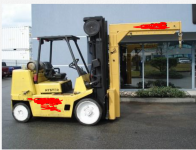
A cushion tired forklift with a rigger's boom is what I would want for starters. Although it does not look like there is a lot of room on the sides of the main machine. I don't think you need a 15k unit (pictured). Something like an 8k is a lot of machine, the boom is something you or another shop could stick weld out of tubing or open structural sections. If you can find a "boxcar special" forklift with its extra-high-stacked counterweight, it has more counterbalance in a short wheelbase. I liken it to approximately having an 8k counterbalance in the basic size of a 5k.

A 10 ton gantry (& chainfall) isn't out of the question, I almost bought one on Marketplace for moving a machine, but I think I would design it so that it rolls on angle iron V-tracks bolted into the concrete floor with 4 rigid casters (vs. swivel casters). Erecting it and even hanging a 10t chainfall is not a trivial exercise.

Lifting from overhead (provided proper structure and rigging practices) is always the safest. Jacks work but you always have the element of instability and the mistakes are potentially fatal. Probably worth a thousand dollars of hardwood cribbing (aka insurance) you get from an independent sawmill.

Once some of those subassemblies are removed they are going to need to be moved around. Pallet jacks are ideal for those loads under ~2-1/2 tons.

1767449804492.png
 
Last edited:

zkdiesel

Well-known member
Joined
Oct 6, 2013
Messages
8,359
Location
chicagoland cornfields
A cushion tired forklift with a rigger's boom is what I would want for starters. Although it does not look like there is a lot of room on the sides of the main machine. I don't think you need a 15k unit (pictured). Something like an 8k is a lot of machine, the boom is something you or another shop could stick weld out of tubing or open structural sections. If you can find a "boxcar special" forklift with its extra-high-stacked counterweight, it has more counterbalance in a short wheelbase. I liken it to approximately having an 8k counterbalance in the basic size of a 5k.

A 10 ton gantry (& chainfall) isn't out of the question, I almost bought one on Marketplace for moving a machine, but I think I would design it so that it rolls on angle iron V-tracks bolted into the concrete floor with 4 rigid casters (vs. swivel casters). Erecting it and even hanging a 10t chainfall is not a trivial exercise.

Lifting from overhead (provided proper structure and rigging practices) is always the safest. Jacks work but you always have the element of instability and the mistakes are potentially fatal. Probably worth a thousand dollars of hardwood cribbing (aka insurance) you get from an independent sawmill.

Once some of those subassemblies are removed they are going to need to be moved around. Pallet jacks are ideal for those loads under ~2-1/2 tons.

1767449804492.png
Judging by his shop/yard I don’t think you’ll even get that close to the building before it’s stuck
 

WisJim

Well-known member
Joined
Dec 20, 2010
Messages
2,286
Location
Menomonie, WI
As I mentioned earlier, get in contact with other steam enthusiasts nearby. Since @thunderskunk doesn't show a location it is hard to give him any specific advice. Even around my home in Wisconsin, there are 2 groups or clubs that have permanent sites and annual shows within 30 miles of me, and a lot more within 100 miles--literally dozens of not hundreds of people with experience working on machines like this, and larger.
 

firebirdparts

Well-known member
Joined
Jun 8, 2016
Messages
10,635
Location
Kingsport, TN
To get it off the ground, you can block up with jacks. That's easy. But to keep that wheel from falling on you, you need plenty of help and a plan or else you'll need something solid overhead. Help and a plan is a lot easier in my opinion, as you can manhandle that wheel and put it anywhere very conveniently. If it's hanging from something then it's very difficult to move the something.
 
Last edited:

kwb

Well-known member
Joined
May 1, 2009
Messages
1,776
Location
PNW
The headroom here is going to make it a challenge to get all the heavy stuff up high off.
simply getting wheels off the ground is pretty basic bottle jack stuff that can be done safely. I'm assuming this is getting the full treatment so, I would be inclined to make stands that are easy to work around rather than cribbing stack.

I would want a smallish (3-4k) forklift for everything else. Space is limited but I think you have enough to get in there. You probably will need to flip forks over for the higher stuff to not hit the underside of trusses. If that isn't up your alley, I would say a gantry with chainfall will be your best bet. You could also build up a platform around it and just work on things one piece at a time in place.

For what is probably a multi-year effort that will cost a lot more than you want anyone to know - do it in a way to not kill yourself in the process.
 
OP
T

thunderskunk

Well-known member
Joined
Oct 4, 2022
Messages
130
holy smokes, what do you plan on doing with this thing? yard art? pull out sequoias and redwoods?
Steam it. Blow the whistle, run a saw mill, run an ice cream maker, pull some hay rides, etc. Teach the boys how to do all sorts of stuff.
As I mentioned earlier, get in contact with other steam enthusiasts nearby. Since @thunderskunk doesn't show a location it is hard to give him any specific advice. Even around my home in Wisconsin, there are 2 groups or clubs that have permanent sites and annual shows within 30 miles of me, and a lot more within 100 miles--literally dozens of not hundreds of people with experience working on machines like this, and larger.
Do you have a local or at least near by engine club? Is there a threshing bee or engine show sometime in the summer? That you give you leads to members of that club or attendees of the show that would probably include some people who have worked on engines like this, or bigger ones, and they would probably have experience and practical tips and ideas on a job like this. I have no idea where the OP lives so I can't make any more detailed suggestions on finding help.

Location is Vermont. I thought I put it on there… anywho. There’s only two “operational” steam engines in Vermont, and mine's one of them. My local club hasn’t run steam in decades. Still leveraging the community; there’s some schools out west I’m attending, but there's no one close by whatsoever. Closest clubs regularly running steam are Connecticut, Western NY, and Maine, at least a 4 hr drive.
@thunderskunk

I've got a 12-ton bottle jack that I bought 50 years ago. That thing picked up a house, one floor joist at a time. Bottle jacks of that size are fairly common. I bet you've got a friend or neighbor who has one.

This, of course, helps you to get this thing off of the ground but doesn't help in moving the wheels around after removal.

I have no idea where you're located. I'm in central Missouri and if you're close you're welcome to borrow it. I can also introduce you to a man in Missouri that has two of those engines but larger. He can give you lots of pointers on wrenching &/or lifting one of those.
We’ve got bottle jacks. It gets complicated; I can’t block the whole boiler up as every plate needs to be inspected with ultrasonic thickness gage in a 4" grid. It can be on blocks, but they'll need to move a few times to get access to everything necessary to prove the boiler is safe.
For heavy machinery like this at my work we use thick steel as cribbing, no wood allowed. The jacks have to sit on large steel plates sized per an engineer to distribute the point loads on our concrete slab without cracking it. We are dealing with machinery that weighs ~4x the steam engine here though.

I also work with heavy parts that move constantly. but the whole building is accessible by cranes, and the blocking is heavily regulated. Expensive, but 99.99% safe. I'm going for 99.91%, or just slower but cheaper ways to lift and move at that high safety margin.


What is the plan? Most railroad shops use huge bottle jacks and cribbing or large gantry cranes. For your purposes I’d guess cribbing will be your friend, but moving the big parts without a forklift or serious material handling gear is going to be difficult to down right dangerous. I take it from the op that a suitable machine isn’t handy our you would have pulled it to the garage with it.
If, as you say, the wheels weigh a few tons each, how do you plan to handle them during and after removal?
To get it off the ground, you can block up with jacks. That's easy. But to keep that wheel from falling on you, you need plenty of help and a plan or else you'll need something solid overhead. Help and a plan is a lot easier in my opinion, as you can manhandle that wheel and put it anywhere very conveniently. If it's hanging from something then it's very difficult to move the something.


The current plan: Each wheel gets it's own "cart" using machine mover skates for wheels and a sort of frame; they'll become fixtures of the building for a while. We have a 70HP gas tractor that will eventually get a bucket, but that won't be for rated loads. That tractor was only able to pull the engine downhill; we used it when we could, but most of the journey to the back yard was fought for by the inch.

That's a really good point about moving loaded lift equipment. It's been on my mind. The right answer was to design the building to be an overhead crane and set the roof on top of the beams, but that was a bit out of budget.
Don't know what your budget allows, but you probably didn't take on that project because it was a bargain. ;)

They say the smallest check we'll write is the first one... we're not rich, just obsessed enough to take it on.

I'm with WisJim on this; find a local or a club that's done it. Before you go further, make a project plan of some sorts. This isn't a simple job, because of the size of everything, poor setup could lead to accidents. I've had to stack and crib and it can turn into a giant Jenga game if you aren't careful. If you've got a budget, MovingAlong's suggestion of steel beams is preferable where you can use it to cribbing although you can't avoid the jack and stack in some places.
Main thing, get a plan in place so the project doesn't die when you run into a unforeseen issue down the road.
BTW - cool machine, keep us posted!

This is sound advice. I've had a plan, but I tried not to obsess over the little details until the engine was moved into the shed and we'd organized all the tools and hardware we have... we got it moved in two months late/a bit further into winter than I wanted, and my sporadic cleaning turned into every evening and weekend.

Interesting info here: https://www.porthurontownship.org/community/longfellow.aspx

I was prompted to look this up because it was rated 19 and 65. It seemed odd, but I guess it's not.
These engines span a unique but short piece of history. The first ones were just a boiler and an engine; no gears or steering. They'd haul it out with a team of horses to do the work. Power ratings were up to the company, hence many standards popped up and frequently changed. It could be calculated by boiler size/heating area, cylinder size, and the power generated at the flywheel. When they added a clutch and gearing to drive, they now have a rating for the "PTO" and pulling power. For this Port Huron, it's 19 HP on the Drawbar and 65 HP on the belt which... makes no sense to me in particular since the engine is geared something like 80:1 when pulling.

However, if you hear someone say "That's a 9/30 HP Case," they are referring to how Case used to rate traction engines before... 1905 or something, and the rating afterwards. Case didn't use two numbers to describe their engines, but it's easier to understand since you might think a 9HP is smaller than a 30HP; they're the same model.

The most interesting aspect to me was that a steam engine didn't replace horses perse; the horses were needed to haul fuel and move materials from the work area. Hence the steam engines were rarely made to go faster than 2.4 mph since that's a good speed for the team of horses to follow along. Steam engines were also terrible at plowing; too heavy, too powerful, too needy, too hot.
 
To avoid these ads, REGISTER NOW!
Top Bottom