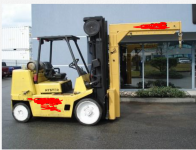
holy smokes, what do you plan on doing with this thing? yard art? pull out sequoias and redwoods?
Steam it. Blow the whistle, run a saw mill, run an ice cream maker, pull some hay rides, etc. Teach the boys how to do all sorts of stuff.
As I mentioned earlier, get in contact with other steam enthusiasts nearby. Since
@thunderskunk doesn't show a location it is hard to give him any specific advice. Even around my home in Wisconsin, there are 2 groups or clubs that have permanent sites and annual shows within 30 miles of me, and a lot more within 100 miles--literally dozens of not hundreds of people with experience working on machines like this, and larger.
Do you have a local or at least near by engine club? Is there a threshing bee or engine show sometime in the summer? That you give you leads to members of that club or attendees of the show that would probably include some people who have worked on engines like this, or bigger ones, and they would probably have experience and practical tips and ideas on a job like this. I have no idea where the OP lives so I can't make any more detailed suggestions on finding help.
Location is Vermont. I thought I put it on there… anywho. There’s only two “operational” steam engines in Vermont, and mine's one of them. My local club hasn’t run steam in decades. Still leveraging the community; there’s some schools out west I’m attending, but there's no one close by whatsoever. Closest clubs regularly running steam are Connecticut, Western NY, and Maine, at least a 4 hr drive.
@thunderskunk
I've got a 12-ton bottle jack that I bought 50 years ago. That thing picked up a house, one floor joist at a time. Bottle jacks of that size are fairly common. I bet you've got a friend or neighbor who has one.
This, of course, helps you to get this thing off of the ground but doesn't help in moving the wheels around after removal.
I have no idea where you're located. I'm in central Missouri and if you're close you're welcome to borrow it. I can also introduce you to a man in Missouri that has two of those engines but larger. He can give you lots of pointers on wrenching &/or lifting one of those.
We’ve got bottle jacks. It gets complicated; I can’t block the whole boiler up as every plate needs to be inspected with ultrasonic thickness gage in a 4" grid. It can be on blocks, but they'll need to move a few times to get access to everything necessary to prove the boiler is safe.
For heavy machinery like this at my work we use thick steel as cribbing, no wood allowed. The jacks have to sit on large steel plates sized per an engineer to distribute the point loads on our concrete slab without cracking it. We are dealing with machinery that weighs ~4x the steam engine here though.
I also work with heavy parts that move constantly. but the whole building is accessible by cranes, and the blocking is heavily regulated. Expensive, but 99.99% safe. I'm going for 99.91%, or just slower but cheaper ways to lift and move at that high safety margin.
What is the plan? Most railroad shops use huge bottle jacks and cribbing or large gantry cranes. For your purposes I’d guess cribbing will be your friend, but moving the big parts without a forklift or serious material handling gear is going to be difficult to down right dangerous. I take it from the op that a suitable machine isn’t handy our you would have pulled it to the garage with it.
If, as you say, the wheels weigh a few tons each, how do you plan to handle them during and after removal?
To get it off the ground, you can block up with jacks. That's easy. But to keep that wheel from falling on you, you need plenty of help and a plan or else you'll need something solid overhead. Help and a plan is a lot easier in my opinion, as you can manhandle that wheel and put it anywhere very conveniently. If it's hanging from something then it's very difficult to move the something.
The current plan: Each wheel gets it's own "cart" using machine mover skates for wheels and a sort of frame; they'll become fixtures of the building for a while. We have a 70HP gas tractor that will eventually get a bucket, but that won't be for rated loads. That tractor was only able to pull the engine downhill; we used it when we could, but most of the journey to the back yard was fought for by the inch.
That's a really good point about moving loaded lift equipment. It's been on my mind. The right answer was to design the building to be an overhead crane and set the roof on top of the beams, but that was a bit out of budget.
Don't know what your budget allows, but you probably didn't take on that project because it was a bargain.

They say the smallest check we'll write is the first one... we're not rich, just obsessed enough to take it on.
I'm with WisJim on this; find a local or a club that's done it. Before you go further, make a project plan of some sorts. This isn't a simple job, because of the size of everything, poor setup could lead to accidents. I've had to stack and crib and it can turn into a giant Jenga game if you aren't careful. If you've got a budget, MovingAlong's suggestion of steel beams is preferable where you can use it to cribbing although you can't avoid the jack and stack in some places.
Main thing, get a plan in place so the project doesn't die when you run into a unforeseen issue down the road.
BTW - cool machine, keep us posted!
This is sound advice. I've had a plan, but I tried not to obsess over the little details until the engine was moved into the shed and we'd organized all the tools and hardware we have... we got it moved in two months late/a bit further into winter than I wanted, and my sporadic cleaning turned into every evening and weekend.
Interesting info here:
https://www.porthurontownship.org/community/longfellow.aspx
I was prompted to look this up because it was rated 19 and 65. It seemed odd, but I guess it's not.
These engines span a unique but short piece of history. The first ones were just a boiler and an engine; no gears or steering. They'd haul it out with a team of horses to do the work. Power ratings were up to the company, hence many standards popped up and frequently changed. It could be calculated by boiler size/heating area, cylinder size, and the power generated at the flywheel. When they added a clutch and gearing to drive, they now have a rating for the "PTO" and pulling power. For this Port Huron, it's 19 HP on the Drawbar and 65 HP on the belt which... makes no sense to me in particular since the engine is geared something like 80:1 when pulling.
However, if you hear someone say "That's a 9/30 HP Case," they are referring to how Case used to rate traction engines before... 1905 or something, and the rating afterwards. Case didn't use two numbers to describe their engines, but it's easier to understand since you might think a 9HP is smaller than a 30HP; they're the same model.
The most interesting aspect to me was that a steam engine didn't replace horses perse; the horses were needed to haul fuel and move materials from the work area. Hence the steam engines were rarely made to go faster than 2.4 mph since that's a good speed for the team of horses to follow along. Steam engines were also terrible at plowing; too heavy, too powerful, too needy, too hot.