To avoid these ads, REGISTER NOW!

Hey you guys pick heavy stuff up… what do I do with this thing?

Stuart in MN

Well-known member
Joined
Sep 8, 2005
Messages
23,135
Location
Minneapolis
I'm not a farmer or a steam expert, but I think they were used more out in the plains states for plowing and harvesting. They also got used in the north woods for logging.

steam-harvester-1903-granger.jpg
 
To avoid these ads, REGISTER NOW!
OP
T

thunderskunk

Well-known member
Joined
Oct 4, 2022
Messages
130
Not really practical but still cool to watch it work. (video)

Kory is a big deal; the social media thing is a good bit of PA, but he's done a lot for smaller circles. Played a big part in revitalizing a local foundry and plays a hand in many engine restorations. The Case 150 is impressive; unfortunately their marketing made Google useless for detailed research for a while. I'd search "Source for 2 inch boiler tubes for steam traction engines" and his videos would be the first hit. It's simmered down a bit, and I didn't mind: fantastic productions with a lot of good info.

They also got used in the north woods for logging.

Particularly, there's an engine called a Lombard log hauler. There was once one down the road from us a hundred years ago, long scrap now. The Maine Forest and Logging Museum has a steam up in February that I highly recommend attending: What an incredible machine!

1767475705478.png
 

bmwrd0

Well-known member
Joined
Nov 7, 2010
Messages
5,486
Location
Beaver Fever Oregon
Great project! I loved working with boilers when I was in trade school, and have started working towards making small, model ones. But big 'uns like yours are the best! Out here in Oregon, we have Antique Powerland Heritage park, which shows off many of these fine beasts, along with stationary engines, steam donkeys, a working steam powered blacksmith shop, and more.
 

Dagny

Well-known member
Joined
Jul 25, 2014
Messages
3,007
Location
Northern Wi.
All the most wonderful people in the world meet at Rollag Mn. Someone there will know.

My neighbor has a smaller version that his father in law made many years ago. He belongs to a steam club because they help pay for the inspections and other rules that come with captivating water and building a big fire under it.
 

WisJim

Well-known member
Joined
Dec 20, 2010
Messages
2,286
Location
Menomonie, WI
Particularly, there's an engine called a Lombard log hauler. There was once one down the road from us a hundred years ago, long scrap now. The Maine Forest and Logging Museum has a steam up in February that I highly recommend attending: What an incredible machine!

1767475705478.png
The Phoenix Manufacturing Co. of Eau Claire, Wis. got the rights to build these machines and there are a couple still around. A friend, since deceased, built an operating scale model of one using his measurements of an original machine. I still regret not getting to know him and his projects better. A 2022 video of an original machine at a local steam show:
 

mreisner

Well-known member
Joined
Jun 25, 2019
Messages
912
Location
North of Detroit
I'm not a farmer or a steam expert, but I think they were used more out in the plains states for plowing and harvesting. They also got used in the north woods for logging.

steam-harvester-1903-granger.jpg
Mostly used for stationary threshing machines where the shocks of grain were brought to the machine.
 

NC Fabricator25

Well-known member
Joined
May 28, 2010
Messages
193
Your request is a little unclear, saying you need to get the wheels and engine off, and get this thing in the air. Frankly there are only a few common ways to undertake those tasks, and if you're working on equipment this large it seems like you're probably already aware of the options, already mentioned in this thread. For lifting it's a forklift rated for what you need, a crane, overhead hoist, or workable construction equipment like an excavator or wheel loader. For lifting the whole unit, any of those would work, rated for the load of course, or more likely, jacks and cribbing.

Maybe you're really trying to ask how to accomplish it without those lifting aids available, or without the expense? Based on the picture you provided, I don't see an overhead hoist, nor room to work around it with a crane or forklift.

What equipment do you have at your disposal for lifting? Do you intend to move it to a more suited shop for disassembly?
 
OP
T

thunderskunk

Well-known member
Joined
Oct 4, 2022
Messages
130
Your request is a little unclear, saying you need to get the wheels and engine off, and get this thing in the air. Frankly there are only a few common ways to undertake those tasks, and if you're working on equipment this large it seems like you're probably already aware of the options, already mentioned in this thread. For lifting it's a forklift rated for what you need, a crane, overhead hoist, or workable construction equipment like an excavator or wheel loader. For lifting the whole unit, any of those would work, rated for the load of course, or more likely, jacks and cribbing.

Maybe you're really trying to ask how to accomplish it without those lifting aids available, or without the expense? Based on the picture you provided, I don't see an overhead hoist, nor room to work around it with a crane or forklift.

What equipment do you have at your disposal for lifting? Do you intend to move it to a more suited shop for disassembly?
Being vague has worked out in my favor; I’d never seen a tripod hoist before someone on here posted a link to someone with several designs. The feedback has been good on here, I’m learning things.

I have a tractor with no loader and some bottle jacks. I don’t own a forklift. The walls on either side can be disassembled if I really have to, but 20x24 with front and back doors is the space I have to work with for now. . I’ve got a bigger 33x40ft machine shop, but the doors are too low to fit the engine.

The world is my oyster; I have several problems to solve and hundreds of ways to solve each one. I could use every perspective I can get.
 

Firebrick43

Well-known member
Joined
May 12, 2015
Messages
14,108
Location
West central Indiana
There were a lot of steam engines in the Midwest as well, not only used for threshing but plowing. It was rare actually to pull a plow like we think of a tractor doing so from the drawbar.

Much of the plowing was down by two engines with under mounted winches being driven via flat belt from the engines pulley. Pulling a plow from the drawbar except in the huge california and western wheat fields wasn't a thing due to the extreme compaction and slow speed and severe drivetrain wear. Its mostly done today at shows because its rare to have 2 machines with winches at the same show. Most of the existing machines had their winches worn out from work but were saved because they didn't drive thousands of miles pulling from the drawbar.


As far as lifting things, that is work for a gantry on wheels with a chain hoist. You don't have enough room for any forklift or pettibone crane in that barn.
 

smiffy

Well-known member
Joined
Jan 5, 2014
Messages
218
My farther rebuilt a traction engine about 30 years ago in an old cattle shed. He had a couple of big jacks, some 6 and 8ft crow bars and a gantry crane with a pair of manually operated chain blocks. He did everything by himself. And no access to any other equipment.
Rather cribbing he often fabricated axle stands to fit each situation. Cribbing can get in the way. Some of the stands had castors on top so components could be slid or the boiler spun.
 

cannuck

Well-known member
Joined
Nov 30, 2021
Messages
4,645
Location
Rural SK
Depending on the anticipated length of the project, I'd be tempted to purchase some steel beams and build them in semi-permanent. Then add a couple chain fall hoists. When the projects done, sell the beams and hoist.
If you have enough room overhead I would reccommend either a 3 ton, 12' span portable gantry crane or better yet build a bolt together (so it can be moved) 3 ton, 12' span (15' if you have the room) overhead crane using S12 40.8 for the bridge. I use S8 for runways, but build a truss underneath to cary bending load in tension. You can hang a 3 ton chain fall from the trolley - and both of those are over-the-counter from a hundred places. Make runways long enough to pick parts off of the engine and load them into a pickup or deck truck/trailer. It is a lot of work and a chunk of change but once you have built and used one, you will never be without.

I assume from the size and nature of this project OP has or can easily acquire the skills to do some fabrication.
 
Last edited:
OP
T

thunderskunk

Well-known member
Joined
Oct 4, 2022
Messages
130
Are you required to have a Boiler's License to operate at public events ?
No; some states have traction engine operators certifications, some states have boiler testing requirements, Vermont has neither. That's besides the point; we will be performing ultrasonic thickness testing, hydraulic pressure test, and safety device certification just like any state with said rules. I have an invested interest in not blowing up.
 

NUTTSGT

Super Moderator
Staff member
Joined
Sep 14, 2009
Messages
51,020
Location
Northern Central Ohio
No; some states have traction engine operators certifications, some states have boiler testing requirements, Vermont has neither. That's besides the point; we will be performing ultrasonic thickness testing, hydraulic pressure test, and safety device certification just like any state with said rules. I have an invested interest in not blowing up.
I believe Ohio requires a Boiler's License... about 15-20 years ago, there was a family that had one at a fair or similar event, basically steam pressure ran away on them and the grandfather was trying to shut it down when it came apart killing him and another.

Sounds great like you know what you're doing and have a procedure to follow.
 
To avoid these ads, REGISTER NOW!

Mike in Ohio

Well-known member
Joined
Sep 27, 2008
Messages
2,405
Location
Canton,Ohio
I believe Ohio requires a Boiler's License... about 15-20 years ago, there was a family that had one at a fair or similar event, basically steam pressure ran away on them and the grandfather was trying to shut it down when it came apart killing him and another.

Sounds great like you know what you're doing and have a procedure to follow.
That was the Medina County fair. I am pretty sure you are right about the licenses since then.
There is a decent steam show in Dover every year usually in August.
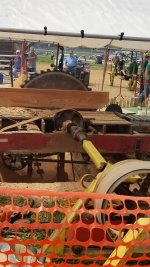
A couple of pics from a couple years ago, a tractor and the saw it was running with the belt.20190817_140347.jpg20190817_140329.jpg
 

Firebrick43

Well-known member
Joined
May 12, 2015
Messages
14,108
Location
West central Indiana
Many of the shows in Indiana have banned live steam after that. Many cant afford the insurance. The antique club I belong to still allows them but they have to be inspected every year by a licensed inspector I believe. The live steam 7.5" railroad has rules for boiler inspections on them. The Minneapolis steam engine based there is well maintained and is ran most of the show.

Things our insurance does not allow and hasn't for years, is horses on the grounds in any shape or form. Last year they started requiring that anyone driving anything, even an antique lawn mower, must have a drivers license.
 
OP
T

thunderskunk

Well-known member
Joined
Oct 4, 2022
Messages
130
That was the Medina County fair. I am pretty sure you are right about the licenses since then.
There is a decent steam show in Dover every year usually in August.
A couple of pics from a couple years ago, a tractor and the saw it was running with the belt.
Here is an absolutely spot on, detailed assessment of the steam explosion at Medina. Everything was wrong: The pressure gage didn't read accurately, the safety valve didn't go off at its set point, and staybolts weren't to specifications. None of that mattered: The crown sheet was thin. 28 million pounds of force, and the pressure was only 90 PSI. That's why we use steam; the energy in expansive steam compared to compressed air is several factors higher. I tried to come up with a TNT equivalent, but it's a different ball game. A cool example is dropping C4 in a puddle vs laying it on the ground; one does nothing, the other makes a 3ft wide crater (made a miserable day at the range interesting). You only have a few cubic feet volume of steam, but combined with heat, shrapnel, the incompressibility of water, steam explosions can be significantly more dangerous than standing near an explosive-explosion. If I had to guess, maybe close to 10kg of TNT, about half what this looks like. Still very violent out in the open.

A book recommendation: Hatchers notebook. Written by an Army officer with the connections to talk to all the folks in firearms development at the pinnacle of development. They took a Springfield rifle, fired a shot, put it on the lathe and turned down the chamber a bit, fired another shot, etc. They got as small as .040" or so, and the barrel still didn't explode. In the same way, a bad boiler can and will pass a pressure test: perfect conditions, slow pressure rise, heck the corrosion still has some form of strength. The pressure test is not the end all be all, hence UT and visual inspections are a must.
 

Lassen Forge

Well-known member
Joined
Apr 26, 2014
Messages
15,277
Location
The romantic hills of central Umbria, Italy,
Live steam is like reloading - you follow everythng to the letter, and triple check your double checks...

For me, the telling situation at Medina was the owner didn't inspect his boiler, maybe because he didn't want to red tag his baby, allowing it to be fired in an extremely unsafe condition. HUGE difference between 3/8" and .08". IF you play with this stuff, you need to do inspections on it, and also make sure it's safe. Reading the inspector's "autopsy" of the boiler says it all:

I estimate the amount of energy released during the explosion at 90 psi. to be around 28,000,000' lbs of force of which approximately 1,280,000' lbs was used to lift the engine and the remaining was dissipated in the blast area around the engine.

IDK if that's why my dad, when he got the old car bug, ended up not getting a Stanley or White (or, heaven help us, a Doble,, which were designed to be safe)... Sad, as inspected and maintained they're fine, but let it slack one time, and it could be the last time.
 

drokihazan

Well-known member
Joined
Apr 8, 2018
Messages
275
If you're determined to restore this thing, I don't think you should skimp on the shop. You need steel beams and a gantry crane to deal with this thing safely.
 

Ultradog MN

Well-known member
Joined
Jan 20, 2024
Messages
778
Location
Twin Cities
Bottle jack(s) and cribbing, but it would be a fair amount of cribbing to get the axles off.
Agree. A simple jack and cribbing.
Go to Home Depot and look for the worst, twisted and bent 6x6 timbers. Than ask for the store manager and have them discount them. Cut them into 24 or32" lengths and stack them up. It might take you months to get all you need but a machine like that will take years to "fix" so start collectjng cribbing now.
 

NUTTSGT

Super Moderator
Staff member
Joined
Sep 14, 2009
Messages
51,020
Location
Northern Central Ohio
This inspection and evaluation was conducted at the request of Medina County Sheriff Neil F. Hassinger and Lt. John Detchon. (This explosion occurred on July 29,2001)


2001, a little bit longer than I thought, almost 25 years ago.

...small world though, the Sheriff mentioned above, his son was my Captain at one time here at the FD.
 

Hooked

Well-known member
Joined
Sep 24, 2010
Messages
438
Location
League City, Texas
The pictures in this thread remind me of the steam engine being used in "The Return to Snowy River". :) :)

Ultra cool project. Hope to set up a build thread.
 

firebirdparts

Well-known member
Joined
Jun 8, 2016
Messages
10,635
Location
Kingsport, TN
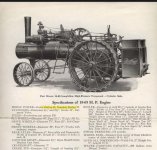
For this Port Huron, it's 19 HP on the Drawbar and 65 HP on the belt which... makes no sense to me in particular since the engine is geared something like 80:1 when pulling.

Well, it's your tractor, but I don't believe 19 is meaningful. The problem with that tractor being rated 19 at the drawbar was the reason I googled it, and that's not how that number was arrived at.
 

firebirdparts

Well-known member
Joined
Jun 8, 2016
Messages
10,635
Location
Kingsport, TN
Not really practical but still cool to watch it work.
Power steering on those.

Some of you guys should read some books on plowing new ground on the prairie with horses. To plow a section with horses, you walked 4 miles and moved the plow over 12 inches. These tractors were very practical.
 

smiffy

Well-known member
Joined
Jan 5, 2014
Messages
218
I thought some of you may be interested to see what our engines look like in the UK. The first picture is the engine my farther restored with its new owner 2009-09-04_14-42-22_DSC_7304.jpg

The next image is a showman's engine. I'm not sure if you guys had these. They towed around travelling funfairs and had generators fitted to power the fun fair once in place. DSC_2782.jpg

The last is a ploughing engine. I don't know know if you guys have these either. A ploughing engine was placed each end of the field, and towed the plow from end to end of the field on winches.

Rusty-Iron-Fowler-11-13-tine-turning-cultivator-lead-1100x770.jpg
 

dscheidt

Well-known member
Joined
Apr 26, 2017
Messages
2,904
The next image is a showman's engine. I'm not sure if you guys had these. They towed around travelling funfairs and had generators fitted to power the fun fair once in place.

These were not a thing in the US, probably because the distances are much longer. Our equivalent was the traveling circus, which moved by train. They then used the circus elephants (and horses, but that’s boring) to pull wagons from the train depot to the fairgrounds.
 
OP
T

thunderskunk

Well-known member
Joined
Oct 4, 2022
Messages
130
Well, it's your tractor, but I don't believe 19 is meaningful. The problem with that tractor being rated 19 at the drawbar was the reason I googled it, and that's not how that number was arrived at.
https://www.thehenryford.org/collections-and-research/digital-collections/artifact/84773

Did the Henry Ford museum get it wrong? Probably. 19 is “nominal” HP, 65 is “brake” HP, as in prony brake. I wish I had a definitive answer for what nominal means: could be based on the boiler, it could be drawbar, I don’t know. Theres so many folks arguing about it on the internet, I just tune it out, and will continue to do so until I meet someone who actually knows what they’re talking about with a logical opinion, maybe even a reference.

On my shelf is “The Encyclopedia of American Steam Traction Engines” which is the best reference on my shelf, and it doesn’t even talk HP. Even mislabels one of the pictures as the wrong rating.
 

Attachments

  • IMG_8680.jpeg
    IMG_8680.jpeg
    338.3 KB · Views: 15

dscheidt

Well-known member
Joined
Apr 26, 2017
Messages
2,904
https://www.thehenryford.org/collections-and-research/digital-collections/artifact/84773

Did the Henry Ford museum get it wrong? Probably. 19 is “nominal” HP, 65 is “brake” HP, as in prony brake. I wish I had a definitive answer for what nominal means: could be based on the boiler, it could be drawbar, I don’t know. Theres so many folks arguing about it on the internet, I just tune it out, and will continue to do so until I meet someone who actually knows what they’re talking about with a logical opinion, maybe even a reference.

On my shelf is “The Encyclopedia of American Steam Traction Engines” which is the best reference on my shelf, and it doesn’t even talk HP. Even mislabels one of the pictures as the wrong rating.

Nominal horsepower is based on the area of the piston and the cube root of stroke length. As a measure of power, it makes just as much sense as quoting the size of gasoline engines in cubic inches (or liters) as a measure of power. James Watt created the formula based on the engines he was building, which were pretty low speed and low pressure, and it made no sense on engines made even shortly later, because the efficiency increased dramatically even in the early 19th century. Some british engineering society created a formal definition, sometime before 1850. I'm sure it's in one of John Bourne's books on steam engines (which are readily available digitally), if you really care. (bourne, by the way, invented the reversing steam engine, and also a number of valve timing mechanisms, that allow steam engines to run at less than full power by varying the amount of steam they're fed.)
 

Byrdnyrd

Well-known member
Joined
Jan 10, 2021
Messages
119
Location
Taxachusetts
Smiffy,

Never mind the tractor, Thats a Beautiful Series 1 Land Rover in the 3rd picture!!

Love it!!

Cheers,
BN
 

HogDude

Well-known member
Joined
Dec 25, 2020
Messages
229
Location
Nebraska
Smiffy,

Never mind the tractor, Thats a Beautiful Series 1 Land Rover in the 3rd picture!!

Love it!!

Cheers,
BN
From this point forward when someone says "Herculean effort" this will be what comes to mind. Impressive. Yeah, following....
 

smiffy

Well-known member
Joined
Jan 5, 2014
Messages
218
These were not a thing in the US, probably because the distances are much longer. Our equivalent was the traveling circus, which moved by train. They then used the circus elephants (and horses, but that’s boring) to pull wagons from the train depot to the fairgrounds.


The fun fairs are amazing, still quite a few steam ones running. Some of the rides had their own steam engine to power them like the gallopers. Others ran of the two large generators on on top of the boiler. Showman's engines are truly the most beautiful prices of machinery you could build, they absolutely gleam and are far bigger than that picture makes them look.


To avoid these ads, REGISTER NOW!
Top Bottom