To avoid these ads, REGISTER NOW!

New system install. How are my static pressure readings? Do I need a trap?

gagecalman

Well-known member
Joined
Feb 5, 2020
Messages
194
Location
MD
Sorry this is a long read but thanks for taking the time to read and teach me.

I'm helping a friend replace my gas furnace and AC here in Maryland. Furnace is in basement.
He has his own HVAC company but does mostly commercial work. He does do residential but he doesn't go looking for it. I've done most of the work because he's been very busy. I probably should have thought this out a little better but it's a learning experience! Feel like it's Groundhog day.

This is what we installed.
Furnace Goodman GR9S960603BN. 60k btu.
Condenser Goodman GLXS5BA3010. 2-1/2 ton.
Coil Goodman CAPTA3026B3. 2-1/2 ton. (Pressure drop at 950 cfm: DRY 0.20, WET 0.25).
Filter AprilAire 2410 MERV 13 16" x 25". (Pressure drop at 950 cfm: 0.14).

I posted already about the bushing that I installed in the gas line. I have since removed it and replaces the furnace wire that was in liquid tight with MC cable.
Plus the fitting that he put on top of the furnace wasn't a hit.

I have two questions. All reading are in wc.
The first is with my static pressures. I just want to know how they look. The total is on the high side at 0.53 but not sure what I can do.
I took 4 readings. Return side of filter (-.11), blower compartment (-.25), furnace below coil (.28), and above coil (.14). So a drop of .14 across filter and .14 across coil which is better than Goodman spec of .20.
The heat and ac blower speeds show the same readings and according to the charts they are 930cfm. I tried to increase the speed on the ac by 110cfm but the pressure went up to .65 which resulted in 1000cfm.

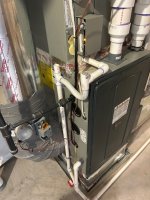
The second is with the coil condensate drain. The coil is under positive pressure. Should I install a trap and a safety switch? If so what's recommended. He mentioned an insulated trap? Not sure why. It will hook up to the PVC pipe sticking up on the right.

Thanks for any comments to help me understand.

Our HVAC replacement 01_2026 034.JPG
 
To avoid these ads, REGISTER NOW!

mm08822

Well-known member
Joined
Jan 13, 2012
Messages
6,005
Location
NJ
I'm not an HVAC guy but digging into many of the same details for my upcoming furnace replacement.
Based on my understanding (so far) and looking at your data:
The ESP limit of 0.5"WC is the pressure difference between furnace inlet and outlet pressures. In your case: Delta P = 0.28 - (-0.25) = 0.53"WC which I would say is perfect.

It does not give you any room for dirty filters (frequent changes) and the evap coil is dry since you are not running ac this time of year. So you want to watch the filter loading.

Also 2.5T of AC nominally requires 1,000CFM. Maybe slightly higher or lower, but that will have to wait until the AC system is running creating a wet coil (resulting from actually cooling humid air) to determine.

As for the trap, there are simple pvc P-traps and also versions with clear pvc and even float-type level sensors. IMO, if you are in are in a basement, it could probably tolerate a little moisture from this drain line condensating. Insulation defeats the visibility aspect of the clear fittings but if you can (and remember to) blow those lines out 2x year, if may not really matter.

I would however, make sure you have strategic access into the entire drain line to blow it out or snake it if ever needed. (I've only ever found wet dust plugs at the duct side of the p-trap causing problems.)
 

fitter30

Well-known member
Joined
Jun 23, 2019
Messages
2,990
Location
Peace Valley,mo
Anytime the evap coil is on the negative side of the blower it needs a condensate needs a trap. Positive side doesn't. Trap depth has to be deeper than the negative presure in inches of water column. Residential 3/4" is more than enough.
 

mm08822

Well-known member
Joined
Jan 13, 2012
Messages
6,005
Location
NJ
Anytime the evap coil is on the negative side of the blower it needs a condensate needs a trap. Positive side doesn't. Trap depth has to be deeper than the negative presure in inches of water column. Residential 3/4" is more than enough.
I thought the trap was needed to prevent movement of radon if draining through the basement floor and stop a leak on the supply side.
 

fitter30

Well-known member
Joined
Jun 23, 2019
Messages
2,990
Location
Peace Valley,mo
I thought the trap was needed to prevent movement of radon if draining through the basement floor and stop a leak on the supply side.
Never heard about radon and condensate trap. Water won't stay in a trap. It will blow some out as it runs in cooling. System off water will evaporate or in heat. Radon detection should have its own exhaust fan running 24/7.
 

mm08822

Well-known member
Joined
Jan 13, 2012
Messages
6,005
Location
NJ
Never heard about radon and condensate trap. Water won't stay in a trap. It will blow some out as it runs in cooling. System off water will evaporate or in heat. Radon detection should have its own exhaust fan running 24/7.
Not every build has a radon exhaust system installed at time of build and possibly not until sale of property and only if levels are discovered high during a buyer's inspection. I thought this entire radon concern was reason to no longer allow gravity drain through basement slabs forcing condensate pumps to be installed. (I don't follow these things.......maybe just another urban legend circulating.)
 

larry4406

Well-known member
Joined
Jan 27, 2006
Messages
19,440
Location
Northern Virginia
Not every build has a radon exhaust system installed at time of build and possibly not until sale of property and only if levels are discovered high during a buyer's inspection. I thought this entire radon concern was reason to no longer allow gravity drain through basement slabs forcing condensate pumps to be installed. (I don't follow these things.......maybe just another urban legend circulating.)
Our new construction homes have had radon passive systems installed as standard for near 15 years now. Dedicated 3" stack run from sump crock lid to the roof and a powered outlet in the attic adjacent the roof penetration for a future pump.

Our mechanical rooms have a floor drain that runs to the sump crock. The HVAC condensate drains run to the floor drain but are not connected to it; this provides an air gap function.

We do not allow trades to drill holes in the lid of the sump crock for drains as this allows an alternate pathway for radon,

The OP is in MD. If he is in WSSC territory (Washington Suburban Sanitary Commission - plumbing AHJ), they consider condensate to be unmetered water and prohibit it from going into a sanitary drain (thus the floor drain to sump crock).

The OP's new unit looks similar to ours at the day job (we use Lennox). The AC drain has a running trap and is tied common with the condensate drain from the furnace. Typically the AC drain turns to the side of the unit, enters into a branch of a vertically oriented tee. Top of tee is capped with a removable plug for cleanout access. Bottom of tee discharges down, elbows into a horizontal running trap, which then discharges to the furnace condensate drain.

Attached is an example picture from a work in progress installation at the day job. Our units sit in a metal pan with a float switch which is the red device (no drain on the pan). If the float switch detects water, it shuts down the unit. The cigarette size box with light on above the AC condensate drain is a sensor for the new A2L refrigerant (I snapped the cover fully on after taking the picture). It is a sniffer as the A2L refrigerant is flammable and it shuts down the unit if it smells the refrigerant.

I don't understand why the installer would say the AC condensate trap should be insulated. If the OP does not have a floor drain or sump crock and is pumping the condensate outside, then efforts are needed to prevent it from freezing.
1768828142312.jpeg
 

bonneyman

Well-known member
Joined
Apr 22, 2010
Messages
8,836
Location
Desert SW
I would install one of the clear PVC trap assemblies mentioned in the OP's post. Makes it much easier to see a clog in the trap since it's clear - one can do it automatically each month when they change their filter. And most often the kit the trap comes with a flexible brush for cleaning out the trap.

if mold growth or nasties are a problem, pour a cup of pine sol and ammonia down the drain every month during A/C season. Seems to help retard the growth of bio-film which clog pipes.

Here's the one on my furnace. Includes an emergency cut-off switch if trap clogs and water backs up - before it overflows and makes a mess.


danski0224

Well-known member
Joined
Jan 29, 2005
Messages
13,468
Location
Near Naperville, IL
You don't need a trap.

The AC and furnace condensate lines should not be tied together, and they should drip into an open site drain. Should not be a connected path from floor drain to condensate connection.
 

pcmeiners

Well-known member
Joined
Aug 13, 2009
Messages
7,938
Location
In the only town in Pennsylvania, Bloomsburg.
I thought the trap was needed to prevent movement of radon if draining through the basement floor and stop a leak on the supply side.
As to radon, if you have it, with no fan purging it will enter your basement through any tiny cracks. Yes it could enter a non- trapped/dried trap condensate pipe but generally older basements constructed without radon remediation will have many avenues to enter your home... cracks, unsealed slab perimeters, sump basins, and cinder or cement block all add to radon levels . Very difficult and expensive to retro seal against radon, much cheaper to have a fan purging system
 
To avoid these ads, REGISTER NOW!

larry4406

Well-known member
Joined
Jan 27, 2006
Messages
19,440
Location
Northern Virginia
@gagecalman

Regarding yes or no for the condensate drain, I encourage you to read the manual that came with it and follow it.

My read of the manual (from googling your specific model number) is that it shows the need to have a pee trap on the primary drain and the manual does not distinguish between positive pressure or negative pressure on the coil. (With positive pressure and no trap, you are blowing air down the drain line vs directing it to the conditioned space.)

1768866796915.png

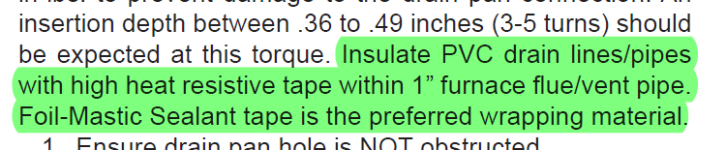
Interestingly, I did see this tidbit regarding insulating the condensate line as alluded to by your friend. I have never seen this done in the field.

1768866667325.png

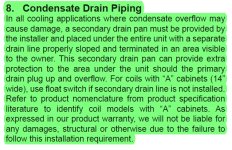
You will need to make a decision regarding how to address your secondary drain.
1768866964864.png

All of the furnace/AC systems installed in our units are vertical upflow units like yours with positive pressure at the coil and drain ports. They are all plumbed like the picture I posted. We have used Goodman, Rheem, Carrier, and now Lennox over the years and they all are plumbed like this. Our vertical upflow units are in the basement like yours.

Years ago, we would have a drain on the overflow pan but this was deleted and the float switch added. The pan drain would allow the unit to continue to run and not alert you to a problem. Deleting the drain lets the pan fill and the switch shuts the unit off which then becomes obvious to the customer.
 
OP
G

gagecalman

Well-known member
Joined
Feb 5, 2020
Messages
194
Location
MD
Thanks for all of the great replies. Lots of info and suggestions.

I did see the trap requirement in the manual. The funny thing is that I can't find any specs on the traps that are being sold. Most state 1" drop and a few state 3" drop. I really don't know what the drop is referring to.

1768871310646.png

I've never seen a furnace around here in the basement sitting in a drain pan or insulation on the drain line.
I'm thinking I'll just install a safety switch like the Asurity CS-2 or the Safe-T-Switch Model SS2.
 

mm08822

Well-known member
Joined
Jan 13, 2012
Messages
6,005
Location
NJ
Thanks for all of the great replies. Lots of info and suggestions.

I did see the trap requirement in the manual. The funny thing is that I can't find any specs on the traps that are being sold. Most state 1" drop and a few state 3" drop. I really don't know what the drop is referring to.

1768871310646.png

I've never seen a furnace around here in the basement sitting in a drain pan or insulation on the drain line.
I'm thinking I'll just install a safety switch like the Asurity CS-2 or the Safe-T-Switch Model SS2.
The 1" version is used for A coils after the blower. This pressurizes the drain port up to a max of ESP= 0.5. Your pressure is lower as expected. You can use the 1" version.
The 3" version is used on air handler type of systems where the A coil is before the fan. This causes a vacuum at the drain port. This extra height is to prevent drawing in any liquid in the p-trap.

I had to troubleshoot a system not running during summer (ac season). Nest t-stat indicated no power. Safety switch was on, cb was on, power was at unit.
It was an upflow furnace sitting in a pan w/o a drain and had water touching a water detection switch located in the pan. Inside of furnace cabinet was wet. Turns out condensate drain line was blocked by wet dust bunnies and condensate overflowed the tray under A coil. Eventually the water switch interrupted 24vac power.
Had to blow out drain line until clear, wipe off water detection switch. 24vac power was re-established and ac able to run. Customer never ever cleaned the line.
 
OP
G

gagecalman

Well-known member
Joined
Feb 5, 2020
Messages
194
Location
MD
According to Goodman's specs they want a 2" minimum drop trap for any setup. Looks like most traps are 1" and I suspect most people are just installing those based on the info I've seen.
 

pcmeiners

Well-known member
Joined
Aug 13, 2009
Messages
7,938
Location
In the only town in Pennsylvania, Bloomsburg.
According to Goodman's specs they want a 2" minimum drop trap for any setup. Looks like most traps are 1" and I suspect most people are just installing those based on the info I've seen
2" trap? Totally ridiculous, furnaces do not ****, shower or shave. I would go 1"

" A 60k BTU furnace needs adequate gas flow, so a 3/4" or 1" line/trap is standard, but always check the furnace's installation manual for the specific gas pipe sizing."
 
OP
G

gagecalman

Well-known member
Joined
Feb 5, 2020
Messages
194
Location
MD
Thanks for all of the great replies.

Any thoughts on the static pressures?
Will the ac run okay at 930cfm?
I tried to increase the speed on the ac by 110cfm but the pressure went up to .65 which resulted in 1000cfm.
 

PoorUB

Well-known member
Joined
Mar 29, 2021
Messages
11,669
Location
Fargo, ND
400 CFM per ton is pretty much the golden number, but the minimum is 350 CFM per ton, so 875, so it should be ok at 372 CFM per ton. Lower air speed will lower the coil temp and dehumidify better.
 
To avoid these ads, REGISTER NOW!
Top Bottom