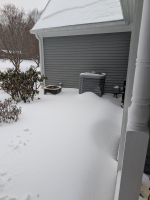
Peak cost efficiency (heat per dollar of electricity consumed) occurs when outdoor temperatures are moderate and resistive heating is not needed. Once you are fully into running the heat strips, the only difference between 10 and 15 kW is can 10kW keep the house warm or not.I know the Carrier system I have is a highly efficient unit which qualified me for very generous tax breaks. It automatically turns on the different stages of electric heat in a way that optimizes energy consumption. To me that means if its calling for 15KW and only getting 10KW it would not be running at peak cost efficiency.
Yes but it might not be the case that you need 12KW to maintain temperature. It may be the case where its more cost effective to run at 12KW than at 10KW on the heating strips.Peak cost efficiency (heat per dollar of electricity consumed) occurs when outdoor temperatures are moderate and resistive heating is not needed. Once you are fully into running the heat strips, the only difference between 10 and 15 kW is can 10kW keep the house warm or not.
Consider this: if you need 12 kW of electric heat to maintain indoor temperature, the 10kW system will run continuously and indoor temps will drop. A 15kW system will maintain temps and the system will cycle on and off as needed. Either way, 100% of that expensive electricity turns into heat. Efficiency (heat per dollar of electricity consumed) doesn't change.
There are 2 different balance points:Yes but it might not be the case that you need 12KW to maintain temperature. It may be the case where its more cost effective to run at 12KW than at 10KW on the heating strips.
It may be the case where its more cost effective to run at 12KW than at 10KW on the heating strips.
Six of one a half dozen of the other.Maybe someone else can but I can't think of any case where that would be true.
Which is more, 10kw for 45 minutes or 15kw for 30 minutes?
To your electric meter and your homes set point it does not matter if the 10kW element or the 15-kW element gets energized. You house need X number of BTUs beyond what the heat pump is producing and the system must energize the strip heaters to get the BTUs. Both strip heaters produce 3412 BTUs per kWh of power they have been feed. Let’s say your house needs 15,000 BTUs beyond what the HP can produce. To get the BTUs you most feed the strips 4.396kWh of power. The 10 kW makes 34,120 BTUs per hour or 568 BTUs per minute so it runs for 26 minutes. The 15kW makes 51,180 BTUs per hour or 853 BTUs per minute so it runs for 17 minutes. The house stayed the same temp the electric meter reading is the same the only difference is the meter moved faster for less time or slower for more time.I know the Carrier system I have is a highly efficient unit which qualified me for very generous tax breaks. It automatically turns on the different stages of electric heat in a way that optimizes energy consumption. To me that means if its calling for 15KW and only getting 10KW it would not be running at peak cost efficiency.
More specifically, the colder it is outside in relationship to the setpoint. i.e. the differential temperature....The thermal balance point of this heat pump in that house at your set point is an important number. The colder it gets outside the fewer BTUs the HP can produce and the more BTUs the house needs to stay at its setpoint...
With cold climate heat pumps on the market, whatever you get should NEVER fall below (or even get close to) a COP of 1 until well below your design day temperature, unless you're in Antarctica. Expect the COP to be significantly >1.75 for all but a few HOURS a year....and lock out the heat pump when it gets so cold that the COP falls below 1 making cheaper to run only the strip heat. This is the economic balance point...
More recent units are the "cold weather climate" units. When the COP < 1 due to low temps, then it's time to run the alternate fuel/heating means even if that is resistive electric heating elements in the same air handler. A.K.A. - economic balance point .More specifically, the colder it is outside in relationship to the setpoint. i.e. the differential temperature.
For typical comfort heating, the OP may get poor performance when it's 0F outside and approaching 70F inside, but when it's 0F outside and only 45F inside, then the heat pump is still operating in its peak performance range.
With cold climate heat pumps on the market, whatever you get should NEVER fall below (or even get close to) a COP of 1 until well below your design day temperature, unless you're in Antarctica. Expect the COP to be significantly >1.75 for all but a few HOURS a year.
I don’t understand what is your point? You are really going to lower your set point to 45 when it gets very cold out so your heat pump will be more efficient? I like to think of myself as a cheapskate if you really lower your set point the colder it gets you have me beat. LOLMore specifically, the colder it is outside in relationship to the setpoint. i.e. the differential temperature.
For typical comfort heating, the OP may get poor performance when it's 0F outside and approaching 70F inside, but when it's 0F outside and only 45F inside, then the heat pump is still operating in its peak performance range.
“Cold climate heat pump” is a pretty subjective term. If you mean a HP with a vapor injection compressor yes they will make more heat at lower temps but it is no free lunch. The compressor works harder so it uses more energy the cop must drop. If you have 1.7 COP data at negative 25 F please post a link.With cold climate heat pumps on the market, whatever you get should NEVER fall below (or even get close to) a COP of 1 until well below your design day temperature, unless you're in Antarctica. Expect the COP to be significantly >1.75 for all but a few HOURS a year.
I'm responding to the OP, who wants to heat a shop only occasionally, and not to comfort indoor temperatures. And people here are making the case for resistive heat. SMH.I don’t understand what is your point? You are really going to lower your set point to 45 when it gets very cold out so your heat pump will be more efficient? I like to think of myself as a cheapskate if you really lower your set point the colder it gets you have me beat. LOL...
Now you know. And you can run another circuit with #10Well with temps down around 0 last night I did find that I need that last 5KW coil, I was running about 5 degrees low last night. I have another week of these temps with overnight lows around 0.
With relying on resistive heating, I'd be seriously attacking air sealing and attic insulation ASAP, if you haven't alreadyI wonder if that will even be enough. Temps going down to -2 tonight and -8 the night after. After that no more negative numbers on the horizon. But not even close to the record low in CT of -32.
Heat loss = heat requiredI wonder if that will even be enough. Temps going down to -2 tonight and -8 the night after. After that no more negative numbers on the horizon. But not even close to the record low in CT of -32.
Auxiliary electric heat is grouped in banks of 5 kw. The conductor size is 6 awg. The circuit ampacity/breaker size is 60 amps. If you have 15 kw, you either have an extra "single point service kit" added, or two 6 guage/ 60 amp circuits. One would have two 5 kw elements and the other would have one 5 kw and the load of the blower motor. Of course there are plenty of exceptions where manufacturers use unequal sized elements to handle staging better. If you have a Square D HOM panel, I have had to replace at least 100 of them on electric heat. If the breaker overheats, it may fry that lug on the bus in the panel. If you have a single point service kit, the wire is larger as someone previously stated and the breaker larger. If you have a #6 AWG wire coming to the breaker, it can't have a breaker greater than 60 amps. Going to a larger breaker will help nothing; and that night when your breaker tripped from a problem, you would have had something similar to an electrical fire instead. If the bus is bad, sometimes we can change it out if it is available. Another circuit may have to be run and you might have to get a new or different panel. Square D makes an excellent product called QO and it doesn't have the same problems in rural areas with electric heat. Now sometimes, in the winter we get "brown power". When everyone on a small residential line, usually in the country, uses a lot of power during a cold spell the voltage goes down. Low voltage causes motors and Electric furnaces to use more amperage. So, yes, inspect the bus, replace the contact grease/antioxidant on the bus then replace the breaker if it is the right size for the wire. If not, an electrician needs to get eyes and hands on it. Electric heat is only safe if we deliberately keep it that way. Electric furnaces are not to be played with because other lives depend on its safety systems and electrical codes. I typed this delayed response for people who will still read it forever.15KW will need wire and cb rated for 80A.
I'm surprised this has just appeared as a problem this late in the game.
What's you typical measured voltage?
At the start of the OP's problem details, he stated he had (apparently a single) ~61/62a (measured) heating load tripping a 60a cb. He was going to replace it with a 125A cb for his temp heating need with 0* temps eminent. He was talked off the death-by-brute ledge and used an 80a cb as a temporary.Auxiliary electric heat is grouped in banks of 5 kw. The conductor size is 6 awg. The circuit ampacity/breaker size is 60 amps. If you have 15 kw, you either have an extra "single point service kit" added, or two 6 guage/ 60 amp circuits. One would have two 5 kw elements and the other would have one 5 kw and the load of the blower motor. Of course there are plenty of exceptions where manufacturers use unequal sized elements to handle staging better. If you have a Square D HOM panel, I have had to replace at least 100 of them on electric heat. If the breaker overheats, it may fry that lug on the bus in the panel. If you have a single point service kit, the wire is larger as someone previously stated and the breaker larger. If you have a #6 AWG wire coming to the breaker, it can't have a breaker greater than 60 amps. Going to a larger breaker will help nothing; and that night when your breaker tripped from a problem, you would have had something similar to an electrical fire instead. If the bus is bad, sometimes we can change it out if it is available. Another circuit may have to be run and you might have to get a new or different panel. Square D makes an excellent product called QO and it doesn't have the same problems in rural areas with electric heat. Now sometimes, in the winter we get "brown power". When everyone on a small residential line, usually in the country, uses a lot of power during a cold spell the voltage goes down. Low voltage causes motors and Electric furnaces to use more amperage. So, yes, inspect the bus, replace the contact grease/antioxidant on the bus then replace the breaker if it is the right size for the wire. If not, an electrician needs to get eyes and hands on it. Electric heat is only safe if we deliberately keep it that way. Electric furnaces are not to be played with because other lives depend on its safety systems and electrical codes. I typed this delayed response for people who will still read it forever.