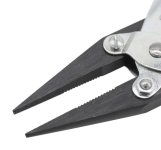
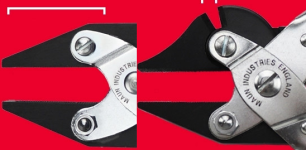
To avoid these ads, REGISTER NOW!

Parallel jaw pliers, what are they good for, why a niche?

YesIHaveAHammer

Well-known member
Joined
Jun 1, 2025
Messages
842
As per the title.

For gripping stuff I see the benefit of fuller contact that these give. I can't say I've missed not having that when using a combination/linesman for such tasks.

The front gripping area is all I use those pliers for, so I was wondering what might do better. This type seems close. Traditional slip joint and TwinGrip have additional stuff in the jaw which detracts from some purposes, but has a versatility benefit.

They aren't I believe common, and there are very few manufacturers.

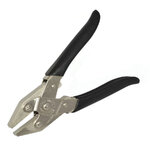
I'm talking about the straight type like this flat nose, or a long nose - not the Knipex Pliers Wrench type.
596-041.01.jpg
 
To avoid these ads, REGISTER NOW!

Dave455

Well-known member
Joined
Mar 19, 2013
Messages
5,821
Location
Sussex, England
They are incredibly useful tools, and I don’t think I could live my life so easily without them.

For gripping most things that fit between the jaws, they generally do a better job than any other type of pliers. The only exception is using combination pliers on round shapes.

I use mine for working on, holding, or manipulating all manner of things with parallel sides. The greater contact area generally causes much less damage for more grip.

I do generally prefer the type with serrated / grooved jaws, although the smooth have their uses if you seek to minimise damage.
IMG_2881.jpegIMG_2880.jpeg

There is no better tool for removing any sort of pin. I regularly remove pins from machine tools without any damage, whereas I regularly see butchers without these tools removing them with end cutters!
IMG_2882.jpeg

They are incredibly useful “general purpose” tools, and as well as the more obvious gripping applications, they can remove small nuts without damage too - and have done so long before the pliers wrench was considered.

My airline pilot father carried a pair in his briefcase, and I’ve seen him unbolt components, cut and strip wire, and even turn round head machine screws with them.

Overall, phenomenally useful tools, and I have a pair in just about every tool box I own!

On Saturday, I will be disassembling, moving and re assembling a hoist. Then using it to re position and re commission a press! I guarantee my 8 inch Maun Pliers will be in the, otherwise relatively minimal, bag of tools I will be carrying!
 

neophyte

Well-known member
Joined
Apr 23, 2012
Messages
9,680
Location
Pennsylvannia
A basic history, is that this style of oarallel plier was invented and patented by a William Bernard of Connecticut back in the late 1800s, with the first patent issued, I think in 1890. (Or at least the early 1890s.
Bernard then came to an arrangement with the William Schollhorn Manufacturing company, where the Patent, and other patents Bernard had filed were transfered yo the Schollhorn Co. with Bernard becoming a shareholder, as well as inventor and salesman for the Schollhorn Co.
Bernard then spent the next few decades designing variations on the pliers, some for very niche specialty use, as well as other specialty compound leverage plier designs, I think with Bernard’s last patent filed in the late 1920s and Bernard dying in the early 1930s.
Schollhorm continued on into the mid to late 1940s, at which point the Schollhorn manufacturing Comoany was sold to the Sargent manufacturing company, (a manufacturer of tools and locks, and hardware), which continued manufacturing the pliers for decades, until the Sargent co was purchased by Assa Abloy, which wanted the lock and hardware division, with the tools division split iff into Sargent Tools, owned by another company.
Sargent continued manufacturing the pliers, but only in several models, with a gap at one point, since most profit seems yo have come from other tools such as specialty crimpers.
Technically Sargent still exists as a division of another specialty tool manufacturer, and the several plier models are still in production.

As far as the pliers go.
Originally, they were marketed as general purpose pliers, with smaller handier models advertised for optometry use, and for general wire use.
One or two of the larger versions were sold with insulated rubber grips for use by people doing electrical work on higher voltage wiring.
The US Government or military purchased and used the pliers during WW1 maybe for use by the signal corps.
One of the armorers tool kits may have also used the pliers, probably the 6-1/2 version with cutters, during WW1, although this is uncertain.
At some point 6-1/2” version with cutters wound ip as a standard item in the general armorer’s tool kit, and remained there thru the recent wars in Iraq and Afghanistan, although I think the pliers recently got dropped from the newer version of the kits.
French Armorer’s tool kits also had the same pliers, and maybe a general tool kit as well, and there were French made versions that say “Armee Francais” on them, maybe from one or two separate manufacturers.
There seem to be Nato stock numbers for the 6-1/2” version and 8” versions, maybe both with and without the cutters.
In Australia, and maybe New Zealand and the UK, the 8” version with cutters, and maybe the 6-1/2” versions, have become one of the standard “fencing pliers” for stretching and cutting wire.
Smaller versions, in the 4 to 5-1/2” inch sizes, and very commonly used in jewelry work, and gave been a standard type of jeweler’s plier for decades. (Usually smooth jawed, but also the serrated versions, and “snipe nose” or needle nose versions).
There are stainless versions made for orthodontic use, and fir surgical use, with the higher end versions usually being made in Germany, and the lower cost versions being made in Pakistan. (Still expensive though).
For decades, the pliers were sold as “fishing pliers” with “Manley” being one of the main brands, but also “Sampo”, and Sargent, who marketed the pliers as “Fishing Pliers”, and who even made a particular model modified in a number of ways for fishing use.

As far as use goes, as has been mentioned, the pliers are great for turning nuts that will fit between the jaws.
The parallel jaws are also great for pulling pins or wire.
The cutters, on versions that have cutters, tend to have very high leverage, and cut wire easily.
While the jaws aren’t completely parallel, the pliers can be used for flattening sheet metal, and are also better than regular pliers for bending wire, and narrow strips of metal.

Sargent still manufactures several version of the pliers, usually the 6-1/2” and 8” sizes in versions with cutters and without.
The main manufacturer of higher quality versions is a manufacturer in the UK called Maun Industries, which seems to have been making the pliers, likely since at least the late 1940s.
Maun probably manufactures the widest variety of higher quality versions, in sizes from about 4”, up to 8”.
Older Maun made versions were sort of roughly finished.
Newer versions seem to have fairly decent machining, and properly hardened jaws, and the cutters sometimes work better than the older USA made Sargent versions.
Sargent at some point decades ago, switched to using rivets to connect the parts together.
This actually makes the riveted pliers, nice and tight, but also means you can’t take the pliers apart for modification.
Maun Industries still uses the original Bernard design using nuts and threaded bolts yo connect the plier jaws to the bent steel sheet handles.
Maun unfortunately has switched to zinc plated handles, which don’t work as smoothly, as the older nickel plated handles.

Personally, I love the pliers as general purpose pliers, and try to keep a pair with each tool kit, and I used to carry a pair in a bag with me.
I don’t know what the surgical versions are like, but most of the pliers are a bit tougher finished than I like nowadays, especially given how much the parallel pliers usually cost.
 
OP
Y

YesIHaveAHammer

Well-known member
Joined
Jun 1, 2025
Messages
842
So why isn't there much of a market for them compared to pivot-based ones? i.e. not many people buying, made only by a few small companies.
 

neophyte

Well-known member
Joined
Apr 23, 2012
Messages
9,680
Location
Pennsylvannia
So why isn't there much of a market for them compared to pivot-based ones? i.e. not many people buying, made only by a few small companies.
The original patent mentions “economical” manufacture, but the parallel haw pliers have always cost 50% more than regular single pivot pliers, even from Schollhorn Co. which manufactured both the parallel pliers, and conventional single pivot forged pliers.
The jaws also bend to the side a bit more than regular forged pliers when twisting, especial if the jaws aren’t clamped really tightly.
It’s possible for the handles to bend together slightly if way too much force is applied, and I have seen some pliers were this has definitely happened, but I’m not really sure how common the problem ever was.
I suspect, tool users may dimply have thought of solid forged pliers as being “the more durable” tool, simply due to the general preference, whether deserved or not, for tools made from forged steel, which might especially come into play if a tool costs 50% more.
There earlier Schollhorn pliers I’ve seem have impeccable manufacture, do I doubt the issue was simply “quality”.
The other issue that might have come into play is the cost to set up manufacture.
The handles for the Bernard type pliers require punching designs out of sheet metal, and then bending and forming those designs into a complex 3 dimensional pattern.
The jaws on the other hand, are or were usually forged, and then machined.
On the older versions with bolt connections, the formed steel handles need to be threaded for a few of the joints.
All the pieces need to be manufactured to the tight tolerances, so that cutters match up, at almost the exact point were the jaws come together.
I suspect setting up manufacture would be a pain, and require stamping, forming, gorging, and machining operations, in addition to heat treating, and plating operations, and it is way more of a pain to set up a manufacturing process, than manufacturers want to bother with.
Midwest, uses similar types of variety of operations to make their aviation shears and other tools, as does Malco, but it took Malco a few years to get the Eagle Grip production up and running, despite the company already making tools with a similar type of manufacturing processes, including “punching” and forming the sheet metal handles, and forging and machining, and plating the jaws.
 
OP
Y

YesIHaveAHammer

Well-known member
Joined
Jun 1, 2025
Messages
842
parallel haw pliers have always cost 50% more than regular single pivot pliers
I'd certainly noticed the cost factor. Looking at Maun, I'd assumed that was mostly down to small volumes and the cost of manufacture in the UK.

Versus Knipex, both with plastic coated handles:
Combination plier 200mm: 2.6x
Long nose plier 200mm: 1.8x
 

Dave455

Well-known member
Joined
Mar 19, 2013
Messages
5,821
Location
Sussex, England
I'd certainly noticed the cost factor. Looking at Maun, I'd assumed that was mostly down to small volumes and the cost of manufacture in the UK.

Versus Knipex, both with plastic coated handles:
Combination plier 200mm: 2.6x
Long nose plier 200mm: 1.8x
I think that it's simply that these are a more complex, and thus more expensive, design to produce than simple two piece pliers.

There are more parts, and to be effective they need to be made to quite a high standard.

Yes, volume of production will have something to do with it, but Maun produce a fair volume.

I’m not convinced it is any more expensive to manufacture in the U.K. than Germany. Hazet offer a pair of compound action cutters very similar to Maun, and they are usually about twice the price!

Also bear in mind that (particularly with the 8 inch combination pliers) you are looking at a vastly different tool compared to regular combination pliers. I don’t have any 8 inch Knipex to compare, but you get the idea with these 7 inch.

IMG_2893.jpeg
 
OP
Y

YesIHaveAHammer

Well-known member
Joined
Jun 1, 2025
Messages
842
Why is it a surprise that an obviously more-complex tool to manufacturer, one that is noticably less common, is more expensive?
It wasn't.

I said mostly down to small volumes and UK manufacture. The rest being a complexity premium. I don't know how much each factor would account for the high price.
 

Twisted Sid

Well-known member
Joined
May 23, 2013
Messages
763
Location
CA
I have a few pairs that I picked up from garage sales. One regular and one with cutters. I dont use them often but they are pretty handy when I do use them or remember that I have them

Found this video last year and thought it was interesting
 

neophyte

Well-known member
Joined
Apr 23, 2012
Messages
9,680
Location
Pennsylvannia
I'd certainly noticed the cost factor. Looking at Maun, I'd assumed that was mostly down to small volumes and the cost of manufacture in the UK.

Versus Knipex, both with plastic coated handles:
Combination plier 200mm: 2.6x
Long nose plier 200mm: 1.8x
Look at the versions with the spring.
Niwadays, the larger versions are usually made with a U-channel body, and the typical way one opens and closes the handles will cause one’s fingers to rub against the edges of the U, which can get irritating with extended usage.
I think the “plastic coated” versions may simply have plastic sleeves pressed on the handles, at least on the Maun versions, and this may prevent the issue, but the spring versions are also usually easier to use as well.
 

neophyte

Well-known member
Joined
Apr 23, 2012
Messages
9,680
Location
Pennsylvannia
Why is it a surprise that an obviously more-complex tool to manufacturer, one that is noticably less common, is more expensive?
Probably because the construction reminds people of Vise Grip style pliers, which were even fairly cheap back when Petersen was still producing the Vise Grip pliers in the USA, and vise grip style pliers tend to cost less than $20 per pair.
The US made and English made parallel pliers are typically $50-$100 per pair nowadays, and the larger sizes were usually at least $50 retail going back to the year 2000 or so.
Even the really small jeweler’s size versions were typically $25 when purchased under the Grobet branding, and that price goes back to the early 1990s, before I even knew larger sizes existed.

Weirdly, there are parallel jaw locking pliers, based on a patent going back to WW2 or earlier, that Bollmann in Germany still produces, but despite the patent being well expired, few other manufacturers seem to have started manufacturing the design, and it’s mostly seen from other German tool manufacturers rebranding variations on the Bollmann made versions.
 

Outahere

Well-known member
Joined
Mar 13, 2021
Messages
874
Location
Idaho
I'd certainly noticed the cost factor. Looking at Maun, I'd assumed that was mostly down to small volumes and the cost of manufacture in the UK.
They are expensive in the US.
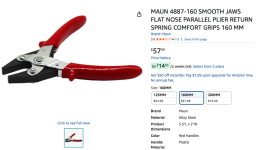
There was only one Amazon review for this specific plier, and it was not complimentary.
...These are better than the cheaper units but barely. At this price it's hard to recommend them, considering how close in quality they are to MUCH CHEAPER units...

Screen Shot 2026-02-06 at 6.29.01 AM.png
 
To avoid these ads, REGISTER NOW!

liliysdad

Well-known member
Joined
Jul 18, 2008
Messages
5,404
I think the coupe of pairs I have are Grobet. I’ve had them for years, they have gotten the bulk of their use in working on guns. They are invaluable in that arena.
 
OP
Y

YesIHaveAHammer

Well-known member
Joined
Jun 1, 2025
Messages
842
Also bear in mind that (particularly with the 8 inch combination pliers) you are looking at a vastly different tool compared to regular combination pliers.
Looks huge, big handle spread according to the specs too. I'd noticed people using the 125/140mm for jewellery making.

Look at the versions with the spring.
Niwadays, the larger versions are usually made with a U-channel body, and the typical way one opens and closes the handles will cause one’s fingers to rub against the edges of the U, which can get irritating with extended usage.
I think the “plastic coated” versions may simply have plastic sleeves pressed on the handles, at least on the Maun versions, and this may prevent the issue, but the spring versions are also usually easier to use as well.
It appears that the bare handle unsprung Maun ones have the U wrapped around into a tube. So they would have this mitigated one way or the other on all models. I'm not much impressed by the look of those sleeved handles (especially with how much extra they want for them), so I'm half tempted to try a bare handled, sprung, serrated 160mm.

and “snipe nose” or needle nose versions
Even more expensive, and small jaw openings (13mm in 200mm). Challenged by slip joint needle noses perhaps. As might the flat nose parallels if someone made a flat jaw slip joint (Knipex FlatGrip anyone?).

There was only one Amazon review for this specific plier, and it was not complimentary.
Most of them appear to be listed on the multi variant listing, and more reviews here too. https://www.amazon.co.uk/Maun-4860-200-Parallel-Action-Silver/dp/B078C5BZB8
 
Last edited:

Dave455

Well-known member
Joined
Mar 19, 2013
Messages
5,821
Location
Sussex, England
Looks huge, big handle spread according to the specs too. I'd noticed people using the 125/140mm for jewellery making.
Yes, they are!

I find the 160mm about the best for general purpose use, and I have both the pliers and cutters in this size in my main box.

The 140mm are good for small jobs, the 125mm for jewellery!
It appears that the bare handle unsprung Maun ones have the U wrapped around into a tube. So they would have this mitigated one way (spring) or the other (sleeved handles) on all models. I'm not much impressed by the look of those sleeved handles (especially with how much extra they want for them), so I'm half tempted to try a bare handled, sprung, serrated 160mm.
The bare metal handles come in two types. The sprung type generally have open handles to allow for the springs. They are not comfortable if you remove the springs and use them conventionally.

The unsprung type have closed handles and are fine to open by hand.
IMG_2894.jpeg

I don’t like the dipped handles. Half the advantage of using these tools is that I can use them in oily or greasy conditions and they just wipe off.
 
OP
Y

YesIHaveAHammer

Well-known member
Joined
Jun 1, 2025
Messages
842
Yes, they are!
Even more so with the cutter option. Adds a lot to the cost too.

I have both the pliers and cutters in this size in my main box
I'm not so readily seeing an advantage to the mechanism just to drive a dedicated diagonal cutter head. Leverage perhaps.

The unsprung type have closed handles and are fine to open by hand.
Many Amazon reviewers of the smaller models appreciate the spring or rate the unsprung one poorly for the lack of it. I think the spring may matter less in the larger sizes. And I think it'd be a nusiance letting go of things as soon as put down.

I don’t like the dipped handles.
They're pressed sleeves to be precise, as neophyte highlighted. Given the handles are hollow, presumably dipping isn't an option.
 

KnurledNut

Well-known member
Joined
Jan 28, 2011
Messages
8,147
Location
n/a
I'm not so readily seeing an advantage to the mechanism just to drive a dedicated diagonal cutter head. Leverage perhaps.
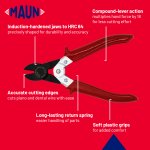
The diagonal cutters are not parallel . Instead they center pivot like aviation snips and provide compound leverage.
They are also rated for cutting hard wire.

diagonal-cutter-140-with-grips.jpg
 
OP
Y

YesIHaveAHammer

Well-known member
Joined
Jun 1, 2025
Messages
842
The diagonal cutters are not parallel . Instead they center pivot like aviation snips and provide compound leverage.
I know. Is the compound leverage greater than what a single pivot plier can achieve, to justify using this design with its costs? The given capacities for different types of wire (as much we can trust them to be comparable) are the same as what Knipex gives for a high leverage of the same size.
 

Jim_No_Garage

Well-known member
Joined
Jan 15, 2011
Messages
3,313
Location
Millington NJ
I have a pair of older Bernard pliers with a Patent Date of 6-17-1913.

We used them this weekend to crimp some metal corners onto leather. The parallel jaws gave us a nice crimp versus say a pair of lineman's pliers.

Jim
 

KnurledNut

Well-known member
Joined
Jan 28, 2011
Messages
8,147
Location
n/a
I came across these Sargent's that I believe to be model #1024.
They are very small and compact at 4-1/2" (115mm). Yet the jaws are a beefy 9/32" (7.2mm) wide and open to 27/64" (10.7mm).

It has heavy duty rivets that were set to allow a very smooth operating action with just a little bit of beneficial resistance. Certainly would have taken some trial and error by the manufacturer to determine the optimal amount of set.
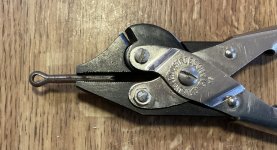
The jaws are 1" (25.4mm) deep and have full-length, sharp, mini-crosshatch serrations. They feature parallel and perpendicular pin gripping slots, as well as what I assume to be a round object gripping recess.
The cutter is a well-machined knife and anvil design.
Both the handles and jaws are nickel plated. The finish has stood the test of time and there is no readily noticeable damage even around the jaws.

I'm not sure if the rivets are stainless or plated but they too have warded off corrosion and allow for fluid movement.
It's also visible here that the serrations extend inside.

The handles have a light diamond pattern for grip with the name beautifully embossed.
I can't quite tell how they finished the handle buttends, but they are solid with no seam line and were ground clean before plating.
I like the ergonomics of the more streamlined thinner/flatter oval versus the bulky Maun round handle design.

Another advantage of this style plier not mentioned yet is the open throat that allows passage of wires/hardware anywhere along their length. I could also see this working well for pulling smaller plastic zip ties tight.
 
Last edited:
OP
Y

YesIHaveAHammer

Well-known member
Joined
Jun 1, 2025
Messages
842
I went for the Maun 4860-160. Thanks for all your thoughts, helped me pick right.

Reasonable value ($40) in this bare handled model considering it's made in England. The inner handle seam is ground but could do with improvement, so I'll take a file to it and might tape them up. They wanted $48 with pushed on sleeve grips.

m - Copy.jpg
 

cody1325

Well-known member
Joined
Apr 17, 2024
Messages
1,094
Location
Southwest Virginia
They are expensive in the US.
There was only one Amazon review for this specific plier, and it was not complimentary.


Screen Shot 2026-02-06 at 6.29.01 AM.png

A feed store near me wanted nearly $100 for the same darn things (the 200mms). I also recall they were about 50% more on the Knipex 200mm Cobolts than KC Tool (where mine came from. BUT, the 200mm Mauns had the wire cutter, so I don't know if that raises the price or not. Really need to check, as they may have changed things up after dumping Southern States and moving to being independent.
 

Farmer J.

Well-known member
Joined
Sep 18, 2016
Messages
1,995
Location
UK, Cornwall/Hertfordshire.
One huge advantage with any of the parallel grip type pliers is that the gripping pressure, the mechanical advantage, the leverage, whatever you call it, remains constant along the whole length of the jaws. I think this is largely why people get to like them so much.
If you grip something at the tip of the jaws with conventional pivot pliers there is hardly any leverage, not very much mechanical advantage over the hand pressure.
This is worse the longer the jaws are, some long nose versions the jaws are as long as the handles so they're no better than using tweezers and only any use for delicate jobs!
I have a Knipex and a Klein plierwrench and find these nice to use, the mechanical advantage, the leverage, is about 10 times the hand pressure. They're parallel action so they also grip as hard at the tip of the jaw as at anywhere along it.
The increase in leverage from hand pressure is big enough that they can grip when using only one handle. The Kleins are more versatile for a travel kit as the jaw can be reversed between smooth or pipe wrench.
 
Last edited:

Farmer J.

Well-known member
Joined
Sep 18, 2016
Messages
1,995
Location
UK, Cornwall/Hertfordshire.
I know. Is the compound leverage greater than what a single pivot plier can achieve, to justify using this design with its costs? The given capacities for different types of wire (as much we can trust them to be comparable) are the same as what Knipex gives for a high leverage of the same size.
This is an interesting thread.
I've not got any Maun pliers, but several people whose opinion I respect like them. I had a look at them recently when shopping for some new cutters something better than the usual diagonal cutters which are handy and convenient but not as efficient leverage. Due to hand issues I compared the leverage of various designs.
It's a fact, increased leverage = reduced capacity, unless there's some kind of ratcheting mechanism.
High leverage side cutters are better than the usual ones, but can be very expensive. The Knipex 73 71 180 TwinForce multiplies hand force by up to 39 times.
Maun compound leverage side cutters increase leverage by 18 times, similar to the various high leverage pivot versions, they're pretty nice.
I eventually bought Knipex 71 01 250 compact bolt cutters which increase hand leverage by 40 times.
https://www.knipex.com/en-uk/produc...knipex-cobolt-xl-compact-bolt-cutters/7101250
 
Last edited:

1982fxr

Well-known member
Joined
Jan 7, 2012
Messages
10,011
Location
Phoenix
So why isn't there much of a market for them compared to pivot-based ones? i.e. not many people buying, made only by a few small companies.
Because 99.9% of society has never heard of them and wouldn't buy them.

Found mine in a toolbox. Had never seen a pair. I love them when I use them
 

1982fxr

Well-known member
Joined
Jan 7, 2012
Messages
10,011
Location
Phoenix
Who currently makes these and are there needle nose versions or other variations?

Personally the cutter gets in the way to me. I'd rather have more clearance and use a separate cutter.
 

Dave455

Well-known member
Joined
Mar 19, 2013
Messages
5,821
Location
Sussex, England
Who currently makes these and are there needle nose versions or other variations? Personally the cutter gets in the way to me. I'd rather have more clearance and use a separate cutter.

These pliers are made by Sergent in the U.S. and by Maun in the U.K.

I don’t know much about the range that Sargent offer, but there are many variations available in the Maun range.

Yes, needle nose are one such option.
IMG_2931.jpeg

Other options include at least four different lengths, models with return springs or without, and grip coverings.

Versions are available with cutterIMG_2933.jpeg

Or without
IMG_2932.jpeg

There are also many other tools available using the same principle.

I like using the cutters, and I’m so used to doing so that conventional ones always seem to be hard work.

Maun offer a huge range of specialised tools, including a lot for metalwork, jewellery making, and factory tasks.

They also offer specialised tools made to order.
 
OP
Y

YesIHaveAHammer

Well-known member
Joined
Jun 1, 2025
Messages
842
If you grip something at the tip of the jaws with conventional pivot pliers there is hardly any leverage, not very much mechanical advantage over the hand pressure.
I eventually bought Knipex 71 01 250 compact bolt cutters
I got those for the equivalent reason - cutting things near the tip due to not being able to get them right down into the jaw due to being stuck to some other part.

It's a fact, increased leverage = reduced capacity, unless there's some kind of ratcheting mechanism.
High leverage side cutters are better than the usual ones, but can be very expensive. The Knipex 73 71 180 TwinForce multiplies hand force by up to 39 times.
The reduced jaw capacity was why I went for the standard high leverage 200, despite the TwinForce claiming about 10% higher cutting capability.
 
OP
Y

YesIHaveAHammer

Well-known member
Joined
Jun 1, 2025
Messages
842
Personally the cutter gets in the way to me. I'd rather have more clearance and use a separate cutter.
I suspected it would, with it sticking out and the different taper. So I got mine without.

The asymmetry might also be a little annoying for picking it up the right way round in your hand.

1771176822893.png
 

KnurledNut

Well-known member
Joined
Jan 28, 2011
Messages
8,147
Location
n/a
I went for the Maun 4860-160. Thanks for all your thoughts, helped me pick right.

Reasonable value ($40) in this bare handled model considering it's made in England. The inner handle seam is ground but could do with improvement, so I'll take a file to it and might tape them up. They wanted $48 with pushed on sleeve grips.

m - Copy.jpg

Have you had a chance to use these yet? Any thoughts?
I managed to land a deal on an older pair of the 140mm Maun compound diagonal cutters and they are quite impressive regarding ease of cutting. Cosmetically, I much prefer the professional look of the stamped branding versus the laser etching they are now doing.
 
Last edited:
To avoid these ads, REGISTER NOW!
Top Bottom