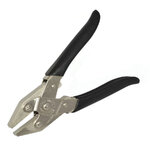
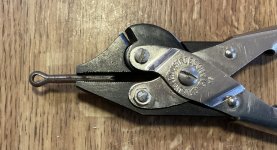
A basic history, is that this style of oarallel plier was invented and patented by a William Bernard of Connecticut back in the late 1800s, with the first patent issued, I think in 1890. (Or at least the early 1890s.
Bernard then came to an arrangement with the William Schollhorn Manufacturing company, where the Patent, and other patents Bernard had filed were transfered yo the Schollhorn Co. with Bernard becoming a shareholder, as well as inventor and salesman for the Schollhorn Co.
Bernard then spent the next few decades designing variations on the pliers, some for very niche specialty use, as well as other specialty compound leverage plier designs, I think with Bernard’s last patent filed in the late 1920s and Bernard dying in the early 1930s.
Schollhorm continued on into the mid to late 1940s, at which point the Schollhorn manufacturing Comoany was sold to the Sargent manufacturing company, (a manufacturer of tools and locks, and hardware), which continued manufacturing the pliers for decades, until the Sargent co was purchased by Assa Abloy, which wanted the lock and hardware division, with the tools division split iff into Sargent Tools, owned by another company.
Sargent continued manufacturing the pliers, but only in several models, with a gap at one point, since most profit seems yo have come from other tools such as specialty crimpers.
Technically Sargent still exists as a division of another specialty tool manufacturer, and the several plier models are still in production.
As far as the pliers go.
Originally, they were marketed as general purpose pliers, with smaller handier models advertised for optometry use, and for general wire use.
One or two of the larger versions were sold with insulated rubber grips for use by people doing electrical work on higher voltage wiring.
The US Government or military purchased and used the pliers during WW1 maybe for use by the signal corps.
One of the armorers tool kits may have also used the pliers, probably the 6-1/2 version with cutters, during WW1, although this is uncertain.
At some point 6-1/2” version with cutters wound ip as a standard item in the general armorer’s tool kit, and remained there thru the recent wars in Iraq and Afghanistan, although I think the pliers recently got dropped from the newer version of the kits.
French Armorer’s tool kits also had the same pliers, and maybe a general tool kit as well, and there were French made versions that say “Armee Francais” on them, maybe from one or two separate manufacturers.
There seem to be Nato stock numbers for the 6-1/2” version and 8” versions, maybe both with and without the cutters.
In Australia, and maybe New Zealand and the UK, the 8” version with cutters, and maybe the 6-1/2” versions, have become one of the standard “fencing pliers” for stretching and cutting wire.
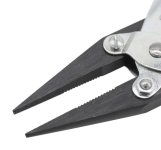
Smaller versions, in the 4 to 5-1/2” inch sizes, and very commonly used in jewelry work, and gave been a standard type of jeweler’s plier for decades. (Usually smooth jawed, but also the serrated versions, and “snipe nose” or needle nose versions).
There are stainless versions made for orthodontic use, and fir surgical use, with the higher end versions usually being made in Germany, and the lower cost versions being made in Pakistan. (Still expensive though).
For decades, the pliers were sold as “fishing pliers” with “Manley” being one of the main brands, but also “Sampo”, and Sargent, who marketed the pliers as “Fishing Pliers”, and who even made a particular model modified in a number of ways for fishing use.
As far as use goes, as has been mentioned, the pliers are great for turning nuts that will fit between the jaws.
The parallel jaws are also great for pulling pins or wire.
The cutters, on versions that have cutters, tend to have very high leverage, and cut wire easily.
While the jaws aren’t completely parallel, the pliers can be used for flattening sheet metal, and are also better than regular pliers for bending wire, and narrow strips of metal.
Sargent still manufactures several version of the pliers, usually the 6-1/2” and 8” sizes in versions with cutters and without.
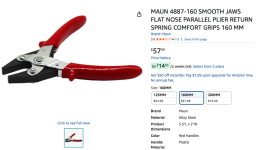
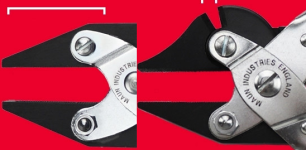
The main manufacturer of higher quality versions is a manufacturer in the UK called Maun Industries, which seems to have been making the pliers, likely since at least the late 1940s.
Maun probably manufactures the widest variety of higher quality versions, in sizes from about 4”, up to 8”.
Older Maun made versions were sort of roughly finished.
Newer versions seem to have fairly decent machining, and properly hardened jaws, and the cutters sometimes work better than the older USA made Sargent versions.
Sargent at some point decades ago, switched to using rivets to connect the parts together.
This actually makes the riveted pliers, nice and tight, but also means you can’t take the pliers apart for modification.
Maun Industries still uses the original Bernard design using nuts and threaded bolts yo connect the plier jaws to the bent steel sheet handles.
Maun unfortunately has switched to zinc plated handles, which don’t work as smoothly, as the older nickel plated handles.
Personally, I love the pliers as general purpose pliers, and try to keep a pair with each tool kit, and I used to carry a pair in a bag with me.
I don’t know what the surgical versions are like, but most of the pliers are a bit tougher finished than I like nowadays, especially given how much the parallel pliers usually cost.