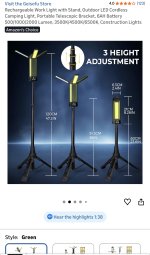
Cheaper than similar lights. $28 with code Z9ZXRFBN. Works now but no idea if it’s regional or will disappear.
That code made it $46 from 49.99 for me. Shoot I could have used this.

Cheaper than similar lights. $28 with code Z9ZXRFBN. Works now but no idea if it’s regional or will disappear.
Maybe they figure it'll overheat & shrink that tube on its own.That is a grand total of 0.45sq mm and equal to an AWG between 20 and 21!...
...a piece of heat shrink over it that was never shrunk.
In general I go for 12 gauge wire for 20 amps and 14 gauge for 15 amp.What would the temperature rise be around that hole in the uninsulated bus suspended in air inside a large aluminum enclosure with a 20 ampere current. Is it excessive? What gauge would an extension cord need to be for 20 amps if it was 30 meters in length. What about an extension cord less than a millimeter in length? What’s the wire gauge of that 60 amp wall wart cell phone charger?
Now I am curious what other ones look like inside.
Worked for me just nowCheaper than similar lights. $28 with code Z9ZXRFBN. Works now but no idea if it’s regional or will disappear.

The current price of $46.99 matches the highest price in this period. The lowest price of $24.99 occurred during late November 2025.Cheaper than similar lights. $28 with code Z9ZXRFBN. Works now but no idea if it’s regional or will disappear.


They claim that's 34% off the regular price of $100. That looks more like 15% off the regular price. But what they probably mean is 34% off a price they're not showing us.

Mine shows 34% off list price of $129.99, they were also on sale for $99 before this lightning deal.They claim that's 34% off the regular price of $100. That looks more like 15% off the regular price. But what they probably mean is 34% off a price they're not showing us.
That makes more sense. I was looking for a list price. I didn't see one when I lookedMine shows 34% off list price of $129.99, they were also on sale for $99 before this lightning deal.
OK. I have received and tested 20A one today.But anyways, mine came today. I picked up two. They're nice solid power strips. Aluminum housing, decent size and outlet spacing, and I'm really liking the angled outlets and mounting options (bottom and back.)


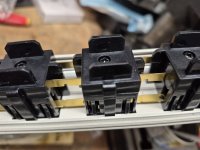
I'm guessing you did not look under the plastic outlet housings? The hot bus does, in fact, have holes in it, but you have to look for themOK. I have received and tested 20A one today.
1. It's not UL listed
2. Its 20A rating is not on the item, but only mentioned in the paperwork
3. The 6-ft cord and connections to the buses (brass(?) strips) are 12AWG wire
4. The hot bus strip is solid. The neutral one has notches. The ground strip is a bit thinner and has holes described above.
For the test, I used an IR thermometer measuring temperatures near all the notches on the neutral bus. The load produced 12.8A current (confirmed with a tester).
Result: the highest neutral bus temperature raise (spots near the notches) was below 5F (and about 1F in the hot bus which has no notches). Not discernable at all by fingers right after the circuit was de-energized. So, I guess there is nothing to be concerned about. No, I didn't energize and check the ground bus. I guess the circuit breaker will not allow melting of the ground bus in case of emergency.
P.S. As a load I used a 4-slot toaster (120V/1560W). It is UL listed. Its power cord is 16AWG. No ground wire (although the toaster has a metal case). Under the full load the power cord becomes just a tiny bit warm.
(see this post). You can see one of the many holes in the pic of the hot bus).Behind the green wire is the bus bar for the hot with holes visible.On the picture you linked, it looks to me like a removed ground bus connected to a bluish-greenish (on my screen) wire. I cannot see the bus connected to the black wire there.
That said, I strongly believe that a flat wire can carry higher current because it has better heat dissipation... But then they cut holes in it.
They claim that's 34% off the regular price of $100. That looks more like 15% off the regular price. But what they probably mean is 34% off a price they're not showing us.
Chinese math is different than the rest of the world. Learned that negotiating with them on machinery purchases many years ago. We employed "Reverse Chinese Logic" to level the playing field...
I see. Thank you. My buses look slightly differently.Behind the green wire is the bus bar for the hot with holes visible.
So what is the verdict, safe to use? Thanks for taking the time!I see. Thank you. My bases look slightly differently.
P.S. By the way, I made a mistake in my first post (Post#6415 above). The bus with notches is the hot one. And the bus that looks solid is neutral. So the hottest spots were on the hot bus where the notches are. It makes no difference, of course, but...
you guys are way to vested in a freaking power strip
Something had to take the place of PVC airlines.you guys are way to vested in a freaking power strip
You’ll learn to love it.lolJeez. All this over a power strip?
FIFY!Jeez. All this over a cheap $13 power strip?
It's 10 degrees outside. What else are we supposed to do?Jeez. All this over a power strip?
I thought it was PCV (Pressure Causes Venting) airlines!Something had to take the place of PVC airlines.
As are the extra "T" slots on the neutral pin. It's just coincidental that this ingenious heat dissipation scheme resembles a NEMA 5-20R receptacle; it's a design feature and it can't be helped!This is so obvious... The holes are there to increase airflow and improve the heat dissipation!
All this over a power strip?
you guys are way to vested in a freaking power strip
Let's not even get started on which way the outlet is supposed to be oriented on the strip ....It's 10 degrees outside. What else are we supposed to do?
Hopefully, I don’t get any with hair around the receptacle.As are the extra "T" slots on the neutral pin. It's just coincidental that this heat dissipation scheme resembles a NEMA 5-20R receptacle; it's a design feature and it can't be helped!
Let's not even get started on which way the outlet is supposed to be oriented on the strip ....
Move. It was upper 70s here today.I thought it was PCV (Pressure Causes Venting) airlines!
Not always a bad thing.Hopefully, I don’t get any with hair around the receptacle.

![52[M][0@0][0].jpg](/forum/data/attachments/2332/2332477-e0afb8db9e6af711e9525e8d68864980.jpg)
![38[M][0@0][0].jpg](/forum/data/attachments/2332/2332476-5dca9bf1a45b6c65a2ea8ebb5323a728.jpg)
![35[M][0@0][0].jpg](/forum/data/attachments/2332/2332475-e59e13b8dcda24e4de9686002c2878b7.jpg)
![32[M][0@0][0].jpg](/forum/data/attachments/2332/2332474-e41adb0f00f9144645c2c9343bfc5cc0.jpg)
![06[M][0@0][0].jpg](/forum/data/attachments/2332/2332473-6b71df320933ed996bf7c5fa73470bf8.jpg)
![05[M][0@0][0].jpg](/forum/data/attachments/2332/2332472-626f55cbbb2930926694abc34305dda5.jpg)