
You are using an out of date browser. It may not display this or other websites correctly.
You should upgrade or use an alternative browser.
You should upgrade or use an alternative browser.
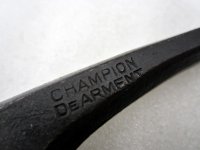
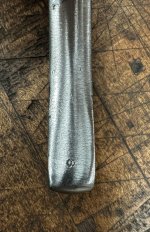
Post up your vintage Champion deArment/Channellock tools
- Thread starter d42jeep
- Start date
jeffmoss26
Well-known member
Wow! Those cleaned up great. What did you use?Here are some formerly rusty Channellock dykes I found at yesterday’s estate sale.
As found.
After de-rusting.
Mystery number.
-Don




Private Lugnutz
Well-known member
Mystery number.
Maybe. If we're speculating... Since the "43" is also the first two numbers of the model number ("436"), perhaps a die designator for dykes. They only made a 436 (6" OAL) and a 437 (7" OAL). The lap joint dykes were 44X and had completely different handles. That could also just be a coincidence.Date code? Quarter/year?
Whatever it is, it wasn't a common practice.
Private Lugnutz
Well-known member
Okay. Good to know. I don't recall seeing them before on mine or others. Do you have a list of them by type/model number? And define "few". How many? Enough to be considered a standard practice? Have you looked for a pattern?Lugz, I’ve seen those codes on a few Channellock tools, always on the inside of the handles.
EDIT: I just searched the thread on "code" and I see that you have mentioned them once before, in regard to a pair of waterpumps with the wartime markings. Also a "43" with an illegible prefix. Linked here. Lending credence to date code.
I still think it falls into the non-standard practice category. Meaning, it's not a well-known common thing like Snap-on or even JPD. In fact, for now, until we find another one, maybe they ONLY did it 1943? Which would be interesting.
Last edited:
Outlawmws
Well-known member
A quick scan though mine immediately found a set of 443's with "C44" then nothing on the rest of the plane steel handle CL's (maybe a dozen that were handy).
Were the 443's used in GMTK tools sets? Maybe a wartime thing?
Were the 443's used in GMTK tools sets? Maybe a wartime thing?
Private Lugnutz
Well-known member
I'm starting to be pretty dang sure it's a date code.
I just went through all of my Champion DeArment tools and found two (2) examples:
- No. 420 waterpump pliers with a "C42"
- No. 410 heavy-duty waterpump pliers with a "B39"
Both of these codes are consistent as date codes with the patent markings, which we wartime GMTK collectors generally look for as the closest we can reasonably come to "wartime", in the sense of the production window being between 1934 (1,950,362) and 1952 (2,592,927).
I just went through all of my Champion DeArment tools and found two (2) examples:
- No. 420 waterpump pliers with a "C42"
- No. 410 heavy-duty waterpump pliers with a "B39"
Both of these codes are consistent as date codes with the patent markings, which we wartime GMTK collectors generally look for as the closest we can reasonably come to "wartime", in the sense of the production window being between 1934 (1,950,362) and 1952 (2,592,927).
Attachments


Private Lugnutz
Well-known member
To be perfectly frank, between Don calling it a "mystery code" to me apparently having paid them no attention before now, this is more than just a little mind-blowing to be discovering this so late in the game. Granted, the GMTK had qty 110+ tools and each one exacted an enormous amount of scrutiny and research. But still. It's bizarre!
And I just double-checked all my GMTK references, notes, guide material, and G503.com discussions to make sure it wasn't just my failing memory. It's not. Maybe we got too "easy" and automatic with the patent markings. Maybe we got sloppy. Or maybe they just don't show up that often. It clearly was not stamped on every example.
I've had at least a half-dozen 420's in the past that went into GMTK's I assembled and sold. I have six 420's right now in the GMTK catch-all bin. All with the "wartime" patent markings. But only one (1) of them with a date code.
It's obviously on other tools, too. To wit, Outlaw's No. 443 and Don's No. 436. I'm just saying something like this would've most likely popped up as a thing with the 420 because of the GMTK angle.
And I just double-checked all my GMTK references, notes, guide material, and G503.com discussions to make sure it wasn't just my failing memory. It's not. Maybe we got too "easy" and automatic with the patent markings. Maybe we got sloppy. Or maybe they just don't show up that often. It clearly was not stamped on every example.
I've had at least a half-dozen 420's in the past that went into GMTK's I assembled and sold. I have six 420's right now in the GMTK catch-all bin. All with the "wartime" patent markings. But only one (1) of them with a date code.
It's obviously on other tools, too. To wit, Outlaw's No. 443 and Don's No. 436. I'm just saying something like this would've most likely popped up as a thing with the 420 because of the GMTK angle.
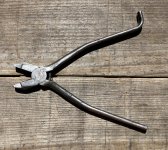
I saw these rusty pliers as a challenge when I saw them at a yard sale. 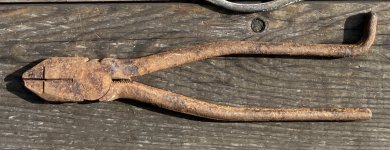
I used the wire wheel to knock off most of the rust before an overnight in the evaporust.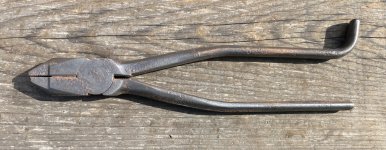

They had quite a bit of pitting but I added a spring that was missing and they are once again functional if not too attractive.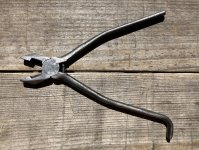
Here is Channellock’s description of the use of the pliers in the earliest catalog I could find showing the 350s.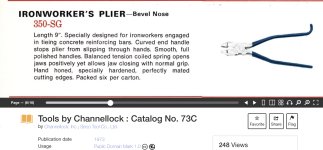
-Don
I used the wire wheel to knock off most of the rust before an overnight in the evaporust.
They had quite a bit of pitting but I added a spring that was missing and they are once again functional if not too attractive.
Here is Channellock’s description of the use of the pliers in the earliest catalog I could find showing the 350s.
-Don
Last edited:
misterbill
Well-known member
- Joined
- Dec 24, 2015
- Messages
- 666
They cleaned up pretty nicely. Ever use bluing to help preserve them and hide the pitting?I saw these rusty pliers as a challenge when I saw them at a yard sale.
I used the wire wheel to knock off most of the rust before an overnight in the evaporust.
They had quite a bit of pitting but I added a spring that was missing and they are once again functional if not too attractive.
Here is Channellock’s description of the use of the pliers in the earliest catalog I could find showing the 350s.
-Don
Eric Brown
ALLIANCE MEMBER
- Joined
- Jun 14, 2024
- Messages
- 678
I talked with a expert at Brownell's about bluing unknown metals. They said they just try different products until one works. Not all metal is gun metal apparently.I bought a bluing kit once but never had much luck with it. These just got a coating of fluid film and are heading for the Channellock box.
-Don

I'm starting to be pretty dang sure it's a date code.
I just went through all of my Champion DeArment tools and found two (2) examples:
- No. 420 waterpump pliers with a "C42"
- No. 410 heavy-duty waterpump pliers with a "B39"
Both of these codes are consistent as date codes with the patent markings, which we wartime GMTK collectors generally look for as the closest we can reasonably come to "wartime", in the sense of the production window being between 1934 (1,950,362) and 1952 (2,592,927).
It is a little more obvious now that I should have paid more attention to what I referred to as mystery codes. The weather finally permitted me to pull out the Channellock collection and check the handles on the early patent Channellocks. Probably half of the 1933 patent 420s had the codes. I don’t see that they could be anything but wartime date codes.To be perfectly frank, between Don calling it a "mystery code" to me apparently having paid them no attention before now, this is more than just a little mind-blowing to be discovering this so late in the game. Granted, the GMTK had qty 110+ tools and each one exacted an enormous amount of scrutiny and research. But still. It's bizarre!
And I just double-checked all my GMTK references, notes, guide material, and G503.com discussions to make sure it wasn't just my failing memory. It's not. Maybe we got too "easy" and automatic with the patent markings. Maybe we got sloppy. Or maybe they just don't show up that often. It clearly was not stamped on every example.
I've had at least a half-dozen 420's in the past that went into GMTK's I assembled and sold. I have six 420's right now in the GMTK catch-all bin. All with the "wartime" patent markings. But only one (1) of them with a date code.
It's obviously on other tools, too. To wit, Outlaw's No. 443 and Don's No. 436. I'm just saying something like this would've most likely popped up as a thing with the 420 because of the GMTK angle.
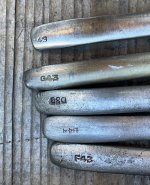
I found the code on another pair of dykes as well and added it to the group.

Here are the pliers with date codes. All had handle patterns for what that is worth. None of the plain handle early 420s had the codes so possibly prewar.

-Don
Last edited:
Private Lugnutz
Well-known member
It's not just you, Don. That's the whole point of why this is so mind-blowing to me. After all these years. It's NOT in my notes and it's NOT on my GTMK Whiz! I can find NO discussion of them on the G. The only criteria we ever used AS A COMMUNITY was looking for the 1934 patent and avoiding the 1950 patent.It is a little more obvious now that I should have paid more attention to what I referred to as mystery codes.
Speaking of which - I just posted over there. You should pile on with your examples and these observations:
This helps with scope, i.e., a sense of proportionally how many do and don't have them.Probably half of the 1933 patent 420s had the codes.
It will be interesting to see if this holds true as more examples are shown. I don't know if we can go so far as to say this eliminates pliers with no codes and bald handles, but it certainly makes the pliers with them more attractive for collectors.All had handle patterns for what that is worth.
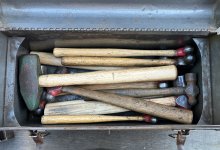
After going through the Champion deArment/Channellock collection doing the research project, I added all of the tools gathered in recent months at various sales. It became obvious during the process that I needed to add another Craftsman Crown storage box.
Early products with ’33/‘34 patent numbers or handle patterns or both.
Champion deArment marked hammers.
Channellock marked hammers.
Tools with blue handles.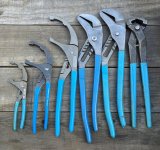


More to follow.
-Don
Early products with ’33/‘34 patent numbers or handle patterns or both.
Champion deArment marked hammers.
Channellock marked hammers.
Tools with blue handles.
More to follow.
-Don



Outlawmws
Well-known member
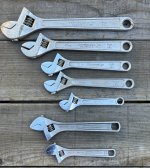
That's a lot of CL Don! I thought my CL count was high at 91 for pliers (only 5 hammers and 1 adjustable...)
Last edited:
jeffmoss26
Well-known member
Only one adjustable? Say it isn’t so!
Outlawmws
Well-known member
Only one adjustable? Say it isn’t so!
In Channellock? sorry
 in other brands,



LNKMK8
Well-known member


four.cycle
Well-known member


four.cycle
Well-known member
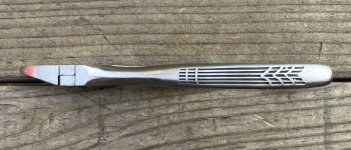
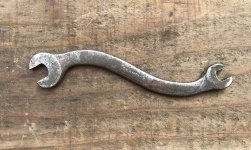
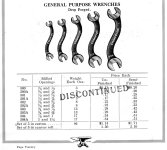
^ love the groovy "deco" handle pattern there, Fred.
genog
Well-known member
I went through my pliers drawer(s) and found this pair of 426's with a Canadian patent year of 1953....

My meager contribution to this thread
My meager contribution to this thread