To avoid these ads, REGISTER NOW!

Drilling a bolt for a safety wire or pin

bluedog225

Well-known member
Joined
Jan 31, 2012
Messages
3,307
Location
Texas
I’ve got a landing I’m going to mount to a concrete wall. It has a staircase that attaches to it. The landing and stairs are from an old airport. The stairs form a parallelogram. That is, whatever level the skyway was at - the stairs with self adjust to that level.

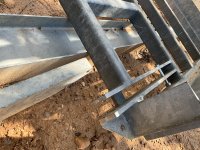
As you can see from the photos below, the stairway attaches to the landing at four points with half inch bolts. In double shear if I’m using that term correctly. I was planning on using B307 hot dipped bolts with lock washers. I wouldn’t mind having a safety wire or a cotter pin given the mission critical function of the bolt.

The sample bolt I’ve got in there has no threads in the bearing area. It seems pretty simple to drill a 1/16” hole and put in a pin. Then a squirt of cold galvanize paint. Though somewhere I read that drilling your own bolts was a bad idea.

Sourcing a predrilled bolt seems unnecessary and difficult. What do you guys think?

Thanks

IMG_4813.jpegIMG_4812.jpegIMG_4811.jpeg
 
Last edited:
To avoid these ads, REGISTER NOW!

whateg01

Well-known member
Joined
Mar 13, 2006
Messages
11,472
Location
doo dah, kansas, usa
What reason is given for not drilling them yourself? Because of lack of corrosion resistance in the newly drilled hole? Or weakening?

Are you wanting a hole in the ends of the threads so the nut can't back off? Or are you drilling through the head so it can't spin?

You can't spray paint the inside of a 1/16" hole. You'd have to either dip them or maybe use a pipette to force the paint inside then blow the excess out.
 
OP
B

bluedog225

Well-known member
Joined
Jan 31, 2012
Messages
3,307
Location
Texas
Candidly, I can’t recall the details regarding the caution against DIY drilling bolts. My only concern is the nut backing off. I’ll keep an eye on it over my next 20 years but it’ll be here a while. I don’t plan on raising and lowering this thing like a drawbridge. But my nephews think that’s the best idea ever. The only motion it will see is the clay soil moving two or 3 inches relative to the foundation. Corrosion is not a huge issue in Central Texas. I’ve been getting hot dipped stuff out of habit, having grown up on the coast.
 

Codyboy

Well-known member
Joined
Jan 31, 2019
Messages
1,708
Location
S.E. TEXAS
Yeah staked or run a jam nut on it.
Safety wire is for things that have vibration and are critical components. Think airplane and helicopter ****.
Hell most cars have some vibration on all those bolts and nuts. I don't think I've ever seen a Safety wire on any of it.
 

whateg01

Well-known member
Joined
Mar 13, 2006
Messages
11,472
Location
doo dah, kansas, usa
Yeah staked or run a jam nut on it.
Safety wire is for things that have vibration and are critical components. Think airplane and helicopter ****.
Hell most cars have some vibration on all those bolts and nuts. I don't think I've ever seen a Safety wire on any of it.
Most automotive fasteners get tightened to the point everything is tight. In this app, I'm going to guess that there will be some gap between the pieces being joined. So there's no appreciable tension on the bolt where just friction will keep it tight. Now, the lack of vibration and other movement means there's nothing making it loosen either, but using automotive fasteners as an example doesn't make much sense here.
 

Codyboy

Well-known member
Joined
Jan 31, 2019
Messages
1,708
Location
S.E. TEXAS
Most automotive fasteners get tightened to the point everything is tight. In this app, I'm going to guess that there will be some gap between the pieces being joined. So there's no appreciable tension on the bolt where just friction will keep it tight. Now, the lack of vibration and other movement means there's nothing making it loosen either, but using automotive fasteners as an example doesn't make much sense here.
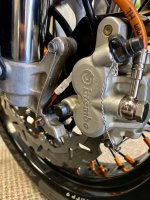
I assumed the tongue on the bottom Pic slips into the parallel flanges on 2nd Pic.
I see no reason why the bolt can't be tightened down. The bolt would be tight on the flanges but the tongue would still float between the flanges and sit on the bolt shaft.
 

whateg01

Well-known member
Joined
Mar 13, 2006
Messages
11,472
Location
doo dah, kansas, usa
I assumed the tongue on the bottom Pic slips into the parallel flanges on 2nd Pic.
I see no reason why the bolt can't be tightened down. The bolt would be tight on the flanges but the tongue would still float between the flanges and sit on the bolt shaft.
Tight enough for that to be the reason the bolt doesn't loosen would pull those pieces together
 

Lassen Forge

Well-known member
Joined
Apr 26, 2014
Messages
15,393
Location
The romantic hills of central Umbria, Italy,
This was how I learned it as a pup, and reinforced when I worked high steel...|
You torque to spec, plus 10%,, You then drill your safety hole 1/8 to 1/4 beyond that. Your safety wire goes in under tension to that hole.
I've NEVER had a safetied boltlike that come loose, or a tie wire show damage, And I've done it that way since I was taught by Unca Bucky at 9 years old, Never mind I'm in my mid-sixties, it's ust one of those things I learned, I stuck with, and right r wrong, its not yet failed me.
 

Codyboy

Well-known member
Joined
Jan 31, 2019
Messages
1,708
Location
S.E. TEXAS
Tight enough for that to be the reason the bolt doesn't loosen would pull those pieces together
Looks like 1/2" steel at the least. You ain't bending that . Especially with the bolt hole that close to the weld, maybe 6 inches or so.
That set up is basically no different than a spring hanger for leaf springs and that steel is not near as thick as what the op has.
 

whateg01

Well-known member
Joined
Mar 13, 2006
Messages
11,472
Location
doo dah, kansas, usa
Bolts through a spring hanger on a trailer rely on a locknut to stay tight. On a vehicle, there's generally a steel sleeve through the bushing that provides a positive stop for you to "torque against". Again, not the same thing.
 
Last edited:

TheClaw

Well-known member
Joined
Dec 25, 2012
Messages
541
Location
Chicagoland
Lock wire is needed on mission critical nuts and bolts that might vibrate loose during use that might have catastrophic results. Motorcycles, race cars, airplanes and rockets. Stairs?, I think you'll be okay with a lock washer or nylock nut.

4242.jpg
 

WILD-BILL

Well-known member
Joined
Dec 10, 2011
Messages
875
Location
Brook Park Oh
I'd wager that those telling drilling a bolt is a bad idea or doesn't work are the same ones that tried doing it with a regular drill and it walked all over the place.

You would need to start with something like a center drill or spotting drill to get a dimple through the existing threads so the wist drill has a nice starting point to follow.

But, as the others stated, in this application it's overkill.
 
To avoid these ads, REGISTER NOW!

PoorUB

Well-known member
Joined
Mar 29, 2021
Messages
11,705
Location
Fargo, ND
If it matters, years ago I worked at a machine shop. We machined parts for manufacturers in the area. One of them used literally tons of bolts that needed to be drilled for a safety clip. They bought plated grade 5 bolts and we drilled the hole and sent them back, literally thousands of them. We would have a machine operator run a mill or lathe on a long cycle, then drill bolts in a manual drill press with a jig to hold the bolts. Every hour of every day for weeks. About the time we got done they would ship over a few more 55 drums full of bolts!
 

WillyBoy

Well-known member
Joined
Nov 10, 2021
Messages
649
Location
Genesee valley area of New York state
As others have said, probably better then I can, if you truly believe that the stairs will have enough vibration to loosen the nuts over the lifetime of the stairway, then by all means get some lockwire pliers and practice with them and lockwire everything.
 

Old tool guy

Well-known member
Joined
Apr 13, 2023
Messages
3,343
This was how I learned it as a pup, and reinforced when I worked high steel...|
You torque to spec, plus 10%,, You then drill your safety hole 1/8 to 1/4 beyond that.
Don’t understand the process. If the nut is at 110% of spec, which means it’s pretty tight, how do you drill a hole 1/8” further down the bolt? You would have to tighten the nut another 100% to get clearance for the hole.
 

lolaetype

Well-known member
Joined
Dec 11, 2019
Messages
2,107
Location
North Western Arkansas
My first choice would be a nyloc. For added safety you could add a dab of threadlocker. Use the right strength and that fastener isn't goiing anywhere.

If you believe that won't be sufficient run a castle nut onto the bolt, mark the location you need to drill the hole for a cotter pin, drill the hole and install.
 

Byrdnyrd

Well-known member
Joined
Jan 10, 2021
Messages
119
Location
Taxachusetts
Your chances of falling down those stairs and getting hurt are much greater than spontaneous disassembly of the nuts and bolts!

Galvy is typically rough and malleable, that would provide enough friction to prevent the nuts from coming undone, but I like the idea of boogering the last couple threads as suggested, 1 wack with a flat faced hammer will do the trick!

Cool Stairs! Pics when they are installed is required!!

Cheers,
BN
 

PCustoms

Well-known member
Joined
Jul 23, 2011
Messages
23,433
Location
VT
My first choice would be a nyloc. For added safety you could add a dab of threadlocker.

While I've never checked this specific combo (why would I, it's unessesary!) FYI most loctite is incompatible with most plastics. This combo is likely counterproductive.
 

lolaetype

Well-known member
Joined
Dec 11, 2019
Messages
2,107
Location
North Western Arkansas
While I've never checked this specific combo (why would I, it's unessesary!) FYI most loctite is incompatible with most plastics. This combo is likely counterproductive.
Of course it's redundant, it's belt and suspenders. I was addressing the OP's concern which may or may not be valid; that's not my call. Use it sparingly or use Loctite 425, it's supposed to be nyloc compatible.
 

LopezBart

Well-known member
Joined
Oct 13, 2023
Messages
2,563
Location
Lopez Island, WA
As others have pointed out, there are a lot of easier and better options than safety wire. Since you cannot torque the nuts down due to the design, you're right in looking for a way to prevent them from loosening. You have three reasonable options: staking the threads, Loc-Tite, or good old-fashioned double nuts. Nylock fasteners aren't available in/for hot-dipped galvanized afaict; the clearances needed for the variable zinc coating thickness makes them ineffective, and the roughness of the zinc coating would tear up the nylon before you get the nut run down very far. Staking tends to disturb the zinc coating somewhat, but unless you're right on the coast that shouldn't be an issue. Portland bolt has heavy 1/2 hot dipped galvanized jam and regular nuts; I'd go that route if there's a chance someone ever needs to take this apart (since it's obvious that loosening is a concern), otherwise Loc-Tite blue is your easiest solution.
 
OP
B

bluedog225

Well-known member
Joined
Jan 31, 2012
Messages
3,307
Location
Texas
As others have pointed out, there are a lot of easier and better options than safety wire. Since you cannot torque the nuts down due to the design, you're right in looking for a way to prevent them from loosening. You have three reasonable options: staking the threads, Loc-Tite, or good old-fashioned double nuts. Nylock fasteners aren't available in/for hot-dipped galvanized afaict; the clearances needed for the variable zinc coating thickness makes them ineffective, and the roughness of the zinc coating would tear up the nylon before you get the nut run down very far. Staking tends to disturb the zinc coating somewhat, but unless you're right on the coast that shouldn't be an issue. Portland bolt has heavy 1/2 hot dipped galvanized jam and regular nuts; I'd go that route if there's a chance someone ever needs to take this apart (since it's obvious that loosening is a concern), otherwise Loc-Tite blue is your easiest solution.

Good info. This may be the only time I’ve heard of a good use of a jam nut.
 

Codyboy

Well-known member
Joined
Jan 31, 2019
Messages
1,708
Location
S.E. TEXAS
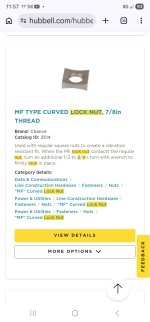
Here's another option , and some of the pole hardware we used came with these locknuts (basically a jam nut)
However we never were used them and threw them away.
Ain't's nobody gots time fo dat

Eta
I will add that in 40 years, I have seen only a handful of nuts backed off or fell off on this type of pole hardware.
87% of those were nut down with a vertical bolt, and the other 13% were horizontally installed.
Don't overthink it.


Screenshot_20260301_115753_Chrome.jpg
 
Last edited:

bwringer

Well-known member
Joined
Jan 1, 2013
Messages
10,321
Location
Indianapolis
Are these stairs moving up and down several times a day?

If they're just attached to a building, then just about any scheme would work. Sounds like the nuts can't be tightened, so jam nuts and/or Nylok nuts would be my choice. And perhaps staking the threads if you really don't care about future disassembly.
 

toplessHO

Well-known member
Joined
Oct 20, 2014
Messages
14,081
Location
central florida
While I've never checked this specific combo (why would I, it's unessesary!) FYI most loctite is incompatible with most plastics. This combo is likely counterproductive.
Really? I think the answer was productive,
The entire nut isnt made of nylon

Or use stainless fasteners and no antiseize
 

yhprum

Well-known member
Joined
Jul 27, 2006
Messages
1,400
Location
Brisbane Australia
So, I had to drill few bolts like this I don’t have a drill press, so it was with a battery powered drill.
I took a regular low grade nut that fits the bolt.
Carefully center punched in the middle of two opposing flats
Drilled undersized pilot holes on the flats held the nut in my bench vise.
Then drilled out to final size straight through from one side
Cleaned up the threads with a tap
Put the nut on the bolt added a jam nut to keep it in place. With the hole on the bolt where I wanted it.
Drilled through from both sides, met in the middle of the bolt shank.
Removed nuts, and deburred the bolt holes on the bolt shank.
 

MoonRise

Well-known member
Joined
Nov 5, 2010
Messages
4,031
Location
NJ
Look into Loctite 243 threadlock compound.

Blue, removable with hand tools (if needed, usually removable), cures 'better' than older formulation 'blue' threadlock (like 242) on inactive metals.

Much quicker and easier to use than trying to drill some bolts and nuts for lockwire.

And your application doesn't seem to really need or require Jesus-bolt level fastener retention and verification.

Put a paint marker witness stripe on your installed fasteners if you want to see if anything ever shifts or loosens.

🍺
 

ipgenie

Well-known member
Joined
Jan 29, 2020
Messages
562
Location
Idaho
Being garage journal I'm surprised nobody said to just weld the nut on and forget about it 🤣

A nyloc jam nut gets my vote. Cheap, easy and effective.
 

MoonRise

Well-known member
Joined
Nov 5, 2010
Messages
4,031
Location
NJ
Nah, welding on galvanized fasteners is not best practice.

Garage Journal level would be to procure a CNC water jet machining center to avoid or minimize thermal degradation from laser or plasma cutting systems or the broken small diameter drill bits from a CNC milling center.

😆
 

BurtEggley

Well-known member
Joined
Oct 8, 2024
Messages
888
drilling for safety wire is not an issue. We used to do it all the time in racing. However if these are grade 8 bolts it takes a special centering punch and drill. Personally I would just use nylock nuts or some blue Loctite. That has been said before me too. If you still go with safety wire, be sure you think thru how to route and anchor each one.
 
To avoid these ads, REGISTER NOW!
Top Bottom