To avoid these ads, REGISTER NOW!

Hex Keys - The Whole Story

Typhon

Active member
Joined
Sep 23, 2021
Messages
41
Location
Taiwan
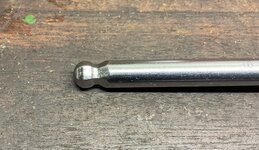
The Wera hex bit sockets have the same problem. They have the ball, which works great for holding fasteners, but the smaller sizes (I want to say maybe <6mm?) will shear off around the rated torque of a grade 12.9 cap screw. The larger sizes were fine. We used to have a few extras of the smaller ones because they broke so often.

It's a shame too, because the hex-plus bits were the best we found for not stripping out the fasteners. The Wera hex keys on the other hand didn't have the ball detent, and were fine. We straight up abused those things with all kinds of cheaters or pipes without issue. Great tools.
Your hands-on experience is incredibly valuable, and I’ve learned a lot from your insights. Given your profound professional experience with these tools, I would truly appreciate it if you could share the specific model numbers (Model numbers) of the sets you recommend.

Wera’s hex key (Hex keys) lineup is so extensive that many sets look almost identical despite having different model numbers. I understand there are important technical differences between them, but I’m currently stuck in "choice paralysis" trying to figure out which one is the right fit. Your specific recommendations would be a huge help!
 
Last edited:
To avoid these ads, REGISTER NOW!

johnre

Well-known member
Joined
Dec 1, 2016
Messages
1,056
Location
Portland, OR
No Allen branded Allen keys?
Here you go - nothing quite like having some from the original inventor of the tool!

I found these used over fifty years ago, and it's only a few sizes, nowhere near a complete set. But they're always the ones I reach for first, as it beats fooling around trying to fit the "L" design wrenches into a socket on the short leg, and turn them when there's little room to swing an arc. Or to put the long leg into the cap screw and not be able to turn the short leg for lack of leverage.

And now, sad to say, I see that Crescent Tool / Apex Group finished off the Allen name in 2017. William G Allen patented the concept way back on June 7, 1910, and his name lasted for 107 years in the business!

1768380393929.png
 
Last edited:

esben57

Well-known member
Joined
Feb 3, 2012
Messages
852
Location
Sheffield. England
Decades back, a box of Allen - we always referred to them as Allen and not hex - cap or grub screws came with the correct UNBRAKO key.
When I returned to the Steelworks in the 90's, I had some CK (I think)ball ended metric and fractional. OK, broke and bent some. Still have them.
I also bought an Allen branded USA made pocket set, fold like a swiss army knife.
 

RoninB4

Well-known member
Joined
Jul 22, 2020
Messages
3,599
Location
Under My House
RoninB4 - you are dead right (again). It was stripper screws (we call them “shoulder screws” in the U.K.) that were involved.
-To be fair, calling them "shoulder" screws/bolts is a more accurate description (same as hex key vs. Allen). A "shoulder" is exactly what is present. Me calling them "stripper bolts/screws" is from my work in the die stamping industry. A "stripper plate" is a component used quite often for stamping dies. The stripper plate has to retract (press/die closes) and then return to an exact (more or less) set point before the next descent of the press. The shoulder offers a guided travel, the fixed engagement of the threaded portion holds the stripper plate at a known distance. The head of the shoulder bolt dead-stops the travel in the accurately machined counter-bore. Calling them stripper bolts is by association of function (for me), shoulder bolts is a better worded description. There's several other applications for shoulder bolts that have a similar function but have nothing to do with a stripper plate. A car door striker bolt comes to mind.
 

GaryM909

Well-known member
Joined
Apr 11, 2016
Messages
1,539
Location
Calgary, Alberta, Canada
I have a partial set of Chesco T-handle hex keys that I use quite a bit. I know they aren't as strong as
the Bondhus ones but I haven't broke one yet. I always liked the handles on them.
I also bought another complete set at a garage sale last year from a retired millwright.
New in the package for $10.
 

Attachments

  • IMG_2726.jpg
    IMG_2726.jpg
    1,009.8 KB · Views: 42
  • IMG_2727.JPG
    IMG_2727.JPG
    980.6 KB · Views: 37

mooman

Well-known member
Joined
Jun 9, 2005
Messages
2,791
Location
CHICAGO, IL
Yes, this. I have Allen, Ekland, Bondhus..... and they are all just fine. I'm sure all are within a few percent of each other and any other brand. But the typical old school holder is a total PITA to use. I didn't need another set of hex keys, but when I saw the Wiha holder design 10+ years ago, I went all in on them. What I have is the early sliding design of the Wiha holder, replaced by the above, but it's an absolute pleasure to use. No rotating 4 keys out of the way to get the one you need. Nope. Two seconds and done. Sure, these are first world problems, but that's what this forum is all about. These also have the holding spring function on the ball end for the larger sizes.


Wiha_hex_keys.jpg
I have the set listed above and HATE the holder design.
 

neophyte

Well-known member
Joined
Apr 23, 2012
Messages
9,755
Location
Pennsylvannia
Nothing quite like having some from the original inventor of the tool.

I found these used over fifty years ago, and it's only a few sizes, nowhere near a complete set. But they're always the ones I reach for first, as it beats fooling around trying to fit the "L" design wrenches into a socket and turn them when there's little room to swing an arc.

And now, sad to say, I see that Crescent Tool / Apex Group finished off the Allen name in 2017. William G Allen patented the concept on June 7, 1910, and the name lasted for 110 years in the business!

1768380393929.png
Bristol used to make a similar T-handle driver, I think in both Bristol-Spline, and Hex.
I don’t know if Bristol made the wrenches for Allen, or Allen made the wrenches for Bristol, or whether there was some standard they both made the wrenches to.
I’m also uncertain whether the style is still in production, but if you're looking to complete a set, and don’t mind the name different, it might be another option.
 
OP
D

Dave455

Well-known member
Joined
Mar 19, 2013
Messages
5,829
Location
Sussex, England
Being in the midst of two days off, I find myself unpacking and cleaning tools from one job (setting up a press) prior to selecting some more for another task (working on a bathroom).

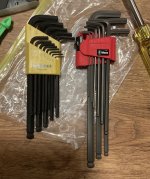
On my last job I discovered I had packed hex keys from two different manufacturers! Once I had recovered from the shock, It was an excuse to do a bit of a comparison.

IMG_2994.jpeg

So, first off, why these manufacturers in particular?

Well, if I’m choosing something for “general” use, assembling equipment and tooling, I’m not going to use my very best PB Swiss. What I’m going for is something “mid grade” - good strong tools, but no colours or plating.

Which brings us to Bondhus and Wera. I said previously, that I generally advise Bondhus as a starting point if folks are unsure what to get. The Wera I find myself using regularly as they seem to be a good complement to PB Swiss.

The two are actually very similar products in some respects. Both are reasonably priced, both are good quality, neither are overly fancy, and both represent excellent value.

The pro’s and con’s are really quite small details. Both the holders are excellent. The hard plastic Bondhus is perhaps slightly more durable than the softer Wera, and easier to clean. The Wera grips the tools better. Both use the same colour coding, which I like.

Of the keys themselves, I can discern little difference in steel or manufacturing quality. I think the Bondhus are slightly more resistant to corrosion, but that’s probably due to the finish. The Bondhus markings are also roll stamped, which is vastly better than the lasered Wera.

The unique profile of the Wera I like. It really does work. But the biggest difference is the length. These are both nominally “long“ keys, but note how much longer the Wera are.

So which to choose? I probably slightly prefer the Wera, but I wouldn’t pay a premium for them. (In the U.K. they are comparably priced). In practice, I use both!
 

KnurledNut

Well-known member
Joined
Jan 28, 2011
Messages
8,179
Location
n/a
On my last job I discovered I had packed hex keys from two different manufacturers! Once I had recovered from the shock, It was an excuse to do a bit of a comparison.
You are very fortunate this ended well, Dave.
It's unsupervised moments like this that create ******* offspring like the Facom Hex Plus! :wtf:
Fortunately it wasn't Bondhus and Eklind left together in a room alone. The in-law feuds would be unmatched!
 

CHI_Tool&Die

Well-known member
Joined
Jul 20, 2021
Messages
1,387
Location
Chicago, IL
I recently purchased some Wiha hex keys and they have really disappointed me. The Ergostar holders are great, a little bulky but really user friendly. The keys are a different story.

The Pros: I really do like the satin chrome finish because of how well it feels in the hand. It gives you a good grip and it doesn’t seem to build up with oils and fluids. All the keys were straight and not bent in weird ways from the factory. They are a very nice long length.

The Cons: The little keys are very soft. I rounded out a 2 and 2.5mm after only a few days at work. My 5/64” formed a pretty nasty bend in it after my first use. The finish isn’t uniform so some keys are really, really rough (my 8mm was so grainy that it wouldn’t fit easily into the holder) and the chrome was flaking after only a couple of months use. Sizing for many of my most used keys, like the 3/16”, 9/64” and 1/4”, were too large by several thousands. I had to stone the 3/16” to get it to snugly fit into the SHCS at work. In fact, most of the SAE keys would get stuck on the fasteners and I’d have to really yank or jiggle them to remove them. I’m not sure they are even all made in Poland. Only the metric keys were stamped ‘Made in Poland’. The SAE set just had CR-V and the number on them. Also the warranty isn’t great. I sent Wiha a bunch of pics and an email explaining some of the issues and they basically said, “***** to ****”.

So overall, I’d recommend a skip for the Wiha keys. If you really wanted to try them, I’d opt for the Polish-made metric keys as they were better overall to the SAE set which was pretty bad. Wera is way better if you wanted a “German” brand.
 

Pinne

Well-known member
Joined
Oct 8, 2024
Messages
340
Give the Eight Tools brand a shot - I've been very impressed with them. Was using Wera happily for a long time but I think the Eight keys are even better. The ball ends on them have the best fit I've found.
 
OP
D

Dave455

Well-known member
Joined
Mar 19, 2013
Messages
5,829
Location
Sussex, England
I recently purchased some Wiha hex keys and they have really disappointed me. The Ergostar holders are great, a little bulky but really user friendly. The keys are a different story.

The Pros: I really do like the satin chrome finish because of how well it feels in the hand. It gives you a good grip and it doesn’t seem to build up with oils and fluids. All the keys were straight and not bent in weird ways from the factory. They are a very nice long length.

The Cons: The little keys are very soft. I rounded out a 2 and 2.5mm after only a few days at work. My 5/64” formed a pretty nasty bend in it after my first use. The finish isn’t uniform so some keys are really, really rough (my 8mm was so grainy that it wouldn’t fit easily into the holder) and the chrome was flaking after only a couple of months use. Sizing for many of my most used keys, like the 3/16”, 9/64” and 1/4”, were too large by several thousands. I had to stone the 3/16” to get it to snugly fit into the SHCS at work. In fact, most of the SAE keys would get stuck on the fasteners and I’d have to really yank or jiggle them to remove them. I’m not sure they are even all made in Poland. Only the metric keys were stamped ‘Made in Poland’. The SAE set just had CR-V and the number on them. Also the warranty isn’t great. I sent Wiha a bunch of pics and an email explaining some of the issues and they basically said, “***** to ****”.

So overall, I’d recommend a skip for the Wiha keys. If you really wanted to try them, I’d opt for the Polish-made metric keys as they were better overall to the SAE set which was pretty bad. Wera is way better if you wanted a “German” brand.
Thanks for the feedback.

I have to say that mirrors my experiences with Wiha hex keys. The German made ones were really decent, but the current Polish made do not appear to be to the same standard. I’m slightly concerned that the SAE were even worse.

I do recall a post from one member, implying that folks insisting on German made were “country of origin snobs”. Sadly, where Wiha hex keys are concerned there’s no snobbery, the newer tools are not the quality of the older.

It does seem that Wiha are trying to reinvent themselves. They were once a bit of a niche manufacturer making primarily screwdrivers and hex keys. They now seem to be targeting themselves at the electrical trades - maybe a sort of European Klein.

This process started a while back when they started making pliers, but the pliers at least seemed to be decent. Since then the range of tools has become greater but the quality seems to be creeping inexorably downwards.
 

YesIHaveAHammer

Well-known member
Joined
Jun 1, 2025
Messages
865
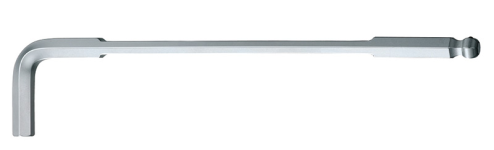
Facom L keys OGV Grip with ball long end 83HGRP.JP9PB
1778880022923.png
 
Last edited:

Gmonkee

Well-known member
Joined
May 9, 2010
Messages
2,881
I am not an engineer or machinist. I was a shop monkey out in the trenches. We abused tools to finish jobs knowing we might break stuff.

I like sets in folding handles. I knew Eklind is good from experience but didn't own any in my earlier years wrenching.

Later on I bought a folding hex set used and have been unable to wear them out.
I found a Chesco torx folder set new and 20 years on those won't wear out. Two pretul sets wore out in another kit in the same time frame. I used them a lot on cars.

I have the Autozone branded ball hex folders too. They outlasted the shop Truper L type by not snapping off the balls in a long time.
Quite good quality and other than loosening up the screws, they're perfect.
Taiwan made but by whom I never knew.

10mm hex bits by Wurth are amazing. 10mm bits of all types actually. They cost a ****** fortune each.
Where others struggled in high torque applications you can really lean on them with a breaker bar.
The VW cv shaft bolts broke a lot of the cheaper ones over time.

If I came across a mushed out 6mm hex I would hammer a Wurth M8 bit into it and back it out as if nothing was wrong.
Others couldn't figure out my trick in the shop for a bit.
It didn't work as well with softer M8 bits. Sometimes the bolt mushed those up.
 
Last edited:
OP
D

Dave455

Well-known member
Joined
Mar 19, 2013
Messages
5,829
Location
Sussex, England
Keiba Lightool ball point wrench

Saves a neglible amount of weight https://www.keiba-tool.com/en/keiba/products/ボールポイントレンチ/

1778879185881.png
Interesting. Didn’t know about these.

My gut feeling is that the weight saving will be negligible, certainly in the smaller sizes. I’m also thinking, that if I was really bothered by weight, I’d be opting for interchangeable bits.

But… I know from my own experience, that small parts (especially bits, that are easily wedged in fasteners) can all too easily get lost, especially if you are working away from base. I’ve moved away from interchangeable bits in my own “road box” for this reason.

I also know that more folks than ever seem to be engaged in some sort of mobile working, and a weight reduction that is worthless to one person, may be very worthwhile to another, so I think I’ll defer judgement till I’ve seen these.
 
OP
D

Dave455

Well-known member
Joined
Mar 19, 2013
Messages
5,829
Location
Sussex, England
Facom L keys with ball long end 83HGRP.JP9PB
1778880022923.png
Something else I have yet to try!

But I probably will.

I don’t recall seeing any comparisons between the Facom OGV / Mac RBRT and the Wera Hex Plus. The Hex Plus look as though they will mess up a fastener if they are used regularly, but they don’t seem to.

I have a feeling these might, but are probably more effective.
 
To avoid these ads, REGISTER NOW!

YesIHaveAHammer

Well-known member
Joined
Jun 1, 2025
Messages
865
That's just inviting a torsional failure.
I won't defend it as a whole, but on this aspect it is a ball end when used in that orientation, so may not be an issue.

Surely it's uncomfortable when using the short end too.

gut feeling is that the weight saving will be negligible, certainly in the smaller sizes
Yes. I only mentioned negligible, but their page gives figures for the larger sizes. The photos show all sizes are slimmed down though.
8mm 86g vs. 100g
10mm 148g vs. 178g
12mm 220g vs. 284g
 

134k

Well-known member
Joined
Oct 1, 2017
Messages
100
Facom L keys with ball long end 83HGRP.JP9PB
1778880022923.png
I use the MAC Tools branded version of these hex keys, and I find them very aggressive in terms of fitment. The fitment is too good and I imagine they leave some damage to fasteners with repetitive use. I've put these away and now only use them on troublesome fasteners. If the Hex-Plus keys fail to remove a screw, these OGV/RBRT keys will certainly remove them.
 

YesIHaveAHammer

Well-known member
Joined
Jun 1, 2025
Messages
865
I find them very aggressive in terms of fitment. The fitment is too good and I imagine they leave some damage to fasteners with repetitive use. I've put these away and now only use them on troublesome fasteners.
I do seem to remember reading here and perhaps even on Facom/Mac/GripEdge's website that OGV Grip (in Facom terms) internal hex were for damaged fasteners only. That's what I keep mine (bit sockets) for. Whereas the OGV Grip external hex (normal) sockets are fine on new stuff as well.

So it surprised me to see them now saying these are fine for everything, and even launching them in P handle form which is more of a regular use type of tool.

1779045183336.png
 

KnurledNut

Well-known member
Joined
Jan 28, 2011
Messages
8,179
Location
n/a
I like how Facom increases the hex size of the wrench body and reduces the tip size. That should add quite a bit of strength to the key.

Those Keibas would be hard to twirl with that flat spot. That would annoy me.
 
OP
D

Dave455

Well-known member
Joined
Mar 19, 2013
Messages
5,829
Location
Sussex, England
I use the MAC Tools branded version of these hex keys, and I find them very aggressive in terms of fitment. The fitment is too good and I imagine they leave some damage to fasteners with repetitive use. I've put these away and now only use them on troublesome fasteners. If the Hex-Plus keys fail to remove a screw, these OGV/RBRT keys will certainly remove them.

I do seem to remember reading here and perhaps even on Facom/Mac/GripEdge's website that OGV Grip (in Facom terms) internal hex were for damaged fasteners only. That's what I keep mine (bit sockets) for. Whereas the OGV Grip external hex (normal) sockets are fine on new stuff as well.

So it surprised me to see them now saying these are fine for everything, and even launching them in P handle form which is more of a regular use type of tool.

1779045183336.png
Yes, unlike say the Wera Hex Plus, which you can use without doing any damage, I think I would be tempted to reserve these for screws I can’t remove any other way.

I think though, that we all need that “final option”…!

Can’t see me not getting a set of these!
 

YesIHaveAHammer

Well-known member
Joined
Jun 1, 2025
Messages
865
Can’t see me not getting a set of these!
Have you considered the hex bits, and bit sockets?

EH.GRP.J9 hex bits 2-8mm, only available as a set
RTM.*GRP 1/4" bit sockets 2-8mm, individually or in sets
STM.*GRP 1/2" bit sockets 10-19mm, individually or in sets
 
OP
D

Dave455

Well-known member
Joined
Mar 19, 2013
Messages
5,829
Location
Sussex, England
Have you considered the hex bits, and bit sockets?

EH.GRP.J9 hex bits 2-8mm, only available as a set
RTM.*GRP 1/4" bit sockets 2-8mm, individually or in sets
STM.*GRP 1/2" bit sockets 10-19mm, individually or in sets
I must admit I was considering this as I was was writing that reply.

Most of the times I have problems I’m using bit sockets anyway.

Although, in fairness, I probably have as many problems with bits twisting, as slipping, so sometimes the grip is adequate.
I call that "left-handed drill bits".
I probably should have said an “intermediate” option.

The good news is that if the screws are really crappy, and the heads deform readily, they drill easily too.

Well, relatively easily. Never ideal when you’re trying to drill out brake rotor screws using a hand held drill. Sometimes I just give up, use a cheap bit, and weld it in!
 

CHI_Tool&Die

Well-known member
Joined
Jul 20, 2021
Messages
1,387
Location
Chicago, IL
Yes, unlike say the Wera Hex Plus, which you can use without doing any damage, I think I would be tempted to reserve these for screws I can’t remove any other way.

I think though, that we all need that “final option”…!

Can’t see me not getting a set of these!
I daily several sets of the OptiGrip hex bit sockets from Matco. They fit very, very tight. It almost makes it a pain to use because I have to really push to set them and pull to get them out. But they have not damaged any fasteners. My biggest gripe is that the steel they use seems weaker than other bits. I’ve twisted and mangled quite a few.
 

YesIHaveAHammer

Well-known member
Joined
Jun 1, 2025
Messages
865
I thought I'd try and enumerate the many form factors, and their common or specific feature options. I'm bound to have missed some. There has been some discussion of form factors alone previously here.

L keys
  1. Lengths
  2. Tip - ball end
  3. Tip - surface drive profile (e.g. Wera Hex Plus)
  4. Tip - aggressive semi-extractor profile (e.g. Facom OGV Grip)
  5. Tip - holding function
  6. Head - stubby
  7. Head - angled
  8. Head - pivot (Bondhus HexPro)
  9. Round shaft
  10. Colour coded (coated or sleeved)
T handles
  1. Repeat 1-5 from above
  2. Comfort or bare handle
  3. P shape handle (available with or without side drive)
  4. Sliding style
  5. Side drive
Flag and wing
  • (none I know of)
Screwdriver
  • Tip - ball end
  • Tip - surface drive profile (e.g. Wera Hex Plus)
Fold up set
  1. Tip - ball end
  2. Lock open mechanism
Hex drive bits
  1. Repeat 1-4 from L keys above
  2. C6, E6, or Japanese shank profiles
Square drive bit sockets
  1. Repeat 2-5 from L keys above
  2. Drive size
  3. Single piece vs. two piece construction, replaceable
  4. Universal joint (built-in swivel)
  5. Outer hex base profile for use with a wrench
Aspects not listed: stainless, insulated, impact rated. Also inter-manufacturer variations e.g. single screwdriver length each, but may vary between manufacturers - unlike L keys where each one offers many lengths.
 
Last edited:

F-22

Well-known member
Joined
Jan 23, 2022
Messages
1,830
Bad idea. That's just inviting a torsional failure.
For sure, but I'd argue every other wrench on the market is made without that cutout. The "Lightool" series has a purpose. Obviously these are niche tools not made for every use case.

I think once you go into larger sizes over 8mm, it does have a more meaningful impact without a major torque penalty. High torque is anyway more in the domain of socket keys...
 

ecotec11

New member
Joined
Dec 21, 2015
Messages
2
Location
UK
Interesting thread and good to hear it's not just me with hex keys... I've tended to use Wera mostly, they are fine but never feel proper pro-quality.

Just wondering if anyone has used Gedore Blue (they have two lines, cheaper red and "pro" blue) - these are made in Germany and look good but it's so hard to tell until you've used them. Not sure if these are manufactured by Gedore or just branded as? Anyone know anything about them? Thanks!

1781385005482.png


Link
 
OP
D

Dave455

Well-known member
Joined
Mar 19, 2013
Messages
5,829
Location
Sussex, England
Interesting thread and good to hear it's not just me with hex keys... I've tended to use Wera mostly, they are fine but never feel proper pro-quality.

Just wondering if anyone has used Gedore Blue (they have two lines, cheaper red and "pro" blue) - these are made in Germany and look good but it's so hard to tell until you've used them. Not sure if these are manufactured by Gedore or just branded as? Anyone know anything about them? Thanks!

1781385005482.png


Link
I’m sorry you’re not feeling your Wera are the quality you desire.

Personally, I think they are pretty good, especially with regard to fit. I know some folks don’t like the plastic sleeves (if yours have them) and I get that.

With regard to Gedore, I very much doubt if they manufacture their hex keys in house. They are German made, so straight away I’m thinking Inbus. A quick look at Inbus sets shows that Inbus use exactly the same colour coding as the set above, so I’m 90% sure they are Inbus made.
IMG_3417.jpeg

I’ve never been very impressed with Inbus. At best they are o.k. but not top end. At worst their quality control is poor. Mind you, I’ve always been fairly underwhelmed by Gedore too, so probably quite fitting!

Depending on what you don’t like about Wera, consider some regular Bondhus. Moving up, you won’t better the fit from Facom.

If you want to go top end, then PB Swiss or Asahi are right up there. But remember that if you get coloured ones the colours do wear. I’d get regular for longevity.
 
Last edited:

ecotec11

New member
Joined
Dec 21, 2015
Messages
2
Location
UK
I’m sorry you’re not feeling your Wera are the quality you desire.

Personally, I think they are pretty good, especially with regard to fit. I know some folks don’t like the plastic sleeves (if yours have them) and I get that.

With regard to Gedore, I very much doubt if they manufacture their hex keys in house. They are German made, so straight away I’m thinking Inbus. A quick look at Inbus sets shows that Inbus use exactly the same colour coding as the set above, so I’m 90% sure they are Inbus made.

I’ve never been very impressed with Inbus. At best they are o.k. but not top end. At worst their quality control is poor. Mind you, I’ve always been fairly underwhelmed by Gedore too, so probsbly wuite fitting!

Depending on what you don’t like about Wera, consider some regular Bondhus. Moving up, you won’t better the fit from Facom.

If you want to go top end, then PB Swiss or Asahi are right up there. But remember that if you get coloured ones the colours do wear. I’d get regular for longevity.

Hi Dave, thanks for your post. The Innbus hex keys look identical, given that the premium price of the Gedore they don't seem worth the cost.

RE: Wera - Yes, I have the colorful set with the plastic sleeves and that's exactly the problem, they just don't feel nice to use. They have however been very durable and there is barely any wear on the set despite lots of use.

I will follow your advice and pick up a set of Facom's to try,

Thanks again,
 

roggy

Active member
Joined
Nov 3, 2025
Messages
31
Growing up - American and Swiss

Bondhus and Eklind


I had been aware for some years of Bondhus. Their “ball hex” drivers were well known from the outset, and a local shop had a big display of them.

Over the years I acquired a good deal of Bondhus, and came to value it’s quality. Although this post is about regular hex keys, I should mention that I’ve found the Bondhus T handle hex keys to be about the best overall. I like the drivers too, but the handles on the smaller sizes are ridiculously small.
IMG_1815.jpeg

So, needing some long hex keys, ideally ball tipped, I set out to get some Bondhus, but found some Eklind on a deal so tried them.

That was a good purchase. Those Eklind sets have lived in my main box ( in fact survived two changes of box ) for decades and have withstood a lot of use. I think the Bondhus would have done so too.
IMG_1816.jpegIMG_1817.jpeg

It’s perhaps a little unfair of me to discuss Bondhus and Eklind in the same paragraph, since I know they are competitors, but from my side of the pond the products are very similar.

They are both incredibly well designed, both very well made, both from very good materials, and both with good quality control. I also have to say that both represent incredibly good value.

Even in the U.K. these tools are priced comparably to tools sourced much closer to home, so there’s really little excuse not to own these.
If you live in the U.S. - there’s no excuse whatsoever!

Bondhus / Eklind are best for value, good for overall quality.

I slightly prefer Bondhus for T Handles, and Eklind for regular keys, but that’s just a slight preference!

P.B. Baumann / PB Swiss.

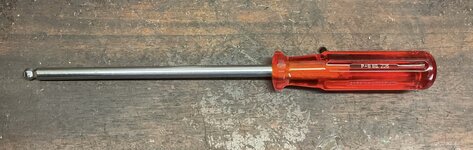
About that time, I bought a set of ball hex drivers, used, from a local shop. They were from the, then unknown, manufacturer - P.B.Baumann.

These drivers were typically Swiss (something about the style and finish you get to recognise) and obviously of the highest quality, but I only realised how good with use. I used these drivers an awful lot, and they just didn’t show any wear, I couldn’t believe it.
IMG_1819.jpegIMG_1820.jpeg

I eventually found their U.K. importer and started buying their regular hex keys. The difference in quality between these and anything else was considerable. They were stronger, better fitting, better finished, and seemed almost not to wear.

I’d use one key of my own for assembly work in preference to the boxes of mid grade keys I was supplied and I was never let down.

I’ve heard people on this forum describe PB Swiss as a “boutique brand”, obviously thinking that their selling point is their coloured keys, or suchlike.

To do so is to totally misunderstand the product. For a start, they’re not a “brand” they’re a manufacturer - a distinction lost on many.

Their selling point is their quality - evident on close examination, or prolonged use, but they are much more.

Max Baumann, the “big cheese” at PB, told me that they carried out extensive research to find what their customers wanted.

One of the things their customers didn’t want was bent keys - so a PB key will deform elastically to it’s limit, and spring back to it’s original shape. Bent beyond that, it will break, but it won’t deform!

PB keys are also designed to flex by a comparable amount when they reach the limiting torque for a typical fastener. When you get used to using them in assembly you find this is true, and I can assemble 4mm x 0.7 cap screws with a PB hex key just as accurately (probably more so) than some monkey with a torque screwdriver.

Their biggest strength though, is their ability to withstand high repetitive loads. I once had an assembly task that involved inserting button head screws. That had to be torqued up quite tight, but couldn’t be accessed by a regular driver, it had to be a ball tip.

We were eating through Wera bits at a shocking rate, and Wiha drivers did little better. We switched to PB and completed the job (hundreds of units) with no further breakages. They are that good.
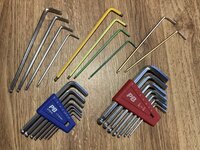
IMG_1821.jpegIMG_1818.jpegIMG_1822.jpegIMG_1823.jpegIMG_1824.jpeg

So, PB Swiss are best for overall quality (and finish) but also very good for the quality of their fit, and the selection available.

They offer short or long keys, standard or ball ended, and I think were the first to offer both the coloured keys, and the short / 100 degree offset.

Somebody will no doubt point out that in some numpty’s hex key test they didn’t take any more of an overload than the next best. Well, firstly they’re not designed to, and secondly, I couldn’t care less - that’s not how I use my tools.
Hello! I've been obsessed with Ball Hex lately, and I've also picked up some awesome hex tools, including the Vessel 5400BP. Here are some close-up photos I took.IMG_20260707_221011.jpgIMG_20260707_215036.jpgIMG_20260707_215059.jpgIMG_20260707_215005.jpgIMG_20260707_221451.jpg
 
OP
D

Dave455

Well-known member
Joined
Mar 19, 2013
Messages
5,829
Location
Sussex, England
Hello! I've been obsessed with Ball Hex lately, and I've also picked up some awesome hex tools, including the Vessel 5400BP. Here are some close-up photos I took.IMG_20260707_221011.jpgIMG_20260707_215036.jpgIMG_20260707_215059.jpgIMG_20260707_215005.jpgIMG_20260707_221451.jpg
Ball hex drivers are seriously useful.

For the size of screws I tend to work with, they are pretty much my “go to”, and if you are working with screwdriver handled tools, the ball tips prevent any bending if the driver is not perfectly aligned

For ball hex generally, my first thought tends to be Bondhus. They were the originators, their ball tip hex keys are superb quality, and reasonably priced. My first choice for ball tip T handles too.

I’m a little disappointed with their ball hex drivers though. The small sizes have ridiculously small handles, and they have discontinued their previous cellulose acetate handles in favour of a, presumably cheaper, option.

PB Swiss are superb, but even with PB I’m not convinced their current tools are as good as their older ones. The handles are a fraction smaller and I’m not convinced the chroming is as good. The old ones were pretty special though.

Yes, the Vessel’s are lovely. I love the colour coded Powergrip handles, and the ball tip is a subtly different shape to most. More options are always better! The smaller sizes still do suffer from small handles though.
 

roggy

Active member
Joined
Nov 3, 2025
Messages
31
Ball hex drivers are seriously useful.

For the size of screws I tend to work with, they are pretty much my “go to”, and if you are working with screwdriver handled tools, the ball tips prevent any bending if the driver is not perfectly aligned

For ball hex generally, my first thought tends to be Bondhus. They were the originators, their ball tip hex keys are superb quality, and reasonably priced. My first choice for ball tip T handles too.

I’m a little disappointed with their ball hex drivers though. The small sizes have ridiculously small handles, and they have discontinued their previous cellulose acetate handles in favour of a, presumably cheaper, option.

PB Swiss are superb, but even with PB I’m not convinced their current tools are as good as their older ones. The handles are a fraction smaller and I’m not convinced the chroming is as good. The old ones were pretty special though.

Yes, the Vessel’s are lovely. I love the colour coded Powergrip handles, and the ball tip is a subtly different shape to most. More options are always better! The smaller sizes still do suffer from small handles though.
The reason pb swiss boll hex feels less confident is the neck connecting the ball end to the shaft is thin, so it is easy to break when you apply much torque. And I prefer ball hex with small tip, not cut tip like vessel ball hex bits.
 

Attachments

  • tb_image_share_1783444505813.png
    tb_image_share_1783444505813.png
    224 KB · Views: 16
To avoid these ads, REGISTER NOW!
Top Bottom