four.cycle
Well-known member
^ the address on Chambers Street looks familiar.

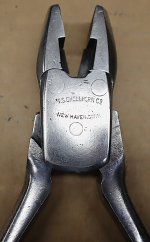
Interesting that their original TM application says it's been in use since "7/15/1908" and mentions nothing about use prior to that?Thanks, Machineman. Those adhere to my theory.
- Dog logo appears on tools with following dates: 1890, 1892, 1894 (cutters) 1907, 1913
- Dog logo does not appear on tools with following dates: 1894 (pliers), 1900, 1914 and 1915.
It's a start. As guys post more tools I will update it as necessary from there. We may need to include the line (LODI, PARAGON, etc), which, as noted before by me on this thread, does not distinguish the model or type of tool, but finish on the same model or type of tool.
Thanks a bunch, notlob. Good detective work. And the source makes sense, since Sargent bought them out. Can't wait to dig in!
There're only a couple explanations I can think of, Todd.Interesting that their original TM application says it's been in use since "7/15/1908" and mentions nothing about use prior to that?
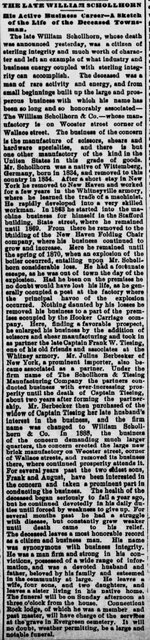
It is. Ironically, tellingly, no mention of William Bernard or pliers. The company through its founder's entire tenure and life was not known for either! Bernard's first patent came just one month before the man whose name is eponymous with the company died. All Bernard era production occurred with his sons running the company.Great story.
Hmm, that intermediate S & Tiesing company is not in DAT, note to add it later.Also, here is his full obit. Great story. I also found where his son was killed by a train in the 1860's.

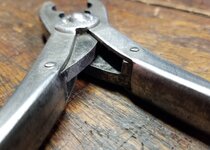

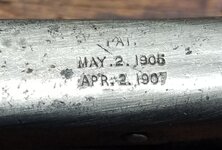
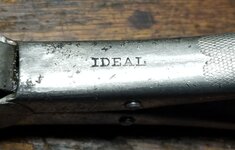

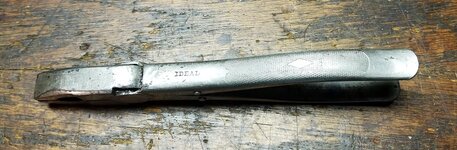
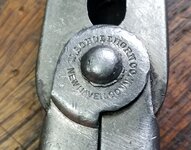

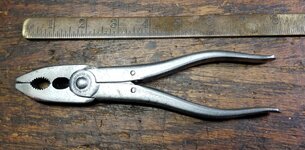
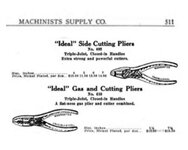
It's a 1/4" hole.What diameter does that one grip?
I'd love to find a pair like that with a 1/2" hole.It's a 1/4" hole.
It'll buff out.I’m happy to say I immediately recognized these in a WW2 museum I recently visited! Neat to think of the history of some of the tools we use.
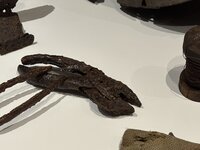
@Private Lugnutz Bastogne War Museum, in Belgium.Which museum, @calandrod ?


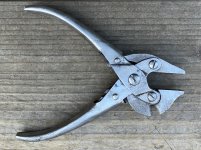

^ I've found "Kroil" and "MMO" a great combination for "rusted solid" pliers.
Wow - you really worked on these; they cleaned up better than you'd guess from the "before" pic.I didn’t have much hope for this pair I found at Friday‘s estate sale but they were almost free so I thought that I would give cleaning them up a try.
They looked better after some wire wheeling and an overnight in evaporust but were still frozen solid. After a soak in penetrating oil I brute forced them open and cleaned off some more corrosion. I may be able to free them up but they will always be pretty pitted.
-Don
I don't believe I even have any brake fluid here... it's junk once you open the bottle here because there's so much moisture in the atmosphere - may as well toss it (or haul to the transfer station.)


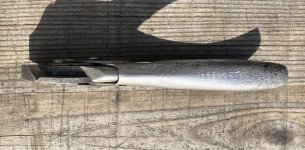
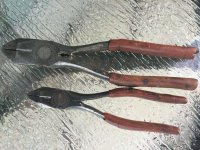


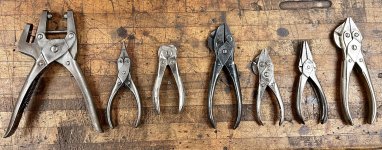
I can’t seem to leave them behind when I see them at garage or estate sales. These have been beat on but still work fine. Found at a Gardnerville NV garage sale yesterday.With a couple of recent additions, my current collection.
-Don


I can’t seem to leave them behind when I see them at garage or estate sales. These have been beat on but still work fine. Found at a Gardnerville NV garage sale yesterday.
...well-made tools. I still have one like this that I got 70+ years ago.


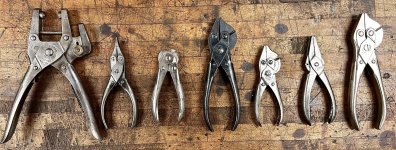
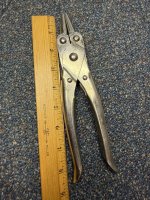
No. I have a 4-incher, and it's the cheaper LODI pattern. Outlaw posted two of the compound pattern a couple years ago, not his, from a machinists' kit originally belonging to an employee of Remington Arms, one longer than the other, and by context of the surrounding tools, they look to be 4" and 6" OAL. Linked HERE.Recently acquired these - a big beast of a wire-forming tool...[ ]...Anyone seen a pair this big?
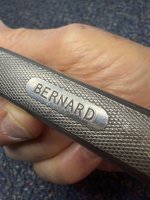
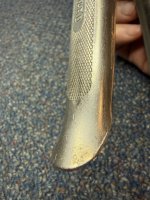
These look fairly "recent" to me. I believe Schollhorn continued to be active into the 1940s, but I can't find a '30s or '40s catalog.No. I have a 4-incher, and it's the cheaper LODI pattern. Outlaw posted two of the compound pattern a couple years ago, not his, from a machinists' kit originally belonging to an employee of Remington Arms, one longer than the other, and by context of the surrounding tools, they look to be 4" and 6" OAL. Linked HERE.
The 1929 catalog has both the No. 101 (heavy pattern round nose) and the No. 104 (light pattern round nose).I believe Schollhorn continued to be active into the 1940s, but I can't find a '30s or '40s catalog.
Thanks, Lugz - I did see the catalog and brochure you mention; I was kinda hoping you had a later one up your sleeveThe 1929 catalog has both the No. 101 (heavy pattern round nose) and the No. 104 (light pattern round nose).
There is a 1943 'brochure' on IA/ITCL, showing just 15 pliers, and neither round nose is shown.
Sargent acquired all the Schollhorn equipment (machinery, tooling, etc), inventory, and rights to manufacture in 1948, making Schollhorn a division. Sargent used the Bernard name on their tools through the 1950's but it disappeared in 1961.
The 1961 Sargent catalog shows the No. 104, but no No. 101.
!