A subject near and dear to me is fire prevention and timely suppression. Philo has no codes regarding number and types of fire extinguishers needed in a structure. I still contacted a friend who works for a large fire extinguisher company to see his recommendations. He said it was common practice to have an extinguisher every 70' or so. Since the old shop is 70' in length I would only need one to cover the whole shop. Great, that's the minimum but what's a good idea?
Starting with the front of the shop....

....when using the acetylene tanks there is an open flame. That's a source of a fire and just behind this is the welding bench, again very hot things..........

So I installed a 15 lbs(6.8 kg) carbon dioxide unit. It's a big heavy unit but you can get right up to it to remove and deploy it. The two 5 lbs (2.2kg) dry chemical units seen are on their way else where so disregard them for now.
Moving about 30 feet (9m) back in the same room...


...a 5 gal (.02kl) pressurized water unit. It's also heavy but nothing is in your way so removing it is fairly easy. Moving to the right 15 feet (4.5m) by the cleaning solvent tank...
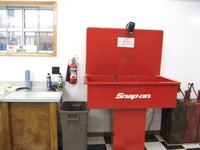
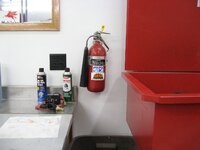
... is another carbon dioxide unit, 5 lbs. Since you have to reach back to get it I didn't want a large heavy unit, rather one that could be retrieved quickly. Also this unit has a wall bracket that you just need to pull the extinguisher toward you, no need to lift it up first.
Then in the back of the shop near the rear overhead door is....

Another 5 gal pressurized water unit. I reasoned that this is by an overhead door and you might also need to put out an outside vegetation fire (leaves, dry grass etc) so water would be ideal for that.
Moving into the lift room.....

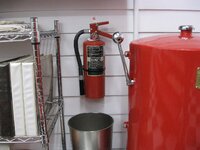
...a 5 lbs halon unit, my personal favorite. It's back and partly hidden so I used a small, light unit that's easy to retrieve. Halon is a very powerful fighting agent so it's small size is offset. Since the most likely fire source here would be from a car, electrical or petroleum based, halon is excellent. That's what we have on the flight decks of our aircraft. If there is an electrical fire behind a panel just stuff it as close as you can and it snuffs out just about anything. Also it leaves no residual material behind to clean up which dry chemical does. Halon is also what I carry in my cars, 2 1/2 lbs (1.1k) units. I bought them years ago when you could still get halon. It's been replaced by haltron which is more environmentally friendly.
In addition to the extinguishers it's important to prevent a fire from starting in the first place (duh). I have a airtight, fire resistant storage can....
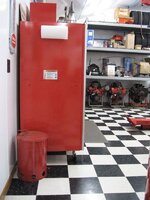
.... note the paper towel rack above...

This is where I put all material that can spontaneously combust.
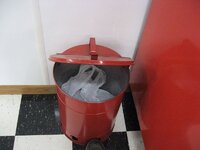
I actually put them in a plastic bag that's in the can and at the end of each day I remove it from the shop so there is no material left inside overnight that could create a problem. Its also an easy way to keep the can clean. I use paper towels for just about everything anymore. I do have cloth shop towels but rarely use them. Paper towels are so easy to dispose of but with cloth towels you tend to hold on to them long after they should be cleaned or recycled out of the shop so as not to pose a hazard.
So I really only need one extinguisher by general codes but have 5 of varying types which gives me options fighting a fire. This shop has been existent for 70-80 years now without a major fire (let me know if want to hear about the minor one that juussst about burned the place down in the 60's) and I would feel just terrible if it was lost due to my carelessness. It is a responsibility I do take very seriously.

Thomas


 )
)