
You are using an out of date browser. It may not display this or other websites correctly.
You should upgrade or use an alternative browser.
You should upgrade or use an alternative browser.
How thick metal can a dremel tool cutting wheel cut?
- Thread starter mikey03
- Start date
strutaeng
Well-known member
24 guage, lol.
zimman
Well-known member
Dremel tool are for model making. LOL
Oh, and two other things I can't remember.
Zim
Oh, and two other things I can't remember.
Zim
KwikFab
Well-known member
Since you've got Milwaukee tools, just get their M12 mini cut off tool.
Works great if you want something small that'll easily cut steel.
Works great if you want something small that'll easily cut steel.
strutaeng
Well-known member
Get a real tool for men: an angle grinder! No men should be without one.
jblnut
ALLIANCE MEMBER
4-1/2” angle grinders are pretty inexpensive these days. If you plan to do any actual metal work I’d invest in one.
To answer your question I’ll ask another. How thick is paper ?
To answer your question I’ll ask another. How thick is paper ?
strength_and_power
Well-known member
- Joined
- Apr 26, 2015
- Messages
- 1,481
Depends on how often you plan on cutting metal. 1-2 times a year, I’d probably suffer through with the dremel. 1-2 times a month, M18 4-1/2” angle grinder with a good quality cut off wheel. More frequent and thicker material, I’d go corded,
MovingAlong
Well-known member
- Joined
- Aug 17, 2013
- Messages
- 1,326
It's really a question of "How much patience do you have?". 
If you're considering a new M12 tool, I'd be looking at the Hackzall:
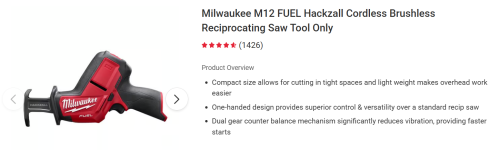
Or the Band Saw:
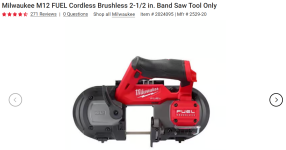
Pricey for my needs, but I really want the band saw!
If you're considering a new M12 tool, I'd be looking at the Hackzall:
Or the Band Saw:
Pricey for my needs, but I really want the band saw!
Honestly I got an angle grinder and a m12 cut off tool and a m12 right angle die grinder and a hacksawl but they don’t seem too precise. I’m thinking sometimes I need to cut something small metal and need it more exact to fit on something. It would seem like the m12 could be more precise and easy to control.
four.cycle
Well-known member
ummmmm..... aluminum foil?
(NOT the "heavy duty" barbecue stuff, though.)
(NOT the "heavy duty" barbecue stuff, though.)
RoninB4
Well-known member
-"Precise" is a relative term but your desire for accuracy from a hand held device are likely too high. You'd have to post your expectations of tolerance to comment on.Honestly I got an angle grinder and a m12 cut off tool and a m12 right angle die grinder and a hacksawl but they don’t seem too precise.
-"Exact fit" hints at what you want but numbers and application would get better replies/suggestionsI’m thinking sometimes I need to cut something small metal and need it more exact to fit on something.
-Using only hand control of the device does NOT assure better results. Technique and fixturing make all the difference.It would seem like the m12 could be more precise and easy to control.
RoninB4
Well-known member
-When using an abrasive disk your technique makes a huge difference in the outcome. You can't just plow into the material and expect it to stand up to the loading, pressure, and flex. The Dremel type moto-tool isn't capable of that sort of operation without being mindful of how underpowered the Dremel is and how fragile those disks are. Material loading of the disk leads to bogging the Dremel which leads to increased pressure at the disk which leads to the disk coming apart. Add flexing of the disk to the process and it will explode in seconds. The tiny little Dremel isn't capable of cutting through a shock eyelet without your assistance. JMOI tried using my Dremel on shock eyelets and it didn't do much of anything. The little cutoff disk snapped before it made much more than a little nick in the metal.
Yeah it ended up being a job for the fire wrench.-When using an abrasive disk your technique makes a huge difference in the outcome. You can't just plow into the material and expect it to stand up to the loading, pressure, and flex. The Dremel type moto-tool isn't capable of that sort of operation without being mindful of how underpowered the Dremel is and how fragile those disks are. Material loading of the disk leads to bogging the Dremel which leads to increased pressure at the disk which leads to the disk coming apart. Add flexing of the disk to the process and it will explode in seconds. The tiny little Dremel isn't capable of cutting through a shock eyelet without your assistance. JMO
RoninB4
Well-known member
-Got tired of being nice to it huh? Been there too, hope it went well.Yeah it ended up being a job for the fire wrench.
Lol the bolts were seized in the sleeves so it was a by any means necessary type dealio.-Got tired of being nice to it huh? Been there too, hope it went well.
Beerhippie
Well-known member
How much time do you have? How many replacement wheels?
The best cut-off wheels for Dremel-type tools are these:

They're a huge improvement over the flimsy brown wheels that come with kits.
I've used my Dremel for cutting DIN openings in fairly thick electrical enclosures. It works, just go slow and make multiple passes. Lead withthe edge of the wheel that wants to pull down into the metal to avoid jumping or climbing out of the cut.
The best cut-off wheels for Dremel-type tools are these:
They're a huge improvement over the flimsy brown wheels that come with kits.
I've used my Dremel for cutting DIN openings in fairly thick electrical enclosures. It works, just go slow and make multiple passes. Lead withthe edge of the wheel that wants to pull down into the metal to avoid jumping or climbing out of the cut.
That’s what I bought. How do you know when to change the blade to the next one before it brakes? Just that it dulls and cuts slower? If I change it too fast I’m wasting expensive disks and if I wait too long I risk them exploding on meHow much time do you have? How many replacement wheels?
The best cut-off wheels for Dremel-type tools are these:
They're a huge improvement over the flimsy brown wheels that come with kits.
I've used my Dremel for cutting DIN openings in fairly thick electrical enclosures. It works, just go slow and make multiple passes. Lead withthe edge of the wheel that wants to pull down into the metal to avoid jumping or climbing out of the cut.
They get too smallThat’s what I bought. How do you know when to change the blade to the next one before it brakes? Just that it dulls and cuts slower? If I change it too fast I’m wasting expensive disks and if I wait too long I risk them exploding on me
That’s what I bought. How do you know when to change the blade to the next one before it brakes? Just that it dulls and cuts slower? If I change it too fast I’m wasting expensive disks and if I wait too long I risk them exploding on me
When all that's left is the bore, time to replace.

PugetDude
ALLIANCE MEMBER
Don't manicurists use a Dremel? 
Beerhippie
Well-known member
I use a 4 1/2" angle grinder and 80 grit flapwheel.Don't manicurists use a Dremel?
RoninB4
Well-known member
-Not familiar with those, are they a fibrous type of disk but thicker than the thin, fragile ones in the Dremel kits?How do you know when to change the blade to the next one before it brakes?
-Most any type of mounted abrasive wheel gets "dull" because it gets clogged with material. Aluminum is notorious for clogging bench grinding wheels. At that point they do cut slower (clogged with material) and excessive heat starts being generated. The excessive heat can/will glaze the abrasives, it will show as shiny spots/sections. Mounted abrasive wheels are supposed to fracture and disintegrate while grinding at the outer periphery to expose new sharp edges. This is called friability and is a mixture of the abrasive, the matrix it's held in, and the relative hardness of the abrasive. If the wheel gets clogged or glazed then this doesn't happen. This can be avoided by using a coarse dressing stick momentarily against the wheel enough to fracture the periphery and de-glaze it. Dressing sticks are uniform shaped but look like they came out of a volcano. They're cheap and should also be used on bench grinder wheels for the same reasons.Just that it dulls and cuts slower?
-Wheels shouldn't explode unless they get clogged/glazed and you're putting too much pressure on them or you're flexing them sideways.If I change it too fast I’m wasting expensive disks and if I wait too long I risk them exploding on me
Beerhippie
Well-known member
The Dremel disks are very thin--like 1/6". They wear fast enough that clogging or glazing are very rarely a problem.
For cutting on the flat, your biggest limit to how small you can let the disk get and still be useful is the body of the tool. The 1 1/2" disk is already smaller dia than the body when new.
The disks have so little mass that any reasonable PPE will protect you from a shattered disk.
For cutting on the flat, your biggest limit to how small you can let the disk get and still be useful is the body of the tool. The 1 1/2" disk is already smaller dia than the body when new.
The disks have so little mass that any reasonable PPE will protect you from a shattered disk.
The Dremel disks are very thin--like 1/6". They wear fast enough that clogging or glazing are very rarely a problem.
For cutting on the flat, your biggest limit to how small you can let the disk get and still be useful is the body of the tool. The 1 1/2" disk is already smaller dia than the body when new.
The disks have so little mass that any reasonable PPE will protect you from a shattered disk.
Damn I haven’t used it yet didn’t realize the disc just gets smaller as you use it. So it got abrasive in the whole body? It’s not just the one edge that when it dulls it’s done? Is it like a Mr clean magic eraser where as you use it gets smaller but the inside is the same material thru out?They get too small
djbmw
Well-known member
You can cut as deep/thick as the remaining life on your cutoff wheel. This is true for any abrasive cutoff tool though *shrugs*If it matters I got a m12 fuel dremel. Wondering the max thickness of metal I can cut through with it. I tried on some shelf brackets and I got a little through it but seemed like it exceeded the tool limits so I stopped.
RoninB4
Well-known member
-I've not examined the ones that @Beerhippie posted but they should be. All of the industrial grade abrasive cut-off wheels I've seen/used are made from the same abrasive material throughout the disk, not like diamond wheels that only have a small section/band coated with diamond. Use them until they get too small in diameter to function. When they do come apart just make sure you're not in the "throw" of the debris zone. You should be doing this as a habit anyway for any type of operation whether it's a grinder, milling machine, or lathe. Use of safety glasses should also be a habit for any type of process that uses a powered device.So it got abrasive in the whole body? It’s not just the one edge that when it dulls it’s done? Is it like a Mr clean magic eraser where as you use it gets smaller but the inside is the same material thru out?
It's the same as a cutting disk for an angle grinder, just smaller and thinner. It'll wear away to nothing.Damn I haven’t used it yet didn’t realize the disc just gets smaller as you use it. So it got abrasive in the whole body? It’s not just the one edge that when it dulls it’s done? Is it like a Mr clean magic eraser where as you use it gets smaller but the inside is the same material thru out?
driftpin
Well-known member
As most of us do, I have 'tool redundancy.' The Dremel E-Z Lock discs are thicker material than the plain un-labeled Dremel abrasive discs which use some sort of fabric reinforcement. Then there are the 'thick as a rose petal (and about as-durable)' Dremel discs which I don't see having the square fabric reinforcement material/no disc label.
I strongly suggest that anyone using any cutting tool like a side-grinder or a die tool, use a faceshield instead of some-sort of safety glasses. You will fare far-better in the event of an explosion of a cutting wheel, a grinding wheel, a bit, or whatever you chuck-up in a small tool such as a Dremel or a side-grinder. I keep a couple of faceshields in the shop, so I don't have to wander far to find one to use. I gifted our adult son w/one to use also.
I've worn-out a couple of Dremels over the years. They have made jobs possible I wouldn't have been able to perform otherwise w/my tools on-hand. I think I'm at 3 side-grinders now, and 3 rotary grinders of the Dremel light-duty type. I have two house locations, so each has at least one.
I strongly suggest that anyone using any cutting tool like a side-grinder or a die tool, use a faceshield instead of some-sort of safety glasses. You will fare far-better in the event of an explosion of a cutting wheel, a grinding wheel, a bit, or whatever you chuck-up in a small tool such as a Dremel or a side-grinder. I keep a couple of faceshields in the shop, so I don't have to wander far to find one to use. I gifted our adult son w/one to use also.
I've worn-out a couple of Dremels over the years. They have made jobs possible I wouldn't have been able to perform otherwise w/my tools on-hand. I think I'm at 3 side-grinders now, and 3 rotary grinders of the Dremel light-duty type. I have two house locations, so each has at least one.
PugetDude
ALLIANCE MEMBER
Gave up on Dremel-branded rotary tools after 2 faulty switches and 3 broken collar locks. Switched to WEN at 25% of the cost, haven't experienced the same issues.
YMMV.
.
YMMV.
.
stickshift
Well-known member
I love the EZ Lock discs. But beware that there are fakes on ebay. Bought a pack of 5 and every one of them tore out the center metal hub very early in life of disc. Meanwhile with genuine Dremel EZ Locks, I can reliably wear the entire disc down to a nub.How much time do you have? How many replacement wheels?
The best cut-off wheels for Dremel-type tools are these:
They're a huge improvement over the flimsy brown wheels that come with kits.
I've used my Dremel for cutting DIN openings in fairly thick electrical enclosures. It works, just go slow and make multiple passes. Lead withthe edge of the wheel that wants to pull down into the metal to avoid jumping or climbing out of the cut.
Dremels and similar tools are very handy. Recently used sanding drum to sharpen hedge trimmers. And they have plastic EZ Lock cutting discs too, which are handy and won't make a mess like trying to use regular cutting disc on plastic.
That said, for cutting metal, if I can fit a mostly worn down (and thus small diameter) cutting disc on a 4-1/2" grinder into a tight place, I will go that route over dremel or OMT - so much faster.
Any recommends on who makes a good face shield or what features they got? Honestly I should buy oneAs most of us do, I have 'tool redundancy.' The Dremel E-Z Lock discs are thicker material than the plain un-labeled Dremel abrasive discs which use some sort of fabric reinforcement. Then there are the 'thick as a rose petal (and about as-durable)' Dremel discs which I don't see having the square fabric reinforcement material/no disc label.
I strongly suggest that anyone using any cutting tool like a side-grinder or a die tool, use a faceshield instead of some-sort of safety glasses. You will fare far-better in the event of an explosion of a cutting wheel, a grinding wheel, a bit, or whatever you chuck-up in a small tool such as a Dremel or a side-grinder. I keep a couple of faceshields in the shop, so I don't have to wander far to find one to use. I gifted our adult son w/one to use also.
I've worn-out a couple of Dremels over the years. They have made jobs possible I wouldn't have been able to perform otherwise w/my tools on-hand. I think I'm at 3 side-grinders now, and 3 rotary grinders of the Dremel light-duty type. I have two house locations, so each has at least one.
Beerhippie
Well-known member
3M makes a very sturdy one. I've bounced a fair amount of **** off of it. Pricing is reasonable and so are the replacement shields.Any recommends on who makes a good face shield or what features they got? Honestly I should buy one
I once shattered a 3" cut-off wheel in a die grinder. Pieces went right through the cheap-*** face shield I had and I had to have one of my bosses pull a chunk out of my earlobe. How was I to know he couldn't handle blood?
kyrbz
Well-known member
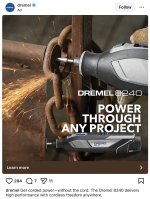
You can power through any project with a Dremel 

PugetDude
ALLIANCE MEMBER
They're so poweful I'm surprised they don't use them to build nuclear submarines.You can power through any project with a Dremel
Crazyjake8493
Well-known member
Theoretically you can cut something as thick as the radius of the cutting disc, but it'll be slow cutting.
I have one of the M12 rotary (Dremel) tools. I don't use it too often, but it's been handy when needed. Cut off a lot of sink faucet nuts that get rusted and corroded. Had to replace the sway bar end links on the car and had to cut the old ones off. Angle grinder wouldn't fit - Dremel did the job. Used the sanding drums to sand or shape parts in tight spots. Used it several times lately at work to cut ferrules off copper supply lines for sinks so I could replace the compression nut.
They do lack power compared to a similar tool like a die grinder. So if you "lean into it" to hard you can stall them out.
I have one of the M12 rotary (Dremel) tools. I don't use it too often, but it's been handy when needed. Cut off a lot of sink faucet nuts that get rusted and corroded. Had to replace the sway bar end links on the car and had to cut the old ones off. Angle grinder wouldn't fit - Dremel did the job. Used the sanding drums to sand or shape parts in tight spots. Used it several times lately at work to cut ferrules off copper supply lines for sinks so I could replace the compression nut.
They do lack power compared to a similar tool like a die grinder. So if you "lean into it" to hard you can stall them out.
NHtoolguy
Well-known member
I've used the original brown cutoff wheels to slice through rusted nuts on multiple occasions, and they worked fine when used with care. As has been said, they will instantly shatter with any side loading. I slowly plunge straight into the offending nut, being careful not to twist the tool or allow it to shift side-to-side. They cut pretty well when used within their limitations.
I'll have to upgrade to the fancy EZ Lock ones Beerhippie mentioned. They look a lot more stout.
I'll have to upgrade to the fancy EZ Lock ones Beerhippie mentioned. They look a lot more stout.
More than once Ive needed cut outs in 1/8” or less plate. Angle grinder cant flush cut at the end of a run. It leaves a radius of material unless you overcut each run. Dremel type tool having small discs quickly completes the job.
scooterbum46
Well-known member
There was a time when the E-Z Lock disks would leave the party with any lateral pressure. Somebody must have rewrote the bonding specs.As most of us do, I have 'tool redundancy.' The Dremel E-Z Lock discs are thicker material than the plain un-labeled Dremel abrasive discs which use some sort of fabric reinforcement.
You laugh, but trailer thieves don't. Easier to carry one of these around in a coat pocket than a 4 1/2" angle grinder. less obvious and just as effective.You can power through any project with a Dremel
I know I'll be accused of being a pedantic, overly detail concerned, 'net wannabe word cop, but Dremel is a brand name, one whose product I've been using since hobby shop days in the 50's. If you have something with M12 on it, I'm guessing it's a Milwaukee rotary tool.I have one of the M12 rotary (Dremel) tools.