To avoid these ads, REGISTER NOW!

The uses and usefulness of different wrench types

To avoid these ads, REGISTER NOW!

Dave455

Well-known member
Joined
Mar 19, 2013
Messages
5,829
Location
Sussex, England
No spud-wrench fans?
They definitely have their uses, but care is needed..

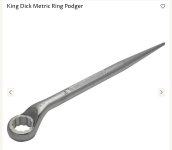
In the U.K. these are known as a “podger”, which is a very old name.

A “podger“ normally incorporates an open ended wrench, but one incorporating a box end (or ”ring spanner” here) therefore becomes a “ring podger“.

So, if you were to incorrectly describe such a wrench by length, and make an unwise choice of manufacturer, you could find yourself requesting an “Eight Inch King **** Ring Podger”….

IMG_3468.jpeg
 

KnurledNut

Well-known member
Joined
Jan 28, 2011
Messages
8,192
Location
n/a
Tekton made a brief and clear video about access wrenches like crowsfeet, flare, service and angle wrenches.
I will add that just because you have the right tool, plan on the fastener putting up a fight that might defeat it.

 
OP
Y

YesIHaveAHammer

Well-known member
Joined
Jun 1, 2025
Messages
877
As far as I can see, the European brands only do angle wrenches in midget thin sizes. I wonder why that would be.

Beta 73 up to 14mm.
Stahlwille "Electric 12" up to 14mm.
Facom 34 up to 17mm.

After looking at the video above, it looks like the crowsfoot would tackle the vast majority of scenarios, while being more compact to store, and more flexible when used with different extensions/ratchets etc.
 

Dave455

Well-known member
Joined
Mar 19, 2013
Messages
5,829
Location
Sussex, England
As far as I can see, the European brands only do angle wrenches in midget thin sizes. I wonder why that would be.

Beta 73 up to 14mm.
Stahlwille "Electric 12" up to 14mm.
Facom 34 up to 17mm.

After looking at the video above, it looks like the crowsfoot would tackle the vast majority of scenarios, while being more compact to store, and more flexible when used with different extensions/ratchets etc.
Yes, you’re right.

Even the European companies, historically, who offered a wide variety of patterns never offered these, as far as I can recall.

I don’t know the reason. It may be that the relevant standards didn’t allow for a situation where they would be needed, but any amount of obstructions seem to be acceptable in some cases now.

I don’t own any myself, but I know folks who do and they all seem to need them regularly. Maybe they are something needed in specific fields, e.g. maintaining heavy plant, but not in others?

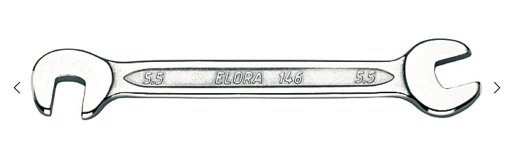
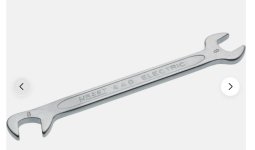
With regard to the midget angle wrenches, these are generally designed for electrical terminal work, and I’ve found them useful for that myself.

Stahlwille, Hazet, and Elora all offer these, but close inspection reveals they are all the same wrenches, differing only in the name. I assume one manufacturer supplies all of these. So. buy the cheapest!

IMG_3469.jpegIMG_3470.jpegIMG_3472.jpeg
 
Last edited:

KnurledNut

Well-known member
Joined
Jan 28, 2011
Messages
8,192
Location
n/a
As far as I can see, the European brands only do angle wrenches in midget thin sizes. I wonder why that would be.
Here's a comparison of an 8mm and 10mm 30/60° angle wrench and a Facom 15/75° 9mm.
Notice how much thinner the head is and shorter the shank.
The european style still has a similar purpose of accessing a fastener from four different ways, but limited to lighter duty applications due to the design.

55358294837_62192e3e21_b.jpg

While angle wrenches in smaller sizes do have some automotive applications, the larger sizes are a must have for hydraulic equipment technicians. Unlike standard double open ends, they are quite expensive though.
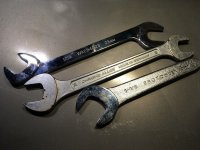
Here's another random comparison of a 30/60° angle, standard double open end and a service wrench just for education sake:
55359648455_5623e4b9bf_b.jpg
 
OP
Y

YesIHaveAHammer

Well-known member
Joined
Jun 1, 2025
Messages
877
a Facom 15/75° 9mm.
Notice how much thinner the head is and shorter the shank.
I guess that must be a model 34?

It doesn't look as thin as the 3mm given in the spec. It looks chunkier overall than the Stahlwille/Hazet type which are also 3mm in that size.
 
To avoid these ads, REGISTER NOW!

KnurledNut

Well-known member
Joined
Jan 28, 2011
Messages
8,192
Location
n/a
An enumeration of all attributes (I can think of) that may be used to describe any particular type.
  1. Number of sizes on one wrench
    1. Single, with different end variants
    2. Twin, with same end variant
  2. Length
    1. Standard
    2. Stubby
    3. Midget
    4. Long
    5. Extra long
  3. End type
    1. Open
    2. Box
    3. Flare nut - standard, flanged
    4. Socket
  4. Lateral head angle
    1. Flat / straight
    2. Angled
    3. Step offset - shallow, deep
    4. Right angle (only for socket ends)
    5. Flex / hinged
  5. Box points
    1. 12 point
    2. 6 point
    3. 6 point with grip feature
  6. Open end rotational angle
    1. Standard
    2. Offset (different at each end)
  7. Open end special feature
    1. Grip
    2. Speed ratcheting
  8. Thickness
    1. Standard
    2. Thin
    3. Thick heavy duty
  9. Ratcheting
    1. None
    2. Single direction
    3. Switchable
  10. Handle type
    1. Straight
    2. Obstruction
    3. Slogging / striking
I don't know how detailed you want to take this, but under "5. Box points" spline is also an option of aerospace wrenches.
I also haven't seen S-shaped and half moon wrenches mentioned. I consider them common, although less so now than in the past.

55359458203_fcdf0d7b3d_b.jpg
 

AEAdam

Well-known member
Joined
May 27, 2023
Messages
2,788
Location
SE PA
They can make them as tight as they want but with use, the yoke will spread and result in a floppy head. same issue that eventually befalls any flex head tool.
I think Snap on does a really great job of this or they did. I’ve heard some here complain about newer versions of what I have. If the joint is well machined and the pivot bolt is high strength and torqued correctly, there really should be a lot of spreading going on.

I had import or craftsman flex heads where there were pretty noticeable gaps and machinings were such that, to get the flex to move easily, it was too lose, tighten it up and it wasn’t movable. This tells me the surfaces were maybe irregular.

In general, I think a tight friction flex is superior to all other sorts but only when it’s awesome. When they aren’t awesome, they are absolute rubbish.
 

Zewnten

Well-known member
Joined
Jun 11, 2017
Messages
1,839
I understand different shapes and angles of wrenches for access but the wrench I've never understood is the "engineer" wrench. Short handle, thick head, shallow open end. Used examples always have hammer marks on them and deformed jaws on the open end, in the small sizes, say under 1", they're ridiculously proportioned.
 

mikey03

Well-known member
Joined
May 17, 2024
Messages
2,156
I understand different shapes and angles of wrenches for access but the wrench I've never understood is the "engineer" wrench. Short handle, thick head, shallow open end. Used examples always have hammer marks on them and deformed jaws on the open end, in the small sizes, say under 1", they're ridiculously proportioned.
Maybe there for machine shop tool spindles to lock and unlock bits of larger sizes

but then if they were I guess honestly they’d be a machinists wrench and not an engineers wrench
 

lund

Well-known member
Joined
Nov 2, 2019
Messages
832
Location
Michigan
I know there are plenty of people that will disagree with me; that's fine, I don't care. I have found that the least useful wrench is the long flex head ratcheting wrench. I don't care for any flex head ratchet wrench I've ever used but the long ones are the worst. Every other type of wrench I've used or own has had it's place even though it might not come out of the box very often but the long flex ratchet wrenches might as well be in the dumpster.

We all have our own styles of work. I would agree that long flex ratchet wrenches are largely redundant considering sockets. But I find for suspension the long handle reach with flex and no-bulky head helps access a lot. One can easily see they will be fragile though. I can't say they are essential. But for me, they speed up what I am doing and can be convenient.

For me, I find I only rarely use open end wrenches. Usually in the context of backing up a bolt when tightening from the other side, or when access is hard. Thin open ends can be useful and can also be good for simple backup use (light etc) when tightening from the other side and you do not need a lot of strength to prevent turning, adjusting jam nuts, etc. But I very rarely pick up an open end wrench as a first choice.
 
To avoid these ads, REGISTER NOW!
Top Bottom