Hohn
Well-known member
Since I'm nearly done (finally!) running air piping in my 3-car garage, I've been watching about every YT video and reading every GJ thread on the subject and while it's been pretty thoroughly discussed, I wanted to offer come thoughts on my experience running black pipe for the first time on air plumbing in general. And since I overthink things to an absurd degree, perhaps I can save you a bit of hassle if you are also an overthinker.
Lots of air system discussion on GJ lately, sorry for piling on.
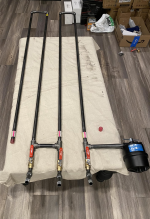
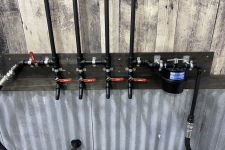
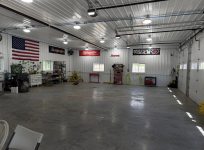
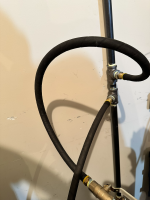
FYI, here's my system as it stands today. Still in work as I have to get the VFD up and running on the Champion so it's more than just a tank.

- The biggest and most absurd bit of over-thinking I've noticed is with aftercoolers and condensing rigs. I've seen the most absurd concoctions made of hundreds of dollars of copper pipe to produce "dry" air. Why is this absurd?
- The air isn't dry! The air isn't "Dry" until it has passed through a refrigerated condenser and/or a desiccant cartridge or two. An aftercooler doesn't make dry air.
- Air that has achieved ambient temperature has condensed all the moisture it will ever condense at that pressure. If you have enough piping and tank capacity that your air is at ambient temperature before you use it, it will have condensed all the moisture it will ever condense. Most of the time, our air usage causes a pressure drop that will cause additional condensation. But this moisture cannot be prevented by an aftercooler.
- Condensing moisture is only half that battle. Fog is condensed, but it still travels perfectly fine through piping.
- COALESCING is the other half of the moisture battle. You need to have those tiny foggy droplets collect together into larger droplets so that they become too heavy to float in air and they fall out of the the air and collect as liquid water so you can drain it off.
- The best coalescer in most air system is a big tank on the compressor outlet. It has very little flow, local low velocity and gives the moisture droplets time to find each other.
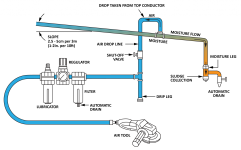
- From the big tank, you want a large diameter riser for low flow velocity. This gives more time for droplets to find each other and as they fall through gravity they will collect other droplets. Make your riser to the rest of your system oversized for very low velocity.
- Any coalescing filters must be as far away from the tank and riser as possible. This will make them as effective as they can possibly be, because all that transit time through the run of piping will let the droplets gets larger and larger as they collect. This makes your coalescing filter more effective at removing them.
- I have a Milton 1020-8 at the end of my piping run right at my main access point. It has as centrifugal flow path to enhance coalescing. But there's so little water at the end of my pipe run that I never get any water to drain out of the bowl. NO aftercooler, No copper anywhere in my system. Black pipe in a generous 3/4 size is quite sufficient to condense almost all the water out. It's all about the transit time and low flow velocity.
- My line pressure right now is only 130psi max (and not regulated, it rises and falls with tank pressure). So there's no much pressure drop (and thus moisture drop) across my regulator. So there's no immediate need for another filter after the regulator. However, when I raise the line pressure to 175psi, there's a good chance that I will need a post-regulator filter as another coalescing stage. A pressure drop of 50-60psi or so WILL drop water out, regardless how long your piping or how much copper you wasted upstream.
- With higher liner pressure, the optimal system problem means moving to a different filter in front of my regulator and moving the 1020-8 to be AFTER the regulator so that its coalescing function can perform properly.
- I have a Milton 1020-8 at the end of my piping run right at my main access point. It has as centrifugal flow path to enhance coalescing. But there's so little water at the end of my pipe run that I never get any water to drain out of the bowl. NO aftercooler, No copper anywhere in my system. Black pipe in a generous 3/4 size is quite sufficient to condense almost all the water out. It's all about the transit time and low flow velocity.
- Black pipe is pretty easy to work with after all. My first project using it and I was able to make a good system without having to thread a single piece. All standard lengths of pipe and ******* worked fine. I can't transport 10ft sticks (no trailer) so I had to make do with 5ft max lengths and a few couplings. Totally not a problem.
- The sealing has been quite good with high density yellow tape and a little buttering of pipe dope.
- Brass and steel/iron (stainless, galvanized, or black) are the only metals you want in your air system. Not only do aluminum hose ends, plugs and couplers not hold up to daily usage, they are bad offenders for galvanic corrosion. Brass on steel isn't ideal, but it's minor enough to be acceptable. Copper should be buffered with brass or stainless unions/coupling or some kind of dielectric union.
- You can almost never have too many ball valves in a system, but at the very least I think you want want at every tank connection (to isolate it) and every vertical run (drip leg).
- Push-lok hydraulic hose with JIC ends is a great way to add flexible hose to your air system if you need it. I'm using it to tie my compressors to the main riser because it's super convenient to use, it gives you a swivel end, and it isolates the compressor vibration from your piping. With the convenience of push-ons, I made some hoses that where NPT male on one end and JIC female at the other. This allows the hose to thread directly into the tank at one end and easily attach to a JIC/NPT male union at the main riser. Because these hoses are only ever seeing tank air, they are well within their temperature and pressure limits.
- Even the cheaper push-on hoses like Parker 801 are still rated to 100C and 300psi in most cases. That's plenty for the task of plumbing air tanks to your piping.
- Little details can help reduce line losses in your system. For example, chamfering certain transitions in plugs or other fittings can make a modest-and-perhaps-invisible improvement on the expansion losses where a small fitting opens up to a larger one. I massaged a couple parts with a 60 degree countersink. But keep in mind that no one part of your plumbing is causing your pressure loss. Your air system is sum total of the dozens of little transitions and unions and fittings. It takes a full-on system audit to really make a low-loss system. Yes, upgrading your air hose from 3/8 to 1/2 will help. A high flow coupler is better than a low flow one. But there's almost certainly no single thing you can swap in your system that will cut losses by 30% or 40%. Pareto reasoning is how you need to approach your air system. All the high flow fittings in the world won't matter if all your air is stored in a tank that discharges through a 1/4" NPT port.
- Most people don't know this because it's counterintuitive, but a sudden opening in your pipe is actually more restrictive than a sudden contraction. Stacking adapters is not cool, but neither is going from 1/4 NPT to 3/4NPT in one short step. Make your steps gradual and the system is happier. For example, if you need to adapt from 1/4 NPT to step up to 1/2 NPT, don't use a bushing, use reducer couplings. Even if you need to stack two of them it's better than a massive square-corner expansion from a single hole to a huge one.
- A sudden step down isn't great, but it's far less bad than a sudden step-up.
- Most people don't know this because it's counterintuitive, but a sudden opening in your pipe is actually more restrictive than a sudden contraction. Stacking adapters is not cool, but neither is going from 1/4 NPT to 3/4NPT in one short step. Make your steps gradual and the system is happier. For example, if you need to adapt from 1/4 NPT to step up to 1/2 NPT, don't use a bushing, use reducer couplings. Even if you need to stack two of them it's better than a massive square-corner expansion from a single hole to a huge one.
- Air pressure drop is fundamentally a distribution problem. Air is someplace other than where it's needed, and it can't get to the point of use fast enough to prevent excess pressure drop. This is why long hoses are bad for pressure drop. This is why having a huge tank at only one point far upstream of the demand location is bad for pressure drop. Air is dumb, it only knows to go where pressure drop tells it to. And small fittings and hoses need a much stronger pressure drop signal to induce flow.
- Most snub tanks don't do much because the port are too small relative to the tank size. They aren't a fix to any real problem.
Lots of air system discussion on GJ lately, sorry for piling on.
FYI, here's my system as it stands today. Still in work as I have to get the VFD up and running on the Champion so it's more than just a tank.