To avoid these ads, REGISTER NOW!

Air System Piping-- don't overthink it (lessons from my recent project)

Hohn

Well-known member
Joined
Aug 25, 2016
Messages
2,701
Location
Diesel Central, Indiana
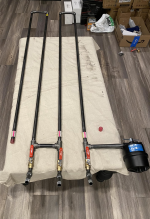
Since I'm nearly done (finally!) running air piping in my 3-car garage, I've been watching about every YT video and reading every GJ thread on the subject and while it's been pretty thoroughly discussed, I wanted to offer come thoughts on my experience running black pipe for the first time on air plumbing in general. And since I overthink things to an absurd degree, perhaps I can save you a bit of hassle if you are also an overthinker.

  • The biggest and most absurd bit of over-thinking I've noticed is with aftercoolers and condensing rigs. I've seen the most absurd concoctions made of hundreds of dollars of copper pipe to produce "dry" air. Why is this absurd?
    • The air isn't dry! The air isn't "Dry" until it has passed through a refrigerated condenser and/or a desiccant cartridge or two. An aftercooler doesn't make dry air.
    • Air that has achieved ambient temperature has condensed all the moisture it will ever condense at that pressure. If you have enough piping and tank capacity that your air is at ambient temperature before you use it, it will have condensed all the moisture it will ever condense. Most of the time, our air usage causes a pressure drop that will cause additional condensation. But this moisture cannot be prevented by an aftercooler.
    • Condensing moisture is only half that battle. Fog is condensed, but it still travels perfectly fine through piping.
      • COALESCING is the other half of the moisture battle. You need to have those tiny foggy droplets collect together into larger droplets so that they become too heavy to float in air and they fall out of the the air and collect as liquid water so you can drain it off.
      • The best coalescer in most air system is a big tank on the compressor outlet. It has very little flow, local low velocity and gives the moisture droplets time to find each other.
      • From the big tank, you want a large diameter riser for low flow velocity. This gives more time for droplets to find each other and as they fall through gravity they will collect other droplets. Make your riser to the rest of your system oversized for very low velocity.
      • Any coalescing filters must be as far away from the tank and riser as possible. This will make them as effective as they can possibly be, because all that transit time through the run of piping will let the droplets gets larger and larger as they collect. This makes your coalescing filter more effective at removing them.
        • I have a Milton 1020-8 at the end of my piping run right at my main access point. It has as centrifugal flow path to enhance coalescing. But there's so little water at the end of my pipe run that I never get any water to drain out of the bowl. NO aftercooler, No copper anywhere in my system. Black pipe in a generous 3/4 size is quite sufficient to condense almost all the water out. It's all about the transit time and low flow velocity.
          • My line pressure right now is only 130psi max (and not regulated, it rises and falls with tank pressure). So there's no much pressure drop (and thus moisture drop) across my regulator. So there's no immediate need for another filter after the regulator. However, when I raise the line pressure to 175psi, there's a good chance that I will need a post-regulator filter as another coalescing stage. A pressure drop of 50-60psi or so WILL drop water out, regardless how long your piping or how much copper you wasted upstream.
          • With higher liner pressure, the optimal system problem means moving to a different filter in front of my regulator and moving the 1020-8 to be AFTER the regulator so that its coalescing function can perform properly.
  • Black pipe is pretty easy to work with after all. My first project using it and I was able to make a good system without having to thread a single piece. All standard lengths of pipe and ******* worked fine. I can't transport 10ft sticks (no trailer) so I had to make do with 5ft max lengths and a few couplings. Totally not a problem.
    • The sealing has been quite good with high density yellow tape and a little buttering of pipe dope.
  • Brass and steel/iron (stainless, galvanized, or black) are the only metals you want in your air system. Not only do aluminum hose ends, plugs and couplers not hold up to daily usage, they are bad offenders for galvanic corrosion. Brass on steel isn't ideal, but it's minor enough to be acceptable. Copper should be buffered with brass or stainless unions/coupling or some kind of dielectric union.
  • You can almost never have too many ball valves in a system, but at the very least I think you want want at every tank connection (to isolate it) and every vertical run (drip leg).
  • Push-lok hydraulic hose with JIC ends is a great way to add flexible hose to your air system if you need it. I'm using it to tie my compressors to the main riser because it's super convenient to use, it gives you a swivel end, and it isolates the compressor vibration from your piping. With the convenience of push-ons, I made some hoses that where NPT male on one end and JIC female at the other. This allows the hose to thread directly into the tank at one end and easily attach to a JIC/NPT male union at the main riser. Because these hoses are only ever seeing tank air, they are well within their temperature and pressure limits.
    • Even the cheaper push-on hoses like Parker 801 are still rated to 100C and 300psi in most cases. That's plenty for the task of plumbing air tanks to your piping.
  • Little details can help reduce line losses in your system. For example, chamfering certain transitions in plugs or other fittings can make a modest-and-perhaps-invisible improvement on the expansion losses where a small fitting opens up to a larger one. I massaged a couple parts with a 60 degree countersink. But keep in mind that no one part of your plumbing is causing your pressure loss. Your air system is sum total of the dozens of little transitions and unions and fittings. It takes a full-on system audit to really make a low-loss system. Yes, upgrading your air hose from 3/8 to 1/2 will help. A high flow coupler is better than a low flow one. But there's almost certainly no single thing you can swap in your system that will cut losses by 30% or 40%. Pareto reasoning is how you need to approach your air system. All the high flow fittings in the world won't matter if all your air is stored in a tank that discharges through a 1/4" NPT port.
    • Most people don't know this because it's counterintuitive, but a sudden opening in your pipe is actually more restrictive than a sudden contraction. Stacking adapters is not cool, but neither is going from 1/4 NPT to 3/4NPT in one short step. Make your steps gradual and the system is happier. For example, if you need to adapt from 1/4 NPT to step up to 1/2 NPT, don't use a bushing, use reducer couplings. Even if you need to stack two of them it's better than a massive square-corner expansion from a single hole to a huge one.
      • A sudden step down isn't great, but it's far less bad than a sudden step-up.
  • Air pressure drop is fundamentally a distribution problem. Air is someplace other than where it's needed, and it can't get to the point of use fast enough to prevent excess pressure drop. This is why long hoses are bad for pressure drop. This is why having a huge tank at only one point far upstream of the demand location is bad for pressure drop. Air is dumb, it only knows to go where pressure drop tells it to. And small fittings and hoses need a much stronger pressure drop signal to induce flow.
    • Most snub tanks don't do much because the port are too small relative to the tank size. They aren't a fix to any real problem.

Lots of air system discussion on GJ lately, sorry for piling on.
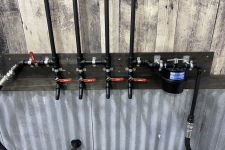
FYI, here's my system as it stands today. Still in work as I have to get the VFD up and running on the Champion so it's more than just a tank.

1782742284673.png
 
To avoid these ads, REGISTER NOW!

cgrutt

Well-known member
Joined
Mar 4, 2016
Messages
8,356
Sorry I didn't read all of that but have a general question about the "cooler and condenser rigs" mentioned in first section above. My understanding is that the purpose of these "rigs" is predominately to cool the heated air stream leaving compressor. During cooling water vapor changes state to liquid. The (better?) systems generally have some sort of valves and/or filter dryers following the cooler/condenser where the liquid water is collected then physically purged from lines. Isn't that effectively making the airstream dryer than what it otherwise would have been when it finally reaches downstream equipment? I understand that as the airstream cools further any additional water vapor will condense further and produce more water but all things equal isn't the system drier than if it the "rig" wasn't used at all? Not challenging you just trying to understand how this works. Thanks.
 

HoosierBuddy

Well-known member
Joined
May 9, 2006
Messages
2,931
Location
Southern Indiana
Man, if that's you "not overthinking"? Good lord.

Here's my thought: Use big enough diameter black iron and you won't need a loss calculation because your volume will be high enough you won't ever have a problem...and it will still be cheaper to build than much smaller competitive materials.

Congratulations on your new black iron system. Mine has been in since 2006 with almost no issues.

Issues I have had aren't related to the black iron.

1. A hose real hooked to your black iron hanging high in the air is great for pneumatic tools. I have one mounted to my lift. Downside is the hoses don't last forever. Seem to last about 10 years before they start leaking.

2. Pro tip, if your wife says she can't keep the lawnmower tires aired up properly because she lacks the grip strength to chuck/unchuck the proper tool, install one of these on a hose end. It takes the pressure off the chuck so almost no force is required for the quick connect.

1782756881869.png
 

jack stand

Well-known member
Joined
Feb 29, 2012
Messages
3,353
Location
Lakes Region Maine
I don't do any painting and battery tools have made most of my air tools obsolete with the exception of airing up tires and blowing dust.
I do admire a thoughtfully designed and assembled air system and your's sounds sweet!👍
 
OP
H

Hohn

Well-known member
Joined
Aug 25, 2016
Messages
2,701
Location
Diesel Central, Indiana
Sorry I didn't read all of that but have a general question about the "cooler and condenser rigs" mentioned in first section above. My understanding is that the purpose of these "rigs" is predominately to cool the heated air stream leaving compressor.

Yes, that's the idea. Most are cooling the air before it hits the tank, leveraging the fact that air is hottest at the pump discharge. Some are installed after the tank, which makes them mostly moot and pointless except for some rare cases.
During cooling water vapor changes state to liquid. The (better?) systems generally have some sort of valves and/or filter dryers following the cooler/condenser where the liquid water is collected then physically purged from lines. Isn't that effectively making the airstream dryer than what it otherwise would have been when it finally reaches downstream equipment?


Water removal is a two-step process. First, we condense by cooling to convert as much vapor to liquid. Then we coalesce so that the liquid actually collects and drains off instead of traveling in the pipes as liquid fog.

Many people will be enjoying cold beverages this coming weekend and notice the condensation on their cans. It starts first as a fog, but as additional moisture is collected, the droplet size increases and then the droplets run down the side of the can instead of staying as a static tiny droplet. That's the process in a nutshell.

Fog is not a vapor-- it's already condensed. But it flows like a vapor and can't be drained off. So now what? That's why we need coalescing. That's what turns billions of tiny foggy droplets into big drops that will collect into even bigger drops that can be poured off and will not stay suspended in the air after they are condensed.

Coalescing occurs naturally if the droplets are given enough time to find each other as they bump into each other in the pipe. As they get too heavy to remain suspended, they will fall out of the air, collecting other tiny droplets as they do.

That's why a large diameter riser pipe is pretty effective at coalescing. The water droplets don't just fall a small distance before finding the pipe-- the fall all the way through the vertical rise, collecting other droplets as they do.

There are other good ways to coalesce. One way is a centrifuge-- the mass of the water droplets flings them outward where they run into other droplets. My Milton 1020-8 has a centrifuge insert in to do this. It also has a sintered element which will coalesce small droplets larger than 40 microns.

I understand that as the airstream cools further any additional water vapor will condense further and produce more water but all things equal isn't the system drier than if it the "rig" wasn't used at all? Not challenging you just trying to understand how this works. Thanks.
If the air cools further, more water condenses. But as explained above, condensing is not the same as clinging to the inside of the pipes and no longer part of the air stream.

The main advantage of the aftercoolers is that they move the condensation point further upstream so that the natural coalescing of the downstream system can be more effective.

But if you put an actual coalescing filter in your system and its far enough downstream that the air has fully cooled, the after cooler does absolutely nothing to reduce the humidity of the air in your hose. The coalescing filter is more effective than lots of extra pipe.

And if you have both a significant pipe run (length and large in diameter) with a coalescer at the end of the run, then an aftercooler does absolutely no benefit to you.

The flip side is that if you put your coalescing filter close to the air compressor, then you may need an aftercooler if the air coming out of the tank is still hot. Hot air into a coalescer is pointless.
 
OP
H

Hohn

Well-known member
Joined
Aug 25, 2016
Messages
2,701
Location
Diesel Central, Indiana
Man, if that's you "not overthinking"? Good lord.

Here's my thought: Use big enough diameter black iron and you won't need a loss calculation because your volume will be high enough you won't ever have a problem...and it will still be cheaper to build than much smaller competitive materials.

Congratulations on your new black iron system. Mine has been in since 2006 with almost no issues.

Issues I have had aren't related to the black iron.

1. A hose real hooked to your black iron hanging high in the air is great for pneumatic tools. I have one mounted to my lift. Downside is the hoses don't last forever. Seem to last about 10 years before they start leaking.

2. Pro tip, if your wife says she can't keep the lawnmower tires aired up properly because she lacks the grip strength to chuck/unchuck the proper tool, install one of these on a hose end. It takes the pressure off the chuck so almost no force is required for the quick connect.

1782756881869.png
My illness is unfortunately well known among some here and in my corner of bartholomew county.

3/4 black iron is so affordable and useful I think anyone settling for 1/2 black iron is missing out. I perhaps should have made my main riser from 1", but there's no denying it's effective as is.

I don't like hose reels because the swivel fitting always ends up leaking and they are hard on hoses. So I just use a hook and coil up the hose.

The safety coupler with the sliding sleeve are real game changer for insertion force. Insertion force is my only complaints about the Prevost high flow couplers-- they require 22# to insert against only 90psi. That's borderline unreasonable. And pity the fool trying to insert the plug against 130 psi or higher pressure.

The milton coupler (and the merlin knock off I use) is superb and definitely the way to go for cases where you don't need absolutely lowest possible pressure drop. And truthfully, I don't think it's ever true that you need the lowest possible pressure drop. Just bump up the regulator a bit if you need more air.
 

cgrutt

Well-known member
Joined
Mar 4, 2016
Messages
8,356
Yes, that's the idea. Most are cooling the air before it hits the tank, leveraging the fact that air is hottest at the pump discharge. Some are installed after the tank, which makes them mostly moot and pointless except for some rare cases.


Water removal is a two-step process. First, we condense by cooling to convert as much vapor to liquid. Then we coalesce so that the liquid actually collects and drains off instead of traveling in the pipes as liquid fog.

Many people will be enjoying cold beverages this coming weekend and notice the condensation on their cans. It starts first as a fog, but as additional moisture is collected, the droplet size increases and then the droplets run down the side of the can instead of staying as a static tiny droplet. That's the process in a nutshell.

Fog is not a vapor-- it's already condensed. But it flows like a vapor and can't be drained off. So now what? That's why we need coalescing. That's what turns billions of tiny foggy droplets into big drops that will collect into even bigger drops that can be poured off and will not stay suspended in the air after they are condensed.

Coalescing occurs naturally if the droplets are given enough time to find each other as they bump into each other in the pipe. As they get too heavy to remain suspended, they will fall out of the air, collecting other tiny droplets as they do.

That's why a large diameter riser pipe is pretty effective at coalescing. The water droplets don't just fall a small distance before finding the pipe-- the fall all the way through the vertical rise, collecting other droplets as they do.

There are other good ways to coalesce. One way is a centrifuge-- the mass of the water droplets flings them outward where they run into other droplets. My Milton 1020-8 has a centrifuge insert in to do this. It also has a sintered element which will coalesce small droplets larger than 40 microns.


If the air cools further, more water condenses. But as explained above, condensing is not the same as clinging to the inside of the pipes and no longer part of the air stream.

The main advantage of the aftercoolers is that they move the condensation point further upstream so that the natural coalescing of the downstream system can be more effective.

But if you put an actual coalescing filter in your system and its far enough downstream that the air has fully cooled, the after cooler does absolutely nothing to reduce the humidity of the air in your hose. The coalescing filter is more effective than lots of extra pipe.

And if you have both a significant pipe run (length and large in diameter) with a coalescer at the end of the run, then an aftercooler does absolutely no benefit to you.

The flip side is that if you put your coalescing filter close to the air compressor, then you may need an aftercooler if the air coming out of the tank is still hot. Hot air into a coalescer is pointless.
This is the video I keep going back to. Seems pretty effective just visually seeing all the water that is released from each of the stages. I do realize that this system is configured post storage tank but still seems to work. He claims he has filters downstream before his CNC plasma table that have never had any physical moisture in them. Maybe I just don't understand the "coalescing" part and having the 1" pipes standing vertically is actually doing what you're talking about. Anyway, just trying to understand whether something like this would be beneficial or not.


SouthernIllinois

Well-known member
Joined
Jan 14, 2024
Messages
1,686
I used:

1/2" black iron pipe for a "cooler"
MotorGuard M-60 filter at the of the black pipe before it enters the TransAir piping
1" TransAir aluminum piping
MotorGuard AC-6500 filter/regulator at each drop

No issues and couldn't be happier with the way it works.

Screenshot 2025-11-30 at 3.48.16 PM.pngScreenshot 2024-12-29 at 6.33.54 PM.pngScreenshot 2025-04-02 at 5.19.53 PM.png
Screenshot 2025-04-02 at 5.38.16 PM.pngScreenshot 2025-01-26 at 12.41.27 PM.pngScreenshot 2025-04-01 at 6.22.02 PM.png
Screenshot 2026-06-29 at 8.01.25 AM.png
Screenshot 2026-01-19 at 2.05.31 PM.png
 
Last edited:
OP
H

Hohn

Well-known member
Joined
Aug 25, 2016
Messages
2,701
Location
Diesel Central, Indiana
well, you asked.

Main air point of use:
1782762663392.png

3/4 black pipe descends carrying unregulated air from a capped cross to make the drop leg which ends in a ball valve. The tee reduces to 1/2 NPT and supplies a shutoff valve (with drain), then the Milton 1020-8, then a Milton regulator. Post-regulator, the system switches to PEX-B. There's a short vertical riser for my King Rotameter (which isn't installed yet, but it will go where that short Pex riser is once is shows up). The PEX run terminates in a Datum manifold--1/2 NPT in and out with 3/8 NPT branches.

Here's a closeup of the manifold:
1782762890048.png

On the right is a 1/2 blubird reduced to 3/8 NPT and threaded directly into the manifold. This is the supply for my high-demand tools. This hose ends in a Prevo high flow coupler (green button).

I plugged the other ports in the middle that aren't too useful on such a tight port pitch and frankly I don't really need them. On the left is a Merlin copy of the Milton 5-in-1 safety coupler with the sliding sleeve. It presently has a 3/8 hose plugged in with Prevost steel plugs. That hose terminates in another Prevost high flow coupler to to maintain compatibility with all my plugs, since I'm using V-style plugs across the board and have converted every air tool I own to that style plug.

On top of the manifold is my point-of use regulator and pressure measurement rig. This allows me to dial in lower pressure for particular tools (spray guns) without messing with the main line regulator. Or I can just have a quick way to dial dynamic pressure at the end of a longer hose run if needed.

If I need a truly long hose reach, then the red hose gets plugged into the blue hose instead of into the manifold.


At the other end of the pipe run, we have this work-in progress situation where the two compressors supply the main riser via JIC fittings and push-lock hose:
1782763396436.png

The champion is almost ready to be placed. The tank, motor and pump are individually verified. I had new BX65 belts, fresh premium oil, and new Solberg filter/silencer and the tank now holds air perfectly with the new check valve. Once the VFD is wired in the the Champion is commissioned, I'll replace the JIC hose with some proper plumbing. I'm loving the JIC though, so I might so some hydraulic hardline with 37 degree flares just because I actually love piping, tubing and hoses.

1782763493630.png


The header run of black pipe is inclined back towards the compressors, so air is basically always traveling uphill for the first 15 feet or so of pipe.

With no aftercooler, the air in the hoses is dry as a bone. If you point the blow gun at your hand and gently vent a little air, your hand will be completely dry. The milton coalescing filter never has any water in it. EVER. I can close the ball valve to depressurize the main access point so that the little drain on the milton can pop up the drain water. It's never even damp, like touching it with your finger gives not even a hint of water.

When I crack the ball valve on the drop leg at the main access point, it also always bone dry. Whatever water there is in this system condensed and coalesces out before it even gets to my actual coalescer.


PEX-B is rated to 160psi at 100F, so it's perfectly safe for the post-regulator portion of this run where the regulator tops out at 125psi.

By using black iron and pex B, I feel like I get the best of all worlds. I get the water condensing advantages and low restriction of 3/4 black pipe, but then I get ease of use for post-regulator parts of the line where there's a lot more going on and the air is already dry.


I fully did not expect this piping system to deliver air as dry as it does. But the evidence is undeniable, whatever is going on upstream of this main access point is sufficient to condense and coalesce all the water capable of being removed at ambient temperature.

The only way the air can be dryer is if there's a proper refrigerated dryer or a dessicant stage added. Considering I have neither, I couldn't be happier with the moisture removal of this simple setup in a small and cluttered 3 car garage.
 
Last edited:
OP
H

Hohn

Well-known member
Joined
Aug 25, 2016
Messages
2,701
Location
Diesel Central, Indiana
I used:

1/2" black iron pipe for a "cooler"
MotorGuard M-60 filter at the of the black pipe before it enters the TransAir piping
1" TransAir aluminum piping
MotorGuard AC-6500 filter/regulator at each drop

No issues and couldn't be happier with the way it works.

Screenshot 2025-11-30 at 3.48.16 PM.pngScreenshot 2024-12-29 at 6.33.54 PM.pngScreenshot 2025-04-02 at 5.19.53 PM.png
Screenshot 2025-04-02 at 5.38.16 PM.pngScreenshot 2025-01-26 at 12.41.27 PM.pngScreenshot 2025-04-01 at 6.22.02 PM.png
Screenshot 2026-06-29 at 8.01.25 AM.png
Your setup is frankly beautiful. My champion is far less pretty than yours, and your pipework and overall system is industrial art. Well done.
 
OP
H

Hohn

Well-known member
Joined
Aug 25, 2016
Messages
2,701
Location
Diesel Central, Indiana
This is the video I keep going back to. Seems pretty effective just visually seeing all the water that is released from each of the stages. I do realize that this system is configured post storage tank but still seems to work. He claims he has filters downstream before his CNC plasma table that have never had any physical moisture in them. Maybe I just don't understand the "coalescing" part and having the 1" pipes standing vertically is actually doing what you're talking about. Anyway, just trying to understand whether something like this would be beneficial or not.

I've watched the video several times. It's a good example of the kind of complicated overkill approaches that work.

This guy's setup is obviously effective, but he used about $200 more worth of copper than he needed. Especially since he used 1" copper, a single loop up and down would be more than enough or one single 6-8ft riser would have been enough.

The problem with videos like his is that it suggests that all that overkill is what is necessary to remove water from your system. This is the classic necessity/sufficiency fallacy. What's actually SUFFICIENT to remove water is obviously something less, but we don't really know how much less.

If one wishes to build a system like this, the way to know how much is enough is simply measure the temperature of the piping while the compressor is under load and flowing air. This is the worst case because there very little residence time in the air tank, so very little time for condensation and coalescing.

Here's how to validate the cooler effectiveness: grab your highest flow air tool. Use the tool to pull down system pressure until the compressor cuts in. Once it cuts in, adjust the regulator down to whatever pressure will cause the high flow tool to just keep pace with the compressor (no net tank pressure increase).

Let the compressor run in open loop for the longest period of continuous usage you expect to encounter. For most of us, that's probably 3-4 minutes.

At the end of that time period, measure the temperature of your discharge pipe starting at the tank and working downstream. You'll get to a point where the temp is basically ambient shop/garage temp. It will probably be under 10 feet. Beyond that point, your piping is no longer actively contributing to condensation. Beyond that, coalescing is the only mechanism of water removal because you're not dropping temperature.

These massive networks of huge copper pipe are effective but completely unnecessary in most cases. A far more modest system can be equally as effective. My own system is thus far quite effective.

Before I make any bold claims about my simple black pipe setup, I have to first point out that all my observations are only with a small 2hp compressor with a max line pressure of 135psi. That's a far cry from an 80 gallon Champion at 175psi.

But it turns out that the small single stage compressor is actually much WORSE for discharge temps during sustained use. So if my piping system is adequate to fully cool the air coming from a single stage compressor at 135psi, it's absolutely much more capable when asked to cool the much lower temp air in an 80 gallon two stage tank. The two stage aspect of the bigger compressor make a huge difference in discharge temps of air into the tank. And thus, for the air leaving the tank as well.
 
Last edited:
OP
H

Hohn

Well-known member
Joined
Aug 25, 2016
Messages
2,701
Location
Diesel Central, Indiana
BTW-- chamfers make me happy:

1782766212627.png

1782766237265.png

Little things like chamfering fitting transitions can actually help a bit, but you have to do it everywhere for it to amount to anything. This was just me playing around to see if I could do it.
 
OP
H

Hohn

Well-known member
Joined
Aug 25, 2016
Messages
2,701
Location
Diesel Central, Indiana
OK, I just did a quick experiment.

I didn't show it above, but I have another air drop really close to the main riser. It's 1/2 coming down off the 3/4 mainline only 5ft away from the supply riser.

I figured it would be worth seeing how much moisture shows up at this near drop immediately after the small compressor kicks off, since the little guy runs so hot, surely this close to the main riser there has to be moisture in the air, right? This drop has no air conditioning whatsoever-- no filter, not dryer, nothing. It's basically mainline air sampled 5ft from the riser.

So I let the small compressor run to kick off at 140psi or so and it's ripping hot. The tank near the discharge tube is almost too hot to touch.

Then I plugged in a blow gun to this near drop and proceeded to blow down all the air pressure I had just built. The idea was surely that hot air hasn't had time to condense anything so I'll get moisture at the blow gun, right? I'm 5 feet from the riser!


Well no. The air was bone dry even here. From 140psi down to 30psi, never even a trace of moisture in that blow gun air. Now in my garage right now it's over 95 degrees and high humidity. If ever there was a day where the compressor is pumping out moisture, today would be it.

But the air was dry even when it shouldn't be. And I know from past experience that plugging an air hose directly into this same compressor would produce a rainstorm at the blow gun exit. MAD amounts of water, such that anything you blew off with it had to be dried afterwards.

Yet here, a mere 5ft downstream for the riser, there's no moisture in the lines at all.

So I cracked the ball valve on the riser drain. A pretty significant amount of water comes out. Hmm. Water in the riser, but none just after it.

So I reached up and felt the riser pipe. And in the instant it took to register that the riser pipe was basically ambient temperature, it hit me: THERMAL MASS.

Thermal mass is the reason the black iron 3/4 pipe is so amazingly effective at condensing out water. Because black pipe in 3/4 has over three times the thermal mass of 3/4 copper. Which means it absorbs a ton more heat without itself rising in temperature.

When you combine that with a very low flow velocity, even at a high air demand of 20 SCFM, the air in my riser takes over a half a second to get to the top. That's half a second in contact with cool black pipe that is pulling moisture but not warming up.

The comparison of the thermal mass of the riser pipe to the air within it reveals that the pipe has over 1250x the thermal mass of the air within it.

Which means that the minute the hot air hits the riser, it's basically flash-cooled to pipe temperature. It like dropping a red hot axe in an Olympic swimming pool-- how much hotter does the water get? How many red hot axes could the pool absorb before getting notably hot and unable to cool more axes?

SO once we step back and realize the role of high thermal mass, plus slow enough velocity to expose the air to that mass to allow heat exchange, it all makes sense.

Because of the huge disparity in thermal masses, the air in the riser has basically cooled to ambient temp before it even hits the main supply header.

The hidden magic of black iron pipe is now revealed. Not only is the black pipe highly effective, it's actually BETTER than copper because heat sinking is far more effective than heat conduction to the air. Copper is actually worse because it comes up to temperature pretty quickly and become less effective as a heat sink.

My 30feet of black iron is the same air condensing effect of 90 feet of 3/4 L grade copper tube. Black pipe is 3x more thermally efficient for condensing. And when you add up the price tag of what that 90 feet of copper would cost vs 30 feet of black iron?


Finally I have a coherent theory that explains the surprising performance of my simple black iron setup and why the mega-pipe copper traps are a waste of money.
 

OccupantRJ

Well-known member
Joined
May 15, 2009
Messages
11,222
Location
Eastern North Carolina
My air piping is 3/4 and 1/2 screw pipe and I rarely have moisture issues. When I do it will be a rarely used drop that only has a short air hose for blow off that is in another building being fed by underground pipe. Here is the link to the original install.


FTG-05

Well-known member
Joined
Oct 11, 2012
Messages
1,543
Location
TN
Man, if that's you "not overthinking"? Good lord.

Here's my thought: Use big enough diameter black iron and you won't need a loss calculation because your volume will be high enough you won't ever have a problem...and it will still be cheaper to build than much smaller competitive materials.

Congratulations on your new black iron system. Mine has been in since 2006 with almost no issues.

Issues I have had aren't related to the black iron.

1. A hose real hooked to your black iron hanging high in the air is great for pneumatic tools. I have one mounted to my lift. Downside is the hoses don't last forever. Seem to last about 10 years before they start leaking.

2. Pro tip, if your wife says she can't keep the lawnmower tires aired up properly because she lacks the grip strength to chuck/unchuck the proper tool, install one of these on a hose end. It takes the pressure off the chuck so almost no force is required for the quick connect.

1782756881869.png
$13 vs $28:


i84x

Well-known member
Joined
Nov 1, 2024
Messages
106
Location
Earth
Whenever i have done air piping i have always followed this system and have never had a problem with water:
IMG_2537.png
Granted that 99% of my experience has been in a factory setting so smaller garages may be a different experience.
 

engineer2

Well-known member
Joined
Dec 13, 2009
Messages
11,824
Location
Chicago burbs
The easiest thing I've found is to look for a small refrigerated air dryer for sale. 10 to 25 SCFM would work depending on your compressor size. Try to get a 35F dewpoint, not the ones with a 50F dewpoint.
I got mine for free as my former employer was going to scrap it. They didn't know why it quit.
It only needed a half a can of 134a to get it going and tightening the leaky cap on the expansion valve, LOL.
 
OP
H

Hohn

Well-known member
Joined
Aug 25, 2016
Messages
2,701
Location
Diesel Central, Indiana
I have two of them. You can see one pictured on my manifold if you squint a little.

They are great. They are also not very durable, but they are a great design and I really like them especially for ease of insertion. Mine personally have held up ok, but I don’t slam on them on the ground; I treat them as the fragile aluminum pieces they are. Others have had much worse luck.


The only reason I stuck with the Prevost instead of just replacing a Merlin on a fix-as-fail-basis is that new system allows much lower line pressure and acceptable insertion force. It’s really only excessive at 120psi or so, where it’s well over 25#.

I keep the Merlins handy. Heck, I might grab the “real” Milton version of it at my local RK as the have one, although it’s $22 and I’d rather have two Merlins than a single Milton.


Most people know that the Milton V (and Prevost High flow) are basically a european 3/8 body fitting that is offered in 1/4 NPT interfaces.

However, many people do not know that Prevost has a 1/2 body sizer version of the “milton V” style plug. They even sell larger green button couplers that work with these fittings. But they have over 40# insertion force! That’s absolutely nuts!
 
Last edited:
OP
H

Hohn

Well-known member
Joined
Aug 25, 2016
Messages
2,701
Location
Diesel Central, Indiana
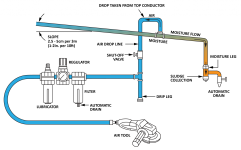
I’m not very different from that setup, all the functions in that system are present in mine as far as I can tell. WIth the exception of “sludge” collection. In my system, that will just collect in the main riser.
 
To avoid these ads, REGISTER NOW!

FTG-05

Well-known member
Joined
Oct 11, 2012
Messages
1,543
Location
TN
I have two of them. You can see one pictured on my manifold if you squint a little.

They are great. They are also not very durable, but they are a great design and I really like them especially for ease of insertion. Mine personally have held up ok, but I don’t slam on them on the ground and treat them as the fragile aluminum pieces they are. Others have had much worse luck.


The only reason I stuck with the Prevost instead of just replacing a Merlin on a fix-as-fail-basis is that new system allows much lower line pressure and acceptable insertion force. It’s really only excessive at 120psi or so, where it’s well over 25#.

I keep the Merlins handy. Heck, I might grab the “real” Milton version of it at my local RK as the have one, although it’s $22 and I’d rather have two Merlins than a single Milton.


Most people know that the Milton V (and Prevost High flow) are basically a european 3/8 body fitting that is offered in 1/4 NPT interfaces.

However, many people do not know that Prevost has a 1/2 body sizer version of the “milton V” style plug. They even sell larger green button couplers that work with these fittings. But they have over 40# insertion force! That’s absolutely nuts!
Thanks to HB, I had no idea those things existed. Never fails: I pressurize my air system, THEN go to unhook/hook something from the end of an air hose and it's like I'm wrestling a greased pig. :ROFLMAO:
 

dscheidt

Well-known member
Joined
Apr 26, 2017
Messages
2,909
So I reached up and felt the riser pipe. And in the instant it took to register that the riser pipe was basically ambient temperature, it hit me: THERMAL MASS.

Thermal mass is the reason the black iron 3/4 pipe is so amazingly effective at condensing out water. Because black pipe in 3/4 has over three times the thermal mass of 3/4 copper. Which means it absorbs a ton more heat without itself rising in temperature.
Essentially all the mechanical energy used by a compressor pump is used to heat up the air. Some of it is rejected into the pump, and into the room from there, but most of it goes into the air. You're basically connecting a X horsepower heater to your air piping. How much heat you dump in depends on your compressors and their duty cycle. In a garage or small shop, the air demand is unlikely to be high enough for long enough to heat the pipes. But that's not a given for a big installation with lots of air. Copper is used for the hot end of air systems because it can reject the heat back to the room much faster than iron does.
 

72Anthony

Well-known member
Joined
May 22, 2010
Messages
296
Location
Houston, TX
I'm sure copper is also used for corrosion resistance. That hot damp air can result in internal corrosion with black iron pipe in high duty cycle environments. I think that's also a reason purpose made aftercoolers are aluminum.
 
OP
H

Hohn

Well-known member
Joined
Aug 25, 2016
Messages
2,701
Location
Diesel Central, Indiana
I'm sure copper is also used for corrosion resistance. That hot damp air can result in internal corrosion with black iron pipe in high duty cycle environments. I think that's also a reason purpose made aftercoolers are aluminum.
At least against water, copper is indeed more corrosion resistant.

Aftercoolers use it more for thermal conductivity than for corrosion resistance.


A key takeaway from this thread is that thermal mass matters more than conductivity. Soaking up the heat from the air is far more effective than trying to conduct it to ambient shop air by using piping. A true heat exchanger is far more effective at conductivity, but I've already shown why a heat exchanger is entirely unnecessary and irrelevant to the moisture content at the ultimate point of use.
 

Yankeefarmer

Well-known member
Joined
Jul 25, 2011
Messages
1,200
Location
Connecticut
….

A key takeaway from this thread is that thermal mass matters more than conductivity. Soaking up the heat from the air is far more effective than trying to conduct it to ambient shop air by using piping. A true heat exchanger is far more effective at conductivity, but I've already shown why a heat exchanger is entirely unnecessary and irrelevant to the moisture content at the ultimate point of use.
The one thing I see missing from all of your posts here is the length of time the air is being used for. Thermal mass in the system is indeed useful for short duration uses. Use the air for a long enough period of time, and you will use up the thermal mass by heating the entire system. I learned that I could get away with a small system if I was only using the air to paint or sandblast for a few minutes, but after 30-40 minutes of sandblasting, moisture would escape the system, and the compressor tank (60 gallon) was too hot to touch.

I solved the problem with a trans cooler heat exchanger between the compressor and the tank. Now the tank doesn’t heat up during long sessions.
 

gte718p

Well-known member
Joined
Mar 12, 2009
Messages
3,977
The one thing I see missing from all of your posts here is the length of time the air is being used for. Thermal mass in the system is indeed useful for short duration uses. Use the air for a long enough period of time, and you will use up the thermal mass by heating the entire system. I learned that I could get away with a small system if I was only using the air to paint or sandblast for a few minutes, but after 30-40 minutes of sandblasting, moisture would escape the system, and the compressor tank (60 gallon) was too hot to touch.

I solved the problem with a trans cooler heat exchanger between the compressor and the tank. Now the tank doesn’t heat up during long sessions.

The other problem sinking heat into the thermal mass of iron piping is it stays there. Once you have saturated the system, the iron is going to hold on to that heat for a long time. Take a short break and thin copper or aluminum will have radiated the heat away and be close to ambient. Black iron will still be hot.
 
OP
H

Hohn

Well-known member
Joined
Aug 25, 2016
Messages
2,701
Location
Diesel Central, Indiana
The one thing I see missing from all of your posts here is the length of time the air is being used for. Thermal mass in the system is indeed useful for short duration uses. Use the air for a long enough period of time, and you will use up the thermal mass by heating the entire system. I learned that I could get away with a small system if I was only using the air to paint or sandblast for a few minutes, but after 30-40 minutes of sandblasting, moisture would escape the system, and the compressor tank (60 gallon) was too hot to touch.

I solved the problem with a trans cooler heat exchanger between the compressor and the tank. Now the tank doesn’t heat up during long sessions.
Exactly true. Heat sinks only work as long as they aren't getting heat soaked. A warm heat sink isn't really working very well.
That's the point where conductivity/cooling matters more than specific heat.

It's possible I could run into an issue in the future if I end up taking advantage of the Champion's much higher output. But I have no room for a blast cab at this point, and I can't imagine what could approach a blast cab for sustained high air usage. It's probably the true acid test of any system.

But the blast cabinet scenario offers an important reframing. The question is now *how long* can I use air before water shows up? Because with continuous high air usage (~20scfm) the pipe will certainly heat saturate at some elevated temperature where it's not an effective condenser.

Some paper calculations suggest that my black pipe riser would heat saturate fairly quickly under sustained blast cabinet usage and that it would cease being an effective condenser.

This gives me an idea to test. I'll plug my blow gun into the drop that's closest to the riser and instead of looking for moisture on a pressure draw down with the pump off, I need to pull the tank down to cut in and see how long before water shows up with the pump continuously running and making heat and water.

My prior test was not valid.

And indeed if you have sustained long duration events, some kind of actual heat exchanger is going to be necessary.

I have blow guns rated from 8 to 40 SCFM so I have an idea for some tests that might reveal the limitations of my system.
 
Last edited:
OP
H

Hohn

Well-known member
Joined
Aug 25, 2016
Messages
2,701
Location
Diesel Central, Indiana
The other problem sinking heat into the thermal mass of iron piping is it stays there. Once you have saturated the system, the iron is going to hold on to that heat for a long time. Take a short break and thin copper or aluminum will have radiated the heat away and be close to ambient. Black iron will still be hot.
It a question of time differences. Obviously they will both eventually cool, it's that the copper cools much faster.

The same heavy thermal mass that makes black pipe an effective heat sink for short blasts also makes it a pretty poor choice for convective cooling once it becomes heat soaked.

There are crossing curves that depend on total heat generation and total air usage. For quick blasts and low duty cycles, the black pipe is quite sufficient. But it wouldn't take many steps in the direction of "serious air usage" to reveal that limitations of that approach once the pipe warms up.
 

MichaelP

Well-known member
Joined
Jul 27, 2009
Messages
952
Location
IL/WI border
Sounds like the OP describes a system which draws air from the tank which was collected there in advance and had plenty of time to cool.

Ever tried touching the line when a tool or tools with a high CFM are drawing air and compressor has to keep up with this? Did you notice that the line is hot closer to the compressor and gets cooler and cooler away from it? What happens to the air moisture in the line when it cools?

Yes, one can measure air temperature and humidity along the line or use his knowledge of physics and math to calculate the length/configuration of line which will cool air sufficiently under the worst circumstances. Naturally, a multitude of parameters and variables will have to be taken into consideration. Or one can use an extra length of line to make it safe based on his previous experience and experience of others. Choose your poison.

And, frankly, I was a bit surprised when I saw use of PEX pipe in a compressed system after all this "overthinking".

I think I'm not ready to call the original post revolutionary or one that breaks stereotypes.
 
Last edited:
OP
H

Hohn

Well-known member
Joined
Aug 25, 2016
Messages
2,701
Location
Diesel Central, Indiana
Here's the experiment I will do to assess the point where my black pipe ceases effectiveness.

1) Pull the compressor down to cut in to get it on and making heat
2) Induce a "known air leak" of the Prevo blow gun which is 8 CFM at 87psi (adjust regulator to 87psi dynamic)
3) Crack the drip leg ball valve supplying the blow gun to check for moisture presence every 60 seconds. Stop experiment when evidence of water at the drip leg shows up.
 

racecougar

Well-known member
Joined
Jan 26, 2021
Messages
5,174
Location
Missouri
I admit that I read this thread days ago and only just re-skimmed it today, but one related topic to consider is the humidity of the air the compressor is pulling in. Particularly for those of us in the humid Midwest this time of year, a compressor located inside a conditioned shop will have far less water to deal with than one located outside in a shed (as is common for space/noise purposes). I noticed a significant reduction in water collected in my tank/traps once I installed air conditioning some years back. Food for thought if anyone is considering placing their compressor outside.
 
OP
H

Hohn

Well-known member
Joined
Aug 25, 2016
Messages
2,701
Location
Diesel Central, Indiana
Sounds like the OP describes a system which draws air from the tank which was collected there in advance and had plenty of time to cool.

Ever tried touching the line when a tool or tools with a high CFM are drawing air and compressor has to keep up with this? Did you notice that the line is hot closer to the compressor and gets cooler and cooler away from it? What happens to the air moisture in the line when it cools?

Yes, one can measure air temperature and humidity along the line or use his knowledge of physics and math to calculate the length/configuration of line which will be sufficient to cool air sufficiently under the worst circumstances. Naturally, a multitude of parameters and variable will have to be taken into consideration. Or one can use an extra length of line to make it safe based on his previous experience and experience of others. Choose your poison.

And, frankly, I was a bit surprised when I saw use of PEX pipe in a compressed system after all this "overthinking".

I think I'm not ready to call the original post revolutionary or one that breaks stereotypes.

No argument there.

Wouldn't be the first time that my being obtuse caused me to experience an epiphany that to others induced side eye or eyerolls.

Edit to add: PEX-b is rated to 160psi at 100f. Since my PEX is only after a 125psi max regulator, I see no reason it wouldn’t be successful when used with pressure limits, temperature limits, and after a coalescing filter.
 
Last edited:
OP
H

Hohn

Well-known member
Joined
Aug 25, 2016
Messages
2,701
Location
Diesel Central, Indiana
I admit that I read this thread days ago and only just re-skimmed it today, but one related topic to consider is the humidity of the air the compressor is pulling in. Particularly for those of us in the humid Midwest this time of year, a compressor located inside a conditioned shop will have far less water to deal with than one located outside in a shed (as is common for space/noise purposes). I noticed a significant reduction in water collected in my tank/traps once I installed air conditioning some years back. Food for thought if anyone is considering placing their compressor outside.
Very good point.

In my particular case, the garage is presently in the mid 90s during the day with atrocious dew points well into the 70s. I wish I had some conditioning in that space, but it's not in the cards for this house or garage.
 
OP
H

Hohn

Well-known member
Joined
Aug 25, 2016
Messages
2,701
Location
Diesel Central, Indiana
Test results:
Busting any consumer duty cycle, I ran my 120V compressor continuously for over 30 min. Used the blow gun to keep it cut in but not drain pressure too low .

At my main point of use, there was never any water. The coalescer was dry, as ever. Zero water in the drip leg.

At the close, unregulated and unfiltered drop, I was able to see water mist in the 15cfm blow gun but not in the 8 cfm gun. I’m not sure when this point would go “wet” because I only checked it after 10 minutes.

The riser does get quite hot, too hot to hold comfortably. But the counter-counter point is that it simply shift the condensation point a bit farther downstream.

There was never any moisture at the main usage point, and never any actual liquid at the super close drop where it would appear first. The observed moisture at the close drop was purely a result of the very high flow and the cooling of the pressure drop. The smaller blow gun never showed any moisture at the close drop, even after 25+ minutes of constant run.

Likewise, no tool if even 28 cfm showed any moisture whatsoever at the point of use, even 25+ minutes into operation.


Conclusion: yes the riser gets warm and loses some effectiveness in prolonged operation. But it never amounts to water that matters, tge system has plenty of reserve condensation and coalescence even on a hot and humid July day.
 
OP
H

Hohn

Well-known member
Joined
Aug 25, 2016
Messages
2,701
Location
Diesel Central, Indiana
Another experiment, this time at much lower air demand and higher average pressure (120psi).

I had water at the close drop in only 2 minutes. No doubt much of that was condensation from a prior test, but it was steady. Not terribly surprising given the pipe distance here is about 12 feet and the pipe was already fairly hot.

The main point of use still never had any water. None in the drip leg. None in the coalescer. None in the manifold.

Not even after 10 minutes consecutive at higher pressure.

I think I’ll just add a small FRL to that close drop to catch the water there and we’ll be fine.
 

NUTTSGT

Super Moderator
Staff member
Joined
Sep 14, 2009
Messages
51,098
Location
Northern Central Ohio
I admit that I read this thread days ago and only just re-skimmed it today, but one related topic to consider is the humidity of the air the compressor is pulling in. Particularly for those of us in the humid Midwest this time of year, a compressor located inside a conditioned shop will have far less water to deal with than one located outside in a shed (as is common for space/noise purposes). I noticed a significant reduction in water collected in my tank/traps once I installed air conditioning some years back. Food for thought if anyone is considering placing their compressor outside.
This is what I was reading through the thread to add. . . the relative humidity of where you're pulling the air from.


The simple act of compressing the air will make it hot or "warm" it.

Got a really good (precision) gauge on your tank ? Drain it completely and let the compressor run till it shuts off. Note the actual pressure and again, once the tank has cooled back down to room temp. It should drop a few psi, amount will probably depend on size of tank and PSI shut off at.


This thread remind me to bring my nitrous scale in and do a before/after on a scba bottle after filling.
 

engineer2

Well-known member
Joined
Dec 13, 2009
Messages
11,824
Location
Chicago burbs
Off the top of my head: if your ambient RH is below around 35%, 120 psig compressed air will be below saturation. In other words, if you live in an arid desert an aftercooler or air dryer isn't going to collect any water.
In our humid climate your compressed air will be saturated with water, but you usually can't see it downstream. Much of it collects in the tank or piping.
 

matt_i

Well-known member
Joined
Mar 14, 2008
Messages
10,741
Location
SE Michigan
I chose copper because I'll never have rusty fines in the system, and it will not ever leak at a sweat-soldered joint. No beaten up drywall from horsing on pipe wrenches. I hoarded up the copper a really long time ago before the prices got wack.
 

OccupantRJ

Well-known member
Joined
May 15, 2009
Messages
11,222
Location
Eastern North Carolina
I have had the iron piping system in use for 16 years and regularly blast for 30 minutes to an hour at a time with no water issue. The compressor is in a drywalled and insulated backroom that is 8x20x8 and the room gets hot enough that I have a 6” thermostat controlled through the wall vent fan to **** heat out of the room after it reaches 90 degrees in there. Sometimes during long sessions a squirrel cage fan get placed to blow on the compressor to assist cooling the unit.
 
To avoid these ads, REGISTER NOW!
Top Bottom