To avoid these ads, REGISTER NOW!

How come common metric sets only go to 19mm but common sae sets run to 1” which would be 25mm?

Nobody-named-Olli

Well-known member
Joined
Jan 9, 2025
Messages
1,620
Location
North Rhine-Westphalia; Germany
@Nobody-named-Olli , I always wondered about this: above you mention 1/2" socket set with metric sized sockets......so the ratchet and extensions are 1/2" as expected. Was this drive size referred to as 1/2" in Europe or ? and same for 1/4", 3/8", 3/4" drives?

Was there ever a true metric sized drive in place?

I was born in ‘86 and haven’t known it any other way. The core drive systems have always been 1/4”, 3/8”, 1/2”, (…).

Some manufacturers, especially Hazet, Gedore come to mind here, do use a form of dual description in their catalogs: 6.3 and 1/4”, 10 and 3/8”, 12.5 and 1/2”, (…).

I’ve never heard anyone actually use the metric equivalents when referring to a drive system.

IMG_0076.jpeg

IMG_0077.jpeg


Certain pipes, fittings, hoses are referred to in their imperial measurements as well. It’s kind of natural/ just the way it is.

Kind regards,
Olli
 
To avoid these ads, REGISTER NOW!

f121

Well-known member
Joined
Dec 8, 2018
Messages
2,078
Location
UK
So if you live in ”metric world” & have a no-skip 10-19 set that will do more than “Joe Average” ever needs. And again, is much more likely to add 8 & 7 to that before anything else. And maybe if “our” “Joe Average” is an avid DIYer he goes for an additional 22 for M14 connection found on tools like mixers, angle grinders, wheel barrow axles. (…)
Working on a lot of larger German sedans (a6/5 series etc), the larger sizes are necessary for suspension fasteners. I think the 21, 22, 24 get the most use, although I’m sure 23 comes out to play occasionally.

This may have changed on the newer sedans, I haven’t yet seen anything past 2018 in that category, although obviously all the SUVs have big suspension fasteners and we see a lot of them.
 

RobBob21

Member
Joined
Jun 17, 2026
Messages
19
Location
Kansas
The only large metric fasteners I have seen over here are on big European made farm equipment. Like Claas silage choppers and the new Fendt tractors I have seen popping up. I am not sure if the bigger sizes are metric or SAE still on the new domestic made equipment, the little bolts are all metric now.
 
OP
M

mikey03

Well-known member
Joined
May 17, 2024
Messages
2,136
@Nobody-named-Olli , I always wondered about this: above you mention 1/2" socket set with metric sized sockets......so the ratchet and extensions are 1/2" as expected. Was this drive size referred to as 1/2" in Europe or ? and same for 1/4", 3/8", 3/4" drives?

Was there ever a true metric sized drive in place?
I bet they call them 12.7mm but the real question isn’t what the tool companies call them but what nickname do regular tool people use.
 

Nobody-named-Olli

Well-known member
Joined
Jan 9, 2025
Messages
1,620
Location
North Rhine-Westphalia; Germany
Working on a lot of larger German sedans (a6/5 series etc), the larger sizes are necessary for suspension fasteners. I think the 21, 22, 24 get the most use, although I’m sure 23 comes out to play occasionally.

This may have changed on the newer sedans, I haven’t yet seen anything past 2018 in that category, although obviously all the SUVs have big suspension fasteners and we see a lot of them.

No argument there, if you need them - you need them. My sets exceed 19 by far as well and go well below 10, but I was trying to keep it related/ specific to that very basic set a 10-19 is, as Mikey was questioning why many sets don’t come with larger sizes - unless it’s a specific set that covers more than basics. :)

you always make good posts @Nobody-named-Olli. Between you and dave you make us all look bad with your picture game 😍

but now I just got to know what this triangular tool is that looks like it has three socket ends or are they fixed

It’s a leftover tool from my childhood and was part of the tool pouch I had on my bicycles over the years. It’s a Y shaped, three way socket wrench with 3 fixed sockets: 8, 10, 12. It has lost its cushioned/plasti dip grip.

Similar tool: https://www.parktool.com/en-us/product/3-way-socket-wrench-st-3?category=General+Shop+Tools

These Y shaped three way wrenches exist in multiple configurations (hex, 1/4” drive, …) and you’ll typically find them in the bicycle aisle at a DIY/ big box store here.

Nothing to write home about, but I used it a few times as a kid and it’s one of the few tools that “survived” from that time. It’s earned it’s keep and sits in the toolbox for sentimental reasons only.

IMG_0078.jpeg


Kind regards,
Olli
 

john.k

Well-known member
Joined
Jun 4, 2024
Messages
1,155
Atlas Copco tried to launch 5/8 (16mm) squar drive to replace both 1/2 and 3/4 small sizes .......socket sets ,sockets , drives,rattle guns and industrial drives ........you still see odd 5/8 tools around,especially the A/C 5/8 air impacts.
 

Ultradog MN

Well-known member
Joined
Jan 20, 2024
Messages
780
Location
Twin Cities
When you see common sets of tools be it wrenches be it sockets be it whatnot, the metric sizes always include 10 to 19mm and the SAE sometimes stop at 3/4” which is the approximation of 19mm but more oft than not they run to 1”

So leads me to wonder what causes this and I came up with thoughts

maybe metric hardware uses smaller head to body ratio so a metric bolt with a 19mm head is about the same diameter bolt as a 1” sae head. I doubt this but it’s easy to confirm or dispute. I’d honestly assume the same head to body ratio.

could be sae is older cars primarily and older cars used bigger hardware with bigger bolts and cars got smaller over time and used smaller bolts so a newer car only uses up to 19mm heads on most things whereas older cars might run up to 1” heads for the same components. Of course on modern cars you got fastener bigger than 19 head but I mean like for the same component like engine bay mostly caps at 19mm heads

could be because metric don’t really use 20, or 22 or 23 as oft then to run 10 to 24 as your set introduces 3 wasted sizes whereas to run in 1/16 to 1” don’t waste since all sizes are used. And 25 is closest to 1” but that’s not used either

could be tools have gotten more expensive since the old days of sae so a 10 to 19 set today costs about the same adjusted for inflation as 3/8 to 1” back in the days so its like making the bag of potato chips smaller for the same price rather than raise the price. They made the tool set smaller and honestly people don’t miss it as much they can add in singles of 21 and 24 and be good.

So anyways I know that you can buy no skip sets from 10 to 24 but is most common to see sets like 3/8” to 1” and 10mm to 19mm and I’m wondering the reason.
SAE tools work off a different metric.
 

Winterborne

Active member
Joined
Dec 3, 2025
Messages
31
For any professional in “metric world” 10-19 covers the most basic needs - complete no brainer to have those sizes.

Kind regards,
Olli
An excellent post laying out the three metric standards.

I wanted to add my personal experience when I was in industrial working on machinery made in Holland. All the fasteners were DIN and M5 hex head cap screws were prevalent throughout (8mm wrench/socket). You mentioned at the beginning of your post that you would add 8 before 22-24 > excellent advice. On the Holland machinery there was only one use for the 22 (mounting bolts on a high torque reduction gearbox), and none for the 24 that I recall.

If you look at McMaster-Carr, the metric hardware is DIN based as well.
 
To avoid these ads, REGISTER NOW!

steve855

Well-known member
Joined
Dec 30, 2019
Messages
65
Location
PA
At one of the popular tool store websites here in Europe, the best selling metric wrench sets go up to these sizes:
  1. 24mm
  2. 32
  3. 22
  4. 24
  5. 41
  6. 32
  7. 19
  8. 22
  9. 19
  10. 34
edit - to be clear, those numbers are the largest sizes in each of the top 10 selling sets. For example, the top selling set ends at 24mm, the 2nd best seller ends at 32mm.
 

NoahG

Well-known member
Joined
Feb 24, 2013
Messages
1,060
Location
Detroit, MI
Even tho 15/16” is far more useful in 1/2dr, I still get annoyed when a 3/8dr set stops at 7/8”.

I wish sets skipped 1" and included 1-1/16" instead.
Give this man an award
It's true I can't even remember the last time I used 1" either. 5/8 bolt is usually 15/16 drive size. 3/4 jumps to 1-1/8.
I have used 1” for exactly two purposes:
-The draw bolt on Greenlee knock-out punches (6pt std. chrome)
-lug nuts on a NASCAR. (6pt deep impact)
 

KnurledNut

Well-known member
Joined
Jan 28, 2011
Messages
8,165
Location
n/a
I have used 1” for exactly two purposes:
-The draw bolt on Greenlee knock-out punches (6pt std. chrome)

Same. I have a dedicated long pattern ratcheting wrench in my set.

55373472250_e9356796f3_b.jpg

Greenlee includes one in some of their sets. I've handled this version and its really comfortable.

1783135713647.png

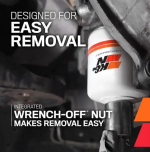
I also use 1" on K&N oil filters with the integrated nut.

1783135944828.png
 
  • Like
Reactions: LWB

Hohn

Well-known member
Joined
Aug 25, 2016
Messages
2,683
Location
Diesel Central, Indiana
Yea but I’m not talking about increments I’m talking about max size of 19mm versus 1 inch as the stopping point

but your point could be there’s more mm tools since the increment size is smaller so they don’t want to sell more expensive sets of more pieces to run to 24mm

Metric sets I think in general have fewer skips. There are very few metric sizes that generally just aren’t used.

ANSI, JIS or DIN uses every metric hex size from 10-19mm (although, as mentioned, 11mm is rare and DIN-only).

Only after 19mm, you get skips in 20 and 23mm.

And anything M16 or bigger is frankly quite rare in any automotive application, so stopping at 19mm makes a lot of sense.
 

dnschmidt

Well-known member
Joined
Oct 3, 2014
Messages
7,284
Location
Phoenix, AZ
The reason is not complicated. Cars have gotten smaller and so have the fasteners that hold them together. In the old days 1/2" and 9/16 inch wrenches would take apart most Chevrolets. Today 8, 10, 12, 14 and 17mm will disassemble everything on a Toyota with the occasional 24mm thrown into the mix for drain plugs on transmissions. It's called evolution.
 

AEAdam

Well-known member
Joined
May 27, 2023
Messages
2,780
Location
SE PA
Metric sets I think in general have fewer skips. There are very few metric sizes that generally just aren’t used.

ANSI, JIS or DIN uses every metric hex size from 10-19mm (although, as mentioned, 11mm is rare and DIN-only).

Only after 19mm, you get skips in 20 and 23mm.

And anything M16 or bigger is frankly quite rare in any automotive application, so stopping at 19mm makes a lot of sense.
All true, but it depends on how you look at it. When you look at an ANSI, PRE ASME, PRE ISO std, there are skips, exactly like JIS, or DIN have. They are single stds and simply do not use every size.

If we had a trade embargo against Japanese cars for example, it’s very possible US tool companies would have skipped 12&14mm tools. Thinking back, pretty sure I had craftsman sets that skipped either 16, 18mm or both. They weren’t part of any stds then that anyone in the US knew about.

If you read the specs, which I’m sure @Hohn has, you find a graph where for a given steel, they graph the tensile capability versus the contact pressure under the head. As you torque the fastener, stress in the bolt stretches it between the reaction in the threads and the surface contact under the head. If the head is small, you could compress (yield) the surface under the head. Especially for a bolt clamping up aluminum. A larger head could react more load without damaging the surface it’s clamping against.

Some design philosophies, Japanese for example, want to design an engine that never ever needs service. The idea of damaging a component during service Is FAR outweighed by the cost and weight of larger headed fasteners. Note, head size doesn’t just effect the weight of the fastener, but also the component it’s attaching. The German std is the opposite.

Since it’s the thread and not the head that establishes the torque reqt, the larger German heads have the advantage of reducing stress inside the wrench or socket which makes the fastener harder to damage.

The newer ISO std found a sweet spot between the two poles, JIS having small heads, DIN having larger ones.

Not a criticism, but I sometimes get the impression people think fastener heads are chosen by random selection, or car manufacturers choose heads to make repairs more difficult. Neither is true.
 
OP
M

mikey03

Well-known member
Joined
May 17, 2024
Messages
2,136
Some design philosophies, Japanese for example, want to design an engine that never ever needs service. The idea of damaging a component during service Is FAR outweighed by the cost and weight of larger headed fasteners. Note, head size doesn’t just effect the weight of the fastener, but also the component it’s attaching. The German std is the opposite.

Since it’s the thread and not the head that establishes the torque reqt, the larger German heads have the advantage of reducing stress inside the wrench or socket which makes the fastener harder to damage.

The newer ISO std found a sweet spot between the two poles, JIS having small heads, DIN having larger ones.
can you please explain this more? Or honestly see if I understand

Japan is saying “don’t take our engines apart, they never need servicing” and are using smaller fasteners because Smaller ones are lighter, so cheaper and better gas mileage but the trade off is smaller fasteners are more likely to break if you take the engine apart?
 

dnschmidt

Well-known member
Joined
Oct 3, 2014
Messages
7,284
Location
Phoenix, AZ
can you please explain this more? Or honestly see if I understand

Japan is saying “don’t take our engines apart, they never need servicing” and are using smaller fasteners because Smaller ones are lighter, so cheaper and better gas mileage but the trade off is smaller fasteners are more likely to break if you take the engine apart?
I doubt that's the message. What you now find is 15 10mm bolts holding something together rather than six 9/16" bolts. This tons of little bolts rather than a couple of big ones is simply the Japanese philosophy.
 

AEAdam

Well-known member
Joined
May 27, 2023
Messages
2,780
Location
SE PA
I doubt that's the message. What you now find is 15 10mm bolts holding something together rather than six 9/16" bolts. This tons of little bolts rather than a couple of big ones is simply the Japanese philosophy.
Kinda. Look at something like a valve cover or an oil pan. Picture a baking pan with a flange around it, drilled to mate with another surface. For any given thread size, take M8 say, the Japanese fastener head is smaller, so the counterbore for the fastener head, or the width of the flange, is closer to the sides of the pan, which makes the pan lighter, because don't have to take as much bending across the mating flange.

So why don't they just use 100 3/16" fasteners? Because of the cost of the fasteners and the time required to install them in the factory.

When you look at something like M10 thread, the German head is a 17mm while the Japanese head is 14mm. That's a pretty big difference. The ISO std compromised and used a 15 or 16mm for that sized fastener.

Really wish someone would make this chart sticky.

Bolt Head Stds.jpg

can you please explain this more? Or honestly see if I understand

Japan is saying “don’t take our engines apart, they never need servicing” and are using smaller fasteners because Smaller ones are lighter, so cheaper and better gas mileage but the trade off is smaller fasteners are more likely to break if you take the engine apart?
Some of this is a bit dated, but back in the day, Japan was pushing to have spark plugs that could survive the life of the vehicle (for example). So they felt they could (and sometimes did) bury them.

German cars USED to be built to be repaired, such that they could run forever. Some German engines were extremely over designed. The old VW/AUDI 1.8L 4 cylinder was one such engine. Some were sleeved so they could be renewed cost effectively. Sad to say modern German engines are messing around with stuff like Aluma-sil and other bore coatings that can go bad and total the vehicle. And that's just the start of it. Volvo was the same or in some ways better than German cars. People, some here, collect Volvos and restore them. Like old Land Rovers.

Even interiors were once designed to come apart with actual metal fasteners. Now they are held together with near one time use plastic rivets. They were cheap and easy for the factory but not great for us.

The design philosphy is to get cars to be more like microwave ovens. It's an appliance that runs until it doesn't. Then you throw it away and get a new one. We're also moving toward cars as a common shared resource, where you are basically just renting it. Leases are like that.
 
To avoid these ads, REGISTER NOW!
Top Bottom