To avoid these ads, REGISTER NOW!

The VISES of Garage Journal

Lump

Well-known member
Joined
Mar 16, 2009
Messages
3,406
Location
Jamestown, Ohio
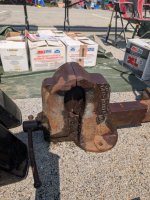
While running my automotive swap meet today, I saw a very large, old bench vise. When I entered the seller's booth to check it out, I learned that it is a Charles Parker No. 289-1/2. It's really big....especially TALL! Jaws are 6" wide, but the whole unit is 14" tall. Anyone know what specific duty this vise was intended for?

Seller wants $700.00. I have no idea what it might be worth, but I figured that number is too high. I've shared some photos here, and would appreciate input from the Vise Experts of Garage Journal. Thanks in advance.
 

Attachments

  • PXL_20260904_172357120.jpg
    PXL_20260904_172357120.jpg
    888.1 KB · Views: 105
  • PXL_20260904_172417687.jpg
    PXL_20260904_172417687.jpg
    594.7 KB · Views: 75
  • PXL_20260904_171853878.jpg
    PXL_20260904_171853878.jpg
    1.1 MB · Views: 65
  • PXL_20260904_171905834.jpg
    PXL_20260904_171905834.jpg
    1.1 MB · Views: 84
To avoid these ads, REGISTER NOW!

micahd1997

Well-known member
Joined
Apr 27, 2022
Messages
281
and I'm aware of what 'assume' makes me. I'll look more into Lewis vises to see if 'replaceable faces' are mentioned.
:LOL: well at some point, assumptions are the best we can hope for without concrete evidence; I'm certainly not above that myself. My personal assumption/theory is that neither the Lewis Tool Company nor the Prentiss Vise Company (Mortimer G Lewis was a shareholder for both companies for the duration of the companies' lives, until his passing in 1915) incorporated removable jaws for any of their vises until around the time of Charles Darwin Bingham's removable jaw patent #994,240 in 1911 (filed in December, 1910). Prentiss' 1910 re-issue of their catalog No 49 (issued late that year) was their first catalog to ever mention or depict removable jaws. Beginning with Prentiss' 1902 catalog, they began including Lewis' vises (despite Lewis having issued their own catalog dating as far back as 1896, though they were incorporated in 1894). Aside from never having seen a Lewis vise with removable jaws, I've also never seen a catalog depiction of a Lewis vise with removable jaws. Prentiss continued advertising Lewis' vises until their 1917 catalog, but they finally discontinued the line in early 1919. Despite updating the visual advertisements for their own vises to depict removable jaws AND even giving the Lewis vise advertisements a refresh in the 1917 catalog, they still didn't depict the Lewis vises with removable jaws. Hope that helps!
Looking back at Mortimer Lewis' vise patents shows that he had swivel jaws from early on. The first two from 1883 and 1884 were for FRONT jaw swivelers and one of them used the commonly missing or stuck Tapered Pin. The swivel lock on the 1883 patent was on the side of the jaw not the rear. The 1905 patent was given to C Hanimann but assigned to Lewis and the swivel lock was located at the rear of the jaw.
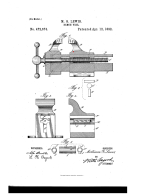
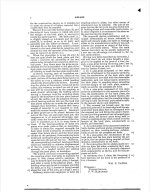
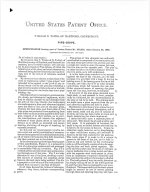
Thanks for sharing those pictures! Beautiful illustrations. I personally don't think I've ever seen a surviving example of either of Mortimer's 1883 or 1884 patents (assuming they were ever actually placed into production). The patents that I believe would apply to @Shiftless vise would be Mortimer's Jan 5, 1892 (#466,466) and Apr 12, 1892 (#472,674) patents (see pictures). The Jan 5th patent specifically includes the swivel jaw locking pin. Given that @Shiftless vise bears the "Lewis Tool Co" name, the company was incorporated in 1894, and the swivel jaw pin patent was issued in 1892, my only reasonable explanation is that it was a mistake from the factory somehow. But it does have me scratching my head a little.

1788614927401.png1788614952560.png
michad: While searching for swivel lock mechanisms, I discovered this 1841 patent of William Sim. In the final paragraph, he talks about casting steel faces into the iron jaws.
Very cool! I wonder if this was the very first suggestion of casting a jaw type of different material into the vise itself?
 

micahd1997

Well-known member
Joined
Apr 27, 2022
Messages
281
@Shiftless Literal seconds after making my post above, I went back to take a closer look at some of the pictures you posted. I don't think you referenced this in your post (so this may be an exciting discovery for you...), but I noticed the remnants of a "PATD APR..." stamp on the slide of your Lewis, which should be a reference to Mortimer's April 12, 1892 patent I shared a picture of above. Pretty neat! I'd be interested in closer pictures if you can discern any other markings.
1788615139350.png
 

Shiftless

Well-known member
Joined
Mar 9, 2014
Messages
14,928
Location
East Bay SFO
…but I noticed the remnants of a "PATD APR..." stamp on the slide of your Lewis, which should be a reference to Mortimer's April 12, 1892 patent I shared a picture of above. Pretty neat! I'd be interested in closer pictures if you can discern any other markings.
THANKS!
I never noticed that before. That pic might be the best view but I’ll try some different lighting angles to see if more stamped lettering shows up. That poor old vise has seen some rough duty over the years.
 

micahd1997

Well-known member
Joined
Apr 27, 2022
Messages
281
Friends, I’m thrilled to introduce you to the one and only Mortimer G Lewis, co-founder of the Prentiss Vise Company, president of the Lewis Tool Company, and recipient of an astounding 23 patents (16 of them vise-related) during his lifetime. I’ve searched for nearly four years to find any surviving picture of Mr. Lewis. At this time, I believe this to be the only known photograph of him.

Mortimer Garwood Lewis was born in Derby, CT on October 3rd, 1834 to Garwood and Sarah Lewis during the last term of our 7th president, Andrew Jackson, 24 years before the American Civil War, and 30 years before the birth of Laura Ingalls. He married Maria Bower Mulford in his late 20s, and by the age of 31 in 1865 was living in Havana, NY with Maria and their 3 year-old daughter, Jessie (pictured). Mortimer and Maria also bore a son named Elmer Paul Lewis several years later in 1874. It was around this time (judging by the age of Mortimer’s daughter, Jessie, in the picture) that this photograph was taken.

Several years later, lumber dealer, James F Hall, moved to Havana in 1876 to partner with longtime resident, Elbert P Cook, in the earliest-documented manufacture of Mason Prentiss’ patented vise. It’s unclear exactly why, but Mortimer G Lewis and his brother-in-law, civil war General John E Mulford, took an interest in the operation and purchased the interest of Elbert P Cook only a year later in 1877. From there, the business expanded quickly. They incorporated as the Hall Manufacturing Company that same year, moved the operation to New York City in 1878, and finally rebranded as the Prentiss Vise Company in 1881. Mortimer proceeded to issue at least 16 separate vise-related patents over the next 23 years. It was on the backs of several of these patents that he incorporated the Lewis Tool Company in 1894 (once again, alongside his brother-in-law, John E Mulford) under which to manufacture his own line of vises. However, despite what appeared to be a successful 13 year run, the Lewis Tool Company dissolved and the Prentiss Vise Company ultimately assumed ownership and production of Lewis’s vises around 1906. It was at this time that Mortimer (now 69) apparently retired and moved with his wife, Maria, to Alassio, Italy. It was here that he ultimately passed away on June 29th, 1915 at the age of 80. We learn from one of his passports just two years prior that he had brown eyes and stood 5’ 10 ½” tall.
 

Attachments

  • IMG_9309.jpeg
    IMG_9309.jpeg
    290.3 KB · Views: 67
  • IMG_9307.jpeg
    IMG_9307.jpeg
    296 KB · Views: 61

Shiftless

Well-known member
Joined
Mar 9, 2014
Messages
14,928
Location
East Bay SFO
Shiftless: I suspect that you're old enough to know what the black triangles at the corners of the photo represent.
Absolutely. Those are little paper adhesive holders where the corners of a photo slip in so that the photo is held in place there in a photo album.
Adding those to your image was a very nice artistic touch. 🍻
 
Last edited:
To avoid these ads, REGISTER NOW!

1Bad55Chevy

Well-known member
Joined
Feb 20, 2025
Messages
721
So I tried taking my Wilton apart today and failed. I tried to drive the spindle nut pins out and that wasn't happening. On one side the pin was SOLID in the casting, on the other it came out with a punch and a hammer. Now as you can see in the picture i drove the pin from the 12 o'clock position down and it hit the lower pin to only move it slightly. In the process of doing this somehow the nut has spun in the casting. I am not sure what to do next besides drill the old retaining pin out so the spindle nut can be removed.
20260908_164023.jpg
 

1Bad55Chevy

Well-known member
Joined
Feb 20, 2025
Messages
721
If the nut is spinning, it should drive out?

No its not spinning but there is slack left to right but it wont twist back far enough to align the pin back to the 12 o'clock position. I don't understand how the nut could even twist unless the other pin was bent. If you zoom in on the picture you can see the pin at the bottom is knocked out about 3/16".

Another thing is there is zero rust on the vise.
 

1Bad55Chevy

Well-known member
Joined
Feb 20, 2025
Messages
721
If it was me I would have cleaned it up a bit to be able to see what I was working on.

Just me two cents.
You would have cleaned it before taking the dust cap off it?

The pins are accessed from the out side, so I just wiped it off and saw where to hit it. Every vise tear down i have seen knocks the pins out dirty then cleans everything after disassembled. Am I doing it wrong?
 

Jayman17

Well-known member
Joined
Feb 6, 2017
Messages
3,849
Location
Seattle, Wa
I've seen a video somewhere where a guy removes those pins from the inside towards the outside, isn't one end of those pins splined?
Aren't they also too long to be punched inward?
 

micahd1997

Well-known member
Joined
Apr 27, 2022
Messages
281
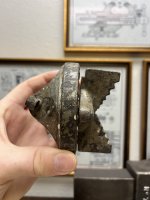
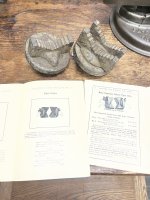
I wanted to share a few pictures and some information on these Athol pipe jaws I received recently. They (and attachments like them) could be considered “less glamorous” than the vises themselves, but nonetheless I find them interesting.

This is a set of either № 15 or № 16 Athol pipe jaws. No examples of these jaws that I’ve ever seen bear the catalog model numbers, which makes the size a little difficult to identify. Based on the fact that the they loosely fit the 4” vise pictured and snugly fit a different 4.5” vise (not pictured), I lean towards a № 15, but I’ll have to try them on a couple of my 6” vises first.

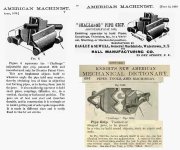
The design was a culmination of the following three patents:
• #211,993: James F Hall of Havana, NY on February 4, 1879
• #231,181: Mortimer G Lewis of Lowville, NY on August 17, 1880
• #252,632: William B Tatro of Hartford, CT on January 24, 1882 (patent picture below)

The pipe jaws experienced evolutions in design with each patent listed above, but from the very beginning, the design was one assigned to and manufactured by the Prentiss Vise Company as their “Peerless Swivel Pipe Jaws). By 1891, the design’s evolution had streamlined into the model represented below. As of yet, no identified examples of the earlier variations have been found.

As the saying goes “imitation is the highest form of flattery”. I imagine the Prentiss Vise Company would have something to say about that (and they did…), but the Athol Machine & Foundry Co eventually copied the design and began manufacturing it themselves (likely after the patents began expiring around the turn of the century). You might say, “well how do you know that Prentiss wasn’t simply manufacturing these jaws for Athol and branding them with Athol’s name”? I’m very glad you asked. Beginning with Prentiss’s 1902 Catalog X, the company places a NOTICE on the second page of the catalog that states, “We desire to call attention of our patrons to the fact that our goods are imitated, in an inferior manner, by some unscrupulous manufacturers. We do not expect to provide all the vises used, but we do ask that when you honor us by ordering a Prentiss Vise, or other vises of our manufacture, you will see that your dealer supplies a vise bearing our name (or the name under which it is catalogued in this price-list), which is conspicuously shown on every vise we make.” Other companies (Columbian, Reed, Barrett, and Yost, to name a few) are also suspected of copying Prentiss’s vise designs around this time. While no company is specifically mentioned in this notice, I find it hard to believe that Prentiss would be in bed with any of these manufacturers behind the scenes while simultaneously calling them “unscrupulous manufacturers” to their patrons. This leads me to believe that Prentiss was not manufacturing and rebranding goods for other manufacturers, but that those other manufacturers were simply copying Prentiss’s goods.

Ultimately, I would love to acquire a pair of Prentiss jaws so that I can compare them. I hope this has been an interesting, Friday morning read. Have a great weekend!
 

Attachments

  • IMG_9452.jpeg
    IMG_9452.jpeg
    474.9 KB · Views: 16
  • IMG_9451.jpeg
    IMG_9451.jpeg
    431.4 KB · Views: 21
  • IMG_9450.jpeg
    IMG_9450.jpeg
    164.3 KB · Views: 21
  • IMG_9449.jpeg
    IMG_9449.jpeg
    576 KB · Views: 21
  • IMG_9448.jpeg
    IMG_9448.jpeg
    517.9 KB · Views: 21
  • IMG_9447.jpeg
    IMG_9447.jpeg
    563.9 KB · Views: 20
  • IMG_9446.jpeg
    IMG_9446.jpeg
    891.4 KB · Views: 20
  • IMG_9445.jpeg
    IMG_9445.jpeg
    884.5 KB · Views: 19
  • IMG_9444.jpeg
    IMG_9444.jpeg
    902.2 KB · Views: 18
  • IMG_9443.jpeg
    IMG_9443.jpeg
    1 MB · Views: 25

jawstight

Well-known member
Joined
Feb 10, 2025
Messages
158
You would have cleaned it before taking the dust cap off it?

The pins are accessed from the out side, so I just wiped it off and saw where to hit it. Every vise tear down i have seen knocks the pins out dirty then cleans everything after disassembled. Am I doing it wrong?
The pins on these vices are not necessarily in line with each other to the point where it's a straight shot from one side to the other. At this point cleaning it up will allow you to see exactly what is going on with your example. If you don't you're only really guessing at what is there. That's what @ChefRex was trying to pass along.
There are ways to drive the pin out from the inside, if you're clever. And cleaning it will likely show you what's preventing the collar from moving back into its original and proper position.
 

SRU1436

ALLIANCE MEMBER
Joined
Apr 1, 2017
Messages
599
Location
Bay Area, CA
I wanted to share a few pictures and some information on these Athol pipe jaws I received recently. They (and attachments like them) could be considered “less glamorous” than the vises themselves, but nonetheless I find them interesting.

This is a set of either № 15 or № 16 Athol pipe jaws. No examples of these jaws that I’ve ever seen bear the catalog model numbers, which makes the size a little difficult to identify. Based on the fact that the they loosely fit the 4” vise pictured and snugly fit a different 4.5” vise (not pictured), I lean towards a № 15, but I’ll have to try them on a couple of my 6” vises first.

The design was a culmination of the following three patents:
• #211,993: James F Hall of Havana, NY on February 4, 1879
• #231,181: Mortimer G Lewis of Lowville, NY on August 17, 1880
• #252,632: William B Tatro of Hartford, CT on January 24, 1882 (patent picture below)

The pipe jaws experienced evolutions in design with each patent listed above, but from the very beginning, the design was one assigned to and manufactured by the Prentiss Vise Company as their “Peerless Swivel Pipe Jaws). By 1891, the design’s evolution had streamlined into the model represented below. As of yet, no identified examples of the earlier variations have been found.

As the saying goes “imitation is the highest form of flattery”. I imagine the Prentiss Vise Company would have something to say about that (and they did…), but the Athol Machine & Foundry Co eventually copied the design and began manufacturing it themselves (likely after the patents began expiring around the turn of the century). You might say, “well how do you know that Prentiss wasn’t simply manufacturing these jaws for Athol and branding them with Athol’s name”? I’m very glad you asked. Beginning with Prentiss’s 1902 Catalog X, the company places a NOTICE on the second page of the catalog that states, “We desire to call attention of our patrons to the fact that our goods are imitated, in an inferior manner, by some unscrupulous manufacturers. We do not expect to provide all the vises used, but we do ask that when you honor us by ordering a Prentiss Vise, or other vises of our manufacture, you will see that your dealer supplies a vise bearing our name (or the name under which it is catalogued in this price-list), which is conspicuously shown on every vise we make.” Other companies (Columbian, Reed, Barrett, and Yost, to name a few) are also suspected of copying Prentiss’s vise designs around this time. While no company is specifically mentioned in this notice, I find it hard to believe that Prentiss would be in bed with any of these manufacturers behind the scenes while simultaneously calling them “unscrupulous manufacturers” to their patrons. This leads me to believe that Prentiss was not manufacturing and rebranding goods for other manufacturers, but that those other manufacturers were simply copying Prentiss’s goods.

Ultimately, I would love to acquire a pair of Prentiss jaws so that I can compare them. I hope this has been an interesting, Friday morning read. Have a great weekend!

Those are interesting and cool.
 

Shiftless

Well-known member
Joined
Mar 9, 2014
Messages
14,928
Location
East Bay SFO
Interesting delve into the history of pipe jaws.

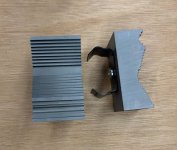
In my rather limited experience of working with pipe, I will say that the pipe jaws of the modern Wilton C series combination vises are the best I know of. They snap in and out of square recesses in the jaw towers. Those black bent straps seen here are spring steel.

1F7216E6-3DB9-4C90-A74B-0578B9F708F3.jpegE644BF63-3873-48DC-972D-EDD2BE3283E6.jpeg
 

micahd1997

Well-known member
Joined
Apr 27, 2022
Messages
281
michad: I ran into this confusion once before. Here are some 1879 articles about Prentiss' CHALLENGE pipe grips. The patent that is referred to is the 1879 Hall patent you mentioned. What gives? Who was zooming who?
This is one of my personal favorite topics, CRS, and it touches on how the Prentiss Vise Company came to be. Essentially, James F Hall lived in Washington County, NY at the time (1868) that Mason Prentiss patented his vise design. No surviving records are currently known to confirm this (though I’ve been searching for four years now), but I believe that James Hall purchased Mason’s patent from him during the next several years because James moved to Havana, NY in 1876 to partner with a longtime resident of the area, Elbert P Cook, in the earliest-documented manufacture of Mason’s vise. John E Mulford and Mortimer G Lewis (also residents of Havana) purchased Elbert’s interest in the partnership about a year later and incorporated the business as the Hall Manufacturing Company. James Hall stayed on as a shareholder for several more years and even issued a couple other patents (one of which was for the swivel base plunger design that Prentiss used for many years (see picture).
I will say that the pipe jaws of the modern Wilton C series combination vises are the best I know of.
I work very, very rarely with pipe, so that’s good to know. I’d be interested in hearing your/others thoughts on the pros/cons of a pair of Athol or Prentiss jaws. I very likely won’t use them enough to develop much of an opinion on their function
 

Attachments

  • IMG_9455.jpeg
    IMG_9455.jpeg
    192.1 KB · Views: 6
To avoid these ads, REGISTER NOW!
Top Bottom