Friends, I’m thrilled to introduce you to the one and only Mortimer G Lewis, co-founder of the Prentiss Vise Company, president of the Lewis Tool Company, and recipient of an astounding 23 patents (16 of them vise-related) during his lifetime. I’ve searched for nearly four years to find any surviving picture of Mr. Lewis. At this time, I believe this to be the only known photograph of him.
Mortimer Garwood Lewis was born in Derby, CT on October 3rd, 1834 to Garwood and Sarah Lewis during the last term of our 7th president, Andrew Jackson, 24 years before the American Civil War, and 30 years before the birth of Laura Ingalls. He married Maria Bower Mulford in his late 20s, and by the age of 31 in 1865 was living in Havana, NY with Maria and their 3 year-old daughter, Jessie (pictured). Mortimer and Maria also bore a son named Elmer Paul Lewis several years later in 1874. It was around this time (judging by the age of Mortimer’s daughter, Jessie, in the picture) that this photograph was taken.
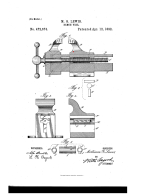
Several years later, lumber dealer, James F Hall, moved to Havana in 1876 to partner with longtime resident, Elbert P Cook, in the earliest-documented manufacture of Mason Prentiss’ patented vise. It’s unclear exactly why, but Mortimer G Lewis and his brother-in-law, civil war General John E Mulford, took an interest in the operation and purchased the interest of Elbert P Cook only a year later in 1877. From there, the business expanded quickly. They incorporated as the Hall Manufacturing Company that same year, moved the operation to New York City in 1878, and finally rebranded as the Prentiss Vise Company in 1881. Mortimer proceeded to issue at least 16 separate vise-related patents over the next 23 years. It was on the backs of several of these patents that he incorporated the Lewis Tool Company in 1894 (once again, alongside his brother-in-law, John E Mulford) under which to manufacture his own line of vises. However, despite what appeared to be a successful 13 year run, the Lewis Tool Company dissolved and the Prentiss Vise Company ultimately assumed ownership and production of Lewis’s vises around 1906. It was at this time that Mortimer (now 69) apparently retired and moved with his wife, Maria, to Alassio, Italy. It was here that he ultimately passed away on June 29th, 1915 at the age of 80. We learn from one of his passports just two years prior that he had brown eyes and stood 5’ 10 ½” tall.


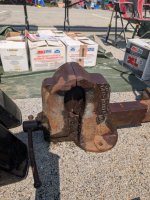


 well at some point, assumptions are the best we can hope for without concrete evidence; I'm certainly not above that myself. My personal assumption/theory is that neither the Lewis Tool Company nor the Prentiss Vise Company (Mortimer G Lewis was a shareholder for both companies for the duration of the companies' lives, until his passing in 1915) incorporated removable jaws for any of their vises until around the time of Charles Darwin Bingham's removable jaw patent #994,240 in 1911 (filed in December, 1910). Prentiss' 1910 re-issue of their catalog No 49 (issued late that year) was their first catalog to ever mention or depict removable jaws. Beginning with Prentiss' 1902 catalog, they began including Lewis' vises (despite Lewis having issued their own catalog dating as far back as 1896, though they were incorporated in 1894). Aside from never having seen a Lewis vise with removable jaws, I've also never seen a catalog depiction of a Lewis vise with removable jaws. Prentiss continued advertising Lewis' vises until their 1917 catalog, but they finally discontinued the line in early 1919. Despite updating the visual advertisements for their own vises to depict removable jaws AND even giving the Lewis vise advertisements a refresh in the 1917 catalog, they still didn't depict the Lewis vises with removable jaws. Hope that helps!