I had some rusty vintage Allen brand hex wrenches so I decided to clean them up. I have tried all the hot and cold phosphating/blackening chemicals and generally use Metal Ready by POR 15 when possible. It's reasonably priced and works well as you can see. Note none of the typical blackening chemicals are true black oxide as that is done >212F. I also have another cold and hot black blackening solution right now in addition to MR and chose to use this because it works so well. And I do not get it for free and am not affiliated with POR 15 in any way.

So, above is what I started with- surface rust with most of the blackening gone
First, gather up the necessary chemicals

Drinks

Metal Ready

Sealer. Don’t cheap out here as this is what gives resistance to corrosion; yeah, I know most people will use WD-40 anyway. The correct sealer is not cheap but, again, this is the majority of the protection, not the actual phosphate process itself. The phosphate conversion process gives a coarse surface for the preservative to stick to, but w/o the proper preservative it’s not going to give the same protection.
Fill a plastic Tupperware style container with Metal Ready. Submerge your objects; the fluid will turn cloudy with the chemical reaction. You want to flip them every hour or so for even coverage. After several hours you will see that the fluid will stop bubbling and turn back to clear/blue; this is when the conversion process is done. Remove the objects, dry with a paper towel, and dip in the rust preventative solution. Let dry on newspaper overnite and then, if necessary, further dry with a rag.

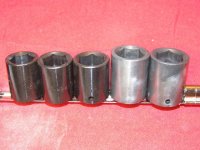
This is what you should end up with. The finish does not wipe off. Different alloys will darken at different rates and sometimes to different shades. Generally the harder the metal the slower to blacken. Some harder alloys may only turn a dark gray.

As you can see the finish is slightly “grainy”. It is not a shiny finish like a “real” black oxide. But, the graininess is what provides the texture for the rust preservative to stick to and gives resistance to corrosion.


So, above is what I started with- surface rust with most of the blackening gone
First, gather up the necessary chemicals
Drinks
Metal Ready
Sealer. Don’t cheap out here as this is what gives resistance to corrosion; yeah, I know most people will use WD-40 anyway. The correct sealer is not cheap but, again, this is the majority of the protection, not the actual phosphate process itself. The phosphate conversion process gives a coarse surface for the preservative to stick to, but w/o the proper preservative it’s not going to give the same protection.
Fill a plastic Tupperware style container with Metal Ready. Submerge your objects; the fluid will turn cloudy with the chemical reaction. You want to flip them every hour or so for even coverage. After several hours you will see that the fluid will stop bubbling and turn back to clear/blue; this is when the conversion process is done. Remove the objects, dry with a paper towel, and dip in the rust preventative solution. Let dry on newspaper overnite and then, if necessary, further dry with a rag.
This is what you should end up with. The finish does not wipe off. Different alloys will darken at different rates and sometimes to different shades. Generally the harder the metal the slower to blacken. Some harder alloys may only turn a dark gray.
As you can see the finish is slightly “grainy”. It is not a shiny finish like a “real” black oxide. But, the graininess is what provides the texture for the rust preservative to stick to and gives resistance to corrosion.