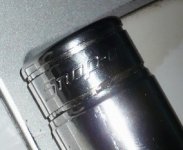
You asked : Ever see a socket do this before?
Sure ....I have see it lots of times , but the socket didn't do it, the person using the socket did.
I understand your a youngster , 16 if I recall ,so you probably haven't had much wrenching experience yet.
Think about what happened , your pulling really hard with a long handle ratchet and the bolt wont move....... but because it is damaged it doesn't fit the socket properly and with enough torque the socket turns around the bolt and slips off causing the damage.
When you abuse a tool you will get damage to it , I understand you weren't intentionally abusing the socket but the end result is the same.
Although the picture is quite poor it appears that the chrome has cracked .
It also looks like the very edge of the center of the flats of the socket where it transitions into the chamfered opening have slightly distorted.
The edge with the worst distortion is the one where it first slipped off the bolt.
I believe your picture makes it look worse than it really is though.
What you did by twisting the bolt around inside the socket was point load the very edge of the flats causing the socket to expand under extreme pressure .
This expansion caused the very thin chrome to crack as one would expect.
With the points of the bolt now at the center of the flats it puts extreme pressure on this small area. (Point loading)
With the edge of the socket flat point loaded at this extreme pressure it can distort the metal as the socket slips off the bolt.
Sockets generally don't slip straight off ,they do more so when used with an impact .
When used by hand the socket slips off the bolt generally in the direction your pushing or pulling the ratchet.
If your pulling in a downward (vertical) motion you will find the greatest distortion to be on the flat that is on top.
This is because the point puts even more pressure on the flat as it comes off on an angle and this causes the point to dig into the flat and distort it even more and force the metal outward.
This type of damage is common when a socket is under pressure and slips off the bolt and in your instance it is quite understandable why it happened.
You sometimes see this type of wear / damage when sockets are used on an impact and slip off the bolt , but the damage is usually pretty even as the socket is spinning rapidly as it happens.
You also see a similar type of damage when people try to break sockets to get new ones under warranty.
Typically a tapered drift , ball bearing , ball end on a ball peen hammer, etc. is forced / pounded / pressed into a socket to expand it to crack it.
This puts a distortion on the top edge of the center of the flats of the socket.
I think you should try a different size / better fitting socket on this damaged bolt or one of those fluted damaged bolt removal sockets.
A soak with Aerokroil and some heat may make a world of difference.
Using an impact may help as well as the repeated hammering may help break the rust bond.
I am sure Snap On will replace the socket as the chrome is now damaged but I would be willing to bet that there was nothing defective with that socket and if you get a new one and try the same thing you will probably get the same result.
Snap On makes great tools , no question about it , but they are not magical , the laws of physics still apply.


 whats the brand?



 I have tools that have come out of the packaging and less than hour later were caked in crud as if they were 20 years old. Sure, I keep my tools clean, but sometimes its impossible to be efficient and timely AND polish my tools to mirror finish...


