My picture selection for posts is rather limited at times while on the road but I'm going to fix that shortly.
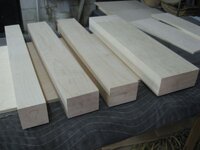
This is the different sizes of the various legs on the bench and their relation to each other. From the left; 3" X 3" (10 legs), 3" X 4" (2 legs) and 3" X 7" (1 leg). All the legs are laminated out of 4 boards with the grain running long ways on the wider legs. When you view them from the side, the end grain stands out.
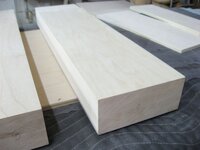
Here's a close up of one of the 4's and the 7. I'll discuss the laminating procedure shortly but note the grain on the left one. It better shows how each board's grain is reversed from one another to give stability after glue up.
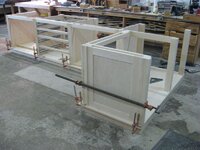
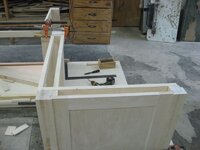
Still on the small bench end, all the inside stringers have now been attached. The middle leg, in back on the right, also has a stringer attached to help locate it and strengthen it.
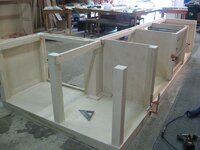
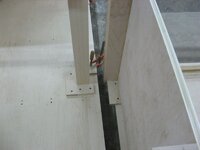
A look at that middle leg from the back side.You can also see that the inside stringers have been surface mounted and screwed to their respective legs. I did glue them also but that's not a very strong glue joint but figured it wouldn't hurt. The real strength comes from the screws in this case. With a well designed and executed glue joint, the glue joint is almost always superior in strength than the wood itself. Since this is hard maple everywhere on this bench, including the blocks screwed on the bases, all holes had to be predrilled with a pilot drill or it would have been next to impossible to install the screws, or keep from twisting them off. I used Bee's Wax on all the screw threads when installing them, (my friend who was helping me had never done this before and was just amazed at the difference it made installing those screws. Highly recommended!) Hard maple, hard woods or soft material, I'm just in the habit of always using Bee's Wax on screws into wood. That's a habit from dear old Dad.

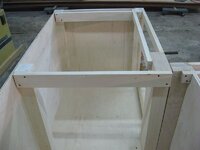
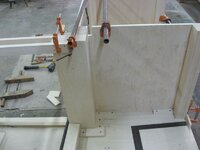
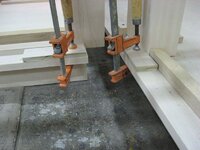
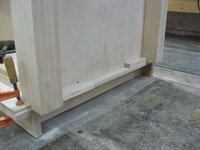
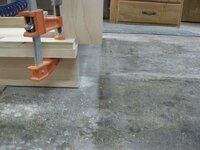
A good look at the screwed attachment of the inside stringers. Also here the 1/2" maple plywood back has been attached on the left to the rear legs. That located the rear legs side to side and the stringers at top located them front to back. When the legs were screwed to the base, that would locate them on the bottom. The gap you see between the 7" and 4" leg on the right will be resolved once the two benches are in place in the barn. Those legs were clamped together during glue up to keep everything in square during that process. The floor here wasn't all that level and created that gap when the clamps were removed. Not to worry.

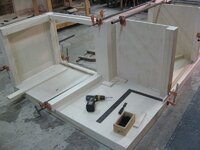
Once the back was installed it gave immense strength and rigidity to all the rear legs all along the back of both benches. The backs were just screwed, no glueing, in case they ever needed to be removed. Note the leg to the far left and how it was notched to allow the plywood to be installed flush with the surface of the leg. By doing that, when that leg is viewed from the end, you won't see plywood end grain.
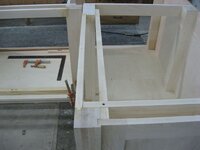
All these various stringers in conjunction with the plywood back give great strength.
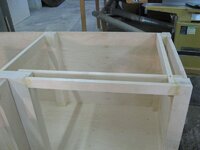
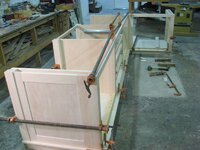
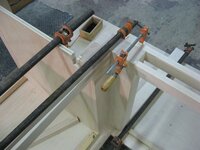
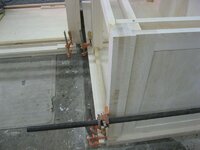
That's glue squeezed out of the tenon ends of the front stringers. Before the glue set it was mixed with a little hard maple sawdust onto the surface, once dry and cleaned up it will look just fine.
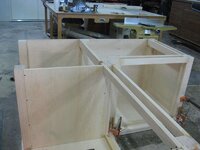
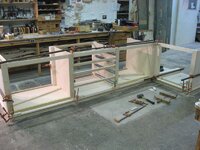
Moving down the bench.

Here's a look from the other end. This was slightly out of sequence since the back on the far end isn't installed in this picture, but you get the idea.
We're now getting near the end on the construction phase, but........I've got more...........
Thomas


 The Garage Journal is a terrific site with a vast array of information, projects and talent available and the best part is most folks here seem to be just, plain nice guys and gals. How great is that?