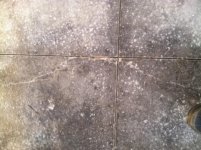
Guys-
Perfect concrete is almost impossible to achieve, but 99% perfect is almost always achievable if you follow the rules. Concrete is an art and a science, and no two truck-loads are the same. Here are the rules:
1. Compact the (your choice of expletive) out of the sub-base.
2. Install a suitable base such as 4" thick #8910 crushed stone (#8s, #9's and #10s, i.e. 3/8" to dust). Compact this with a plate compactor, not a "j" tamp.
3. Install a good vapor barrier, 6mil or thicker. Tape the joints if you have any.
4. Don't bother with welded wire mesh. My structural engineer says it only serves as reinforcement if maintained parallel to the top and held at 1/3 of the slab thickness up from the bottom. Pretty much cannot be done. Use #4 rebar at 12" o.c.e.w. at the same location, 1/3 of the slab thickness up from the bottom. Set the rebar on "chairs" at the correct height ands tie all crossings. Alternatively, use fibermesh mixed into the concrete prior to pouring. The fibermesh does reinforce the concrete and it does so in all directions, not just in the horizontal plane. I had a project to remove some machine foundations poured with fibermesh and it is agonizingly frustrating and quite time consuming b/c it does such a good job. I have it in my 20' x 24' garage floor and have no cracks, but that is also due to 5, 6, and 7.
5. Know how to order redi-mix concrete. If you do not, your best bet is to have a superintendent from a reputable general contractor manage this for you. I ordered a 3500# mix to be somewhat stronger than the typical 3000# design (3500# has more bags of cement). I ordered it with a 4" slump and when it arrived I only allowed a small amount of water to be added b/c it was stiffer than 4" slump. Be
VERY careful here. Water added at the site is the culprit for 99% of slab failures b/c it weakens the concrete design in a major way.
6. My next best recommendation is to have a professional finisher place and finish the concrete. You can do it yourself but you will not get as good a job, and you may have to live with it a long time. My floor is set to drain water towards the overhead door at a slope of 1/8" per foot. My finisher set rows of grade stakes to work from. When properly placed, bull-floated, and almost all of the "bleed water" evaporated, my finisher machine trowelled the top. When he was finished, I made him go over it 2 more times to insure a "hard" trowel finish.
6. At this point he made the saw cuts using a "soft cut" saw blade, made for very green concrete. It will not ravel the joints in green concrete. The timing of joint cutting is
VERY important. Wait until tomorrow and you may miss the window of opportunity- the crack will go where it wants no matter where you saw joints. The grid is most important too. Too few joints, and/or too far apart and again the crack will meander where it wants. A 4" thick slab usually wants joints at 12' - 15' o.c.e.w. Mine are 10' x 12' (half the length x half the width.)
7. My last recommendation is PROPPER curing! Without proper curing a slab will crack
EVERY time. There are several ways to cure a slab. The easiest way is to spray "cure-n-seal" with a pump-up sprayer. You must get it sprayed that night. This forms a barrier on the top of the slab to greatly retard the moisture coming out of the slab. Eventually almost all the moisture escapes and the slab is cured. Many concrete design mixes if properly cured will achieve 50% strength in 7 days, 75% in 15 days, and 100% in 28 days.
This concludes the written portion of the Concrete 101 course.