To avoid these ads, REGISTER NOW!

HELP!!! My New Garage Floor Cracked

rcnut223

Member
Joined
Sep 18, 2010
Messages
7
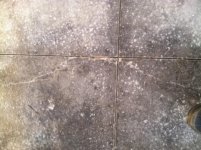
My Dream Garage had the Garage Floor Poured On Friday and On Sunday the Floor started to Crack:shocking:

It has been deternined the cement dried to quickly. Now a crack runs back and forth either side of the cut line in the center of the floor. 6-8 inches on either side of the cutline.

The floor has Pex tubing in it. Piece are chipping off now and it seems the cracks are spider cracking it's been getting worse since exposed to rain.

The contractor want's to cut either side of the failure grind an inch off the floor pour epoxy and then paint the floor so it looks good.

What is the correct fix for this?
 
To avoid these ads, REGISTER NOW!

rockchucker

Well-known member
Joined
Mar 27, 2010
Messages
1,764
Location
Seattle WA
Only 2 things I know about Concrete are...When it's dry it's done and it will crack.


Tough call without pictures or size of the pad.
 
OP
R

rcnut223

Member
Joined
Sep 18, 2010
Messages
7
Here's a picture of the crack

Pad is 28 x 36

2 inch foam with Pex tubing.no rebar or wire was poured with fibergalss strand .
 

Attachments

  • photo.jpg
    photo.jpg
    56.6 KB · Views: 950

ConCretin

Well-known member
Joined
Jan 20, 2011
Messages
3,379
Location
Central Maine
It has been deternined the cement dried to quickly.

Just out of curiosity, how was this determination made?

A couple of additional questions;

When were the saw cuts made? Can you measure the depth of the saw cuts? How is the slab reinforced?
 

amuffly

Banned
Joined
Jan 25, 2010
Messages
61
Location
Wichita, KS
When you use fibermesh you can remove the steel. Most times they offset in cost. The fiber is a complete mix in where the wire mesh ends up on the bottom which rusts over time and doesn't do jack for you.
 

ScaldedDog

Well-known member
Joined
Jan 15, 2008
Messages
1,065
Location
Sedalia, CO/NSB, FL
Dropping a boatload of money and time in insulation and pex and then not springing for rebar just seems silly to me. Fiber is great for the contractor, as he gets out sooner while still charging for "reinforced" concrete, but not so good for the guy living with the slab. My $.02.

Mark
 

darkk

Well-known member
Joined
Dec 24, 2009
Messages
3,361
Location
Willimantic, Ct.
When you use fibermesh you can remove the steel. Most times they offset in cost. The fiber is a complete mix in where the wire mesh ends up on the bottom which rusts over time and doesn't do jack for you.
This is not true. 6 mil plastic should have been laid out on the bottom before thepour to keepthe water from being wicked out during the cure period andalso help prevent water soaking in from the bottom after cure. The fibermesh is designed to help prevent surface crackswhile drying, it has no other purpose once the floor is cured. Steel mesh will help hold the concrete together even when cracked. If the steel mesh falls to the bottom, it is because the contractor left it there during the pour. The steel mesh is usually pulled up in the concrete while the crew is standing in the wet crete leveling it. The concrete also should have been kept very wet for at least the first 7 days to help prevent cracking. My 30 x 30 floor was done this way and has no cut lines or cracks. It is over two years old now.
 
Last edited:

ConCretin

Well-known member
Joined
Jan 20, 2011
Messages
3,379
Location
Central Maine
The fibermesh is designed to help prevent surface crackswhile drying, it has no other purpose once the floor is cured. Steel mesh will help hold the concrete together even when cracked. If the steel mesh falls to the bottom, it is because the contractor left it there during the pour. The steel mesh is usually pulled up in the concrete while the crew is standing in the wet crete leveling it.

I agree on the purpose of fibermesh. It does restrain early shrinkage cracks while the concrete is still 'plastic' and then ceases to be of much value.

It was sold as an alternative to steel mesh because the reality is that unsupported wire mesh ends up on the ground. Even if the finishing crew is religeous about pulling it up as they rake and spread, the guys on the board wade back in and tromp it down again. if you aren't going to spend the money on proper supports (I like continuous slab bolster at 4' centers), don't waste you time on mesh.

It is less expensive to control cracks with sawcuts, but if you want to minimize or eliminate them, pony up for wire mesh or rebar on supports AND fibermesh.
 

RaceDeck1

Well-known member
Joined
Oct 8, 2007
Messages
3,001
Location
Salt Lake City , Utah
Hurry 'Cover it" with RaceDeck ;) - Seriously, I would have your contractor re-do the entire floor. Even if he fixes the current crack, more are sure to follow due to a poor installation - Good luck
 

thegarageguy

Well-known member
Joined
Oct 24, 2007
Messages
1,489
Location
NJ
The concrete pictured looks like a 50 yr old slab, did they use your back yard soil in the mix?...aggregate is showing, along with plenty of filth....I've never seen new concrete looking so old. The cracks looks very normal and minor. Concrete cracks, saw cut control joints sometimes are useless.

We would treat the crack like any other, chase it, fill it and pour a system...,done
 

LegacyIndustrial

ALLIANCE MEMBER
Joined
Jun 7, 2010
Messages
7,994
Location
deerfield, IL
The concrete pictured looks like a 50 yr old slab, did they use your back yard soil in the mix?...aggregate is showing, along with plenty of filth....I've never seen new concrete looking so old. The cracks looks very normal and minor. Concrete cracks, saw cut control joints sometimes are useless.

We would treat the crack like any other, chase it, fill it and pour a system...,done

I agree. Bandage the cracks and coat with a good system or hit Jorgen up for a hardship deal. :thumbup:
 

RivennHewn

Well-known member
Joined
Jun 4, 2011
Messages
10,378
Location
PNW
Is the pict the extent of it? How about more picts? What was the weather like? Really hot? Did you have adequate compaction of subgrade? Did you wet the subgrade prior to pouring? Did the contractor add a lot of water?

Too many variables for us to tell much of anything. Need more info.
 

Carl B

Well-known member
Joined
Feb 3, 2006
Messages
525
Location
Clearwater, Florida USA
The concrete pictured looks like a 50 yr old slab, did they use your back yard soil in the mix?...aggregate is showing, along with plenty of filth....I've never seen new concrete looking so old.

I agree. Looking at the picture - I'd want to have that concrete tested for strength by a company that could testify in court. I'd question if you actually received the specific mix you ordered and paid for - from the Ready Mix company. I'd think your contractor would be doing the same.

Might be that the Ready Mix company is liable for the removal and resupply. If not the labor involved.

Sorry to see that you are having a problem.. that is a real bummer..

FWIW,
Carl B
 

Cryptic1911

Well-known member
Joined
May 24, 2008
Messages
2,884
Location
Willimantic, CT
The concrete pictured looks like a 50 yr old slab, did they use your back yard soil in the mix?...aggregate is showing, along with plenty of filth....I've never seen new concrete looking so old. The cracks looks very normal and minor. Concrete cracks, saw cut control joints sometimes are useless.

We would treat the crack like any other, chase it, fill it and pour a system...,done


Agreed.. that is some nasty looking concrete, but I don't think it should have cracks in it yet.. its not even a week old, so it should be soft enough to not crack at this point. Aren't you supposed to let it harden before cutting it? I wonder if it was a hot mix?..those spots don't look good either
 

ConCretin

Well-known member
Joined
Jan 20, 2011
Messages
3,379
Location
Central Maine
It is very difficult to develop an informed opinion based on a very small photo. What I see are pretty typical shrinkage cracks. They may have formed before the floor was saw-cut or possibly the saw cuts aren't deep enough.

These cracks develop when the concrete is still plastic and it is not unusual to see a little raveling around them.

I don't see any proof either way that there is a catastrophic problem. Let's get a little more info from the OP before we rip it out. :D
 
To avoid these ads, REGISTER NOW!

ForceFed70

Well-known member
Joined
Apr 27, 2010
Messages
3,441
Location
BC, Canada
From that picture, I don't see anything that would cause me a lot of concern.

Like others have said, that crack looks like a typical shrinkage crack of little concern. Especially if it's the only one.

As for the concrete looking "dirty". To me it looks like it was power-polished and then covered with water. Water will disolve some of the surface minerals and deposit it as "spots" when it dries. Would need a better picture to see for sure, but I honestly don't see anything that should ring alarm bells in that picture.
 

dab21

Member
Joined
Jun 19, 2011
Messages
5
Guys-
Perfect concrete is almost impossible to achieve, but 99% perfect is almost always achievable if you follow the rules. Concrete is an art and a science, and no two truck-loads are the same. Here are the rules:
1. Compact the (your choice of expletive) out of the sub-base.
2. Install a suitable base such as 4" thick #8910 crushed stone (#8s, #9's and #10s, i.e. 3/8" to dust). Compact this with a plate compactor, not a "j" tamp.
3. Install a good vapor barrier, 6mil or thicker. Tape the joints if you have any.
4. Don't bother with welded wire mesh. My structural engineer says it only serves as reinforcement if maintained parallel to the top and held at 1/3 of the slab thickness up from the bottom. Pretty much cannot be done. Use #4 rebar at 12" o.c.e.w. at the same location, 1/3 of the slab thickness up from the bottom. Set the rebar on "chairs" at the correct height ands tie all crossings. Alternatively, use fibermesh mixed into the concrete prior to pouring. The fibermesh does reinforce the concrete and it does so in all directions, not just in the horizontal plane. I had a project to remove some machine foundations poured with fibermesh and it is agonizingly frustrating and quite time consuming b/c it does such a good job. I have it in my 20' x 24' garage floor and have no cracks, but that is also due to 5, 6, and 7.
5. Know how to order redi-mix concrete. If you do not, your best bet is to have a superintendent from a reputable general contractor manage this for you. I ordered a 3500# mix to be somewhat stronger than the typical 3000# design (3500# has more bags of cement). I ordered it with a 4" slump and when it arrived I only allowed a small amount of water to be added b/c it was stiffer than 4" slump. Be VERY careful here. Water added at the site is the culprit for 99% of slab failures b/c it weakens the concrete design in a major way.
6. My next best recommendation is to have a professional finisher place and finish the concrete. You can do it yourself but you will not get as good a job, and you may have to live with it a long time. My floor is set to drain water towards the overhead door at a slope of 1/8" per foot. My finisher set rows of grade stakes to work from. When properly placed, bull-floated, and almost all of the "bleed water" evaporated, my finisher machine trowelled the top. When he was finished, I made him go over it 2 more times to insure a "hard" trowel finish.
6. At this point he made the saw cuts using a "soft cut" saw blade, made for very green concrete. It will not ravel the joints in green concrete. The timing of joint cutting is VERY important. Wait until tomorrow and you may miss the window of opportunity- the crack will go where it wants no matter where you saw joints. The grid is most important too. Too few joints, and/or too far apart and again the crack will meander where it wants. A 4" thick slab usually wants joints at 12' - 15' o.c.e.w. Mine are 10' x 12' (half the length x half the width.)
7. My last recommendation is PROPPER curing! Without proper curing a slab will crack EVERY time. There are several ways to cure a slab. The easiest way is to spray "cure-n-seal" with a pump-up sprayer. You must get it sprayed that night. This forms a barrier on the top of the slab to greatly retard the moisture coming out of the slab. Eventually almost all the moisture escapes and the slab is cured. Many concrete design mixes if properly cured will achieve 50% strength in 7 days, 75% in 15 days, and 100% in 28 days.
This concludes the written portion of the Concrete 101 course. :)
 

ConCretin

Well-known member
Joined
Jan 20, 2011
Messages
3,379
Location
Central Maine
4. Don't bother with welded wire mesh. My structural engineer says it only serves as reinforcement if maintained parallel to the top and held at 1/3 of the slab thickness up from the bottom. Use #4 rebar at 12" o.c.e.w. at the same location, 1/3 of the slab thickness up from the bottom. Set the rebar on "chairs" at the correct height ands tie all crossings. Alternatively, use fibermesh mixed into the concrete prior to pouring.

6. At this point he made the saw cuts using a "soft cut" saw blade, made for very green concrete.

7. My last recommendation is PROPPER curing! The easiest way is to spray "cure-n-seal" with a pump-up sprayer.

This concludes the written portion of the Concrete 101 course. :)

Pretty good summary of the issues involved with getting a good floor slab but I'd like to offer a few unsolicited comments;

Wire mesh or rebar in a slab isn't really effective as reinforcement in the traditional sense because the section is too small. The slab really depends on the sub-grade below for it's 'structural' strength.

The purpose of bar or mesh is to resist tension brought on be shrinkage or thermal changes. Either will do this as long is it is properly supported. Wire mesh is used in the vast majority of commercial slabs for this reason.

Fiber resists tension during early age shrinkage long enough for the Soffcut saw cut to provide a relief for cracking to occur in an aesthetically acceptable manner i.e. a straight line.

I'm a big fan over overkill myself but you have designed an expensive slab - rebar, supports, mesh and saw cuts. Most don't need to spend this much on a slab.

An average garage floor is fine with just fiber as long as adequate saw cuts are made in a timely manner. Mesh can be added for a little extra insurance against crack movement. Rebar is really more for slab systems with that seek to eliminate cracks.

One final thought. Curing compounds leave a residue that can interfere with future floor treatments - a water cure is far more desirable,
 
Last edited:

katit

Well-known member
Joined
May 5, 2006
Messages
862
Location
St. Louis, MO
To OP:

I wouldn't worry about this crack if you plan to epoxy. My previous garage had much worse cracks and after proper patching with special epoxy - they didn't come back after 7 years I lived there.

For other guys who plan to do it:

I went with 7-sak (whatever it means) over regular concrete. It was like $150 more for 2 car garage. I also went with 6inch slab. And with fiber + rebar + grid. Seems like too much? Didn't cost whole lot more...

I DID NOT do any cuts in 24x24 slab. There is another option. They installed plastic strip 1 inch below surface of concrete. And yes, I got nice hair crack right there in a middle where strip was.

I installed epoxy over after 4 month and you can't see crack and I'm very happy at the end.
 

gooned

Well-known member
Joined
Jul 6, 2011
Messages
505
Location
B.C.
Concrete is a big investment relative to the rest of the building costs-get it right.
 

RivennHewn

Well-known member
Joined
Jun 4, 2011
Messages
10,378
Location
PNW
There are a lot of options for design mixes like high early strength, or fast cure that hits 100% in a matter of a few days.

There are additives for pouring in cold and hot weather.

Most pre-mix companies have outside sales guys that will come to your job and discuss options.

Same with pumping companies. I always have a sales guy out to talk about which size pump to use.
 

ConCretin

Well-known member
Joined
Jan 20, 2011
Messages
3,379
Location
Central Maine
I DID NOT do any cuts in 24x24 slab. There is another option. They installed plastic strip 1 inch below surface of concrete. And yes, I got nice hair crack right there in a middle where strip was.

'Zip Strip' is a good alternative to saw cutting especially in radiant floors. If forms a kerf rather than cutting but it can be hard to get in straight and a lot of finishers don't want to fuss with it.
 

Dragster Racer

Well-known member
Joined
Feb 9, 2008
Messages
1,891
Location
Morrison, IL
I'm sure there are folks here that know way more than me. And many that are pickier than me. The pict looks like it is still drying, explaining the darkness. The texture looks odd though, like the aggregate is right there or something. I wouldn't tear that out for that crack alone though. If there is more to it, then maybe. But I can't see any contractor or Ready Mix company getting excited about that. I have some minor cracks in my shop like pictured, and there is rebar up the wazoo, and plastic under that. I have seen some very nice concrete that was free from cracks. But not often.
 

Dragster Racer

Well-known member
Joined
Feb 9, 2008
Messages
1,891
Location
Morrison, IL
I second that about the cure and seal. I like it and have used it. But....if you are planning a different coating, don't do it. You will have to remove it.
 

Edger

Well-known member
Joined
May 18, 2011
Messages
623
Location
Melbourne Australia
Dab21

Love your information. I repaired concrete for many years so I saw most of the problems and eventually found out the causes which you have covered so well.

For guys who want to coat their floors after, the cure n seal coating is a nuisance and costly to remove. Is there any other quick way to cure it slowly other than a water seal which seems a lot of work?
 

dab21

Member
Joined
Jun 19, 2011
Messages
5
Wow- these are some great posts.

One final thought. Curing compounds leave a residue that can interfere with future floor treatments - a water cure is far more desirable,

TRUE THAT ! (what was I thinking?) Well, my floor has no coating so the cure-n-seal was the best insurance to get the slab cured. And it allowed me to get on it within 7 days to get on with building the structure.

Willysfan, Edger and others are absolutely correct if you are planning a coating, stain, etc., cure with water. The old methods of a lawn sprayer, or water soaked burlap do work but they will work you as well as you must keep the surface wet for 28 days. The simplest water cure is to soak the slab and cover it with polyethylene. This needs to be kept in-place until the end of the mix design cycle which is usually 28 days for a proper cure to achieve the original design strength. This really is the best cure.

One last addn/correction: Joints- (zip strip included) Joints need to be 1/3 of the slab depth or you may as well not have any. The whole purpose of a joint is to have the coming crack to be in a straight line, architecturally pleasing.

Some say "all concrete cracks." This is not an absolute truth, but it may as well be for slab-on-grade purposes. Think of it this way. If a cubic yard of concrete has 20 gallons of water mixed-in at the plant to make it flow able and get out of the truck, as it cures almost all of that water evaporates and the concrete mass shrinks. If the form is 9' x 9' x 4" (27 cuft) and placed on a TOTALLY frictionless surface, theoretically it will shrink but not crack. However, when you place a yard or more of concrete as a thin section (4") on a surface of poly over crushed stone, even as slick as poly is, friction is introduced and the slab will crack. This is b/c the friction caused by concrete's weight (4000# per cuyd) on an irregular surface prevents it from shrinking uniformly and continuously. Cracks allow it to shrink. Concrete slabs-on-grade will usually crack in square to rectangular patterns of 1.5 to 2:1 ratio. One example: 5' wide concrete walks are usually scored or jointed at 5' intervals. Check any 5' wide conc. walk with a pocket knife and almost always there will be a crack in every other joint.
 
Last edited:

ConCretin

Well-known member
Joined
Jan 20, 2011
Messages
3,379
Location
Central Maine
Dab21 - Nice clear explanation of cracks and shrinkage. It's obviously a big issue on here. That will be helpful to folks who read it.
 

Omphaloskeptic

Well-known member
Joined
Oct 11, 2008
Messages
2,346
Location
Ultima Ratio, Wa.
rcnut223, thanks for starting this thread, lots of good information and advice coming from it!
How long after the pour was your picture taken? The cracks appear to be hairline thick and the concrete appears to have some mottling and damp sections, yes? It sounds serious if your contractor is willing to grind the failure area down an inch (wow) and lay in epoxy. I guess my plan would be to let him grind down the inch, vacuum the area, and have an unbiased professional examine it at that point to give the go-no-go for the epoxy fill. Your insurance company might be able to point you to a qualified concrete consultant. You might have to foot the bill at first, but the pro might be able to point the finger (in court?) at the people ultimately responsible for the failure. He might even be able to assure you its just cosmetic and there is no worry of continued problems like pinching the pex or some other nasty result. Good luck!


Not to hijack the thread, but is there any way to determine if a sealer was used to aid curing or if it was a simple water cure? It would be nice to know if I have to grind/treat the floor prior to using an epoxy finish.
The shop I bought was built in 2006. The copy of the plans I picked up at the city records office show specs of 4000#, 4" slab, no rebar or wire on 6" compacted base on top of a 4 mil poly with control cuts. The plans did not specify fiber re-enforced mix. The surface is baby-**** smooth with some minor cracking where the control cuts die out before the concrete stem walls. I only pray that the owner/builder G.C. followed the plan! lol
 

rburke65

Well-known member
Joined
Nov 10, 2007
Messages
12,349
Location
Canfield, Ohio
dab21....I will be keeping this helpful "101". But tell me please.....what is a "j" tamp? o.c.e.w.? What is this? On center each way?....each width? This is some hard reading! You assume all of us here are concrete finshers or something....Thanks for the help.
 

dab21

Member
Joined
Jun 19, 2011
Messages
5
Sorry about the "insider jargon"- I hate when someone does that and here I am doing the same.

"J" tamp is a one man operated compacting thing more or less in the shape of a "J". It will compact a one square foot area to China if you have it running and stand in the same place about 30 seconds. It is usually used in footing and trench bottoms. A plate compactor is the size of a small lawn mower with a steel plate on the bottom that "pats" the base like you see on the Yard Crashers when they install base for the patio stones. Proper compaction prior to pouring concrete reduces or eliminates settlement later.

o.c.e.w is short-hand for "on center each way" Good guess, by the way.
 

Dudester60

New member
Joined
Jul 19, 2011
Messages
4
I agree that the concrete looks abnormally dark and dirty. The crack is minimal, but shouldn't have cracked after only a week of drying. I have a very similar crack on my garage floor, that appeared in the Spring thaw, after being poured the year prior. It's been like that for 11 years now, and has never got worst. This just tells me that the ground and garage settled after a year, which is normal. However, cracking after a week is NOT. Tough call on who is to blame here, the contractor or the cement company, but I would tend to go after the contractor, cause he was the one responsible for the job...or should have been at least. In this case, I think I would have the contractor remove it and start again. Is this a floating slab, or a floor with a footing ?
Mine is a floating slab, filled with rebar as well as steel 6" mesh throughout. So I know that crack will never get wider, because of all the steel inside keeping it together. Good luck, and I look forward to hearing what the contractor does....if anything.:rocker:
 

AlphaGarage

Well-known member
Joined
Apr 16, 2008
Messages
1,298
Location
Every Garage, AnyTown, USA
Rebar or mesh isn't that tough to keep positioned at the proper height, just use "dobies," avail at most big box stores. When I was building homes we had forms for them, if we had a bit of extra concrete one of the guys would fill up the forms and crank out dobies.

It is tough to tell from the pic exactly what's going on, but if the concrete is sound otherwise, and the cracks static, no big deal. Chase, fill, coat, enjoy.

In my hood (SoCal hills) I could search a long time, and probably come across Casey Anthony, before finding a garage floor w/o cracks.

We have a coating that's applied to concrete within 4 hours of the pour, it helps retain the correct amount of moisture in the concrete for proper curing. It also allows acts as a primer and allows you to over coat with epoxy the next day. The mixing and application times are a bit tricky so right now it's contractor only.
 
To avoid these ads, REGISTER NOW!
Top Bottom