To avoid these ads, REGISTER NOW!

Battery testers

0.511MeV

Well-known member
Joined
May 25, 2011
Messages
421
I'm sure there is a very clear and reliable relationship between the two. I'm basing my argument on two things.

1. Capacitance style ones are an indirect measurement of output, carbon pile testers are a direct measurement of output, I don't doubt that a capacitance style machine cannot be accurate, but I do doubt that setting user error aside, the could ever be more accurate than a direct measurement. I mean if you want to measure X, simply measuring X is more accurate than measuring Y, even if Y is usually very closely related to X.

Carbon pile testers rely on measuring physical effects other than current output. They use Ohm's law and measure voltage and resistance. Measuring current directly is rather difficult in comparison.
 
To avoid these ads, REGISTER NOW!

G_P

Well-known member
Joined
Jul 11, 2010
Messages
7,135
Location
Central CT
I used the hell out of one of these when I was working repairing electric wheelchairs.

For small batteries they are great but my 200a is just so/so for checking actual car batteries.......

For the fact the wheelchair batteries are basically deep cycle gell cell lawn tractor batteries.
 

Greatbear

Well-known member
Joined
Jan 17, 2008
Messages
1,702
Location
Columbia/Fulton, MD
I have the HF "Chicago Electric" carbon pile tester. It goes for about 80 dollars (before coupons) and is a pretty decent value for the price. WHen I got mine, the first thing I did was pen the case and check things out. It is surprisingly well made, with a true current shunt ammeter and separate voltmeter, both of which have trimpots to allow for calibration. I found the meters to be within a couple percent of actual value during my testing. The tester has a current triggered timer that will sound a beeper after the ten second time limit has been hit, you need to back off the carbon pile for a couple minutes to allow it to cool off. The big connector clamps use true four-wire sensing, using one half of each clamp as the voltmeter sensing connection, thus testing the true voltage of the battery itself and not after any voltage drop in the test leads. Most people are unaware of this and complain that the tester does not read proper voltage or does not draw any current. Both jaws of each clamp need to make solid contact with the terminals.

My only issue with the box when I got it was that I found a lot of loose bolt-on connections inside. Some were barely more than finger tight. The unit might have worked, but at best it could have given unstable reading, at worst the ill fitting connections would have burned up from the several hundred amps going through them. This same box goes by many different names from several sources, and despite the name and color of the box, all the innards are the same, and judging by comments I have read,m a lot suffer from the same loose connections inside regardless of brand. Why this is such a widespread issue makes no sense to me. A few minutes with a screwdriver and a couple wrenches tightening everything and you have a solid tester.

I have owned a "toaster tester" for a good 3o+ years, and it was fine for a quick test, but it was limited at best. Go or no-go. Eventually the element burned out and I got a new one a few years ago because I liked the roughly 100 amp load it put on a battery. The carbon pile tester is much more useful, as it can draw roughly 20 amps minimum and go up from there, a good load test for alternator testing. In the past I would use an actual carbon pile (a rack full of carbon wafers with a screw clamp that squeezes them together and nothing else) and a current clamp for current measurements, but that was awkward. On more than a few occasions I would have to pick up spilled carbon wafers from the rack if I accidentally knocked it over and the clamp screw was not tight enough. I got the fully contained box late last year and saved the monster carbon pile for extreme testing (it can pull close to 1000 amps for a short period).

A few years ago I picked up a Schumacher conductance tester. I find it useful for general battery condition testing. It will let you know if a battery is wearing out, and can be used to match batteries that are going to be used in pairs like in diesels or extreme audio or hydraulic setups. But otherwise, such testers are one-trick ponies. You can test a battery that is in or out of a vehicle, but not while the engine is running or the battery on a charger, it gives false readings or will tell you that the test can't be completed. It draws at most about 1 amp from a battery, and does so in a pulsating, on-and-off pattern of varying frequency. This slight load is enough to superimpose an AC waveform on top of the 12-ish volts DC, it is the magnitude of this waveform at different frequencies that the tester measures, and it tallies the readings and gives a pretty good approximation of battery capacity and condition. As a battery ages, the plates become sulphated and otherwise deteriorate, causing an increase in the internal resistance of the battery. The tester performs a "conductance" test which measures the resistance (conductance is 1/resistance) and takes the result and compares it to an internal table of values, along with the entered CCA of the battery and the voltage to give a report of condition. The advantage is there is no huge current draw needed, the tester is compact, and there is no chance of arcing and showers of sparks coming from bad connections. Like the HF battery load box I mentioned before, these little testers use 4-wire test methodology, so both jaws of each clamp need to make good contact. While the current draw by the tester is very low, the resulting voltage drop that makes up the AC signal is only in the low millivolts, so the connection needs to be good and the vehicle needs to be completely turned off to do the testing. In fact, the only way to get a truly good reading with the little testers is to disconnect the battery entirely and test it directly off the terminals. These little testers are great to take with you to the auto parts store to see which batteries on the rack are the freshest. Salespeople reaction varies. :lol:
 

oldtools

Well-known member
Joined
Sep 15, 2008
Messages
2,706
I have the HF "Chicago Electric" carbon pile tester. It goes for about 80 dollars (before coupons) and is a pretty decent value for the price. WHen I got mine, the first thing I did was pen the case and check things out. It is surprisingly well made, with a true current shunt ammeter and separate voltmeter, both of which have trimpots to allow for calibration. I found the meters to be within a couple percent of actual value during my testing. The tester has a current triggered timer that will sound a beeper after the ten second time limit has been hit, you need to back off the carbon pile for a couple minutes to allow it to cool off. The big connector clamps use true four-wire sensing, using one half of each clamp as the voltmeter sensing connection, thus testing the true voltage of the battery itself and not after any voltage drop in the test leads. Most people are unaware of this and complain that the tester does not read proper voltage or does not draw any current. Both jaws of each clamp need to make solid contact with the terminals.

My only issue with the box when I got it was that I found a lot of loose bolt-on connections inside. Some were barely more than finger tight. The unit might have worked, but at best it could have given unstable reading, at worst the ill fitting connections would have burned up from the several hundred amps going through them. This same box goes by many different names from several sources, and despite the name and color of the box, all the innards are the same, and judging by comments I have read,m a lot suffer from the same loose connections inside regardless of brand. Why this is such a widespread issue makes no sense to me. A few minutes with a screwdriver and a couple wrenches tightening everything and you have a solid tester.

I have owned a "toaster tester" for a good 3o+ years, and it was fine for a quick test, but it was limited at best. Go or no-go. Eventually the element burned out and I got a new one a few years ago because I liked the roughly 100 amp load it put on a battery. The carbon pile tester is much more useful, as it can draw roughly 20 amps minimum and go up from there, a good load test for alternator testing. In the past I would use an actual carbon pile (a rack full of carbon wafers with a screw clamp that squeezes them together and nothing else) and a current clamp for current measurements, but that was awkward. On more than a few occasions I would have to pick up spilled carbon wafers from the rack if I accidentally knocked it over and the clamp screw was not tight enough. I got the fully contained box late last year and saved the monster carbon pile for extreme testing (it can pull close to 1000 amps for a short period).

A few years ago I picked up a Schumacher conductance tester. I find it useful for general battery condition testing. It will let you know if a battery is wearing out, and can be used to match batteries that are going to be used in pairs like in diesels or extreme audio or hydraulic setups. But otherwise, such testers are one-trick ponies. You can test a battery that is in or out of a vehicle, but not while the engine is running or the battery on a charger, it gives false readings or will tell you that the test can't be completed. It draws at most about 1 amp from a battery, and does so in a pulsating, on-and-off pattern of varying frequency. This slight load is enough to superimpose an AC waveform on top of the 12-ish volts DC, it is the magnitude of this waveform at different frequencies that the tester measures, and it tallies the readings and gives a pretty good approximation of battery capacity and condition. As a battery ages, the plates become sulphated and otherwise deteriorate, causing an increase in the internal resistance of the battery. The tester performs a "conductance" test which measures the resistance (conductance is 1/resistance) and takes the result and compares it to an internal table of values, along with the entered CCA of the battery and the voltage to give a report of condition. The advantage is there is no huge current draw needed, the tester is compact, and there is no chance of arcing and showers of sparks coming from bad connections. Like the HF battery load box I mentioned before, these little testers use 4-wire test methodology, so both jaws of each clamp need to make good contact. While the current draw by the tester is very low, the resulting voltage drop that makes up the AC signal is only in the low millivolts, so the connection needs to be good and the vehicle needs to be completely turned off to do the testing. In fact, the only way to get a truly good reading with the little testers is to disconnect the battery entirely and test it directly off the terminals. These little testers are great to take with you to the auto parts store to see which batteries on the rack are the freshest. Salespeople reaction varies. :lol:

Awesome info. According to Midtronics, the battery doesn't need to be fully charged to perform a conductance test.
 

Stick

Well-known member
Joined
Dec 12, 2007
Messages
2,302
Location
Alaska
Awesome info. According to Midtronics, the battery doesn't need to be fully charged to perform a conductance test.
While they say that the battery doesn't need to be fully charged, I've had inconsistent results if the battery is below 11.5V. It's better than having to have a fully charged battery like you would need for a resistance style test though.
 
OP
S

scott37300

Well-known member
Joined
May 5, 2010
Messages
3,450
Location
Wisconsin
Is there any advantage for a home mechanic to have a battery tester like the midtronics PBT100 120 dollar tester? Is there anything this tester can tell me that a volt meter and carbon pile can't?

I am going to be getting a carbon pile to test charging systems but was just wondering if I should look into a capacitance style for testing batteries or if that isn't needed?
 

Stick

Well-known member
Joined
Dec 12, 2007
Messages
2,302
Location
Alaska
Is there any advantage for a home mechanic to have a battery tester like the midtronics PBT100 120 dollar tester? Is there anything this tester can tell me that a volt meter and carbon pile can't?

I am going to be getting a carbon pile to test charging systems but was just wondering if I should look into a capacitance style for testing batteries or if that isn't needed?

The only real advantages of a capacitance based tester for a homeowner is the ability to test a battery at less than full charge and simple use and operation of the unit.

Both have their places, but for the average homeowner working on their vehicles, a resistance based tester is going to be more versatile. For someone who's working in a shop, both are really needed to do battery and charging system tests, as no one test is going to catch every bad battery or alternator. If you were doing daily PM inspections and repair on vehicles, I'd say to get a capacitance based unit, but that's an entirely different situation.
 

otis66

Well-known member
Joined
May 28, 2010
Messages
1,875
So how do you guys test on Diesels with 2 batteries, such as a powerstroke. If you disconnect 1 battery and tape up the terminals, usually they don't have enough juice to cycle the glowplugs before cranking. If you used a conductance tester such as a SnapOn EECS 500, how do you go about it?

Inquiring minds want to know.

Thanks.

D.

You have to disconect the batt and test each battery sepratly.
 
Last edited:

otis66

Well-known member
Joined
May 28, 2010
Messages
1,875
While they say that the battery doesn't need to be fully charged, I've had inconsistent results if the battery is below 11.5V. It's better than having to have a fully charged battery like you would need for a resistance style test though.

My midtronics tester will tell me if the battery needs to be charged or if the battery is no good. After I test the batteries with the midtronics tester If the battery is NG I take the battery back to the parts store. The Midtronics tester is very acurate. Eevery battery that tested bad with the midtronics was in deed bad....So far.
 

cortez

Well-known member
Joined
Apr 9, 2009
Messages
171
Location
Chicago
...
How long ago were block heaters and jump leads invented? :headscrat


This was when we were teens in the early 60's and we didn't have garages.

We bought a car among 3 to 4 of us to get to work. We barely knew how to read, so we had no knowledge of oil dip stick heaters or trickle chargers. And if we had hooked these up by the morning they would be stolen anyways.

Every night on the coldest days we would alternate and take the car home. Me and my brother divided the tasks of draining the oil whilst the other took out the battery.

Those were the good days where everyone helped each other and thus all were content.:bounce:
 

Eagle Point

Well-known member
Joined
Sep 3, 2010
Messages
469
Location
Granite Bay,California
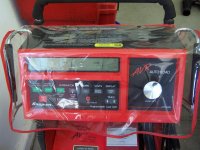
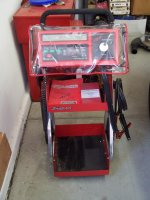
This Snap-on MT1590 AVR was on my tool truck when I was a dealer years ago and I ended up keeping it along with lots of other stuff. I get tempted to sell it but then again when you need it, it sure comes in handy. This is a great tool for properly testing the charging system and battery under load, etc.
 

Attachments

  • 100_2627.jpg
    100_2627.jpg
    142.4 KB · Views: 48
  • 100_2626.jpg
    100_2626.jpg
    139 KB · Views: 44
OP
S

scott37300

Well-known member
Joined
May 5, 2010
Messages
3,450
Location
Wisconsin
The only real advantages of a capacitance based tester for a homeowner is the ability to test a battery at less than full charge and simple use and operation of the unit.

Both have their places, but for the average homeowner working on their vehicles, a resistance based tester is going to be more versatile. For someone who's working in a shop, both are really needed to do battery and charging system tests, as no one test is going to catch every bad battery or alternator. If you were doing daily PM inspections and repair on vehicles, I'd say to get a capacitance based unit, but that's an entirely different situation.

Thanks for all the info Stick!:beer:

I am going to be ordering a pile tester for the charging system tests. I'm also going to look into upgrading my fluke and getting an amp clamp, this will get more use than a capacitance battery tester. I was thinking about getting a PBT100 or 200 just to be able to have a simple and fast tester for batteries but after thinking some more I think the money would be better spent on other tools, like a new fluke. I bought my fluke about 10 years ago when I was working for an electrician and it does just about anything I need it to for home electrical and has been fine for all the car electrical I have needed but I'm starting to get deeper into this diagnostic stuff so it's starting to lack, it's a model 16.

Since I never used used a pile tester what are some of the common test to do with it? For example how would I go about testing a battery. Or alternator? Or anything else it can test?

Thanks again, between this thread and my other one in FP I have learned so much this week!
 

Stick

Well-known member
Joined
Dec 12, 2007
Messages
2,302
Location
Alaska
Since I never used used a pile tester what are some of the common test to do with it? For example how would I go about testing a battery. Or alternator? Or anything else it can test?

Thanks again, between this thread and my other one in FP I have learned so much this week!

Maybe I'll see if I can get enough time to get our carbon pile tester at work out and take some pictures tomorrow of how to check out batteries and charging systems. It'd be a good kickoff for my idea about a monthly how to thread. Start the thread with the basics, and then show some of the more advanced stuff like labscope usage for checking out charging systems.
 
OP
S

scott37300

Well-known member
Joined
May 5, 2010
Messages
3,450
Location
Wisconsin
Maybe I'll see if I can get enough time to get our carbon pile tester at work out and take some pictures tomorrow of how to check out batteries and charging systems. It'd be a good kickoff for my idea about a monthly how to thread. Start the thread with the basics, and then show some of the more advanced stuff like labscope usage for checking out charging systems.

That's a great idea. I've learned a lot from this thread and the other one. A how to about testing batteries and charging systems using DVOM, pile tester, capacitance tester, etc would be amazing.
 

Moose-LandTran

Well-known member
Joined
Mar 8, 2008
Messages
15,945
Location
The Brink of Insanity (England)
So i need a good battery tester of my own, but am stuck trying to choose one.

If you had $300 to spend on a new battery capacitance tester, what would you buy?

So far, the Bosch BAT 110 is favourite. It's a rebranded Midtronics unit in lime green. (The colour makes all the difference, naturally..)
 
OP
S

scott37300

Well-known member
Joined
May 5, 2010
Messages
3,450
Location
Wisconsin
So i need a good battery tester of my own, but am stuck trying to choose one.

If you had $300 to spend on a new battery capacitance tester, what would you buy?

So far, the Bosch BAT 110 is favourite. It's a rebranded Midtronics unit in lime green. (The colour makes all the difference, naturally..)

Moose, I know Stick has answered all my questions so far but just out of curiosity what do you have right now to test batteries and why are you looking to upgrade? Why the bosch capacitance tester? Just wondering, still trying to decide if I want to look for a midtronics PBT100 sometime down the road or if it would just be a waste of money for me. These are the tuff decisions in life!!! It would be nice to just throw a capacitance tester on and have results but trying to decide if the once a year or so I would use it would pay, or if I stick to the load tester and multimeter testing of batteries.
 

Moose-LandTran

Well-known member
Joined
Mar 8, 2008
Messages
15,945
Location
The Brink of Insanity (England)
Moose, I know Stick has answered all my questions so far but just out of curiosity what do you have right now to test batteries and why are you looking to upgrade? Why the bosch capacitance tester? Just wondering, still trying to decide if I want to look for a midtronics PBT100 sometime down the road or if it would just be a waste of money for me. These are the tuff decisions in life!!! It would be nice to just throw a capacitance tester on and have results but trying to decide if the once a year or so I would use it would pay, or if I stick to the load tester and multimeter testing of batteries.

We have a PBT105 at work, shop-owned, i don't have my own tester. What i want is a good capacitance tester that covers multiple standards (SAE, DIN, EN, JIC.) and does more than just tell me good or bad. The Bosch unti does those 4 standards, plus basic start/charge testing and tells you the available CCA as well as the good/charge/bad LED indication.

I deal with lots of late-model cars packed with electronics and a faulty (although seemingly functional) battery can really throw things off, lots of fault codes for high resistance/low voltage, components not functioning correctly and such.

I want a good tester so i can make my first port of call test, the battery, and either eliminate that as a fault or know to replace it and then follow any additional diag if needed.

Had a BMW 5-Series at work recently with all kinds of electrical problems, warning lights randomly illuminating and going out, all kinds of faults and problems. The other mech put his parts cannon on full auto and let rip, including a new battery, and didn't fix it. Main dealer mis-diagnosed it as steering angle sensor, turned out to be alternator. (That wasn't diagnosed, per-se, but replaced under "parts cannon protocol" and turned out to fix it.) I want the correct test equipement (and knowledge) to avoid that kind of ****.
 

oldtools

Well-known member
Joined
Sep 15, 2008
Messages
2,706
Moose, I know Stick has answered all my questions so far but just out of curiosity what do you have right now to test batteries and why are you looking to upgrade? Why the bosch capacitance tester? Just wondering, still trying to decide if I want to look for a midtronics PBT100 sometime down the road or if it would just be a waste of money for me. These are the tuff decisions in life!!! It would be nice to just throw a capacitance tester on and have results but trying to decide if the once a year or so I would use it would pay, or if I stick to the load tester and multimeter testing of batteries.

Why don't you buy both HF carbon pile and conductance testers and see which one you like better. Return the one you don't like. If you like conductance tester, but don't like HF, return it also and get a Midtronics. Also, Midtronics and other manufacturers have free online manuals you can look through to see if the device meet your needs. My Midtronics Micro 520 will perform starter current draw test, alternator voltage regulator test, and alternator AC ripple (diode test) test.
 
To avoid these ads, REGISTER NOW!
OP
S

scott37300

Well-known member
Joined
May 5, 2010
Messages
3,450
Location
Wisconsin
What i want is a good capacitance tester that covers multiple standards (SAE, DIN, EN, JIC.) and does more than just tell me good or bad.


Can you explain this, I don't understand these "standards"? SAE, JIC, DIN, sound like thread sizes to me! Sorry if this is a stupid question.

The Bosch unti does those 4 standards, plus basic start/charge testing and tells you the available CCA as well as the good/charge/bad LED indication.

Why don't you buy both HF carbon pile and conductance testers and see which one you like better. Return the one you don't like. If you like conductance tester, but don't like HF, return it also and get a Midtronics. Also, Midtronics and other manufacturers have free online manuals you can look through to see if the device meet your needs. My Midtronics Micro 520 will perform starter current draw test, alternator voltage regulator test, and alternator AC ripple (diode test) test.

So are these alternator and starter tests these do, are they good enough for a home mechanic? Or should I stick to a carbon pile tester like Stick recomended? The part stores use one of these capacitance testers to test alt and starters. I think I would like one of these capacitance testers for the ease of use but Stick seemed to recomend a pile tester because it was more versitile. I was set on a pile tester but if a capacitance tester will do the basic alt and starter test I might just go that route. Sorry for all these questions! I just don't have a lot of experience with these testers and don't have the money to buy both of them and just trying to get the one that will best suite my needs. Which I thought was a carbon pile tester but the more I read the more confused I get! I don't test a lot of batteries or charging systems but I like to have the tools around if I need them so I can diagnose the problem without a lot of guesing.
 

Moose-LandTran

Well-known member
Joined
Mar 8, 2008
Messages
15,945
Location
The Brink of Insanity (England)
Can you explain this, I don't understand these "standards"? SAE, JIC, DIN, sound like thread sizes to me! Sorry if this is a stupid question.

They're standards for measuring CCA. (Cold Cranking Amps) Like measurements of volume they vary. (like a US and GB gallon are different.)

SAE is largely a US measurement system
JIC is the Japanese standard
EN is a European standard
DIN is the German standard.

Batteries use varying standards depending on where they're manufactured and their OE fitment (If an original part) so it helps to have a tester that covers them all if you're working on multiple brands and cars from different countries of manufacture.


So are these alternator and starter tests these do, are they good enough for a home mechanic?

I think the starter and alternator tests are min/max voltage and a good/bad indication of alternator diode ripple. They're a basic test.

Or should I stick to a carbon pile tester like Stick recomended? The part stores use one of these capacitance testers to test alt and starters.

I think they're better for diag of the charging system, as opposed to the battery alone, but Stick can answer that question better than me.

I think I would like one of these capacitance testers for the ease of use but Stick seemed to recomend a pile tester because it was more versitile. I was set on a pile tester but if a capacitance tester will do the basic alt and starter test I might just go that route. Sorry for all these questions! I just don't have a lot of experience with these testers and don't have the money to buy both of them and just trying to get the one that will best suite my needs. Which I thought was a carbon pile tester but the more I read the more confused I get! I don't test a lot of batteries or charging systems but I like to have the tools around if I need them so I can diagnose the problem without a lot of guesing.

I think realistically the battery testers are only good for testing batteries and basic tests of the starting/charging system. For anything more, a carbon pile tester is seemingly the way to go.
 
OP
S

scott37300

Well-known member
Joined
May 5, 2010
Messages
3,450
Location
Wisconsin
They're standards for measuring CCA. (Cold Cranking Amps) Like measurements of volume they vary. (like a US and GB gallon are different.)

SAE is largely a US measurement system
JIC is the Japanese standard
EN is a European standard
DIN is the German standard.

Batteries use varying standards depending on where they're manufactured and their OE fitment (If an original part) so it helps to have a tester that covers them all if you're working on multiple brands and cars from different countries of manufacture.


I think the starter and alternator tests are min/max voltage and a good/bad indication of alternator diode ripple. They're a basic test.


I think they're better for diag of the charging system, as opposed to the battery alone, but Stick can answer that question better than me.


I think realistically the battery testers are only good for testing batteries and basic tests of the starting/charging system. For anything more, a carbon pile tester is seemingly the way to go.

Thanks Moose! I will stick to the pile tester for now. Maybe sometime down the road I will look into a capacitance tester but for the little I need to test batteries I will probably just stick to the pile tester and multimeter. You would think I was buying a new car or something for the amount of back and forth decision making I am doing!

Thanks again for the help. I thought I was pretty good at electrical testing from my old car stereo competition days but I see I really don't know squat besides how to measure voltage! Now to just get some money together for a pile tester, new meter, amp clamp, .............and everything else I "NEED"!!!
:beer:
 

Stick

Well-known member
Joined
Dec 12, 2007
Messages
2,302
Location
Alaska
Scott, the reason that I recommended a carbon pile tester for you is cost vs. benefit. A Midtronics MCR-500 that does automatic starting/charging/load testing runs just shy of $800. A carbon pile tester that will do all of the above in combination with a multimeter, except you do the tests manually, will run you around $100.

For a homeowner who's doing tests occasionally, it's just not worth spending the money on a fancy piece of kit that will sit in the toolbox most of the year. There are inexpensive capacitance based testers, but they are generally limited to battery testing and maybe a quick voltage based analysis of the charging system. Kind of a one trick pony IMO.

If you were doing work professionally like Moose, I'd have a different view. It's like buying Snap-On when Harbor Freight will do just fine.
 
OP
S

scott37300

Well-known member
Joined
May 5, 2010
Messages
3,450
Location
Wisconsin
Scott, the reason that I recommended a carbon pile tester for you is cost vs. benefit. A Midtronics MCR-500 that does automatic starting/charging/load testing runs just shy of $800. A carbon pile tester that will do all of the above in combination with a multimeter, except you do the tests manually, will run you around $100.

For a homeowner who's doing tests occasionally, it's just not worth spending the money on a fancy piece of kit that will sit in the toolbox most of the year. There are inexpensive capacitance based testers, but they are generally limited to battery testing and maybe a quick voltage based analysis of the charging system. Kind of a one trick pony IMO.

If you were doing work professionally like Moose, I'd have a different view. It's like buying Snap-On when Harbor Freight will do just fine.

I understand Stick, and if you can't tell I really respect your advice!

I just read Moose's and the other post about the 300 dollar tester being able to do charging system tests and if that was the case I would just buy that tester for ease of use, but as mentioned it is a basic test. I will stick with the pile tester like you recomended. I just overthink these things sometimes since I don't have experience with a pile tester or capacitance tester so don't really know what each can do and can't do and always try and get the best I can afford. I can't afford an 800 dollar tester so since the 200-300 dollar testers won't do the charging system tests than the pile tester it is. If the 200-300 dollar capacitance testers could do a good job testing the alt and starter than I would jump all over it but since it's just a generic test I will stick with the pile tester.

So when's that how to article going to be done so I can learn how to use the pile tester and multimeter to test the battery and chargine system? Just kidding! Thanks again for all your advice and help.
 

Danglerb

Well-known member
Joined
Sep 6, 2007
Messages
9,736
Location
SoCal
All my cars have headlights, so I am missing what the value of a load tester would be vs using a meter (with a DC amp clamp).

I would like something smart enough to look at ripple and tell me if the alternator has bad diodes etc., but I don't see anything that is close to the cost of a battery as a better option to substituting a known good battery.

For me anyway that boils down to just using my meter and skipping one more "thing", especially since I really want some kind of small scope.
 

oldtools

Well-known member
Joined
Sep 15, 2008
Messages
2,706
I agree with Stick. If a $300 conductance tester can only perform simple voltage test on the charging and starting system, then it may not be worth it. A $70 carbon pile tester would be a more cost effective way to go. It may be old and bulky, but a VAT 40 (carbon pile) can perform battery, starter, and alternator tests without additional equipment. They are on Craiglist for $100 or less.
 

Stick

Well-known member
Joined
Dec 12, 2007
Messages
2,302
Location
Alaska
It may be old and bulky, but a VAT 40 (carbon pile) can perform battery, starter, and alternator tests without additional equipment. They are on Craiglist for $100 or less.

If you see a VAT 40 that works and is complete on craigslist for $100, I'll double your money buying it off you. Complete units in good working condition are hard to find around here.

Hell, for that matter if Eagle Point wants to sell his MT1590, I'd be interested in that as well. I'd just need to figure out how to ship it to Alaska.
 

Moose-LandTran

Well-known member
Joined
Mar 8, 2008
Messages
15,945
Location
The Brink of Insanity (England)
Does anyone own, or has anyone used, a Midtronics MCR-400? I believe that series is now called the Micro series.

They look to be pretty good, as they're popular as branded main dealer tools, but would be interested to head back from anyone that's used one.

(Just bought a new old stock one.)
 

Original Man

Well-known member
Joined
Feb 26, 2011
Messages
712
Location
South Florida
When I was in the dealership I remember it was common practice to use a midtronic on a dead battery to get the print out for warranty if it passed a bad battery in a customers car. Made me question why use it as the de facto battery tester for warranty if it was often incorrect
 

Moose-LandTran

Well-known member
Joined
Mar 8, 2008
Messages
15,945
Location
The Brink of Insanity (England)
When I was in the dealership I remember it was common practice to use a midtronic on a dead battery to get the print out for warranty if it passed a bad battery in a customers car. Made me question why use it as the de facto battery tester for warranty if it was often incorrect

Like Stick said, no one method will catch every failure. It may also be the case that they were testing a battery that was dead but not beyond being "revived" by proper charging.
 

Danglerb

Well-known member
Joined
Sep 6, 2007
Messages
9,736
Location
SoCal
These days I'm not sure the "true" good/bad matters, its what does the box that checks for warranty say, and my checker needs to give me a good guess at what that is going to be so I don't drag around a battery that isn't going to be warrantied.
 

MikeZ

New member
Joined
Aug 28, 2011
Messages
1
I was in Walmart a week ago and they tested my battery and gave me a printout that everything was OK. Yesterday, Aug 27th I took the battery in again and was told it checked out good. However, when I used the tester using the floating balls all the balls sunk to the bottom. I used the same tester on a different battery and the balls all floated to the top. I question the accuracy of these testers Walmart uses. When I full charged my battery it read 12.71 volts, by the time I took it to walmart it was 12.36 volts. I pulled the battery from the car and took it to Walmart using another vehicle. The battery was never hooked up while charging nor was it hooked up prior to taking it to Walmart. The accuracy of these testers Walmart uses seems to be questionable. As a side note, all six cells showed the same reading as the four balls sank on every cell. I have never seen this before as usually I have seen one or two cells bad not all six.
 

theoldwizard1

Well-known member
Joined
Feb 22, 2011
Messages
43,270
Location
SE MI
The "floating ball tester" is called a hydrometer. A hydrometer measures the specific gravity of the liquid (acid). In simple terms it shows how much "charge" your battery has.

If they are all low, it just means your battery needs charging. If a couple of cells read low and the rest read high, you have might have a bad battery.

The correct way to use a hydrometer is

  • Disconnect the battery from the vehicle
  • If possible, make certain that all cells have adequate liquid
  • Charge the battery for 12-24 hours
  • Check each cell with the hydrometer

If there is a more than a 10-24% difference between any cell you probably have a battery on it way ou.
 
OP
S

scott37300

Well-known member
Joined
May 5, 2010
Messages
3,450
Location
Wisconsin
I was in Walmart a week ago and they tested my battery and gave me a printout that everything was OK. Yesterday, Aug 27th I took the battery in again and was told it checked out good. However, when I used the tester using the floating balls all the balls sunk to the bottom. I used the same tester on a different battery and the balls all floated to the top. I question the accuracy of these testers Walmart uses. When I full charged my battery it read 12.71 volts, by the time I took it to walmart it was 12.36 volts. I pulled the battery from the car and took it to Walmart using another vehicle. The battery was never hooked up while charging nor was it hooked up prior to taking it to Walmart. The accuracy of these testers Walmart uses seems to be questionable. As a side note, all six cells showed the same reading as the four balls sank on every cell. I have never seen this before as usually I have seen one or two cells bad not all six.

Like Stick mentioned no one tester is going to find all faults. The tester's walmart and parts stores use are basically just a quick tester for the charging system that is pretty accurate for what it is.

For the DIY Stick recomended a carbon pile and multimeter.
 
To avoid these ads, REGISTER NOW!
Top Bottom