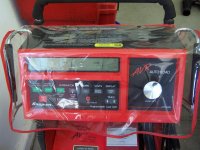
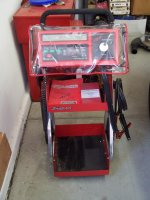
I have the HF "Chicago Electric" carbon pile tester. It goes for about 80 dollars (before coupons) and is a pretty decent value for the price. WHen I got mine, the first thing I did was pen the case and check things out. It is surprisingly well made, with a true current shunt ammeter and separate voltmeter, both of which have trimpots to allow for calibration. I found the meters to be within a couple percent of actual value during my testing. The tester has a current triggered timer that will sound a beeper after the ten second time limit has been hit, you need to back off the carbon pile for a couple minutes to allow it to cool off. The big connector clamps use true four-wire sensing, using one half of each clamp as the voltmeter sensing connection, thus testing the true voltage of the battery itself and not after any voltage drop in the test leads. Most people are unaware of this and complain that the tester does not read proper voltage or does not draw any current. Both jaws of each clamp need to make solid contact with the terminals.
My only issue with the box when I got it was that I found a lot of loose bolt-on connections inside. Some were barely more than finger tight. The unit might have worked, but at best it could have given unstable reading, at worst the ill fitting connections would have burned up from the several hundred amps going through them. This same box goes by many different names from several sources, and despite the name and color of the box, all the innards are the same, and judging by comments I have read,m a lot suffer from the same loose connections inside regardless of brand. Why this is such a widespread issue makes no sense to me. A few minutes with a screwdriver and a couple wrenches tightening everything and you have a solid tester.
I have owned a "toaster tester" for a good 3o+ years, and it was fine for a quick test, but it was limited at best. Go or no-go. Eventually the element burned out and I got a new one a few years ago because I liked the roughly 100 amp load it put on a battery. The carbon pile tester is much more useful, as it can draw roughly 20 amps minimum and go up from there, a good load test for alternator testing. In the past I would use an actual carbon pile (a rack full of carbon wafers with a screw clamp that squeezes them together and nothing else) and a current clamp for current measurements, but that was awkward. On more than a few occasions I would have to pick up spilled carbon wafers from the rack if I accidentally knocked it over and the clamp screw was not tight enough. I got the fully contained box late last year and saved the monster carbon pile for extreme testing (it can pull close to 1000 amps for a short period).
A few years ago I picked up a Schumacher conductance tester. I find it useful for general battery condition testing. It will let you know if a battery is wearing out, and can be used to match batteries that are going to be used in pairs like in diesels or extreme audio or hydraulic setups. But otherwise, such testers are one-trick ponies. You can test a battery that is in or out of a vehicle, but not while the engine is running or the battery on a charger, it gives false readings or will tell you that the test can't be completed. It draws at most about 1 amp from a battery, and does so in a pulsating, on-and-off pattern of varying frequency. This slight load is enough to superimpose an AC waveform on top of the 12-ish volts DC, it is the magnitude of this waveform at different frequencies that the tester measures, and it tallies the readings and gives a pretty good approximation of battery capacity and condition. As a battery ages, the plates become sulphated and otherwise deteriorate, causing an increase in the internal resistance of the battery. The tester performs a "conductance" test which measures the resistance (conductance is 1/resistance) and takes the result and compares it to an internal table of values, along with the entered CCA of the battery and the voltage to give a report of condition. The advantage is there is no huge current draw needed, the tester is compact, and there is no chance of arcing and showers of sparks coming from bad connections. Like the HF battery load box I mentioned before, these little testers use 4-wire test methodology, so both jaws of each clamp need to make good contact. While the current draw by the tester is very low, the resulting voltage drop that makes up the AC signal is only in the low millivolts, so the connection needs to be good and the vehicle needs to be completely turned off to do the testing. In fact, the only way to get a truly good reading with the little testers is to disconnect the battery entirely and test it directly off the terminals. These little testers are great to take with you to the auto parts store to see which batteries on the rack are the freshest. Salespeople reaction varies.