Okay, so...
This is one of those 'tool accountability' posts.
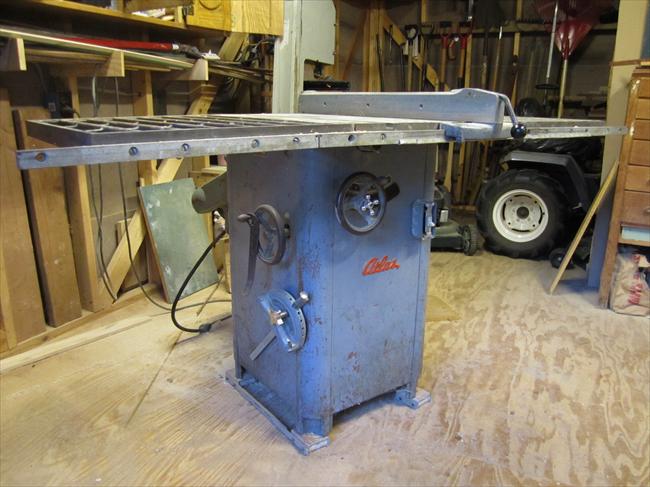
I picked up an old Atlas cabinet saw last year. Model 3160. 10".
It is a fine saw. I use my Unisaw because it is plug and play. However, I saw this for sale and I had to rescue it. You all know I have a weak spot for Atlas tools.
Okay, so a while back I put it up for sale. Thing is, saws like this (especially in its current condition) just don't fetch hardly anything. I primarily wanted to sell it just to get some space in the garage back. However, I've decided to restore it.
I will probably get rid of it in the future, but maybe it will be given to a relative or someone that could really use it. Heck maybe it could even be a 'Garage Journal' give-a-way or something like that to keep the cool 'pay-it-forward' vibes going. In any case, I am making a post about it so that you can all keep me accountable.
It will go slow, but it will get done.
Here is what a put-together Atlas 3160 looks like:
And here is what my sad little saw looks like:
These are actually pretty cool saws. The cabinet saw (any cabinet saw) is my favorite type of tool. I don't see myself owning 5 jointers, or 5 band saws, or 5 planers, or 5 whatever else. But I could see myself owning 5 table saws...from a collectible and functional point of view.
Here are the guts(EDIT: wow, terrible picture!):
This is a well designed saw. It has two main flaws. The tilt actuation piece and trunions are made out of zamak, which I believe is a distant cousin of pot metal. Heaven only knows why many of the saws of this day had one of its most important components (trunions) made out of anything less that solid steel. Actually, I do know. Cost

All that being said, if someone was to machine steel trunions and the t-bolt for the tilt screw, this saw would be absolutely bomb proof. As it is, though, it is pretty stout. I like it.
Some more disassembly:
The guts are mounted to the underside of the table, so it is a little less 'cabinet saw-ish' and more 'bench saw-ish' with a floor cabinet. Which isn't a bad thing. I do believe it helps with rigidity, but makes aligning the blade to the miter slot a little more touchy.
Here is the cabinet with everything (original and non-ugly) removed:
As you can see, the cabinet base had random wheels bolted on. These will be removed and holes patched.
Since the bottom of the saw cabinet is pretty rusty, I'm going to used electrolysis to removed the bottom 4" of rust. Everything else can get touched up by a wire wheel and sandpaper, but it would be pretty hard to get all the rust out of the nooks and crannies of the feet.
More pictures to follow...