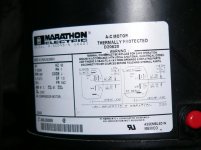
The suggestions about reading nameplate FLA's from the motor nameplate and then comparing actual voltages and currents during the start-up and in steady state are right on. I don't recall in any of these threads if your problem was only at start-up or also later while running. I will assume it is only at start-up.
Upon start-up of the motor, while it is not rotating, the only current limiting component is the resistance of the circuit - building wiring, a/c lead cord, and the motor windings. So here's an example for this case - lets say you have 2 ohms total in the above circuit. 120 volts/2 ohms = 60 amps initially at startup. As the motor starts to rotate, inductive reactance builds and the 60 amps reduces to ~12amps. This case only happens if the time-curve of the cb will provide enough time before opening the breaker.
Now lets add the extension cord into the circuit and maybe even go to a different receptacle -further away from a panel and even wired with #14. So this overall circuit has maybe 1 ohm more. 120 volts/ (2+1 ohms) = 40 amps. As the motor starts to rotate, inductive reactance builds and the 40 amps reduces to ~12 amps. This case happens because the time-curve of the cb provides enough time going from 40 to 12, so the breaker doesn't open while the circuit is reducing the start-up current.
Sure changing to a 30 Amp cb fixes this by applying a different time curve to the circuit, but the problem is you will be violating the NEC by protecting a 20 A receptacle with a 30 A cb. The code only allows for increasing breaker sizes on dedicated motor circuits. Dedicated means that there is only a motor connected to that circuit and that is accomplished by hard-wiring the motor into the circuit - meaning there is no receptacle for anyone to conveniently add or change anything in the motor circuit.
Since you need the compressor to be portable, hard-wiring this doesn't work for you.
You could change it over to 240 volts but again this has limitations on portability because you wont find 240 v recepts as easily as 120v recepts.
Since this compressor can plug into a 15 Amp receptacle, it has to have a nameplate FLA of 12 amps or less (continuous) - because no load can exceed 80% of the circuit rating by code. 15A x 80% = 12A. (If it had a 20 Amp plug, the nameplate FLA's would be 16 Amps max.)
Taking voltage and current readings appears to be out of your comfort zone, you can't go much further to get facts about what is actually happening.
Since the design of the compressor is to run reliably on the circuit for which it is designed and tested for, I suspect that the motor is drawing too much current for any of these reasons: starting capacitor is out of spec, start winding has a slight short between wraps (which reduces initial resistance and lowers the inductance), the unloader valve is not fuctioning properly some or all of the time, maybe even the compressor head has issues. Even the supply voltage could be high - once in a while my voltage is 125V-summertime.
You could take the entire compressor to a motor shop and let them look at it but you'll spend a few bucks.
If you really feel compelled to do something yourself, you could open up the motor and read the ratings off of the capacitors (microfarad and working voltage values) and replace them - they're cheap - go to graingers.
But your easiest solution to get rid of the symptoms is to add in the extension cord to the circuit (never thought i'd ever say that!). This way you get a new extension cord to use around the house, no code violations, compressor remains portable, you remain healthy, you save a few bucks without being penny-wise, pound-foolish, and no more time buried into this problem.
So if you do nothing more than add the extension cord and the motor is having issues that could get worse over time, the unit is grounded and it should have internal overload protection built in to shut it down. Then you'll spend some money, since the warranty/return period has already expired.