
You are using an out of date browser. It may not display this or other websites correctly.
You should upgrade or use an alternative browser.
You should upgrade or use an alternative browser.
Above 1200 Sq/FT Restored 1930's Auto Shop
- Thread starter BB767
- Start date
Wokspaces above 1200 squarefeet.
ZRX61
Well-known member
I'm suprised you didn't do one with casters that lock Thomas. It would make a good movable work surface if you needed to do something under a car or for fitting something that's not near the benches.
What he said. I'd have cut the legs down on one & fitted wheels so it ends up as the same height as the others...
... & a bit of sanding on the plywood... & some BLO...

landroversforever
Well-known member
- Joined
- Jan 27, 2011
- Messages
- 86
On the one hand I'm surprised Thomas hasn't done that with one bench on castors... but I'm sure he has something up his sleeve! (must be a big sleeve!!)
Scuderia-F1
Well-known member
These new benches looks really great, can´t go wrong with powdercoat!
realvc
Well-known member
I knew there would be some powder coating involved when you posted the first pictures of your new tables.
Looking good Thomas, that blue theme is very nice in your barn.
Looking good Thomas, that blue theme is very nice in your barn.
I'm suprised you didn't do one with casters that lock Thomas. It would make a good movable work surface if you needed to do something under a car or for fitting something that's not near the benches.
What he said. I'd have cut the legs down on one & fitted wheels so it ends up as the same height as the others...
... & a bit of sanding on the plywood... & some BLO...
Thanks guys for the input, I did think about it so we're all on the same page. The original intent was to have a stable, solid, nice size work surface. I already have a several (5) smaller wheeled carts, work surfaces, benches or what ever you want to call them and honestly I thought these new benches would have been too big. Each one is 34" (86 cm) X 53" (135 cm) and that size would have been hard to maneuver up close and personal. The blue ones are right next to the lift and work very well in that spot. Your ideas have merit and I've been pondering something similar for some time. As I spend some time in the barn and gain experience working out there I'll have a better idea of just what I need.
Rick, the plywood was soaked through and stained with oil, edges chipped and splintered in some spots and just nasty appearing. No amount of sanding was going to clean that wood up unfortunately. I did arrive at a solution that wasn't as fast as just sanding and applying some linseed oil but it did work out well so no harm done.
Thomas
On the one hand I'm surprised Thomas hasn't done that with one bench on castors... but I'm sure he has something up his sleeve! (must be a big sleeve!!)
If you look back back near the beginning of this thread...
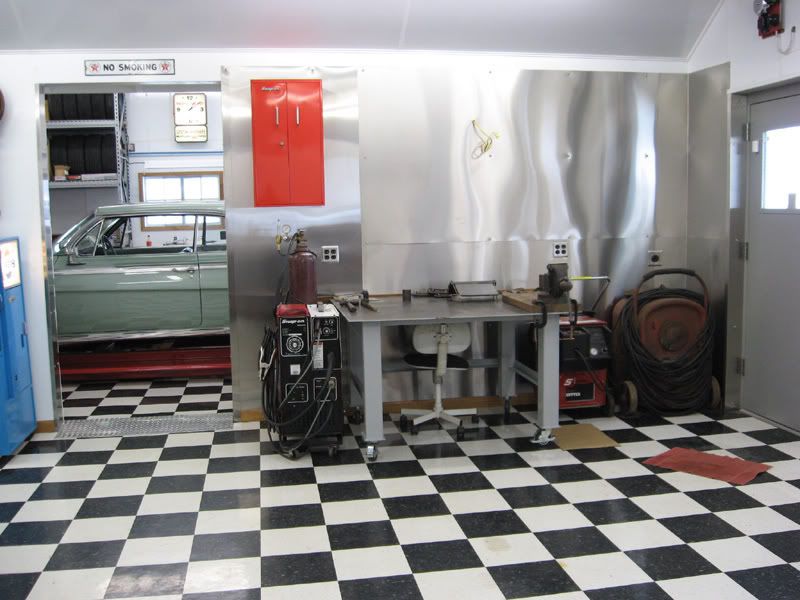
...you'll see that the welding bench is indeed on locking casters. That was the first bench fabricated out there. But I do have other things up my sleeve, stay tuned.
Thomas
These new benches looks really great, can´t go wrong with powdercoat!
I knew there would be some powder coating involved when you posted the first pictures of your new tables.
Looking good Thomas, that blue theme is very nice in your barn.
You are so right, how can you possibly go wrong with powder coat?

realvc that blue theme just happened, it wasn't planned........at first. I already had the blue tool box for several years in another building, that was the color Rotary supplied those lifts in and the air line was standard issue blue. The only thing I had a color choice in was the air compressor and by then I figured why fight it, blue it shall be.
Thomas
ihredo4
Well-known member
Since no one else has asked I will...Did you clock those screws holding the wood on the workbenchs? LOL
ZRX61
Well-known member
Each one is 34" (86 cm) X 53" (135 cm) and that size would have been hard to maneuver up close and personal.
We have a couple that are 4x8ft built from 4x4 & 2x6's with plywood tops down at the airport. You'd be surprised how handy having one that big on wheels can be
Nuts
Well-known member
I can't believe you leaned that crusty plywood on the car 
Thomas I thoroughly enjoy checking in and seeing what you and Chris are up to, thanks for putting up with us giving you heck about your alignment issues.
Doug

Thomas I thoroughly enjoy checking in and seeing what you and Chris are up to, thanks for putting up with us giving you heck about your alignment issues.
Doug
markviii
Well-known member
Nuts - you missed the piece of cardboard between that crusty plywood and the car!
Since no one else has asked I will...Did you clock those screws holding the wood on the workbenchs? LOL
I can't believe you leaned that crusty plywood on the car
Thomas I thoroughly enjoy checking in and seeing what you and Chris are up to, thanks for putting up with us giving you heck about your alignment issues.
Doug

Nuts - you missed the piece of cardboard between that crusty plywood and the car!
Is she a great wife or what? She knew there was NO WAY in the world I would have leaned plywood against that car. And even with the cardboard there for protection (circled in red) the plywood was placed very gingerly. Just thinking about it is like fingernails down a chalk board to me.
Doug I can't believe you would think I'd do something sacrilegious like that, shocked!!

Now about those alignment issues, do you suppose Chris knows?
Hope everyone is having as much fun here as Chris and I are, yup living the dream.............
Thomas
We have a couple that are 4x8ft built from 4x4 & 2x6's with plywood tops down at the airport. You'd be surprised how handy having one that big on wheels can be
My point exactly.
 It may seem rather large but if you do a clutch job you've got enough room to lay all the parts out along with the tools and work from either end of the lift.
SPOSE project Part 2.
With all the original plywood tops and shelves re-installed, screws all properly clocked......... (just kidding), it was time to address the poor visual appearance of that oil stained plywood.

This was done by just covering it up with new 3/4" plywood on the tops.

Now the tops were 1 1/2" (3.8 cm) thick, very solid and rigid and the added weight helped make the benches more stable. With that new plywood screwed to the original wood I addressed the exposed edges of the plywood.

Back to my wood shop where banding material was cut.

The smaller thin pieces were used for banding the lower shelves.They are 1/4" (.6 cm) X 1" (2.5 cm). Note the vast differences in the grain pattern in the thin strips and yet all those pieces came from the same board. The wood was Sycamore.

Thicker material was used for banding the tops. They are 3/4" (1.9 cm) X 2" (5.1 cm) all Sycamore.

Here you can see the two pieces of plywood and the banding material that will be attached to the edges. Note the contrast between the old, oil soaked wood and the new wood.


This view from the end shows how the edges of the plywood will be hidden. Also note that the banding material extends about 1/8" (.3 cm) above the top of the plywood.

All of the plywood is going to be covered with sheets of 1/8" tempered Masonite. The Masonite is a sacrificial top piece that if it gets gouged, torn or damaged in any way can be easily replaced with new Masonite. That way the expensive, harder to replace plywood underneath is protected and the bench tops can periodically be renewed quickly, easily and inexpensively. I attached the banding either flush with the Masonite or just slightly below it (as seen here) so if an object is slid off the edge of the top it won't snag the banding and perhaps loosen it from the edge of the plywood.

Here's a test piece to see what it looks like with a full sheet of Masonite.

Glued mitered corners were used on the top corners. The banding was installed with brads using a pneumatic nailer.

Here all the top banding was installed.

Next the Masonite sheets were fitted.

Here the banding extending up past the top is seen. This is what will hold the Masonite in place and keep it from sliding around.


I managed to get pretty good corner miters and Masonite fitment most everywhere. Fussing with the corners took the most time. I kept telling myself these are just work benches and not fine furniture, but for me it's still difficult sometimes to know when it's good enough. So I find I am willing to spend a bit of extra time and get it where I'm quite happy with it.

For the lower shelves I didn't put additional plywood on them, just covered the old plywood with an overlay of 1/8" Masonite. Here the Masonite is being fitted.


This is the lower shelf banding...

...which will hold the Masonite in place.

That's it for Part 2. Standby for the final phase. Can I really install the anvil in a secret, hidden compartment in one of the benches and what about a built in wash bay for Gus? You'll just have to check back and see for yourselves.
Thanks everyone.
Thomas
With all the original plywood tops and shelves re-installed, screws all properly clocked......... (just kidding), it was time to address the poor visual appearance of that oil stained plywood.
This was done by just covering it up with new 3/4" plywood on the tops.
Now the tops were 1 1/2" (3.8 cm) thick, very solid and rigid and the added weight helped make the benches more stable. With that new plywood screwed to the original wood I addressed the exposed edges of the plywood.
Back to my wood shop where banding material was cut.
The smaller thin pieces were used for banding the lower shelves.They are 1/4" (.6 cm) X 1" (2.5 cm). Note the vast differences in the grain pattern in the thin strips and yet all those pieces came from the same board. The wood was Sycamore.
Thicker material was used for banding the tops. They are 3/4" (1.9 cm) X 2" (5.1 cm) all Sycamore.
Here you can see the two pieces of plywood and the banding material that will be attached to the edges. Note the contrast between the old, oil soaked wood and the new wood.
This view from the end shows how the edges of the plywood will be hidden. Also note that the banding material extends about 1/8" (.3 cm) above the top of the plywood.
All of the plywood is going to be covered with sheets of 1/8" tempered Masonite. The Masonite is a sacrificial top piece that if it gets gouged, torn or damaged in any way can be easily replaced with new Masonite. That way the expensive, harder to replace plywood underneath is protected and the bench tops can periodically be renewed quickly, easily and inexpensively. I attached the banding either flush with the Masonite or just slightly below it (as seen here) so if an object is slid off the edge of the top it won't snag the banding and perhaps loosen it from the edge of the plywood.
Here's a test piece to see what it looks like with a full sheet of Masonite.
Glued mitered corners were used on the top corners. The banding was installed with brads using a pneumatic nailer.
Here all the top banding was installed.
Next the Masonite sheets were fitted.
Here the banding extending up past the top is seen. This is what will hold the Masonite in place and keep it from sliding around.
I managed to get pretty good corner miters and Masonite fitment most everywhere. Fussing with the corners took the most time. I kept telling myself these are just work benches and not fine furniture, but for me it's still difficult sometimes to know when it's good enough. So I find I am willing to spend a bit of extra time and get it where I'm quite happy with it.
For the lower shelves I didn't put additional plywood on them, just covered the old plywood with an overlay of 1/8" Masonite. Here the Masonite is being fitted.
This is the lower shelf banding...
...which will hold the Masonite in place.
That's it for Part 2. Standby for the final phase. Can I really install the anvil in a secret, hidden compartment in one of the benches and what about a built in wash bay for Gus?
You'll just have to check back and see for yourselves. Thanks everyone.
Thomas
Nuts
Well-known member
Is she a great wife or what? She knew there was NO WAY in the world I would have leaned plywood against that car. And even with the cardboard there for protection (circled in red) the plywood was placed very gingerly. Just thinking about it is like fingernails down a chalk board to me.
Doug I can't believe you would think I'd do something sacrilegious like that, shocked!!
Now about those alignment issues, do you suppose Chris knows?
Hope everyone is having as much fun here as Chris and I are, yup living the dream.............
Thomas
Thomas and Chris, I kid I joke, it's a gift.
Looking forward to some anvil storage.
Doug
Scuderia-F1
Well-known member
You keep impressing me Thomas, that is going to be some VERY nice workbenches Thomas. Very clever idea with the easy to change masonite too.
realvc
Well-known member
Thomas, putting the protective Masonite covering on the workbenchs is really "Over the Top"
I thought you would do something pretty cool with the work bench tops and you did.
Way to go on the cardboard between the plywood and your Chevy II.
I thought you would do something pretty cool with the work bench tops and you did.
Way to go on the cardboard between the plywood and your Chevy II.
Stuart in MN
Well-known member
Masonite is great stuff for bench tops. It's really durable and stands up well to oil and grease.
Thomas and Chris, I kid I joke, it's a gift.
Looking forward to some anvil storage.
Doug
Doug never fear, I completely understand the joke. It's the hallmark of our friendship that we can all kid around like that. Hope you didn't take my remarks too seriously! I've had a couple of PM's from folks concerned I might take some comments the wrong way. Never gonna happen, so no worries everyone. You're having fun here and I defiantly am having fun so carry on.

Now excuse me, I'm struggling with how to get the anvil tucked behind one of those bench legs.

Thomas
Omphaloskeptic
Well-known member
The anvil will be powder coated blue too, won't it Thomas?
Tell me more
about sycamore
Seriously, I've never worked with it. Did you choose it for any particular reason? I'm guessing you didn't buy it at a big box store.
Correct I didn't get it locally but from a regional lumber mill that cut their own logs. That was back in the late 1970's. I needed some secondary wood, Poplar in this case, and while I was at the mill I found a few hundred board feet of Sycamore they had for a very good price. It was mostly wide boards that some hadn't dried very straight. However when cut into narrow, shorter boards it could be straighten up and would work just fine for a project like the banding on those benches. For the banding I wanted lighter color wood to contrast with the dark Masnoite and I had some of that Sycamore left so that's how it got selected.
Now if you want me tell you more about Sycamores,
well, here goes.......Platanus occidentalis, also known as American Sycamore, American planetree, Occidental plane, and Buttonwood, is one of the species of Platanus native to North America. It is usually called Sycamore in North America, a name which can refer to other types of tree in other parts of the world.
Description
An American sycamore tree can often be easily distinguished from other trees by its mottled exfoliating bark, which flakes off in great irregular masses, leaving the surface mottled, and greenish-white, gray and brown. The bark of all trees has to yield to a growing trunk by stretching, splitting, or infilling; the Sycamore shows the process more openly than many other trees. The explanation is found in the rigid texture of the bark tissue, which lacks the elasticity of the bark of some other trees, so it is incapable of stretching to accommodate the growth of the wood underneath and the tree sloughs it off.
A sycamore can grow to massive proportions, typically reaching up to 30 to 40 meters (98 to 130 ft) high and 1.5 to 2 meters (4.9 to 6.6 ft) in diameter when grown in deep soils. The largest of the species have been measured to 51 meters (167 ft), and nearly 4 meters (13 ft) in diameter. Larger specimens were recorded in historical times. In 1770, near the junction of the Kanawha and Ohio Rivers, George Washington recorded in his journal a sycamore measuring nearly 45 feet (14 m) in circumference at 3 feet (91 cm) from the ground.
The lower sycamore tree trunk is often very free from branches. Spreading limbs at the top make an irregular, open head. Roots are fibrous. The trunks of large trees are often hollow.
Another peculiarity is the way the leaves grow sticky, green buds. In early August, most trees in general will have—nestled in the axils of their leaves—the tiny forming bud which will produce the leaves of the coming year. The sycamore branch apparently has no such buds. Instead there is an enlargement of the petiole which encloses the bud in a tight-fitting case at the base of the petiole.
Platanus occidentalis GS344.png
The characteristic bark of an American Sycamore
Bark: Dark reddish brown, broken into oblong plate-like scales; higher on the tree, it is smooth and light gray; separates freely into thin plates which peel off and leave the surface pale yellow, or white, or greenish. Branchlets at first pale green, coated with thick pale tomentum, later dark green and smooth, finally become light gray or light reddish brown.
Wood: Light brown, tinged with red; heavy, weak, difficult to split. Largely used for furniture and interior finish of houses, butcher's blocks. Sp. gr., 0.5678; weight of cu. ft., 35.39 lbs.
Winter buds: Large, stinky, sticky, green, and three-scaled, they form in summer within the petiole of the full grown leaf. The inner scales enlarge with the growing shake. There is no terminal bud.
Leaves: Alternate, palmately nerved, broadly-ovate or orbicular, four to nine inches long, truncate or cordate or wedge-shaped at base, decurrent on the petiole. Three to five-lobed by broad shallow sinuses rounded in the bottom; lobes acuminate, toothed, or entire, or undulate. They come out of the bud plicate, pale green coated with pale tomentum; when full grown are bright yellow green above, paler beneath. In autumn they turn brown and wither before falling. Petioles long, abruptly enlarged at base and inclosing the buds. Stipules with spreading, toothed borders, conspicuous on young shoots, caducous.
Flowers: May, with the leaves; monoecious, borne in dense heads. Staminate and pistillate heads on separate peduncles. Staminate heads dark red, on axillary peduncles; pistillate heads light green tinged with red, on longer terminal peduncles. Calyx of staminate flowers three to six tiny scale-like sepals, slightly united at the base, half as long as the pointed petals. Of pistillate flowers three to six, usually four, rounded sepals, much shorter than the acute petals. Corolla of three to six thin scale-like petals.
Stamens: In staminate flowers as many of the divisions of the calyx and opposite to them; filaments short; anthers elongated, two-celled; cells opening by lateral slits; connectives hairy.
Pistil: Ovary superior, one-celled, sessile, ovate-oblong, surrounded at base by long, jointed, pale hairs; styles long, incurved, red, stigmatic, ovules one or two.
Fruit: Brown heads, solitary or rarely clustered, an inch in diameter, hanging on slender stems three to six inches long; persistent through the winter. These heads are composed of akenes about two-thirds of an inch in length. October.
Distribution
In its native range, it is often found in riparian and wetland areas. The range extends from Iowa to Ontario and Maine in the north, Nebraska in the west, and south to Texas and Florida. Closely related species (see Platanus) occur in Mexico and the southwestern states of the U.S.A. It is sometimes grown for timber, and has become naturalized in some areas outside its native range. It has grown well in Bismarck, North Dakota,[3] and is sold as far south as Okeechobee. The American Sycamore is also well adapted to life in Argentina and Australia and is quite widespread across the Australian continent especially in the cooler southern states such as Victoria and New South Wales.
Uses
A sycamore in winter.
The sycamore is able to endure a big city environment and has been extensively planted as a shade tree. It bears transplanting well and grows rapidly.
Investigations have been made into its use as a biomass crop.
Propagation and pests
The American sycamore is a favored food plant of the pest sycamore leaf beetle.
Diseases
Old sycamores can have massive trunks
American sycamore is susceptible to Plane anthracnose disease (Apiognomonia veneta, syn. Gnomonia platani), an introduced fungus naturally found on the Oriental plane P. orientalis, which has evolved considerable resistance to the disease. Although rarely killed or even seriously harmed, American sycamore is commonly partially defoliated by the disease, rendering it unsightly as a specimen tree.
The disease makes its appearance soon after the leaves have expanded, appearing in the form of small black spots which lie close to the veins. As a result, the half grown leaves turn brown, shrivel, and fall. It is very common in early July to see these trees putting forth their second crop of leaves while the first hang brown, dead, and unsightly on the ends of the branches. This greatly shortens the effective growing season for the plant.
As a result of the fungus' damage, American sycamore is not often planted; the more resistant London plane (P. x hispanica; hybrid P. occidentalis x P. orientalis) being preferred instead.
History
The terms under which the New York Stock Exchange was formed are called the "Buttonwood Agreement", because it was signed under a buttonwood (sycamore) tree at 68 Wall Street, New York City, in 1792.
The sycamore made up a large part of the forests of Greenland and Arctic America during the Cretaceous and Tertiary periods. It once grew abundantly in central Europe, from which it has now disappeared. It was brought to Europe early in the 17th century.
Hope that gives you enough information.
Thomas
Last edited:
The anvil will be powder coated blue too, won't it Thomas?
Well, duh......................................
Thomas who never met a powder coater he didn't like.
Masonite is great stuff for bench tops. It's really durable and stands up well to oil and grease.
What Stuart in MN said and the best part.................wait for it..................it's relatively cheap. !/8", 4' X 8' tempered sheet, about $15.
Thomas
ZRX61
Well-known member
Sycamore = weeds...
I just started reading about your garage and this and its my first post on here as I just joined yesterday ........ amazing build .....just amazing...My Dad keeps our family's 50 year old transmission business alive here in Johnson City N.Y. This post has made me realize at the young/dumb age of 26 that maintaining/restoring the shop is as equally important as the same as we drive into our customers/family/friends heads about there cars! also we have many things here that have not been touched in ???years taking up "our" space but other people can use that will not be thrown out... thank you so much and if u keep posting Ill keep reading!!!....once I catch up I have a couple hundred pages to go
arcticfireinside I'm a little late in acknowledging you joining our crew here (Omphaloskeptic beat me to it
) but if you just started reading you won't get to this post for a while I suppose. I note with interest your Dad's shop is in Johnson City. Wonder if Johnson's Welding and Repair had any special appeal to you? It's never too late to organize the shop and weed out unused items that others would put to good use. Keep us advised of your progress and pictures never hurt here. Happy reading and say hi to Dad for me. Welcome to our slice of heaven here.
Thomas
type47fan
Member
The anvil will be powder coated blue too, won't it Thomas?
Maybe powder coat the base, but . . . the anvil itself, being the fine tool that it is, should be afforded the . . . oil quench procedure. Shouldn't be too difficult to heat that mass to a dull glow 15 or 20 times, alternately dunking it into a 100 gallon tank of oil

Maybe powder coat the base, but . . . the anvil itself, being the fine tool that it is, should be afforded the . . . oil quench procedure. Shouldn't be too difficult to heat that mass to a dull glow 15 or 20 times, alternately dunking it into a 100 gallon tank of oil
Just kidding Wayne, just kidding, honest, cross my heart. But say, now that you mention it..........about that oil quenching that Rick does, so very well..............and we all know how fond of anvils he is.........hmm............
What'd say Rick, we'll put you up when you come out and you can have all the soda you can drink. Deal??
Thomas
PlekVis
Member
Now excuse me, I'm struggling with how to get the anvil tucked behind one of those bench legs.
Thomas
deja vu?
rlwhitetr3b
Well-known member
Now if you want me tell you more about Sycamores,
Hope that gives you enough information.
Thomas
Ok, we now have about three pages of questions on the test about Sycamores!
deja vu?
Quite so. I guess when you're moving a 230+ lbs anvil by yourself you inevitably will describe it as a struggle.
Thomas
Ok, we now have about three pages of questions on the test about Sycamores!
Well don't blame me, onething asked the question. I just answered it. It's all his fault, blame him.
I'm just the innocent pilot in all this.Thomas
onewaydave
Well-known member
Nice treatise on the Sycamore. I only disagree with one part. From Tennessee to Kansas they usually have a single massive trunk and don't branch until about 25-30' up.
It is also hard to dry as it likes to split. Need to coat the cut ends almost before shutting down the chain saw.
I harvested some stumps left on the curb for trash in Memphis in 1996. The product is going in as trim in the cherry cabinets I'm building right now. That's satisfaction.
Dave, the innocent _______ in everything.
It is also hard to dry as it likes to split. Need to coat the cut ends almost before shutting down the chain saw.
I harvested some stumps left on the curb for trash in Memphis in 1996. The product is going in as trim in the cherry cabinets I'm building right now. That's satisfaction.
Dave, the innocent _______ in everything.
Correct I didn't get it locally but from a regional lumber mill that cut their own logs.
blah blah blah
For the banding I wanted lighter color wood to contrast with the dark Masnoite and I had some of that Sycamore left so that's how it got selected.
Now if you want me tell you more about Sycamores,
wikipedia blah blah blah
In its native range, it is often found in Texas.
History
The terms under which the New York Stock Exchange was formed are called the "Buttonwood Agreement", because it was signed under a buttonwood (sycamore) tree at 68 Wall Street, New York City, in 1792.
Hope that gives you enough information.
Thomas
Too soon in the relationship?
Everybody else dog piled you.Would you consider it a relatively hard wood? Yes or no will do
Nice treatise on the Sycamore. I only disagree with one part. From Tennessee to Kansas they usually have a single massive trunk and don't branch until about 25-30' up.
It is also hard to dry as it likes to split. Need to coat the cut ends almost before shutting down the chain saw.
I harvested some stumps left on the curb for trash in Memphis in 1996. The product is going in as trim in the cherry cabinets I'm building right now. That's satisfaction.
Dave, the innocent _______ in everything.
Absolutely spot on onewaydave about the typical single massive trunk. That correction has been made. As a fun fact for the quiz, Chris and I use to own some land near here that had the largest Sycamore in Champaign County growing on it. At 5' above the ground the trunk measured over 42" in diameter. The first main branch was easily 30' up. We sold that land a long time ago but go for a visit ever so often and that tree is still flourishing, towering over everything else. The bark is awfully messy though. Because it splits so easily it would be best to harvest in late fall through early spring if you can and even then you'll get checks and splits. Just can't be helped.
I can only imagine the grain pattern that would come from stump wood. Nice work saving it from the landfill and putting it to good use.
Thomas
Too soon in the relationship?
Would you consider it a relatively hard wood? Yes or no will do
Seriously, all kidding aside can I hedge and just say not really. I personally think of it as kind of in between if you will. As such I consider it a secondary wood.
Hey thanks for the questions. If you asked them undoubtedly others wondered too. Sorry if I wise a$$ed your original question. Chris told me behave and play nice.
Honestly, I thank you for your interest and I hope I was helpful.Thomas
SPOSE project Part 3.
With the Masonite fitting so close all around to the banding it would be very difficult to remove it when you needed to, even though it's not fastened down, but laying there loose. You can't get hold of an edge. So here's the solution I came up with to keep from gouging up the edge of the banding while trying to prey up and remove the masonite.

Note the hole circled in red. It's drilled all the way through both pieces of plywood.

That hole is big enough for a screwdriver, pencil etc...

... so I can just push the Masonite up from below and then it's easy to remove since it's not fastened down.

Generally I've always liked to stain wood which brings out that beautiful grain pattern, the Barn Bench top being an exception. The horizontal band board on top is stained while the vertical one is not yet. I used a natural stain on these benches which didn't color the wood but brought out any natural color it had and enhanced the grain.

I sealed the bands with Varathane satin clear Floor Finish, same as I used on the Barn Bench top. Since I don't consider Sycamore all that hard a wood, Varathane will help compensate and provide a hard, durable finish.

Varathane is somewhat thick and since I had a close fit with the Masonite I didn't want any build up on the backside of the banding. It's best to keep the Varathane out all together, rather than remove it afterward. I used this small wood block to keep it off the backside while the finish was being applied.

Just slide it along as finish was brushed on.

As some finish will creep over the top edge of the board I followed up with a putty knife wrapped with a paper towel and removed any residual finish. I applied 3 coats of finish and if I wasn't diligent about keeping it cleaned out, it would have built up such that the Masonite couldn't fit nice and close to the banding.

Hand sanding the first coat with 220 and then using 320 to finish the last 2 coats. I vacuumed the bulk of the saw dust and used a tack cloth to wipe down the surface just before each new coat was applied.

To keep from getting anything on the Masonite it was removed while staining and finishing.


Once the finish had dried The Masonite was re-installed. You can see if there was any build up of Varathane on the backside of the banding I wouldn't get that nice tight fit.


The lower shelves.

To keep the two benches together I just used some clamps underneath.

With the clamps installed they'er pretty unobtrusive. If I need to separate the benches it can be done quickly and easily. I still need to fill the holes left by the brads but with all our picture framing supplies I'll be able to get a pretty exact match.

Here a Sow's Ear...

...and here...

...maybe...

... a Silk Purse or at least close? While the benches were perfectly functional before I value visual aesthetics as well. Now I have a large, solid work surface right next to the lift.

When you first enter the barn what you see is this working corner. I think it sets a good "tone" and inspires one to work to a high standard. Slowly getting the barn all set up. Joe I have been working in the tool shed and there are more projects on the way, please check back.
Thanks again everyone for all your interest.
Thomas
With the Masonite fitting so close all around to the banding it would be very difficult to remove it when you needed to, even though it's not fastened down, but laying there loose. You can't get hold of an edge. So here's the solution I came up with to keep from gouging up the edge of the banding while trying to prey up and remove the masonite.
Note the hole circled in red. It's drilled all the way through both pieces of plywood.
That hole is big enough for a screwdriver, pencil etc...
... so I can just push the Masonite up from below and then it's easy to remove since it's not fastened down.
Generally I've always liked to stain wood which brings out that beautiful grain pattern, the Barn Bench top being an exception. The horizontal band board on top is stained while the vertical one is not yet. I used a natural stain on these benches which didn't color the wood but brought out any natural color it had and enhanced the grain.
I sealed the bands with Varathane satin clear Floor Finish, same as I used on the Barn Bench top. Since I don't consider Sycamore all that hard a wood, Varathane will help compensate and provide a hard, durable finish.
Varathane is somewhat thick and since I had a close fit with the Masonite I didn't want any build up on the backside of the banding. It's best to keep the Varathane out all together, rather than remove it afterward. I used this small wood block to keep it off the backside while the finish was being applied.
Just slide it along as finish was brushed on.
As some finish will creep over the top edge of the board I followed up with a putty knife wrapped with a paper towel and removed any residual finish. I applied 3 coats of finish and if I wasn't diligent about keeping it cleaned out, it would have built up such that the Masonite couldn't fit nice and close to the banding.
Hand sanding the first coat with 220 and then using 320 to finish the last 2 coats. I vacuumed the bulk of the saw dust and used a tack cloth to wipe down the surface just before each new coat was applied.
To keep from getting anything on the Masonite it was removed while staining and finishing.
Once the finish had dried The Masonite was re-installed. You can see if there was any build up of Varathane on the backside of the banding I wouldn't get that nice tight fit.
The lower shelves.
To keep the two benches together I just used some clamps underneath.
With the clamps installed they'er pretty unobtrusive. If I need to separate the benches it can be done quickly and easily. I still need to fill the holes left by the brads but with all our picture framing supplies I'll be able to get a pretty exact match.
Here a Sow's Ear...
...and here...
...maybe...
... a Silk Purse or at least close? While the benches were perfectly functional before I value visual aesthetics as well. Now I have a large, solid work surface right next to the lift.
When you first enter the barn what you see is this working corner. I think it sets a good "tone" and inspires one to work to a high standard. Slowly getting the barn all set up. Joe I have been working in the tool shed and there are more projects on the way, please check back.
Thanks again everyone for all your interest.
Thomas
Last edited:
Bob Heine
ALLIANCE MEMBER
The dead-end street I grew up on had a sycamore in the vacant lot at the intersection. Nailed 2x4s to the trunk to create toe-holds. Never measured the trunk but it was huge. Just climbing to the first set of branches was scary. A fall from half way up the ladder was my first experience knocking myself out. Pretty sure it was permanent brain damage 'cause my mind don't work so well anymore....
But I don't climb trees anymore either.
But I don't climb trees anymore either.
tdkkart
Well-known member
SPOSE
Boy, would I like to be the first person to flop an old greasy powerglide up on that bench and then roll it around till all the fluid ran out of it.........

