To avoid these ads, REGISTER NOW!

Have You Ever Been Shocked By Your Tools?

The Shop

Active member
Joined
Mar 2, 2012
Messages
43
Location
Texas
Well, yesterday my Grandfather's old cast iron Georgia Tech bench grinder finally shocked me while I was using it. But, I knew that it was probably going too happen for a awhile because every time I turned it on you could see sparks fly inside the motor until it got up to speed. I Guess it's time for a rebuild. :D So, has anyone else been shocked by there tools? And shocked by tool prices don't count. :lol:
 
To avoid these ads, REGISTER NOW!

ZRX61

Well-known member
Joined
Aug 15, 2006
Messages
28,716
Location
Solar Blight Valley, SoCal
Yup, brand new SnapOn grinder in the UK many years ago, 240v @13a threw me across the workshop. ******* screws that held it together were live, was VERY tempted to beat the SO guy to death with it.
 

Trucky

Well-known member
Joined
Apr 26, 2011
Messages
1,747
Bridgeport mill.. man... a good portion of my hand was black for a while.

I'm very careful around electricity.. and thus I leave it to the pros from now on until I feel comfortable with it.
 

Brian_B_

Well-known member
Joined
May 12, 2012
Messages
505
Location
North Central, AR
Yes..not bad though. The steel fab shop I worked in for years was not wired right. The mig welders would shock you if you touched the metal body. Not a bad shock..but enough to make you not do it again for a while.

One guy had an air hose that was steel braided around the liner. It got a bad spot and you could see the wires. Hold that close to one of the wall and it would spark to the building (while it was hooked up). I guess it completed the circuit or something???? :headscrat

I do not pretend to understand what the problem was.

That place was scary!
 

Link-Belt

Well-known member
Joined
May 7, 2012
Messages
512
Location
Arlington Texas
Trying to drill holes in cold rolled steel burned up a half dozen kobolt steel bits. Pulled out an old masonry bit it chowed right through it 20 something holes.

Oh sorry I took shocked to mean surprised that the tool profound a task it was not made to do not electrocute.
 
Last edited:

Trucky

Well-known member
Joined
Apr 26, 2011
Messages
1,747
Trying to drill holes in cold rolled steel burned up a half dozen kobolt steel bits. Pulled out an old masonry bit it chowed right through it 20 something holes.

I don't mean to hijack the thread, but what were you cutting this steel on? Drill press, mill? Fixed speed/variable? There could be any number of things that would cause that to happen... but in reality the first thing I'd go to is the bits.. buy some good ones! Not saying that Lowes/Cman bits won't do you fine for home jobs but really at least a decent Norseman set won't hurt next time.

How'd you get shocked? Or do you mean by the performance of your drill bits? :lol:
 

Outlawmws

Well-known member
Joined
Aug 9, 2011
Messages
39,296
Location
The Badlands
One of the more scary ones was when I was using my Portaband to cut a cyclone fence post down the drive way using an extension cord from my garage. The post of course was well grounded and I kept getting buzzed while cutting it. I stooped and spent an hour or two back tracing everything in the circuit. It was inside my damn drill press where it was cross wired hot to return. Once that was unplugged (and corrected a bit later) I stopped getting shocked.

Repeat after me: white to silver, Black to gold (edit: and green to chassis ground)... its just not that damn hard people! :shocking:
 
Last edited:

MrMark

Well-known member
Joined
Jan 25, 2010
Messages
4,626
Location
Southern Cal.
That shouldn't have mattered. Polarity reversal isn't going to hurt you. The motor will just run backwards. Ground fault, meaning live ground wire, meaning live case, is another issue. The fact that the post was in the earth doesn't matter either. Current doesn't go through the earth to return.

I had a US made Dewalt 3/8 drill shock me. It made cracking sounds when I was wire brushing something and I felt little stabs. I thought at first that it was wire from the brush but it was really shocking me. I threw the thing out on the spot. Not worth fooling with.
 
Last edited:

ncfh

Well-known member
Joined
Jul 1, 2011
Messages
777
Long, long ago, Hammerstein Ballroom, NYC. Got a frantic call from backstage that the patch panel was burning. Run back, find the panel pouring smoke, start yanking pins.

Third or fourth one, BAM.

Loose set screw in the handle, hit me HARD. I flew about 10' stopped by a wall. I don't remember anything after running back there and seeing the panel, but apparently I was smoking pretty well myself. Went in my hand and out my knee.

Fortunately I had automated the lighting so well that the TD was able to run the board for me and the show continued uninterrupted.

Now I'm a welder and I say everything is "just a tickle, get back to work." :lol_hitti
 

Alchymist

Well-known member
Joined
Mar 1, 2009
Messages
4,423
Location
Central PA
That shouldn't have mattered. Polarity reversal isn't going to hurt you. The motor will just run backwards. Ground fault, meaning live ground wire, meaning live case, is another issue. The fact that the post was in the earth doesn't matter either. Current doesn't go through the earth to return.

I had a US made Dewalt 3/8 drill shock me. It made cracking sounds when I was wire brushing something and I felt little stabs. I thought at first that it was wire from the brush but it was really shocking me. I threw the thing out on the spot. Not worth fooling with.

Would you care to stand in a puddle of water outside barefoot and grab the hot side of a 110 outlet? NO, not a GFCI......
 

BrokewrenchLS1

Well-known member
Joined
Jul 10, 2011
Messages
1,650
Location
WV
I do a lot of safety testing putting stuff into very unsafe conditions, so it's gotten ingrained into me to always check for voltage with a DMM before I touch anything. Bad electrical design and leakage current testing can make for a nice hot metal enclosure. Some of the stuff we test requires 480Vac 60A service, so screwing around with things isn't a good idea. Another test setup we have is 24Vdc at about 1200A, and that'll melt stuff really quick. Learning to be careful is the first month of training here.

That said, not too long after I started doing testing, I was working on one of the environmental chambers in the lab, and grabbed a 240Vac terminal that was supposed to have been off. Got a nice little zap out of that one. Learned my lesson and I make sure to double-check the mains disconnect being off with a DMM.

I've also had the misfortune of bumping a big metal box right after we did ESD testing on it, and got a nice shock from residual 10,000 volts. Couldn't feel my arm for about 5 hours with that one.
 

lzenglish

Well-known member
Joined
Sep 3, 2009
Messages
616
Location
California
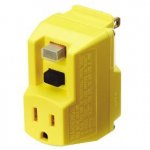
Yes, I have been shocked too many times, so I finally bought one of these. It is a portable GFI unit, that plugs into your outlet, then you plug your tool into it. There are many makes, and models, with wide price variations. I show this one just for referance.

Wayne
 

Attachments

  • $(KGrHqZ,!ngE-5UJRT-wBPzUWPmFEg~~60_1.jpg
    $(KGrHqZ,!ngE-5UJRT-wBPzUWPmFEg~~60_1.jpg
    9.6 KB · Views: 9

Outlawmws

Well-known member
Joined
Aug 9, 2011
Messages
39,296
Location
The Badlands
That shouldn't have mattered. Polarity reversal isn't going to hurt you. The motor will just run backwards. Ground fault, meaning live ground wire, meaning live case, is another issue. The fact that the post was in the earth doesn't matter either. Current doesn't go through the earth to return.

I had a US made Dewalt 3/8 drill shock me. It made cracking sounds when I was wire brushing something and I felt little stabs. I thought at first that it was wire from the brush but it was really shocking me. I threw the thing out on the spot. Not worth fooling with.

Grounding, sometime called "Earth" IS the dirt we stand on for AC. Why do you think ground rods are so important to an AC circuit and it's safety? if the dirt is damp (This was), and something in the circuit is using the tools ground as neutral for instance, it can back feed and get you, and that was what happened here. I was catching the buzz indirectly, or I could have been electrocuted, so I was very lucky....

I don't remember the specifics of what was mis-wired after over 25 years, but it was real, and it was fixed by getting things wired properly.
 
Last edited:

Milton Shaw

Well-known member
Joined
Feb 11, 2011
Messages
4,844
I kept a Volt Alert type tester with me when ever I worked on electrical as it would go off without connection to see if chassis/cabinet/wires had voltage when they were not supposed to. I found many incorrectly wired appliances in a 20 years. Almost all of them were appliances that homeowner/installer had installed the power cord wrong. Some had house wiring faults that left metal parts hot that should have been grounded. Saw a whole apartment house that had been wired wrong from the utility connection, had all the neutrals in 24 apartments with 120 on them. A lot of burned out dishwashers controls when they turned on the power, also a lot of burned out light bulbs that the contractor could not figure out were burning out.
 

eljefino

Well-known member
Joined
Feb 21, 2008
Messages
336
A brand new weedwhacker, think it was a homelite. It was poorly designed and when I stretched my arm/ elbow a certain way the spark plug came up under my arm/shoulder. It had a rubber boot on it but if I was sweaty that boot wasn't enough and I'd get all tingly in relation to the machine's RPM.
 

MrMark

Well-known member
Joined
Jan 25, 2010
Messages
4,626
Location
Southern Cal.
Would you care to stand in a puddle of water outside barefoot and grab the hot side of a 110 outlet? NO, not a GFCI......

Well, you are right, I should have clarified. A tiny amount of current may go through the earth and the water, and of course this tiny amount depends on the resistance path of the earth and the water back to the transformer. The bad thing about electricity is that only a tiny amount that goes through the earth, if it goes through your body first, could kill you. It all depends on how good the return path through your body is.
 
Last edited:
To avoid these ads, REGISTER NOW!

MrMark

Well-known member
Joined
Jan 25, 2010
Messages
4,626
Location
Southern Cal.
Grounding, sometime called "Earth" IS the dirt we stand on for AC. Why do you think ground rods are so important to an AC circuit and it's safety? if the dirt is damp (This was), and something in the circuit is using the tools ground as neutral for instance, it can back feed and get you, and that was what happened here. I was catching the buzz indirectly, or I could have been electrocuted, so I was very lucky....

I don't remember the specifics of what was mis-wired after over 25 years, but it was real, and it was fixed by getting things wired properly.

Ground rods don't do what you think. You first said it was polarity reversal. It couldn't have been that.

Ground rods aren't important for AC circuit and safety. Your house would be just about as safe without them. Your lights intensity may move around a bit but no one is getting killed. Ground rods are for lightning strike and to reference the neutral to earth potential and to dissipate static. They have nothing to do with AC fault clearing.
 
Last edited:

woody 73

Well-known member
Joined
Apr 14, 2009
Messages
11,546
Location
The Great State Up North
Being color blind *****...Darn if I ever ask some practical joker what color the wires are I swear I will jab those wires down their tookass and let them have all the fun that I could have had!:lol:
 

Outlawmws

Well-known member
Joined
Aug 9, 2011
Messages
39,296
Location
The Badlands
Ground rods don't do what you think. You first said it was polarity reversal. It couldn't have been that.

Ground rods aren't important for AC circuit and safety. Your house would be just about as safe without them. Your lights intensity may move around a bit but no one is getting killed. Ground rods are for lightning strike and to reference the neutral to earth potential and to dissipate static. They have nothing to do with AC fault clearing.

And you would be wrong. That ground is there primarily to provide a better path to ground in the unlikely event that the metal chassis of the tool goes hot via a short circuit, You may get a tingle, but you won't be the primary path to ground. Does it help in a lightnig strike? sure, but not it's primary purpose, or places that rarely have lightning wouldn't have cared...

Things like double insulated tools and GFIC is the next gen of safety for that purpose. The reason double insulated tools don't have a ground prong is someone convinced the regulators that it was adequate safety being double insulated.
 

BrokewrenchLS1

Well-known member
Joined
Jul 10, 2011
Messages
1,650
Location
WV
Things like double insulated tools and GFIC is the next gen of safety for that purpose. The reason double insulated tools don't have a ground prong is someone convinced the regulators that it was adequate safety being double insulated.

Double-insulated is acceptable in part because most modern tools have plastic enclosures and there's minimal chance of a person touching a metal part during any single fault condition. There are also a lot more safety standards dealing with tools now than back in the 40s and 50s, or even 70s.

You can operate all sorts of electrical stuff without a ground and 99.9% of the time be perfectly safe, and the majority of the time even a single-fault condition isn't hazardous without a ground, but it's there for the very rare occurrences that get people killed and lead to huge liability lawsuits. Lightning strike systems are a completely different game than normal house ground systems.
 

angzt

Active member
Joined
May 20, 2012
Messages
31
Location
NJ
I once cut a live wire by accident installing an electrical panel with my father. We were on and off with the breakers testing continuity. We forgot to open the one line ...
The nice pair of Snapon dykes now have a nice big hole through them. Luckily they were insulated..... I didn't feel a thing, just lots of sparks and a new pair of underwear.
 

MrMark

Well-known member
Joined
Jan 25, 2010
Messages
4,626
Location
Southern Cal.
And you would be wrong. That ground is there primarily to provide a better path to ground in the unlikely event that the metal chassis of the tool goes hot via a short circuit, You may get a tingle, but you won't be the primary path to ground. Does it help in a lightnig strike? sure, but not it's primary purpose, or places that rarely have lightning wouldn't have cared...

Things like double insulated tools and GFIC is the next gen of safety for that purpose. The reason double insulated tools don't have a ground prong is someone convinced the regulators that it was adequate safety being double insulated.


http://ecmweb.com/bonding-amp-grounding/grounding-vs-bonding-part-2-12


502ecm17fig3.jpg
 
Last edited:

MrMark

Well-known member
Joined
Jan 25, 2010
Messages
4,626
Location
Southern Cal.
And you would be wrong. That ground is there primarily to provide a better path to ground in the unlikely event that the metal chassis of the tool goes hot via a short circuit, You may get a tingle, but you won't be the primary path to ground. Does it help in a lightnig strike? sure, but not it's primary purpose, or places that rarely have lightning wouldn't have cared...

Things like double insulated tools and GFIC is the next gen of safety for that purpose. The reason double insulated tools don't have a ground prong is someone convinced the regulators that it was adequate safety being double insulated.

You fail to understand that the equipment grounding conductor doesn't return to the transformer through the ground rods to any appreciable degree in a proper system. The earth is not a sufficiently low enough impedance path to clear a fault(i.e., open a breaker) or to prevent you from being a viable parallel current path and get shocked or killed. The green ground is there to clear a fault to the metal case and provide a return path ultimately via the neutral back to the transformer. It has nothing to do with ground rods.

That ground wire goes back to the service neutral at the service entrance and gets home to the transformer via that path. Not through any ground rod. The ground rod has nothing to do with preventing you from being shocked despite what you may think.
 
Last edited:

egnorant

Well-known member
Joined
May 2, 2012
Messages
1,805
Location
East Texas
At age 16 I was wet sanding my Mustang with Dads electric pad sander.
Dad always said that car taught me a lot of stupid!

Bruce
 

2oolhound

Well-known member
Joined
Dec 18, 2010
Messages
5,918
Location
BC Canada
I haven't shared this too often but one time when I was doing a photo shoot I got a real bad zap. 1st I'll explain, photographic lights have 2 lights, one a "model light" which is usually 300 to 500 watts and allow the photographer to see where the shadows are. 2nd there is the "flash" which is 10 or more times more powerful. It lasts about 1000th of a second and is synced with the camera's shutter. The power is stored until then in a capacitor. This system allows you to have very bright lights for the photo without the expense and heat build up of having a bunch of 2-3000 watt lights burning constantly.

So anyway I'm setting up for a photo shoot and I reach up to adjust a hair light and I don't remember what I touched but I got a terrible shock. I must have been wearing insulated shoes because the closest thing to ground was my gonads (and I'm not bragging here). I let out a yelp and grabbed hold of them with both hands just as my clients (man and woman) were coming down the stairs with a perfect view. The embarrassment in no way over shadowed my agony but I managed to keep a brave face and diverted our attention to the task at hand as quickly as possible. (I know what a hockey player feels like when on his knees on the ice in the fetal position after taking a slap shot ... well, you know where) :eek:

I'm proud to report all equipment was later tested and found to be functioning perfectly.
 

MrMark

Well-known member
Joined
Jan 25, 2010
Messages
4,626
Location
Southern Cal.
This sums it up nicely:

"This difference in impedance means only a minute amount of fault current flows through the grounding electrode. The fault typically travels along the equipment ground (conductors and metal raceway systems), through the neutral-ground bond, and back to the source through the grounded (neutral) conductor. It's the high fault current through the low-impedance path that causes an overcurrent device to trip — not the negligible amount of current that flows through the dirt via a ground rod (Fig. 1).

If that's the case, what's the function of the grounding electrode? Believe it or not, it has several, including the following:

Limiting voltages imposed by lightning, surges, or accidental contact with higher voltage lines.

Stabilizing the voltage to earth during normal operation, helping to maintain the voltage within predictable limits.

Assisting the utility in clearing its own faults by basically becoming part of the utility's multi-point grounding system.

Providing a path to earth for static dissipation."


http://ecmweb.com/content/bringing-grounding-down-earth


OUTLAWNMS:Does it help in a lightnig strike? sure, but not it's primary purpose, or places that rarely have lightning wouldn't have cared...


Outlawmws

Well-known member
Joined
Aug 9, 2011
Messages
39,296
Location
The Badlands
You fail to understand that the equipment grounding conductor doesn't return to the transformer through the ground rods to any appreciable degree in a proper system. The earth is not a sufficiently low enough impedance path to clear a fault(i.e., open a breaker) or to prevent you from being a viable parallel current path and get shocked or killed. The green ground is there to clear a fault to the metal case and provide a return path ultimately via the neutral back to the transformer. It has nothing to do with ground rods.

That ground wire goes back to the service neutral at the service entrance and gets home to the transformer via that path. Not through any ground rod. The ground rod has nothing to do with preventing you from being shocked despite what you may think.

Mark , you are failing to understand what I said, and misunderstanding the difference between a ground fault, and protections from shorts, (ground faults) not protected by a GFIC...

You are also apparently not very conversant with the history of electrical protection systems and what was in place long before things like GFIC existed.

First; I never said grounding "Cleared the ground fault". I said it is your first protection in the event of a short circuit to the motors chassis.

Second, that internet site you are quoting appears to bite it's own tail in the subject of lightning protection:

Grounding and bonding in grounded systems. The NEC requires you to ground (earth) system windings to limit the voltage imposed on the system by lightning, unintentional contact with higher-voltage lines, or line surges[/B] (Sidebar below). Another function of this earthing is to “stabilize the voltage to earth during normal operation” by providing a common reference point.


In addition, grounding (earthing) the metal parts of electrical equipment doesn't protect electrical or electronic equipment from lightning-induced voltage transients (high-frequency voltage impulses) on the circuit conductors inside the building or structure. Nor does it protect equipment within a structure from transients generated from other equipment in that structure.

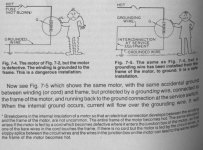
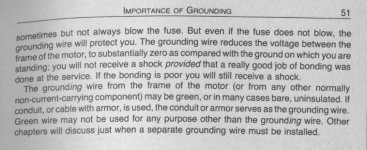
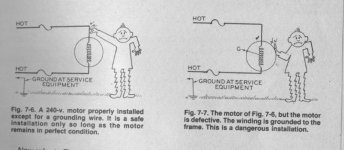
Getting a more historical look at this from "Wiring Simplified" by H.P. Richter (first published in 1959 and updated yearly for the past 78/9 years to meet current NEC codes..), demonstrate that indeed, protecting people from shock was the primary reason for grounding being added to the circuits.

Are there better ways to protect people? Yes, GFIC for one... But the fact is, grounding while it does not "clear the ground fault" DOES provide a significant level of safety in the event of a shorted motor.


attachment.php


attachment.php


attachment.php


attachment.php


attachment.php
 

Attachments

  • Diagram1.jpg
    Diagram1.jpg
    52.2 KB · Views: 108
  • Diagram2.jpg
    Diagram2.jpg
    93.7 KB · Views: 107
  • Diagram2a.jpg
    Diagram2a.jpg
    68.4 KB · Views: 107
  • Diagram3.jpg
    Diagram3.jpg
    54.3 KB · Views: 106
  • Diagram4.jpg
    Diagram4.jpg
    57.8 KB · Views: 106

MrMark

Well-known member
Joined
Jan 25, 2010
Messages
4,626
Location
Southern Cal.
You still don't get it.

It says "Grounded connection at Service Equipment" in your book.

That is a CONNECTION TO THE NEUTRAL A LOW IMPEDANCE PATH SUFFICIENT TO PROTECT YOU AND CLEAR THE FAULT . . . not the ground rods, sigh. Grounding protects people BUT THAT ISN'T the GROUND AS IN THE EARTH. Technically, you are confusing two different things

1) the EGC or equipment grounding conductor - the green or bare wire tied to metal in the system - this system prevents shocks and death - it is connected to the low impedance neutral at the service, and

2) the grounding electrode system - which exists for the purposes stated above which are not to protect from shocks and death

a) lightning
b) reference neutral to earth or around 0 Volts so your lights and other electrical devices run steady at around 125 Volts.
c) dissipate static
d) utility fault clearing

Nothing I have said has anything to do with GFIC. A ground fault is a fault of line or neutral to ground. A GFCI is a special device that monitors the current passing through it on the line side and the current passing back through it on the neutral side and can detect if a tiny current on the order of 5 mA is lost through a ground fault. It will then trip on this amount. This device has NOTHING to do with anything being discussed by me.

I give up.
 
Last edited:

MrMark

Well-known member
Joined
Jan 25, 2010
Messages
4,626
Location
Southern Cal.
Let me just tell you that the dirt path that you seem to be enamored with is very high impedance relative to a piece of wire. Let's say the dirt path is 70 ohms. Your body is even higher resistance depending on man or woman and the path. Let's say 200 ohms through your body.

Two parallel paths, one 70 ohms and one 200 ohms. Current splits in inverse proportion to the resistance. You tell me how that dirt path is going to save your life when it only takes milliamps to kill?
 

cbacres

Well-known member
Joined
May 28, 2010
Messages
5,998
Location
SW Florida
Yes, I went out to shop late one night and there they were, naked and *******.

It was the screw gun doing the *******.

Man, was I shocked!
 

Ric in Richmond

Well-known member
Joined
Oct 17, 2009
Messages
388
Location
Richmond...duh
I get a tiny tingle from an old atlas drill press I have. I ran a separate ground to the steel cabinet it is mounted on and no problems now.

No idea how to really fix it, but grounding it seems to make it happy!

The biggest shock I ever got was polishing metal with good insulated shoes on. Building up a huge static charge and then touching ground with a bare finger and ZAPPPPPP.

I learned to touch ground with metal first and discharge myself....that or touch metal to my little brother and zap him instead.
 

MrMark

Well-known member
Joined
Jan 25, 2010
Messages
4,626
Location
Southern Cal.
OUtlaws, do this test for me to see if the earth and your ground rod protects you like you interpret that 1958 book to show (be wary of anything regarding electricity that has "simplified" in its title, that picture is misleading without clarification so I can see how you got your ideas no matter how wrong):

1)open the neutral on your service so that the only return path you have is through your grounding rods, ie. the DIRT.

2)Next, touch the drill motor just where that book shows you will be safe to do so. Show your faith in your book.

3) Finally, report back your results. lol.
 
Last edited:

Outlawmws

Well-known member
Joined
Aug 9, 2011
Messages
39,296
Location
The Badlands
Mark, I no longer care what you think, or say on this subject, done, finis,,, you want to continue to take things out of context and misquote me. Your not worth the time to argue with. Go troll and insult someone else...
 

sumner52000

Well-known member
Joined
May 13, 2010
Messages
1,025
Location
Roxboro, NC
I was working on a strobe light on top of a pickup for the cable company. I saw a spot arc so i started poking around with my test light. It knocked me off the toolbox and wound up laying in the bed of the truck. They got a whole new strobe light and so did any other trucks they brought in with a light problem.
 

MrMark

Well-known member
Joined
Jan 25, 2010
Messages
4,626
Location
Southern Cal.
Mark, I no longer care what you think, or say on this subject, done, finis,,, you want to continue to take things out of context and misquote me. Your not worth the time to argue with. Go troll and insult someone else...

Whatever makes you happy. I'll take that as you know you are wrong. It is not in your character to man up and recognize that you are way off. You just resort to the bs of saying I am taking things out of context and misquoting you. Yet, you do not show where I have done so. When I am wrong I admit it. Something you should try on for size. I spot bs'ing like Holeshot (exaggeration master) and that 07Forrester guy (total bs'er), not saying you are near as bad as them you just have "fear of admitting I'm wrong," and call them on it.

BTW, probably 90 percent of electricians don't understand the above either, so you shouldn't get upset. Grounding is probably one of the most misunderstood things in electrical and it is VERY complicated in the NEC. Most, like you, think current returns or goes to ground, which isn't true. Current returns to its source, whether it be a battery, a transformer, a generator, whatever, it won't flow unless it can return to its source.
 
Last edited:

Outlawmws

Well-known member
Joined
Aug 9, 2011
Messages
39,296
Location
The Badlands
Whatever makes you happy. I'll take that as you know you are wrong. It is not in your character to man up and recognize that you are way off. You just resort to the bs of saying I am taking things out of context and misquoting you.

Take it any way you want to Mark; When someone cannot have a discussion without using insult and innuendo, even stooping to mis-characterizing quoted references, their not in it for the subject matter.

You clearly have your own motives for derailing this thread. You really don't care about the whole grounding thing, and not a single one of your posts has been on topic, just a thinly veiled attack. I don't play well with trolls, as I don't understand what motivates them. I'm not obligated to prove anything to a troll. I made my story and you have done nothing but attack whatever I say.

You want to claim victory in your mind, go right ahead. I guess its little things like that that males a trolls life complete. Be happy.
 
To avoid these ads, REGISTER NOW!
Top Bottom