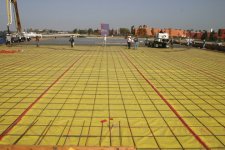
I think it matters not whether you use 15psi or 25 psi foam beneath your slab as any point load on the surface of the concrete gets distributed to an area beneath roughly equal to the area of the base of a cone with 45 degree slope... in other words, in 6" concrete floor, a point load on the surface gets distributed over an area of 113 square inches. Furthermore, since concrete doesn't flex, the load is actually distributed over a MUCH larger area. But even if we ignored this fact, 15psi foam will not depress until you exceed a 1700 lb point load at the surface.
Plus, as Kert points out, the soil beneath isn't likely to even be this supportive. 2000 PSF dirt (typical for clay/loam mix) is same as 14 psi - or less than the cheap 15psi foam. So spend your $ on what matters... THICKER foam!!
Now, I have a question for you all. If it agreed that foam under (and around) the slab is a good idea, where do you put the polyethylene barrier? Joseph Lstiburek at BuildingScience.com intones us never, ever to put the polyethylene layer under the foam or we'll simply have moisture laden foam for eternity. (see paragraph 5 in
http://www.buildingscience.com/documents/insights/bsi-059-slab-happy)
Yet, if we put the polyethylene layer OVER the foam, then tack the radiant heat tubing to the foam, we've now just put thousand of holes in the poly, making it kinda useless, wouldn't you think? Now, if the polyethylene is being used to control vapor, no big deal as most vapor moves with air, and concrete is an air barrier. But, what if we are employing the polyethylene for control of radon gases?
So, tell me, where do you put you polyethylene layer? What is your solution to this dilemma?